

An insurance glossary turns the words in your policy into plain English. As of 5 September 2026, the definitions that matter most to Indian policyholders come from IRDAI's Insurance Products Regulations 2024, its 2024 master circulars and the Insurance Act, 1938 as amended by the Sabka Bima Sabki Raksha Act, 2025. Below are 60 terms, grouped by topic.
Where a term has its own guide, the definition links to it. Agents can share this page with clients ahead of an annual policy review meeting.
What are the core terms in every insurance policy?
Grace period rules come from the IRDAI (Insurance Products) Regulations, 2024 and free-look, underwriting and claim timelines from the Master Circular on Protection of Policyholders' Interests of 5 September 2024.
- Premium: The amount you pay for cover. Section 64VB of the Insurance Act generally bars an insurer from assuming risk until the premium is received in advance.
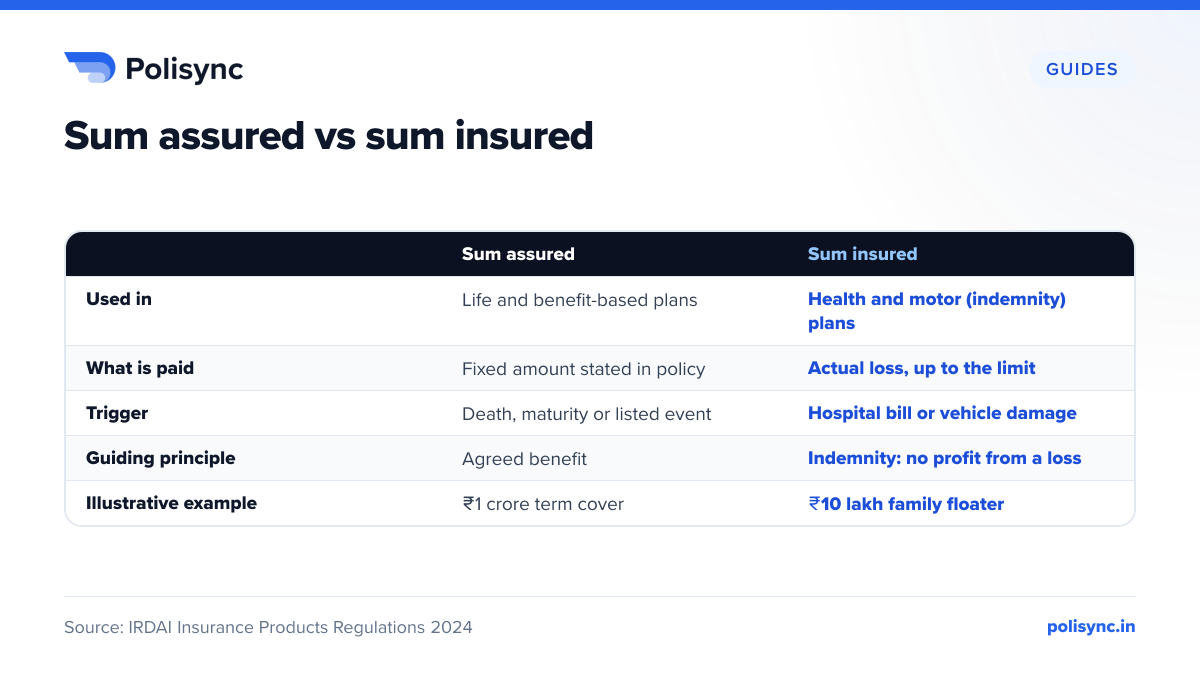
- Sum assured: The fixed amount a life policy guarantees to pay on a covered event, such as death or maturity, as stated in the policy.
- Sum insured: The maximum an indemnity policy, such as health or motor own damage cover, will pay. You are compensated for the actual loss up to this limit.
- Proposal form: The application in which you disclose age, health, habits, occupation and other facts so the insurer can assess the risk.
- Underwriting: The insurer's assessment of a proposal to decide whether to accept it and on what terms. Insurers must seek any extra details in one go within 7 days and decide within 7 days of receiving them.
- Exclusion: A cause or situation the policy does not cover. Every Customer Information Sheet must summarise the exclusions.
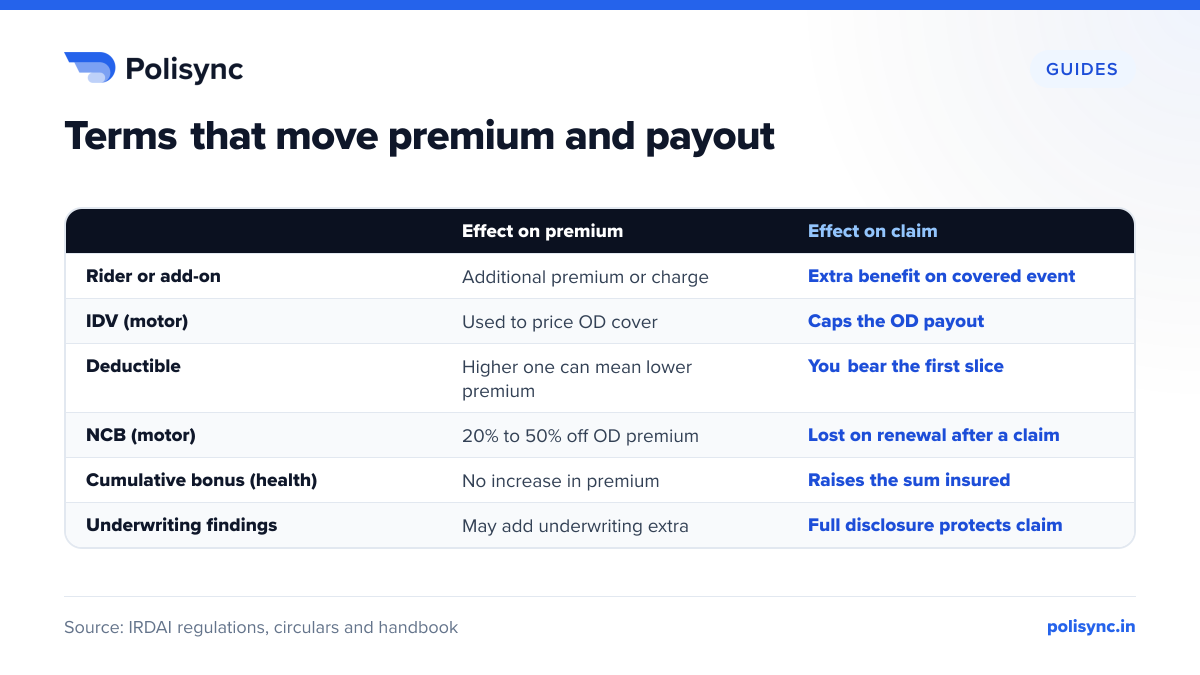
- Rider: An extra cover added to a base policy for an additional premium or charge, such as waiver of premium. See insurance riders explained.
- Grace period: The window after the due date in which you can still pay without losing cover or continuity: 15 days for monthly premiums and 30 days for other modes, in both life and health policies.
- Free-look period: 30 days from receiving the policy document to cancel for any reason, on life policies and new individual health policies of one year or more. The refund deducts proportionate risk premium, medical and stamp duty costs. See the free-look period guide.
- Lapse: Cover stops because a premium was not paid within the grace period. A life policy that has acquired a surrender value instead continues as paid-up, subject to minimum amounts.
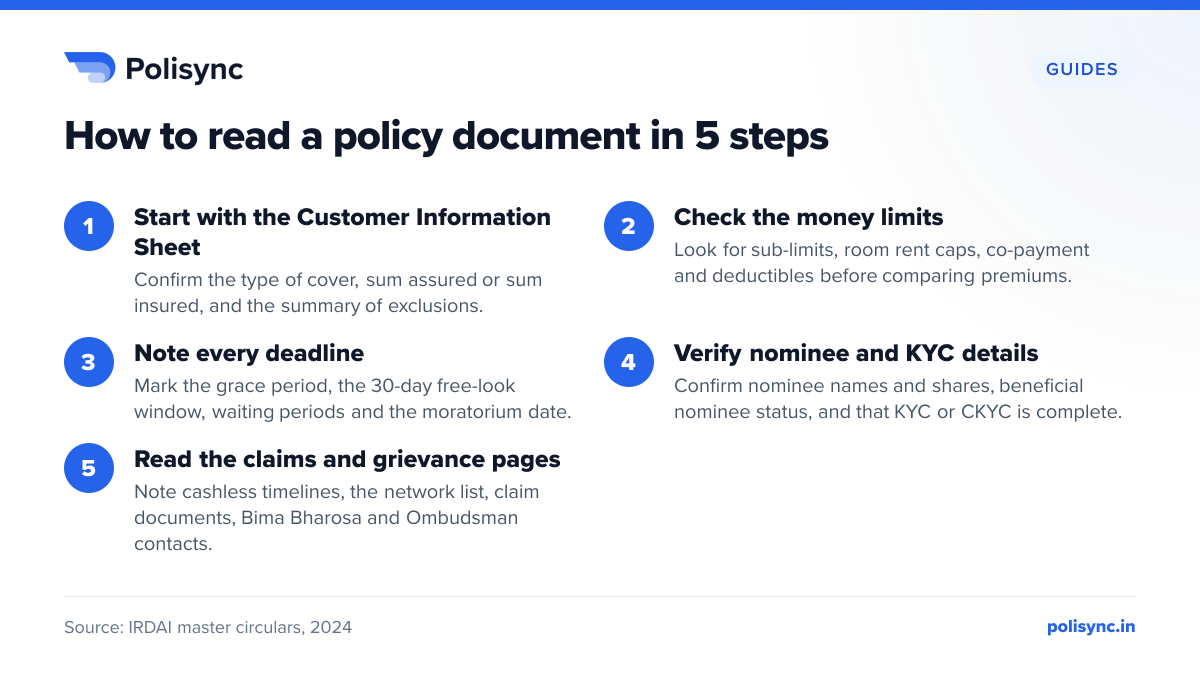
- Customer Information Sheet (CIS): A short sheet issued with every policy summarising the cover, sum assured or sum insured, exclusions, free-look period, claims process and grievance contacts.
Clients commonly confuse sum assured with sum insured, which decides how a claim is paid.
Which life insurance terms should every policyholder know?
Life definitions follow Schedule I of the Products Regulations, the Master Circular on Life Insurance Products of 12 June 2024, and Sections 38 and 39 of the Insurance Act.
- Term insurance: Pure protection for a set period that pays your dependants if you die during the term, with no savings element. Compare term vs whole life insurance.
- Endowment plan: A savings-linked policy with a fixed maturity date that pays the sum assured on death during the term, or the maturity proceeds if you survive. See endowment vs ULIP vs term.
- ULIP (unit linked insurance plan): A life policy whose benefits depend on the performance of the funds your premiums buy, so you bear the investment risk. It has a five-year lock-in.
- NAV (net asset value): The price of one unit of a ULIP fund. Your fund value equals units held multiplied by NAV.
- Death benefit: The amount payable on the death of the life assured, as stated in the policy document.
- Maturity benefit: The sum assured on maturity plus any additional and accrued benefits, such as bonuses, paid when the term ends.
- Revival: Restoring a discontinued policy by paying all due premiums and charges, subject to continued insurability. The revival period is five years for non-linked plans and three for ULIPs. See how to revive a lapsed policy.
- Surrender value: The amount paid if you exit before maturity. Non-linked savings plans acquire a guaranteed surrender value once premiums for at least two consecutive years are paid, and you get the higher of the guaranteed and special surrender value.
- Paid-up value: The reduced cover kept when you stop paying after acquiring a surrender value: at least the sum assured multiplied by the premium period paid, divided by the full premium period.
- Benefit illustration: A customised statement of what the policy may pay in different events. You and the salesperson sign it, and it forms part of the policy document.
- Nominee: The person you name to receive the policy money on your death. You can make or change a nomination any time before maturity.
- Beneficial nominee: Under Section 39(7), a parent, spouse or child you nominate is beneficially entitled to the money, not just a trustee for legal heirs. See nominee vs legal heir.
- Assignment: Transferring a policy's rights, wholly or partly, to a person or lender under Section 38, by an endorsement on the policy or a separate instrument, signed and attested by at least one witness.
- Persistency: The share of policies still paying renewal premiums over time. IRDAI asks life insurers to track it across channels and curb the mis-selling behind lapses and surrenders.
What do health insurance terms like moratorium and co-payment mean?
Health definitions come from Schedule III of the Products Regulations and the Master Circular on Health Insurance Business of 29 May 2024.
- Pre-existing disease (PED): Any condition diagnosed, or for which treatment was advised or received, within 36 months before the policy starts. The PED waiting period cannot exceed 36 months of continuous cover.
- Waiting period: A period from the start of cover during which specified illnesses or treatments, except those due to accident, are not covered; specific waiting periods run up to 36 months. See health insurance waiting periods.
- Moratorium period: After 60 continuous months of cover, including ported or migrated time, a health policy cannot be contested for non-disclosure or misrepresentation, except for established fraud. Any enhanced sum insured starts a fresh 60 months.
- Co-payment: A specified amount or percentage of each admissible claim that you pay yourself.
- Deductible: A specified amount up to which the insurer pays nothing; on larger claims it is subtracted from the total. Deductibles drive top-up and super top-up plans.
- Sub-limit: A preset cap for a treatment, disease or expense, beyond which the insurer will not pay even if the sum insured is not used up.
- Room rent limit: A sub-limit on daily room or ICU charges. The policy schedule must disclose any proportionate deductions that a costlier room triggers.
- Cumulative bonus: A no-claim reward that raises the sum insured at renewal without extra premium; a renewal discount may be offered instead, at your choice.
- Cashless: The insurer settles the hospital bill directly. It must decide cashless requests within one hour and approve discharge within three hours. See cashless vs reimbursement.
- Reimbursement: You pay the hospital, then claim the money back with bills and documents, as needed when treated outside the cashless network.
- Network hospital: A hospital or provider with a cashless tie-up with your insurer, which must publish its network list.
- TPA (third party administrator): An intermediary that services health claims for insurers, including cashless approvals. A TPA's pay cannot depend on the claims ratio of the policies it serves.
- Portability: Moving to another insurer while keeping waiting-period and pre-existing disease credits. Apply 30 to 60 days before renewal; the old insurer must share data within 72 hours and the new one decide within 5 days. See the portability guide.
- Migration: Moving to another policy with the same insurer while keeping waiting-period and pre-existing disease credits.
- Critical illness cover: A benefit-based policy or rider that pays a fixed amount when a listed illness occurs, whatever the bill. Read critical illness vs health insurance.
What do OD, TP, IDV and NCB mean in motor insurance?
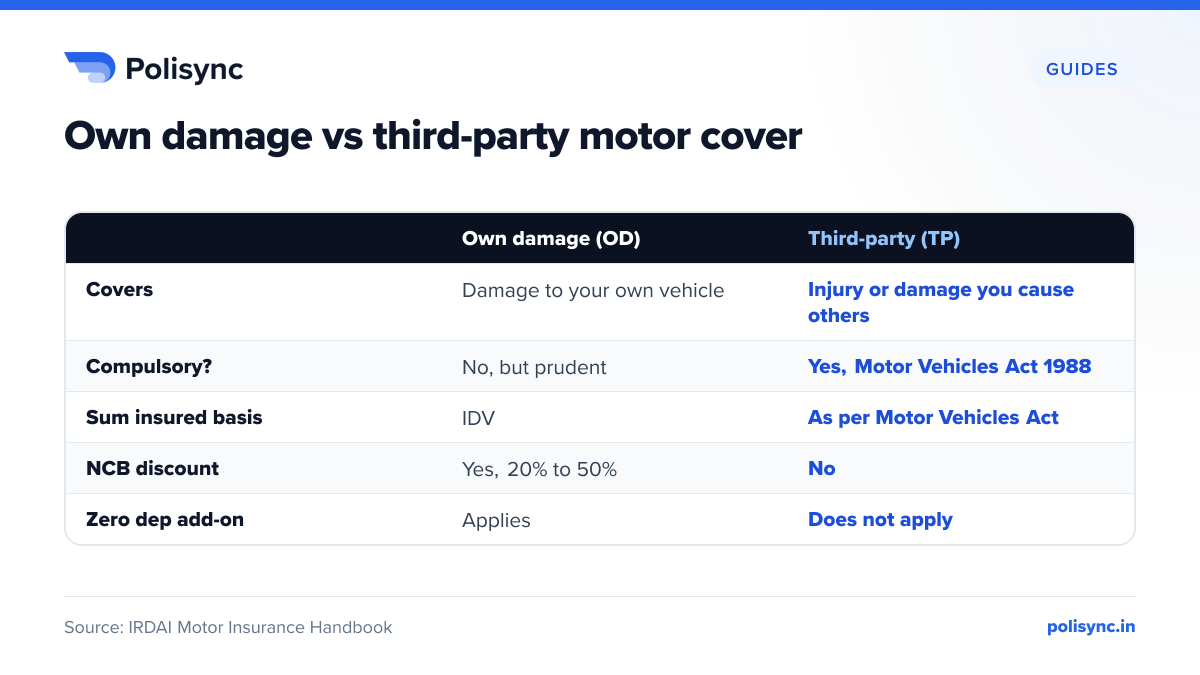
Motor terms follow IRDAI's Motor Insurance Handbook. Third-party cover is compulsory under the Motor Vehicles Act, 1988. The India Motor Tariff was de-notified from 1 April 2024 by IRDAI's notification of 20 March 2024, but its NCB and depreciation rules still shape standard wordings. See our motor insurance guide.
- Own damage (OD): The part of a package policy that pays for loss or damage to your own vehicle from perils such as fire, theft, flood or accident.
- Third-party (TP) liability: Cover for your legal liability for injury, death or property damage your vehicle causes to others; a liability-only policy is also called Act only cover.
- IDV (insured declared value): The sum insured for own damage, based on the manufacturer's present value of the vehicle less depreciation for its age.
- No claim bonus (NCB): A discount on the OD premium for claim-free years, from 20% up to 50%. It belongs to you, not the vehicle, and is lost if a comprehensive policy lapses over 90 days. See NCB explained.
- Zero depreciation: An add-on that waives the depreciation deducted on replaced parts in a partial loss claim: under an IRDA order of 8 January 2013, 50% on rubber, plastic and nylon parts, tyres, tubes, batteries and airbags, 30% on fibreglass, and nil to 50% on metal parts by vehicle age.
Which claim principles and complaint routes decide whether you get paid?
The Products Regulations require every product to follow principles including indemnity, utmost good faith, contribution and subrogation. IRDAI's Section 45 guidance explains the three-year window.
- Utmost good faith: Both parties must disclose all material facts honestly. For you, it means answering every proposal form question fully and truthfully.
- Indemnity: A payout should restore your financial position after a loss, not leave you better off. It applies to health and motor cover, not to life insurance's fixed benefits.
- Subrogation: After paying your claim, the insurer can step into your shoes to recover the loss from whoever caused it.
- Contribution: When two or more indemnity policies cover the same loss, the insurers share the claim, so you cannot recover more than the loss.
- Section 45 (three-year rule): Under Section 45 of the Insurance Act, a life policy cannot be questioned on any ground three years after the issue, risk start, revival or rider date, whichever is later. Before that, it can be repudiated for fraud or material misstatement, with premiums refunded within 90 days if there is no fraud.
- Claim settlement ratio: The share of claims an insurer pays out of those it handles in a year. Per IRDAI's Annual Report 2024-25, life insurers paid 97.82% of individual death claims by number in 2024-25. See claim settlement ratio explained.
- Bima Bharosa: IRDAI's grievance portal for registering and tracking complaints online. Insurers must resolve complaints within 14 days.
- Insurance Ombudsman: A free forum under the Insurance Ombudsman Rules, 2017 for complaints up to ₹50 lakh. Per the Council for Insurance Ombudsmen, you complain to the insurer first, then approach the Ombudsman within one year.
Life insurers must settle death claims within 15 days of intimation, or 45 days if investigation is needed, and cannot reject a claim only for missing documents or late intimation. See the death claim process.
Who regulates and sells insurance in India?
- IRDAI: The Insurance Regulatory and Development Authority of India, the statutory regulator set up under Section 3 of the IRDA Act, 1999.
- KYC (Know Your Customer): The identity and address checks insurers must carry out under IRDAI's AML/CFT Master Guidelines, 2022, on paper or digitally. See KYC and CKYC for clients.
- CKYC: The Central KYC Records Registry, run by CERSAI since a 26 November 2015 notification. Share your KYC identifier and the insurer retrieves your records instead of asking for documents again.
- POSP (point of sales person): An individual, at least 18 and class 10 pass, who clears an exam after 15 hours of training and sells only simple, predefined-benefit POS products for an insurer or intermediary, under IRDAI's Master Circular on Point of Sales Products and Persons (life, 2019). From 1 January 2027, 2026 amendments make intermediaries record the seller's name and functional identity on the proposal and policy.
- Corporate agent: A company, LLP, bank or other eligible entity registered under the IRDAI (Registration of Corporate Agents) Regulations, 2015 to solicit and service life, general or health insurance. Compare roles in POSP vs agent vs broker.
- Insurance broker: An intermediary registered under the IRDAI (Insurance Brokers) Regulations, 2018 that, for remuneration or a fee, arranges insurance for its clients with insurers. Unlike an agent, whom Section 42 limits to one life, one general, one health and one of each mono-line insurer, a broker acts for the client across insurers.
- Solvency ratio: Available solvency margin divided by required solvency margin. IRDAI's actuarial and finance regulations set the control level at 150%; under Section 64VA, an insurer below it must file a plan to fix the shortfall within six months.
How do you read a policy document using these terms?
A five-minute read using these terms catches most surprises before a claim.
Which terms change your premium or your payout?
Some terms trade a lower premium for a smaller payout. IRDAI's motor handbook warns that a cheaper quote may carry higher deductibles, lower coverage and a lower IDV, which hurts at claim time.
What this means for insurance agents
Many disputes start with a word the client misunderstood at the point of sale. Explaining the terms that apply to each policy, in the client's language, is one of the simplest ways to avoid mis-selling. Grace dates, free-look deadlines and nominee details are also easier to track in one place, whether a spreadsheet or agency software such as Polisync.
A practical checklist for agents:
- 1. Walk every client through the CIS at delivery and note the 30-day free-look deadline.
- 2. Explain sum assured versus sum insured using the client's own policy amounts.
- 3. Record the nominee, check beneficial nominee status, and update it after marriage or a birth.
- 4. Diary grace-period dates and the 60-month moratorium date for every health client.
- 5. At motor renewal, compare IDV and NCB across quotes and never let a comprehensive policy lapse beyond 90 days.
- 6. Insist on full disclosure in proposal forms, and explain Section 45 and the moratorium.
- 7. For complaints, explain the route: insurer first, then Bima Bharosa, then the Insurance Ombudsman.