

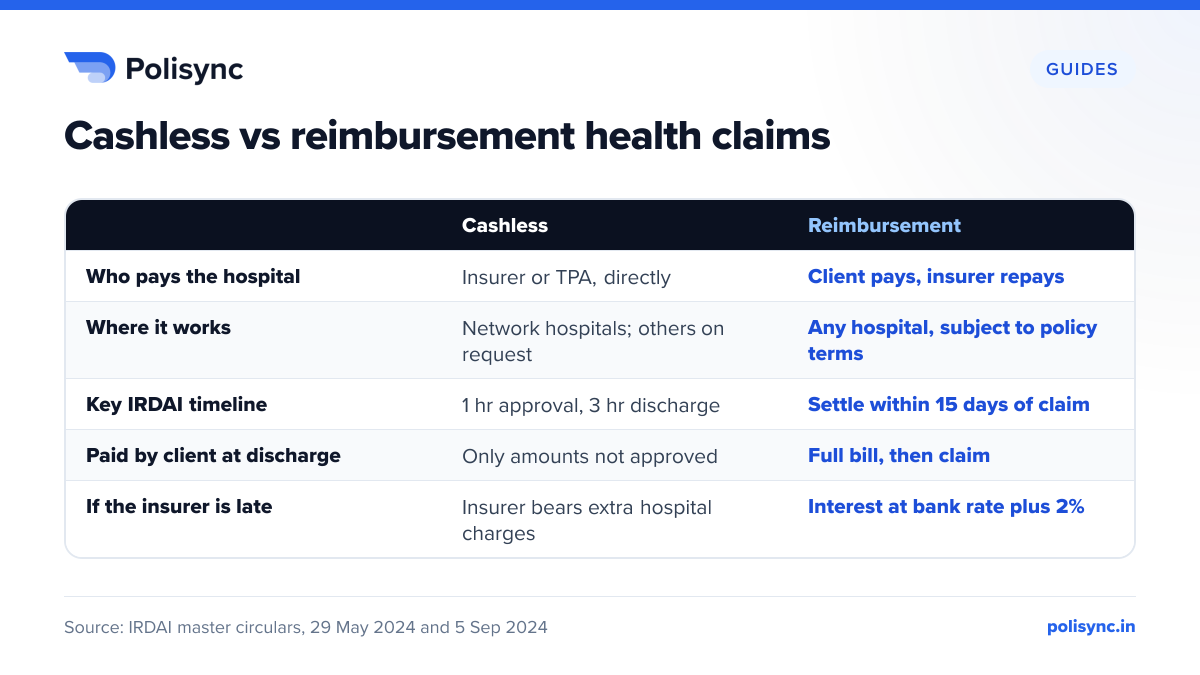
In a cashless claim, the insurer or its TPA pays a network hospital directly after approving the treatment; in a reimbursement claim, the patient pays the bill and claims it back. As of 3 August 2026, IRDAI rules require insurers to decide cashless requests within 1 hour, approve discharge within 3 hours, and settle other claims within 15 days of submission.
This guide walks through both routes step by step, with the exact timelines from IRDAI's two 2024 master circulars, the documents to keep ready, why claims get cut or rejected, and how an agent can help a client when a claim gets stuck.
What is the difference between cashless and reimbursement claims?
IRDAI defines a cashless facility as one where the insurer or its Third Party Administrator (TPA) pays the network provider directly for treatment covered by the policy, to the extent pre-authorisation is approved. A TPA is a company registered with IRDAI and engaged by an insurer, for a fee, to service health policies and claims (IRDAI FAQs on health insurance regulations).
A network hospital is one that has an agreement with the insurer for cashless treatment. At any other hospital, the default is reimbursement: the client pays, then files a claim, which is allowed subject to the policy's terms and conditions. Insurers must publish their network hospital list, their claim procedures and their turnaround times on their websites.
Cashless is already the main route, but reimbursement is far from rare. General and health insurers settled 2.69 crore health claims in 2023-24: about 58% by number (66% by amount) went only through cashless and about 39% only through reimbursement, and 72% were settled through TPAs, according to IRDAI's Annual Report 2023-24.
What are IRDAI's timelines for cashless claims?
The rules sit in IRDAI's Master Circular on Health Insurance Business (Ref. IRDAI/HLT/CIR/PRO/84/5/2024, dated 29 May 2024). The same timelines are repeated in the September 2024 master circular on policyholder protection.
What the circular requires of insurers:
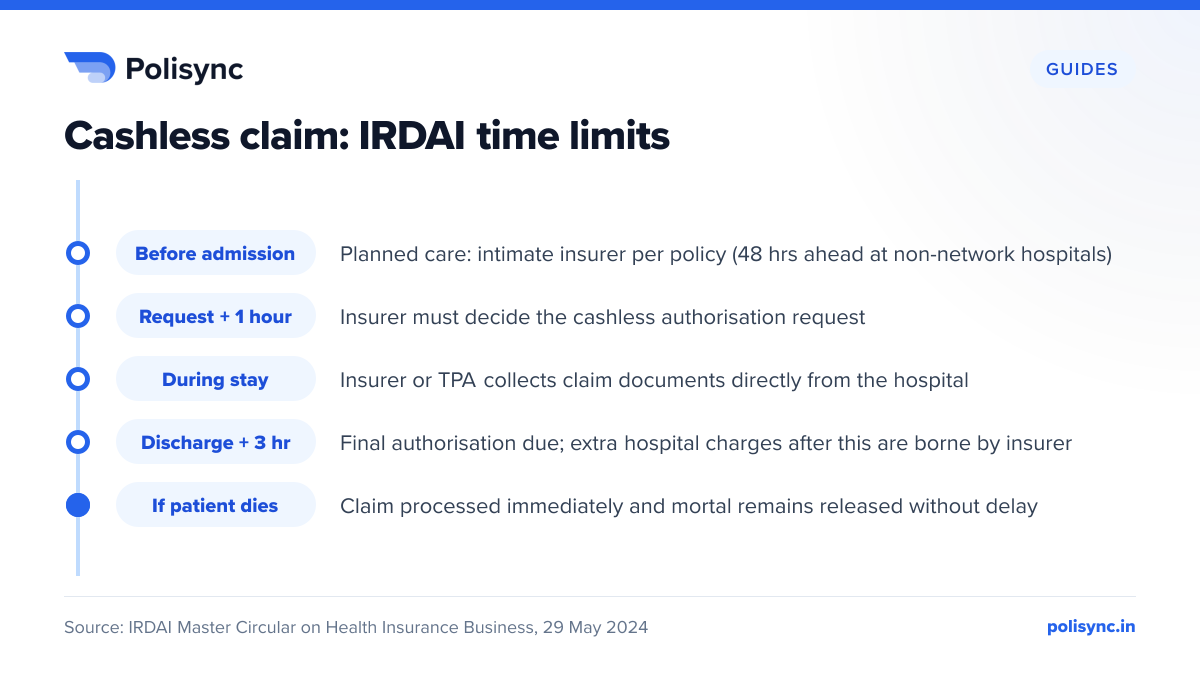
- 1 hour for cashless authorisation: the insurer must decide a cashless request immediately, and in no case later than one hour after receiving it. Systems had to be in place by 31 July 2024.
- 3 hours for discharge: final authorisation must come within three hours of the hospital's discharge request, and the patient must never be made to wait to be discharged.
- Insurer pays for its own delay: if final authorisation takes longer than three hours, any additional amount charged by the hospital is borne by the insurer from shareholders' funds, not by the policyholder.
- Digital pre-authorisation: insurers must offer pre-authorisation to policyholders through a digital mode, and may set up physical help desks at hospitals.
- Death during treatment: the insurer must process the claim immediately and get the mortal remains released from the hospital immediately.
- 100% cashless as the goal: every insurer must strive for 100% cashless settlement in a time-bound manner, with reimbursement kept to a bare minimum and to exceptional cases.
How does the cashless claim process work, step by step?
- 1. Check the network. Confirm the hospital is on the insurer's or TPA's network list, which insurers must display on their websites.
- 2. Intimate the claim. Inform the insurer at the earliest possible time: online, through the agent, the TPA, the hospital's insurance desk or the insurer's call centre.
- 3. Pre-authorisation request. The hospital's insurance desk sends the cashless request to the insurer or TPA, which must decide within 1 hour.
- 4. Treatment. The hospital treats the patient; the insurer and TPA gather the documents they need from the hospital.
- 5. Discharge approval. The hospital sends the final bill for authorisation; the insurer must respond within 3 hours.
- 6. Settle the balance. The client pays only what the insurer has not approved, such as items the policy does not cover, and should ask for the written reasons for any cut.
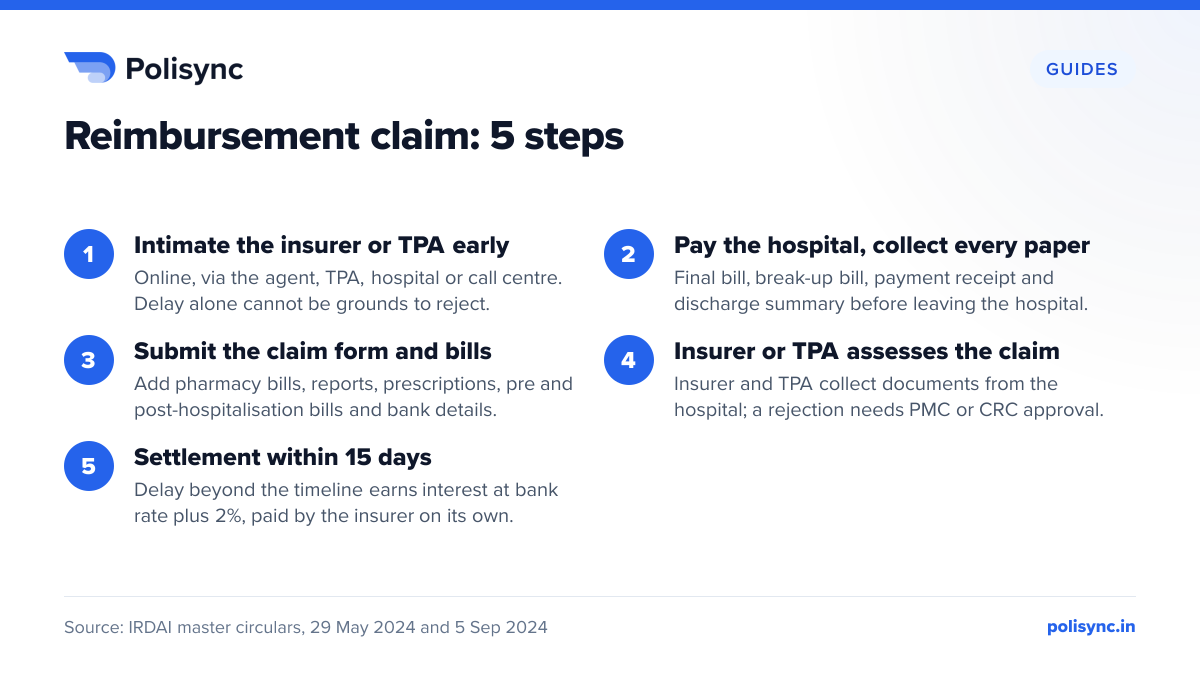
How early must a client inform the insurer? That depends on the product. Intimation windows for planned and emergency admissions are set in each policy's wording, so check the Customer Information Sheet (CIS), which must explain the claims procedure in simple words. IRDAI's September 2024 circular also states that no claim shall be rejected or closed for want of documents or for delayed intimation.
What is Cashless Everywhere, and can clients use it at a non-network hospital?
The General Insurance Council launched Cashless Everywhere on 24 January 2024, in consultation with all general and health insurers. It lets a policyholder seek cashless treatment at a hospital that is not in the insurer's network (Business Today).
The conditions announced at launch:
- For planned (elective) procedures, inform the insurer at least 48 hours before admission.
- For emergencies, inform the insurer within 48 hours of admission.
- The claim must be admissible under the policy terms and the insurer's operating guidelines.
- The hospital should have at least 15 beds and be registered with state health authorities under the Clinical Establishments Act (Digital Health News).
Treat it as a request, not a guarantee: the claim must still be admissible under the policy and the insurer's operating guidelines, and hospital-insurer relationships can break down. In August 2025, the Association of Healthcare Providers India advised its member hospitals in North India to suspend cashless treatment for Bajaj Allianz policyholders from 1 September 2025, citing outdated rates, deductions and slow approvals, adding that cash-paying patients could still claim reimbursement (Business Today). The advisory was revoked after a meeting on 28 August 2025 (Business Today), but it shows why reimbursement remains the fallback.
How does a reimbursement claim work?
Reimbursement is used when the hospital is outside the network or cashless is declined or not available. It also covers bills paid separately, such as pre- and post-hospitalisation expenses where the policy covers them. The client settles the hospital bill, then claims it from the insurer or TPA.
How long does the insurer have to settle a reimbursement claim?
IRDAI's Master Circular on Protection of Policyholders' Interests, 2024 (Ref. IRDAI/PP&GR/CIR/MISC/117/9/2024, dated 5 September 2024) says claims other than cashless shall be settled within fifteen days from submission of claim. If a claim is not settled within the specified timelines, the claimant is entitled to interest at bank rate plus 2% from the date the insurer received the claim intimation to the date of payment, and insurers must pay it suo moto, without being asked.
Many websites still quote a 30-day limit. That figure came from the older 2016 health insurance regulations, which IRDAI's own FAQ page still describes. For current client conversations, use the 15-day timeline in the 2024 circular.
Which documents are needed for a reimbursement claim?
The 2024 circulars put the burden on the insurer: after intimation, insurers and TPAs must collect the required documents from the hospital, and the policyholder shall not be required to submit them. In practice, claim forms still carry a document checklist, so clients should keep originals and copies ready. A typical checklist, taken from the reimbursement claim form of TPA Medi Assist:
- Claim form, signed, and a copy of the claim intimation, if any
- Hospital main bill, break-up bill and payment receipt
- Discharge summary and operation theatre notes (if surgery)
- Pharmacy bills and doctor's prescriptions
- Doctor's request for investigations and the reports (CT, MRI, USG, HPE, ECG)
- Pre- and post-hospitalisation bills
- PAN, bank account number, bank name and IFSC for payment
- MLC report and police FIR, where the hospitalisation followed an accident reported to police
Why do health claims get rejected or partly paid?
The money at stake is large. In 2023-24, insurers paid ₹83,493 crore on health claims but disallowed ₹15,100 crore under policy terms and repudiated another ₹10,937 crore, together about 22% of the ₹1.17 lakh crore claimed, as per IRDAI's annual report. Business Today noted the combined figure was 19.1% higher than in 2022-23.
Most disputes trace back to the policy terms the CIS is required to summarise:
- Waiting periods: treatment for a pre-existing disease or specified illness before its waiting period ends. See our guide to health insurance waiting periods.
- Exclusions: treatments or items the policy does not cover at all.
- Sub-limits and deductibles: caps on specific expenses, and amounts the client bears before the insurer pays.
- Non-disclosure: a condition not declared on the proposal form. After the 60-month moratorium of continuous cover, a claim cannot be contested on this ground except for established fraud.
Two safeguards help clients. No claim can be repudiated without approval from the insurer's Product Management Committee or its three-member Claims Review Committee. And any rejection or partial payment must be communicated with reference to the specific policy terms relied on. A strong claim settlement ratio is useful, but clear disclosure at the proposal stage matters more for any single claim.
What can a client do if a claim is denied or delayed?
The escalation path under the September 2024 circular:
- Insurer's grievance cell: complain by branch visit, letter, email, website or call centre. The insurer must acknowledge immediately and resolve within 14 days, giving reasons with reference to the policy terms.
- Bima Bharosa: the complaint can also be registered and tracked on IRDAI's Bima Bharosa portal, which insurers' grievance systems must mirror.
- Insurance Ombudsman: if unsatisfied, escalate free of charge for claims up to ₹50 lakh. The Council for Insurance Ombudsmen requires that the client has complained to the insurer first, and that the complaint is filed within one year of the insurer's rejection, or of one month passing without a reply.
- Ombudsman award: insurers must comply within 30 days of receiving the award, or pay a penalty of ₹5,000 per day to the complainant.
What this means for insurance agents
A client remembers the claim, not the sale. The hours around admission and discharge are where an agent earns loyalty, and where client trust is won or lost. The 2024 circulars give agents firm dates and rules to cite, instead of just chasing a TPA helpline.
Where agents add the most value:
- Before any claim: explain waiting periods, sub-limits and the network in plain language, and make sure every condition is disclosed on the proposal form.
- At admission: check the hospital against the network list, register intimation the same day, and push for the 1-hour cashless decision.
- At discharge: track the 3-hour clock and remind the hospital that any extra charges from the insurer's delay are not the patient's cost.
- After discharge: help assemble reimbursement papers, note the submission date, and follow up when the 15-day window closes.
- If disputed: draft the grievance, then guide the client to Bima Bharosa and the Ombudsman if needed.
- After the claim: review gaps the claim revealed, such as a low sum insured, as part of a health insurance cross-selling conversation.
Action checklist for agents
- 1. Save each insurer's and TPA's claim helpline, email and network hospital link for every client policy.
- 2. Give every health client a one-page claim sheet: intimation steps, the 1-hour and 3-hour rules, and the 48-hour Cashless Everywhere windows.
- 3. For planned surgeries, confirm network status and send intimation at least 48 hours before admission.
- 4. Record the date and time of every pre-authorisation, discharge request and claim submission, so delays can be proven.
- 5. Ask for written reasons for any deduction or rejection, citing the policy clause relied on.
- 6. Escalate in order: insurer grievance cell (14 days), Bima Bharosa, then the Insurance Ombudsman.
- 7. Use claim experiences to review cover, and run the numbers with the health insurance calculator.
- 8. Keep policy, claim and grievance records organised in one place; agency management software such as Polisync can help with this.