

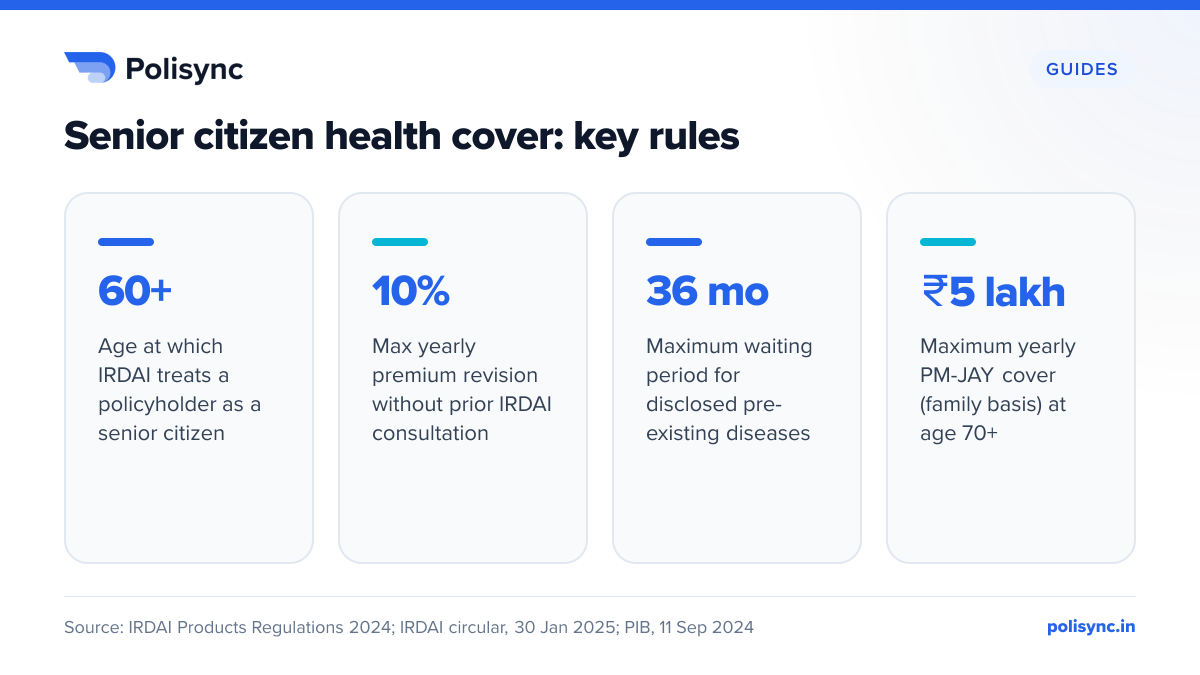
Senior citizen health insurance in India has no regulatory upper entry age: since 1 April 2024, IRDAI rules require insurers to offer health products for all age groups, cap pre-existing disease waiting periods at 36 months, and run a separate claims and grievance channel for senior citizens. Since 30 January 2025, premiums on their individual indemnity policies cannot rise more than 10% a year without prior IRDAI consultation.
This guide, written as of 31 August 2026, explains those rules in plain language, shows agents which policy features matter most for clients aged 60 and above, and covers how Ayushman Bharat PM-JAY, the tax deduction and the GST exemption fit around a private policy.
Who counts as a senior citizen for health insurance?
For IRDAI purposes, a senior citizen has the meaning given in the Maintenance and Welfare of Parents and Senior Citizens Act, 2007, as the IRDAI (Insurance Products) Regulations, 2024 state. IRDAI's January 2025 premium circular describes this group as policyholders "aged 60 years and above".
The tax law uses the same age line. Under the Income-tax Act, 2025, a senior citizen is a resident individual aged 60 or more at any time during the relevant tax year.
What did IRDAI change for senior citizens in 2024?
The Insurance Products Regulations, 2024 (notified 20 March 2024) and the Master Circular on Health Insurance Business (29 May 2024, IRDAI/HLT/CIR/PRO/84/5/2024) reset the rules that matter most to older buyers.
- No age group left out: Schedule III says insurers "shall ensure that they offer health insurance products to cater to all the age groups" and may design products specifically for senior citizens. It also asks insurers to endeavour to cover people with all types of existing medical conditions. The master circular adds that each insurer's board-approved underwriting policy must cover its approach to offering cover across all ages and medical conditions.
- Shorter pre-existing disease wait: the waiting period for disclosed pre-existing diseases is capped at 36 months of continuous coverage, and specific waiting periods also run up to 36 months.
- Moratorium of 60 months: after 60 continuous months of cover (portability and migration included), a policy or claim cannot be contested for non-disclosure or misrepresentation, except for established fraud.
- Separate senior citizen channel: all insurers must set up a separate channel for the health insurance claims and grievances of senior citizens, with details published on their websites.
- Renewal protection: renewal cannot be denied because the insured made claims in earlier years, and individual renewal loadings must be set at portfolio level, not on one policyholder's claim history.
Business Today summed up the change on 21 April 2024: people above 65 can now buy health insurance too. Agents should explain the nuance: there is no regulatory upper entry age, but each insurer still underwrites, so terms, loadings and medical tests differ by product.
For a detailed walk-through of initial, specific and PED waits, see our guide to health insurance waiting periods.
How much can insurers raise premiums for senior citizens?
IRDAI's circular on revision of premium rates for senior citizens (IRDAI/HLT/CIR/MISC/27/1/2025, dated 30 January 2025) noted a steep increase in premium rates under some products offered to people aged 60 and above. It applies to all general and standalone health insurers offering indemnity-based individual health products to senior citizens, with immediate effect.
The circular directs insurers to:
- not revise the premium for senior citizens by more than 10% per annum;
- consult IRDAI in advance if a proposed increase is above 10% a year, or before withdrawing an individual health product offered to senior citizens;
- give wide publicity to the measures taken for senior citizens; and
- work towards common empanelment of hospitals and negotiated package rates on the lines of PM-JAY, since the absence of standardised rates was pushing up claim costs.
Note what the cap does and does not say. It limits how far insurers may revise senior citizens' premiums each year without first consulting IRDAI; it is not a promise that the bill never rises, and a client who raises the sum insured or adds cover pays for that extra cover. The circular does not spell out how a move into a higher age band is treated, so ask the insurer to explain any large renewal increase in writing. Explain all this before the first renewal notice, not after.
Which features should agents compare in a senior citizen policy?
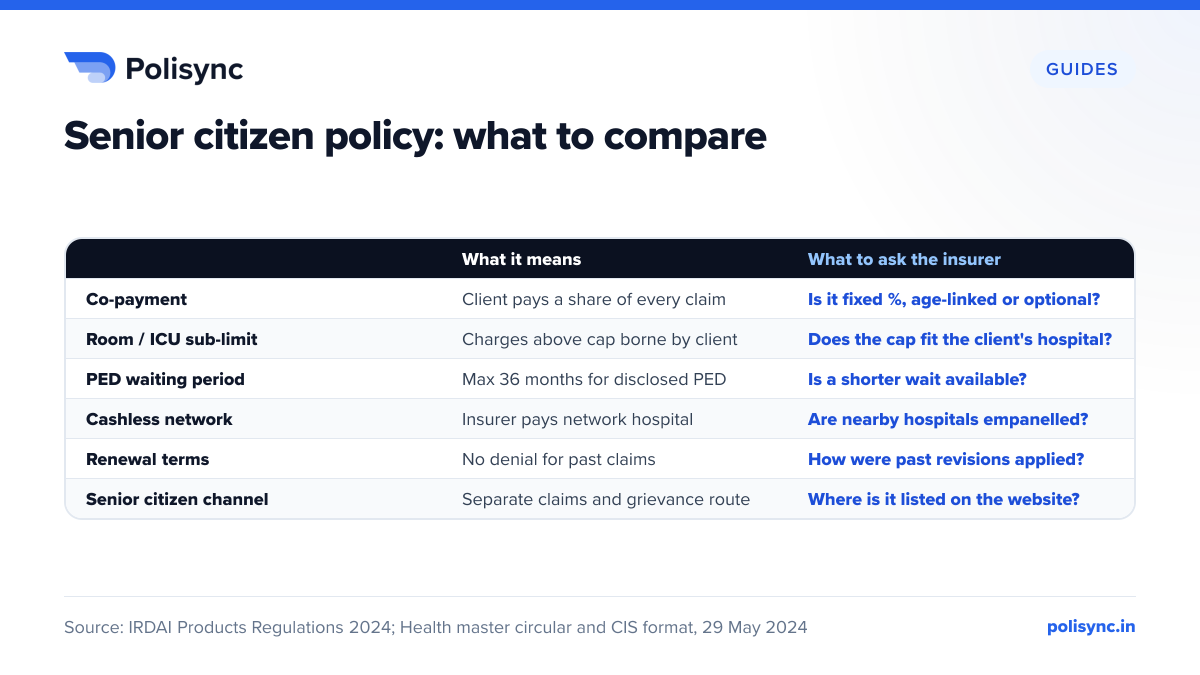
Two senior citizen plans with the same sum insured can pay very different amounts on the same hospital bill. The Customer Information Sheet (CIS) that IRDAI requires with every policy lists the cost-sharing terms in one place, so start there.
Co-payment
A co-payment is a specified amount or percentage of the admissible claim that the policyholder pays, as the CIS format defines it. Check whether a plan has one, and whether it is fixed or optional. Illustrative example: with a 20% co-pay, a hypothetical admissible claim of ₹3 lakh leaves the client paying ₹60,000 even though the sum insured was enough.
Room rent and other sub-limits
A sub-limit is a pre-defined cap above which the insurer will not pay. The CIS format specifically asks insurers to disclose "Room / ICU charges beyond" a set amount as a cost the client shares. For a senior client, check the room cap against the hospitals they would actually use, and ask how other charges are treated if a higher room category is chosen.
Waiting periods and pre-existing diseases
The 36-month PED limit is a ceiling, and IRDAI asks insurers to endeavour to offer shorter waits. Compare the PED wait, the list of specific-disease waits (especially any procedure the client already expects to need) and the initial waiting period side by side.
How do cashless claims work for older clients?
For older clients, the claim experience matters as much as the premium. Under the health master circular:
- insurers must decide a cashless authorisation request within one hour of receiving it;
- final discharge authorisation is due within three hours, and any extra amount the hospital charges because of a longer delay is borne by the insurer from shareholders' funds;
- insurers and TPAs must collect claim documents from the hospital, not from the policyholder; and
- no claim can be repudiated without approval from the Product Management Committee or its three-member Claims Review Committee.
If a client holds more than one indemnity policy, they can choose which policy to claim under first, and that insurer must coordinate with the others for any balance. For the full process, see cashless vs reimbursement health claims.
How does Ayushman Bharat PM-JAY for 70+ fit with private cover?
The Union Cabinet approved the expansion of AB PM-JAY to every citizen aged 70 and above, irrespective of income, on 11 September 2024, according to the PIB release. The government says the expansion took effect on 29 October 2024, as stated in a Rajya Sabha reply reported by PIB.
Key points for agents:
- Eligible seniors get a separate card (the Ayushman Vay Vandana card) and cover of up to ₹5 lakh a year on a family basis.
- Seniors in families already covered by PM-JAY get an additional top-up of up to ₹5 lakh a year for themselves, which they do not share with younger family members.
- Seniors with private health insurance or ESI cover are also eligible. Those on CGHS, ECHS or Ayushman CAPF must choose between their existing scheme and PM-JAY.
- Enrolment is application based, through the Ayushman app, beneficiary.nha.gov.in, an empanelled hospital or a Common Service Centre.
As of that March 2025 reply, PM-JAY covered 1,961 treatment procedures across 27 specialties, through a network of over 30,201 empanelled providers, including 13,473 private ones. Treat it as a useful base layer, not a substitute: PM-JAY works through its empanelled hospitals and listed procedures, while a private policy works across the insurer's network and can be tailored to the client. Ask every client aged 70 or more whether they have enrolled, and help them do it.
What tax and GST benefits apply to senior citizen health insurance?
From 1 April 2026, the health insurance premium deduction that taxpayers knew as Section 80D of the Income-tax Act, 1961 sits in Section 126 of the Income-tax Act, 2025. Under Section 126:
- the usual ₹25,000 limit for premium on self and family, and separately for parents, rises to ₹50,000 where the insured person is a senior citizen;
- an uninsured senior citizen's medical expenditure can be claimed up to ₹50,000, but only if no health insurance premium was paid for that person;
- preventive health check-ups count within the limit, up to ₹5,000, and can be paid in cash; premiums must be paid by a non-cash mode; and
- a multi-year premium paid in one go is spread equally across the years of cover.
This deduction applies only if the client opts out of the default tax regime in Section 202, which computes income without most Chapter VIII deductions. Explain the rule, but leave the regime choice to the client and their tax adviser.
On GST, the Department of Financial Services FAQ confirms that GST on all individual health insurance policies was cut from 18% to zero from 22 September 2025. The same FAQ says family floater plans are included, while group and employer-sponsored health policies still attract 18%. The FAQ on the 56th GST Council decisions adds that senior citizen policies are explicitly covered.
How should agents advise senior citizen clients?
Disclose everything, in writing
A pre-existing disease is any condition diagnosed, or for which treatment was advised or received, within 36 months before the policy starts. Until the 60-month moratorium ends, non-disclosure can be used to contest a claim. Fill the proposal form with the client, list every condition and medicine, and keep a copy. Our guide to avoiding insurance mis-selling covers the documentation habits that protect you both.
Weigh co-pay against premium honestly
A co-pay plan usually costs less upfront, but the client carries more risk on every claim. Show both options with the same illustrative bill so the client sees what they would actually pay. The health insurance premium calculator is a quick way to start that conversation.
Layer cover rather than buying one huge base policy
For many seniors, a moderate base policy plus a super top-up with a deductible can stretch the budget further. Explain how deductibles work using our comparison of super top-up vs top-up health insurance, and consider a benefit plan for lump-sum needs, covered in critical illness vs health insurance.
Protect continuity
Waiting periods, the moratorium and no claim bonus credits all depend on continuous cover. Renew within the grace period (30 days for annual premiums) and use portability or migration to change plans, not a fresh purchase that restarts the clock. For whole-household planning, see our family insurance planning guide.
What this means for insurance agents
The senior segment is no longer a market where the answer is "too old to cover". The rules now require products for all ages, cap premium revisions, and give older clients a dedicated claims and grievance route. The agent's job shifts from finding any policy to finding the right cost-sharing terms, and then making sure the client understands them.
It also raises the stakes on service. IRDAI itself calls senior citizens the most vulnerable age group, with limited sources of income, and a badly handled disclosure or a missed renewal can cost them cover that is hard to replace.
What should agents do now? A 6-step checklist
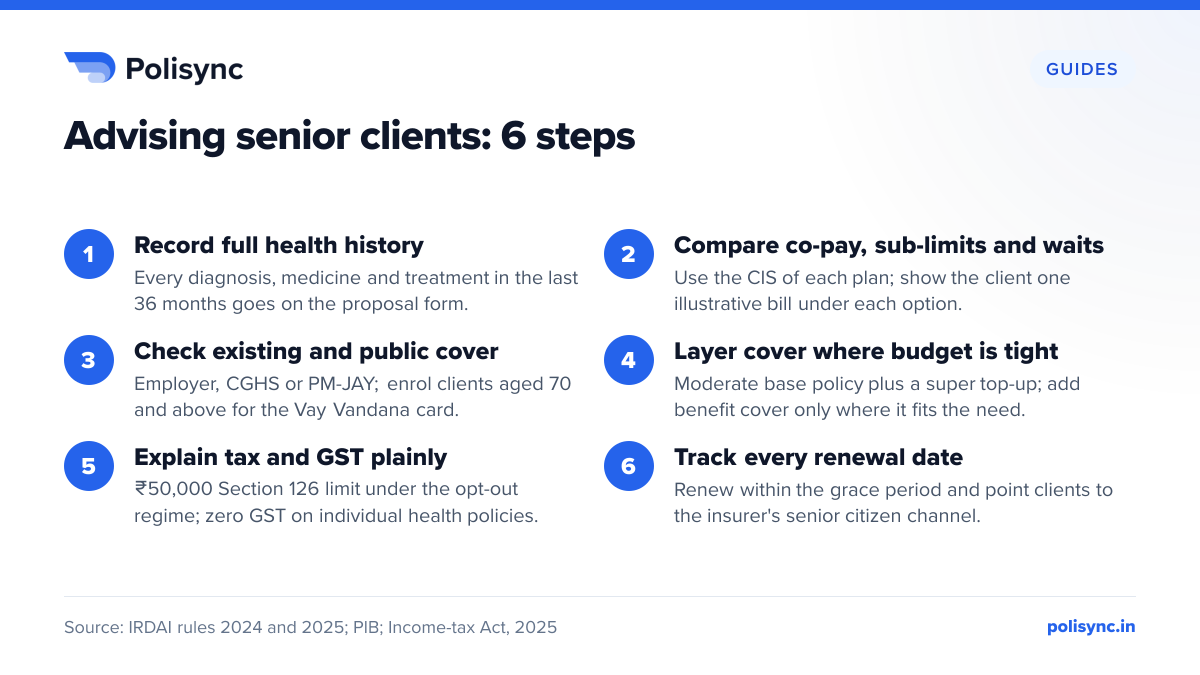
- Collect a complete health history before quoting, and keep a signed copy of the proposal form.
- Pull the CIS for every shortlisted plan and compare co-payment, room and ICU caps, and waiting periods.
- Ask about existing cover: employer, CGHS, ECHS or PM-JAY. Help clients aged 70 and above enrol for the Vay Vandana card.
- Model layered cover: base policy plus super top-up, and explain how the deductible works.
- Explain the 10% revision cap at the first renewal, so a rise within the cap does not come as a shock.
- Keep renewal dates and disclosures on record. Agency management software such as Polisync can help keep these records organised.
- Save the insurer's senior citizen channel details with each client file so complaints reach the right desk first.