

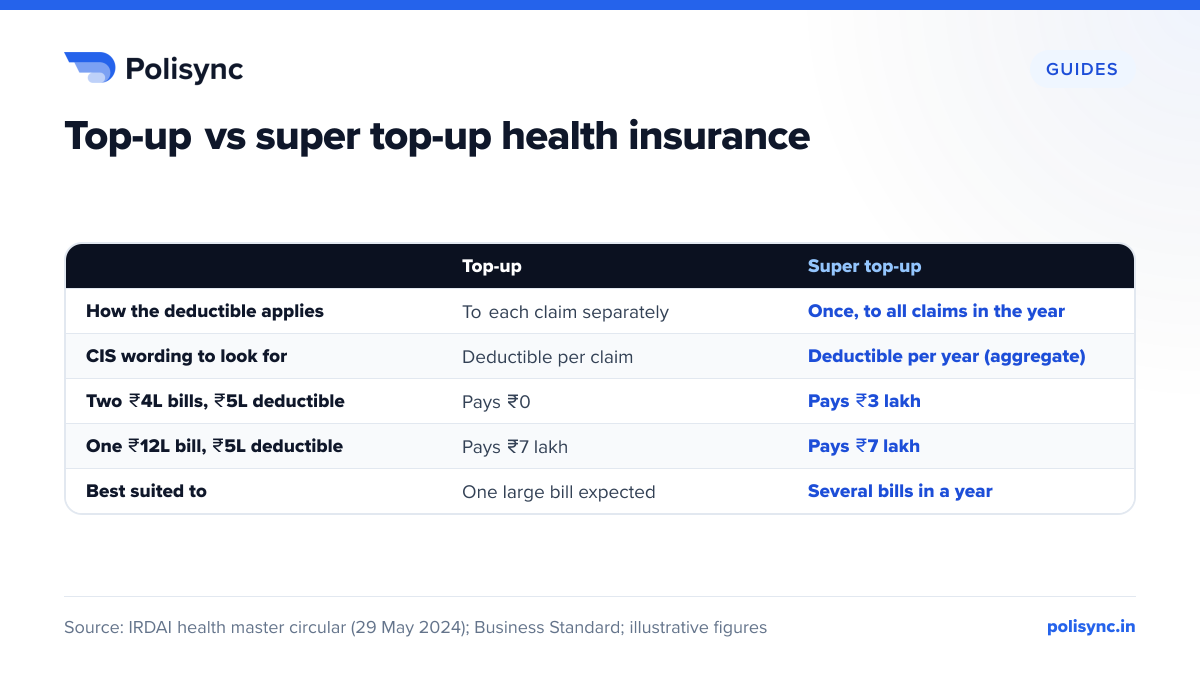
As of August 2026, a super top-up suits most clients better. Both products pay only above a deductible, but a top-up applies that deductible to every claim separately, while a super top-up applies it once to the total of all claims in a policy year. With a ₹5 lakh deductible and two ₹4 lakh bills, a top-up pays nothing and a super top-up pays ₹3 lakh (illustrative).
This guide, current as of 22 August 2026, covers how deductibles interact with base and group cover, what IRDAI's 2024 health rules say, and how the premium is taxed, ending with a checklist for client meetings.
What is a deductible in health insurance?
A deductible is the amount of an admissible claim that the insurer will not pay. IRDAI's Master Circular on Health Insurance Business (29 May 2024) defines it in the Customer Information Sheet (CIS) as a specified amount up to which the insurer will not pay any claim, and which is deducted from the total claim if the claim is larger.
The CIS format in the circular's annexure asks insurers to state the deductible as per claim, per year or both. That one line on the CIS tells you whether a product is a top-up (per claim) or a super top-up (per year, also called an aggregate deductible). Every policyholder must receive and acknowledge a CIS, so check it first.
What is the difference between top-up and super top-up health insurance?
How a top-up plan works
A top-up pays only when a single claim crosses the deductible. Business Standard's health insurance buying guide (9 June 2026) explains it with a ₹5 lakh deductible: the top-up comes into play only when a hospital bill is more than ₹5 lakh. A bill below the deductible gets nothing from the top-up, however many such bills arrive in a year.
How a super top-up plan works
A super top-up adds up every admissible hospitalisation bill in the policy year and pays once that running total crosses the deductible. In a Business Standard explainer (20 November 2025), Policybazaar's head of health insurance noted that multiple claims which individually fall below a top-up's limit do not trigger it. The article's example: with a ₹10 lakh deductible and four claims of ₹5 lakh each, a standard top-up pays nothing, while a super top-up pays the ₹10 lakh above the deductible.
The Bajaj General Extra Care Plus brochure shows the mechanics in its own table. With a ₹10 lakh sum insured and a ₹2 lakh aggregate deductible, three claims of ₹1.5 lakh, ₹3 lakh and ₹7.5 lakh were paid as nil, ₹2.5 lakh and ₹7.5 lakh. The first claim used up ₹1.5 lakh of the deductible, the second used the last ₹50,000, and from then on the policy paid in full. The brochure also notes that a deductible does not reduce the sum insured.
How do the two plans pay on real claims? An illustrative example
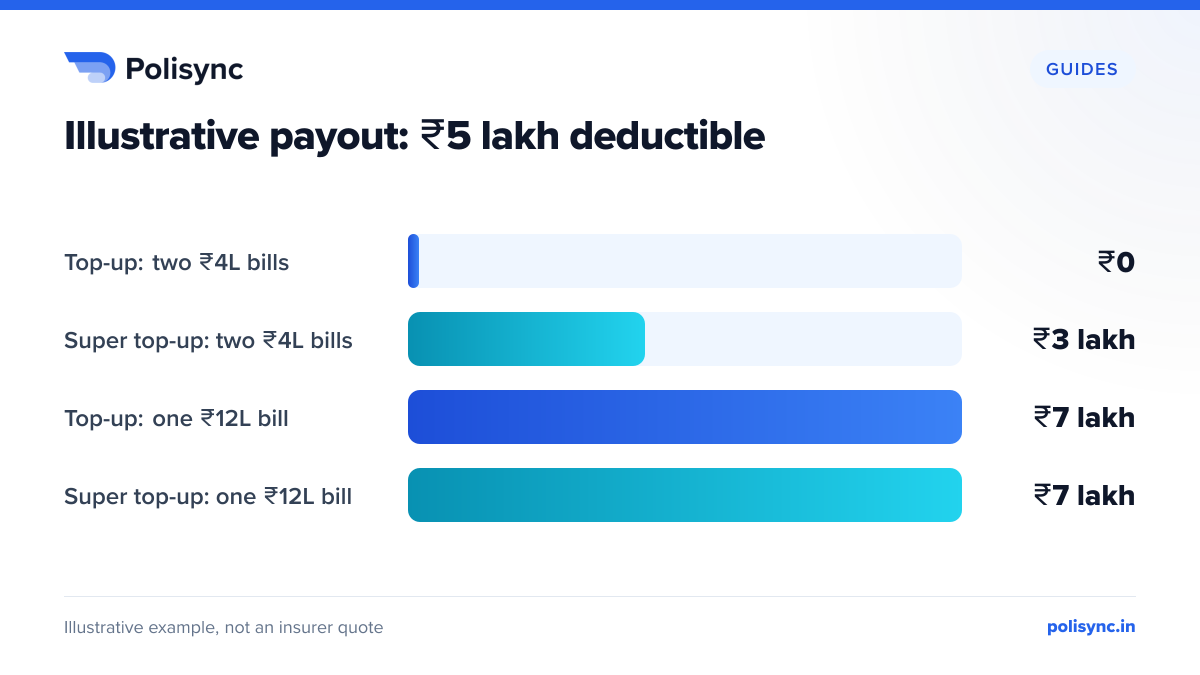
The numbers below are hypothetical and ignore room-rent limits, co-pays and non-payable items. Assume a client has a ₹5 lakh base policy and is choosing between a top-up and a super top-up, each with a ₹20 lakh sum insured and a ₹5 lakh deductible. In one policy year the client is hospitalised twice, with admissible bills of ₹4 lakh each.
Here is how each claim is settled:
- Claim 1 (₹4 lakh): the base policy pays ₹4 lakh and has ₹1 lakh left. Neither plan pays, because ₹4 lakh is below the ₹5 lakh deductible on its own and also as a yearly total.
- Claim 2 (₹4 lakh), with a top-up: the base policy pays its last ₹1 lakh. The top-up looks at this claim alone, finds ₹4 lakh is below ₹5 lakh, and pays nothing. The client pays ₹3 lakh out of pocket.
- Claim 2 (₹4 lakh), with a super top-up: the base policy pays its last ₹1 lakh. The yearly total is now ₹8 lakh, ₹3 lakh above the aggregate deductible, so the super top-up pays ₹3 lakh. The client pays nothing.
Note the trap in claim 2: the base policy was already partly used up by claim 1. Clients often assume the base policy will cover the deductible in full every time, but once the base sum insured is exhausted in a year, each further bill falls entirely on whatever sits above it.
What if there is only one large bill?
On a single ₹12 lakh bill in the same example, the base pays ₹5 lakh and either product pays ₹7 lakh. The two designs differ only when a year brings several bills, and since nobody can predict that, the aggregate design is the safer default for most families.
Why are top-up and super top-up premiums lower than a bigger base policy?
Because the insurer pays nothing below the deductible, most routine hospitalisations never reach it, and the premium reflects only the rarer, larger claims. In an October 2024 Business Standard report, Policybazaar's head of health insurance estimated that for a 45-year-old, a ₹10 lakh base policy (₹11,000 to ₹13,000) plus a ₹90 lakh super top-up (₹2,000 to ₹5,000 more) would cost at most about ₹18,000 a year, against about ₹36,000 for a ₹1 crore base policy. These are indicative figures, so quote actual premiums for the client's age and city.
Business Standard's report on the SBIG Health Super Top-Up launch (26 September 2024) gives a sense of the range on offer: sum insured from ₹5 lakh to ₹4 crore, annual and long-term aggregate deductible options, and the ability to sit over any existing corporate or personal policy from any insurer.
There is a second reason clients choose this route. Under the health master circular, insurers cannot do fresh underwriting at renewal unless the sum insured is increased, and then only on the increase. A super top-up is a fresh proposal too, so it is underwritten, but it lets the client keep the base policy and its accrued benefits untouched.
How does the deductible work with a base policy or employer group cover?
The deductible always has to be paid by someone. It can be bridged by a personal base policy, by employer group cover, or by the client's own savings. Bajaj General's brochure says Extra Care Plus can be bought even if the client has no existing health insurance, which means the client would carry the full deductible personally.
Clients with a personal base policy
The usual advice is to set the deductible equal to the base sum insured. SBI General's chief product and marketing officer told Business Standard that the deductible should ideally be equivalent to the base sum insured. The same report showed the cost of a mismatch: with a ₹5 lakh base policy, a ₹10 lakh deductible and an ₹8 lakh bill, the base pays ₹5 lakh, the bill never reaches the deductible, and the client pays ₹3 lakh out of pocket.
Salaried clients with employer group cover
Employees are classic super top-up buyers: a ₹5 lakh group cover with a ₹5 lakh deductible super top-up is a low-cost way to reach a much higher total cover. The SBI General launch release, as reported by Business Standard, specifically named people with group health policies who need additional cover.
The risk is that group cover is tied to the job. If the client resigns, retires or is laid off, the group policy stops but the super top-up deductible does not change. Until the client buys a personal base policy, every bill up to the deductible is out of pocket. A salaried client with a super top-up should ideally hold at least a modest personal base policy as well.
What do IRDAI's 2024 rules say about waiting periods, portability and renewal?
Top-ups and super top-ups are indemnity policies in their own right, so they carry their own waiting periods counted from their own start date. Schedule III of the IRDAI (Insurance Products) Regulations, 2024 caps the pre-existing disease (PED) waiting period at 36 months of continuous coverage and defines specific-disease waits as up to 36 months; insurers may offer less. Bajaj General's Extra Care Plus brochure, for example, lists a 30-day initial waiting period (not applicable to accidents) and 12 months for pre-existing diseases and listed conditions, counted from the first Extra Care Plus policy. Compare the CIS of each product; our guide to health insurance waiting periods covers the general rules.
Key provisions of the 29 May 2024 health master circular that apply to these covers:
- Moratorium: after 60 months of continuous coverage, no policy or claim can be contested for non-disclosure or misrepresentation, except for established fraud. Credits gained under ported and migrated policies count towards the 60 months.
- Portability: a policyholder can port an indemnity policy to another insurer. The existing insurer must share data through the Insurance Information Bureau within 72 hours, and the acquiring insurer must decide within 5 days. The policyholder can transfer credits gained for sum insured, no claim bonus, waiting periods and moratorium.
- Migration: moving to another product of the same insurer carries the same credits across.
- Renewal: an insurer cannot deny renewal because the policyholder made claims in earlier years.
- Free look: 30 days from receipt of the policy document, for policies with a term of one year or more.
Remember that a base policy and a super top-up are separate contracts. Porting the base policy does not move the super top-up, and vice versa. Read our health insurance portability guide before advising a client to switch either one, and confirm in writing how the acquiring insurer will treat the deductible and accrued credits.
Is the super top-up premium eligible for Section 80D tax deduction?
Yes, for clients in the old tax regime. The Income-tax Act, 2025 (Act No. 30 of 2025) came into force on 1 April 2026 and repealed the Income-tax Act, 1961. The deduction for health insurance premia that clients know as Section 80D is now Section 126 of the new Act. Bajaj General's Extra Care Plus brochure, and an Anand Rathi Insurance Brokers manager quoted in Business Standard's October 2024 report, both describe super top-up premiums as eligible for this deduction.
Points to explain to clients:
- Old regime only: Section 202 of the Act, the default new tax regime, computes income without Chapter VIII deductions other than a few listed sections, and Section 126 is not among them. Clients must opt for the old regime to claim it.
- One overall limit: Section 126 allows up to ₹25,000 in aggregate for the health insurance of self, spouse and dependent children, and a further ₹25,000 for parents. Each limit becomes ₹50,000 where the insured person is a senior citizen (60 or older). The super top-up premium shares the limit with the base premium; it does not get a separate one.
- Multi-year premiums: where a premium covering more than one year is paid in a lump sum, the deduction is spread equally over the years the cover remains in force.
- No cash: premiums must be paid by a mode other than cash; only preventive health check-up payments, which count within a ₹5,000 sub-limit, can be made in cash.
- Not tax advice: ask clients to confirm their regime choice and limits with their tax adviser.
How do cashless claims work when two insurers are involved?
When a client holds a base policy with one insurer and a super top-up with another, the hospital bill has to be split. The master circular deals with this directly: the policyholder can choose which policy to claim under, that insurer becomes the primary insurer, and if its cover falls short it must seek details of the other policies and coordinate with the other insurers to settle the balance without hassle to the policyholder.
The same circular requires insurers to decide cashless authorisation requests within one hour and final discharge authorisation within three hours. Two-insurer cases still need more coordination: Insurance Samadhan's co-founder told Business Standard that when the base and super top-up are from different insurers, the second insurer may insist on reimbursement, and the report advised informing both insurers at admission. Our guide to cashless vs reimbursement health claims explains the documents for each route.
What this means for insurance agents
Match the product to the client's situation:
- Salaried client with group cover: a super top-up with the deductible near the group sum insured, plus a small personal base policy so a job change does not leave the deductible unbridged.
- Family wanting higher cover at lower cost: a family floater base policy plus a floater super top-up; see our family insurance planning guide.
- Client who can absorb a deductible from savings: a super top-up on its own may work, but only if the client truly has the deductible amount set aside.
- Client offered a pure per-claim top-up: explain the multiple-bill gap clearly before they sign; in most cases a super top-up is the better design.
Selling a top-up when the client expected a super top-up is a classic misunderstanding that surfaces only at claim time, so read our note on avoiding insurance mis-selling. Super top-ups are also a natural conversation opener with clients who only have employer cover, which our health insurance cross-selling guide covers in detail.
Agent checklist: advising on top-up and super top-up plans
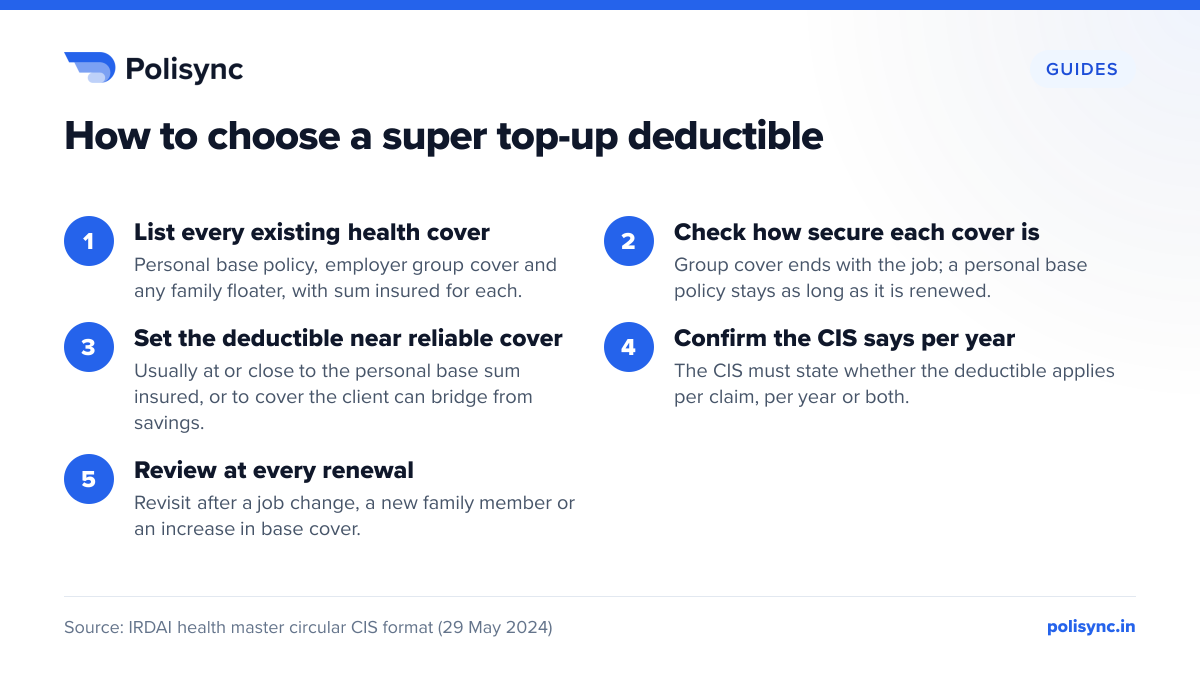
Work through these steps with each client:
- 1. Record every health policy the client holds, including employer cover, with insurer, sum insured and renewal date.
- 2. Read the CIS of the proposed product and confirm whether the deductible is per claim, per year or both.
- 3. Set the deductible to match cover the client can rely on, and explain what happens if group cover ends.
- 4. Walk through one illustrative two-bill year so the client sees how the deductible is used up.
- 5. Compare waiting periods, sub-limits and room-rent rules of both the base and the super top-up.
- 6. Explain that the premium falls under Section 126 (old Section 80D) only in the old tax regime, within one shared limit.
- 7. Tell the client to declare both policies at admission and keep copies of both e-cards together.
- 8. Use the health insurance calculator to discuss total cover needs, then review the plan at every renewal.
Keeping both policies, their deductibles and renewal dates in one place matters because the two contracts renew separately. A spreadsheet works for a small book, and agency management software such as Polisync can help keep these records organised as the book grows.