

Retirement planning with annuity and pension plans means turning a client's savings into income that lasts for life. As of 16 September 2026, insurers' pension plans follow IRDAI's Master Circular on Life Insurance Products (12 June 2024), which allows commutation of up to 60% at vesting, while non-government NPS subscribers can take up to 80% as lump sum and must annuitise at least 20% under PFRDA's December 2025 exit rules.
This guide explains the products, the rules and the maths an agent needs before a retirement conversation. It does not recommend any product or insurer.
What is the difference between an immediate and a deferred annuity?
An annuity is a contract in which a client pays a lump sum or a series of premiums to an insurer and receives a regular income in return. The two basic forms differ only in when the income starts.
- Immediate annuity: the client pays a single purchase price and payouts begin straight away, monthly, quarterly, half-yearly or yearly. It suits someone who is retiring now and has a corpus to convert into income.
- Deferred annuity: the client pays now (single, limited or regular premium) and the annuity starts at the end of a deferment period. IRDAI's master circular says that under deferred annuity products the annuity commences at the end of the deferment period and is guaranteed for life.
- Pension plan (accumulation product): a savings plan, linked or non-linked, that builds a corpus until a vesting date, when most of the money must be used to buy an annuity.
Under the IRDAI (Insurance Products) Regulations, 2024, annuity products include immediate and deferred annuities in which the underlying annuity is guaranteed for life. Immediate annuities do not acquire a guaranteed surrender value, so clients should treat the purchase price as committed once the free-look period ends.
What annuity options can clients choose?
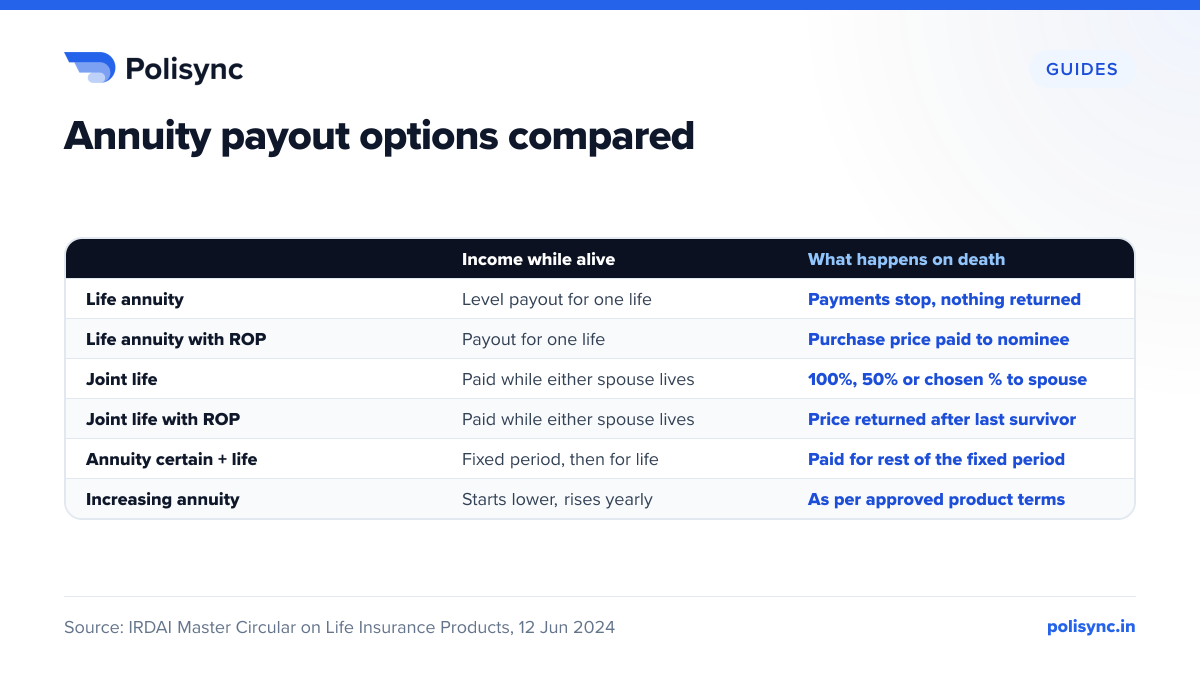
The payout option is the biggest decision in an annuity sale because it usually cannot be changed later. Paragraph 30.2 of IRDAI's master circular lists the guaranteed-for-life options insurers may offer, and every annuity product must offer at least the first two:
- Life annuity: income for as long as the annuitant lives, stopping on death.
- Life annuity with return of purchase price (ROP): income for life, with the purchase price paid to the nominee on death.
- Annuity certain for a specific period and life thereafter: income for a fixed period whether or not the annuitant survives, then for life.
- Joint life annuity: after the primary annuitant dies, 100%, 50% or another chosen percentage continues to the secondary annuitant (usually the spouse), with or without ROP on the last survivor's death.
- Variable annuity payout: income linked to a publicly available benchmark, with a minimum guaranteed annuity.
- Any other annuity, as approved: this is the route for options such as an increasing annuity, where the payout starts lower and rises by a fixed percentage each year. IRDAI does not list it by name, so it is available only where an insurer's approved product includes it. Check the brochure.
The variable option is allowed only with the life-with-ROP and joint-life-with-ROP options, and the master circular sets a floor: the minimum guaranteed annuity rate cannot fall below 60% of the rate at inception under the life-with-ROP or joint-life-with-ROP option. IRDAI's own worked example uses an inception rate of 7% per annum, giving a floor of 4.2%. That 7% is the regulator's illustration, not a market rate.
How do insurers' pension plans work under IRDAI's 2024 rules?
Insurers' pension plans are deferred products: the client builds a fund during the accumulation phase and converts it into income at vesting. The rules come from Schedule I of the Insurance Products Regulations, 2024 and paragraphs 29, 42 and 44 of the life products master circular.
Assured benefit
Individual pension products must have an explicitly defined assured benefit payable on death (or a covered health contingency). Non-linked pension plans must also define an assured benefit on vesting. For unit-linked pension plans, an assured benefit at vesting is optional. An assured benefit means either a non-zero positive return on premiums paid up to vesting, or an absolute amount that results in a non-zero positive return.
Commutation and annuity purchase at vesting
At vesting or surrender, the client of an individual pension plan chooses one of these routes:
- Use the entire proceeds to buy an immediate or deferred annuity at the then prevailing annuity rate.
- Commute up to 60% (take it as a lump sum) and use the balance to buy an annuity.
- In either case, the client may buy an annuity from another insurer with up to 50% of the proceeds net of commutation.
- If the amount left after commutation is too small to buy the minimum annuity under the regulations, it can be paid out as a lump sum.
For unit-linked pension plans, the client can also extend the accumulation period within the same policy at vesting if they are below 60.
Partial withdrawal before vesting
Individual non-linked pension plans allow partial withdrawals during deferment under strict conditions:
- Only after 3 years from the policy's commencement, and at most three times during the deferment period.
- Total withdrawals cannot exceed 25% of the premiums paid, and each withdrawal is treated as an advance of the commuted portion.
- Only for listed reasons, including children's higher education or marriage, buying or building a first home, critical illness treatment and disability-related expenses.
- Unit-linked pension plans follow a similar rule: only after the lock-in period, up to 25% of the fund value, three times in the policy term, and only for the same kinds of listed reasons.
If a client is weighing a pension plan against an endowment or ULIP, our guide on endowment vs ULIP vs term insurance explains the structural differences.
How do NPS exit rules work after the December 2025 changes?
The National Pension System (NPS) is regulated by PFRDA, not IRDAI, but NPS annuities are bought from annuity service providers, which the regulations define as IRDAI-registered life insurers empanelled by PFRDA. PFRDA notified amendments to its exit regulations in December 2025, and its press release of 19 December 2025 summarises them. The release says the changes are aimed primarily at the non-government sector.
Key normal-exit rules for the All Citizen Model and Corporate Sector, as of 16 September 2026:
- Up to 80% lump sum and at least 20% annuity (earlier 60:40).
- Corpus up to ₹8 lakh: the full amount can be taken as lump sum or through systematic withdrawals.
- Corpus above ₹8 lakh and up to ₹12 lakh: up to ₹6 lakh lump sum, with the balance through systematic unit redemption for at least six years or an annuity, or the 80:20 route.
- Corpus above ₹12 lakh: up to 80% lump sum and at least 20% annuity.
- All Citizen Model vesting is now 15 years or age 60, whichever is earlier.
- Entry and exit age has been raised to 85, and the lump sum or annuity purchase can be deferred up to 85.
Government sector subscribers keep the 60:40 split, with the same ₹8 lakh and ₹12 lakh corpus bands. Premature exit remains at up to 20% lump sum and at least 80% annuity, although a corpus of up to ₹5 lakh can now be withdrawn in full. The consolidated exit regulations (last amended 20 July 2026, by an amendment on specific purpose schemes that did not change these splits) also set a default annuity: joint life of subscriber and spouse with return of purchase price, re-issued to family members in a specified order. Subscribers can opt out of the default and choose another annuity type from the empanelled providers.
Clients can estimate their NPS corpus with the free NPS calculator before you discuss the annuity split.
How is annuity income taxed?
Annuity income is taxable as income at the client's slab rate in the year it is received. The Income-tax Act, 2025 replaced the Income-tax Act, 1961 from 1 April 2026, as confirmed in a PIB release, so section numbers have changed:
- NPS lump sum: Schedule II, Serial No. 6 of the 2025 Act (earlier section 10(12A)) exempts a payment from the NPS Trust on closure or opting out only to the extent it does not exceed 60% of the total amount payable. The Finance Act, 2026 did not amend this entry, so on a plain reading the part of an 80% lump sum above 60% is not covered by the exemption. Ask the client's tax adviser to confirm before the exit.
- NPS annuity: section 124(6) of the 2025 Act (earlier section 80CCD(3)) treats pension received from an annuity bought on closure as income of the year in which it is received. Under section 124(9), amounts used to buy an annuity in the same tax year are not treated as received.
- Insurer annuities: section 16 of the 2025 Act counts any annuity or pension as "salary", and Schedule XV (paragraph 5, Serial No. 2, the old section 80CCC) taxes pension from an insurer's annuity plan, where a deduction was claimed on contributions, as income of the year received. Confirm the exact head of income and treatment for each client with a tax adviser.
Because annuity income is taxed in full each year, the post-tax yield on an annuity can be noticeably lower than the quoted rate for clients in higher slabs. Show the post-tax figure, not just the headline rate, and keep tax opinions to a qualified adviser.
How much corpus does a client need for a target pension?
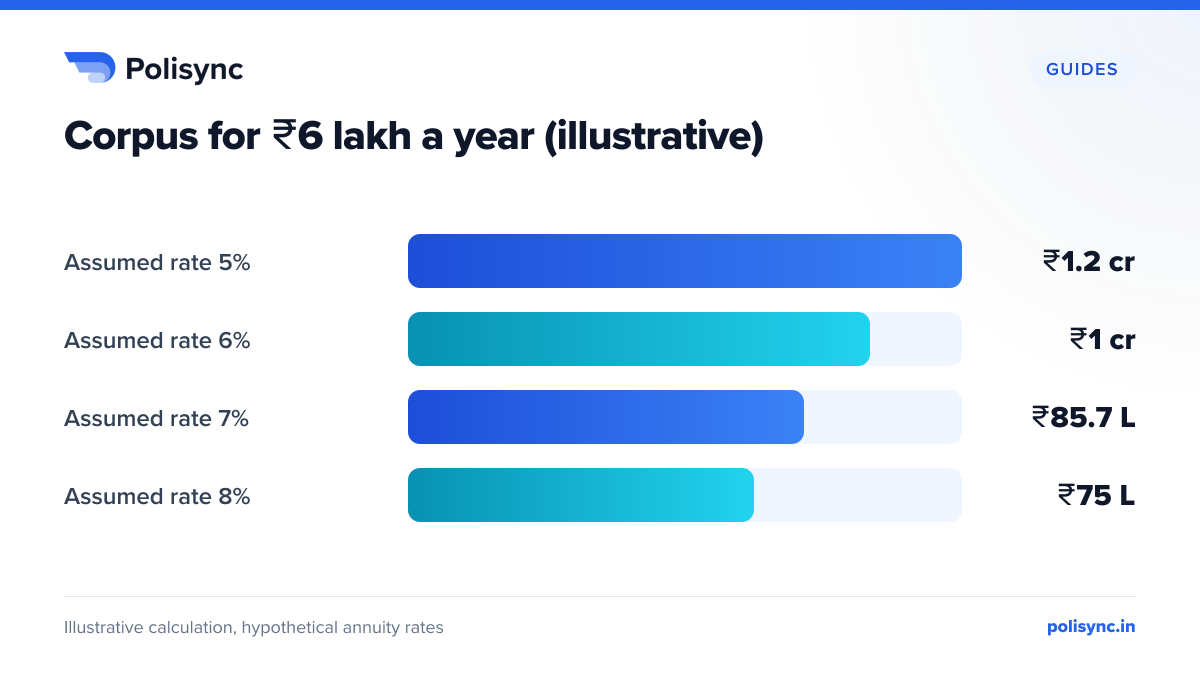
The simplest way to start is to reverse the annuity rate: corpus needed = target annual income ÷ annuity rate. The example below is illustrative only. The rates are hypothetical and are not any insurer's quotes. Real rates depend on age, option chosen, purchase price and the date of purchase.
Illustrative example: a client wants ₹50,000 a month (₹6 lakh a year) from a level life annuity. At a hypothetical 5% rate they would need ₹1.2 crore, at 6% about ₹1 crore, at 7% about ₹85.7 lakh and at 8% about ₹75 lakh. Rates differ by option, age and insurer, and a lower rate sharply raises the corpus required, so always size the corpus on quotes for the option the client will actually choose.
Longevity risk and inflation risk
Two risks shape almost every retirement conversation:
- Longevity risk is the risk of outliving savings. A life annuity transfers this risk to the insurer, and IRDAI requires every annuity product to offer at least the life annuity option. A lump sum kept in deposits or funds leaves it with the client.
- Inflation risk is the loss of purchasing power over time. Illustratively, at a hypothetical 6% inflation rate, a level ₹50,000 monthly annuity would buy only about what ₹20,900 buys today after 15 years, and a client who needs ₹50,000 today would need about ₹1.6 lakh a month in 20 years.
One way to handle both risks is to combine a level annuity for core expenses, an increasing option (where available) or other investments for growth, and health cover for medical costs. For the health side, see our senior citizen health insurance guide. For corpus planning, the retirement corpus calculator helps clients test their own assumptions.
Is suitability assessment mandatory for annuity sales?
Yes, in most cases. IRDAI's Master Circular on Protection of Policyholders' Interests (5 September 2024) requires suitability assessment for savings-related life insurance products and annuity products, except annuities bought from NPS proceeds and from employer-offered superannuation funds.
What the circular expects:
- Collect suitability information: age, income, family status, life stage, financial and family goals, investment objectives and existing insurance.
- Assess suitability against the product's nature, premium mode, policy tenure and premium payment period.
- Document the need analysis, give a copy to the prospect, and preserve the information and the salesperson's recommendation as part of policy records.
- Obtain the consent of the prospect and the salesperson on the suitability information. Online sales need express consent, such as an OTP from the prospect's registered mobile number or email.
For an immediate annuity bought from NPS proceeds, the circular says the NPS exit form is treated as the proposal form, and any missing details such as nomination may be collected separately. Even when formal assessment is not required, recording why an option was chosen protects both client and agent.
What this means for insurance agents
- Retirement is a needs conversation, not a product pitch. Start with a financial needs analysis and record the client's income gap.
- NPS exits are now a bigger decision. With up to 80% available as lump sum for non-government subscribers, clients may annuitise less, which raises the importance of planning how the lump sum will generate income.
- Option choice is usually permanent. Explain death benefits and the spouse's position before the client signs, especially between life annuity and joint life with ROP.
- Rates are not comparable on headline alone. Compare the same option, same age and same frequency across insurers, and remember the right to buy up to 50% from another insurer at vesting.
- Mis-selling risk is real. Positioning a pension plan as a short-term savings product, or hiding the annuitisation requirement, is exactly what suitability rules aim to stop. See how to avoid insurance mis-selling.
How should agents run the retirement planning conversation?
A structured conversation keeps the discussion honest and makes the suitability record easy to complete.
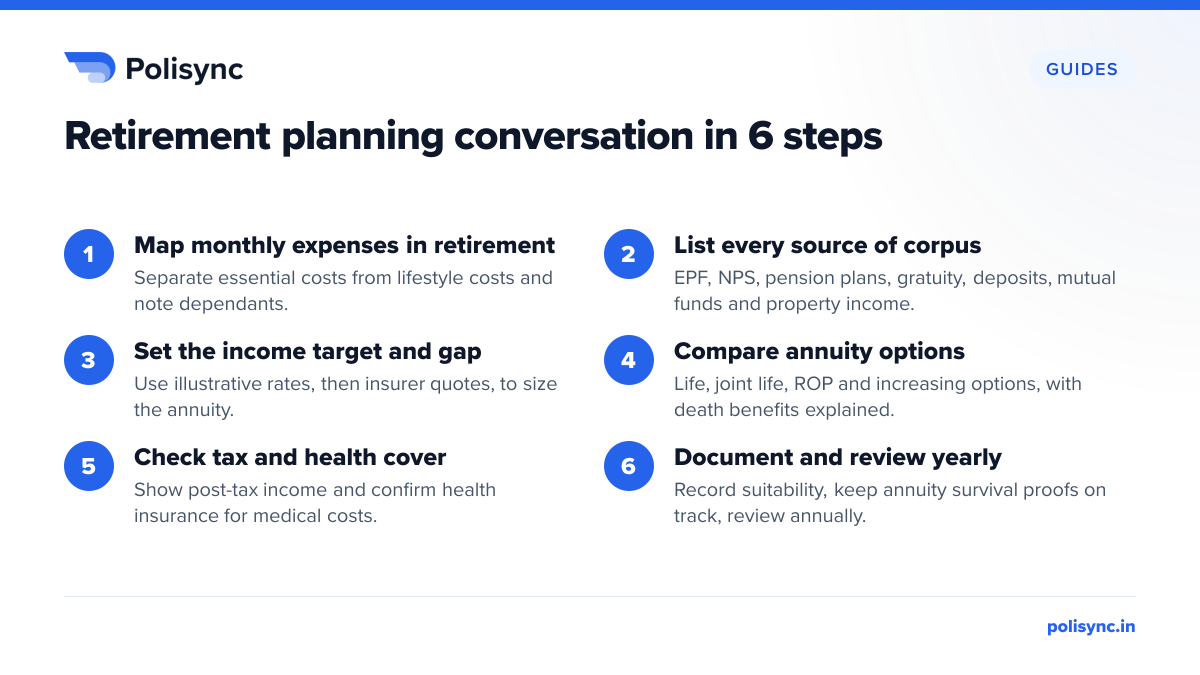
Action checklist for your next retirement meeting:
- 1. Ask for the client's NPS statement, pension plan vesting dates and any employer superannuation details.
- 2. Run the numbers with the retirement corpus and NPS calculators, and label every assumed rate as hypothetical.
- 3. Get actual annuity quotes for at least two options and the same payout frequency.
- 4. Explain the 60% commutation limit on insurer pension plans and the 80:20 (or 60:40) NPS split that applies to the client.
- 5. Discuss the spouse's income after the client's death before choosing between single and joint life.
- 6. Flag the tax position and refer specific questions to a tax adviser.
- 7. Complete the suitability record where required and give the client a copy.
- 8. Diarise the review; our annual policy review meeting checklist covers what to revisit.
Keeping vesting dates, annuity options and review notes in one place matters when you serve many retired clients, and agency software such as Polisync can help keep those records organised.