

A financial needs analysis (FNA) is a structured fact-find in which an agent records a client's family, income, expenses, loans, goals, existing cover and health, then recommends products that close the gaps, protection first. For savings and annuity plans, IRDAI's Master Circular of 5 September 2024 makes this documented need analysis mandatory, with a copy for the client.
This guide gives you a 6-step FNA process, the discovery questions to ask, a one-page fact-find template and an illustrative young-family case, all mapped to what IRDAI expects at the point of sale as of 8 August 2026.
What is a financial needs analysis in insurance?
A financial needs analysis is the written record of a client's financial situation and goals that justifies every product you recommend. It turns a sales pitch into a diagnosis: you find the gaps first, then prescribe cover.
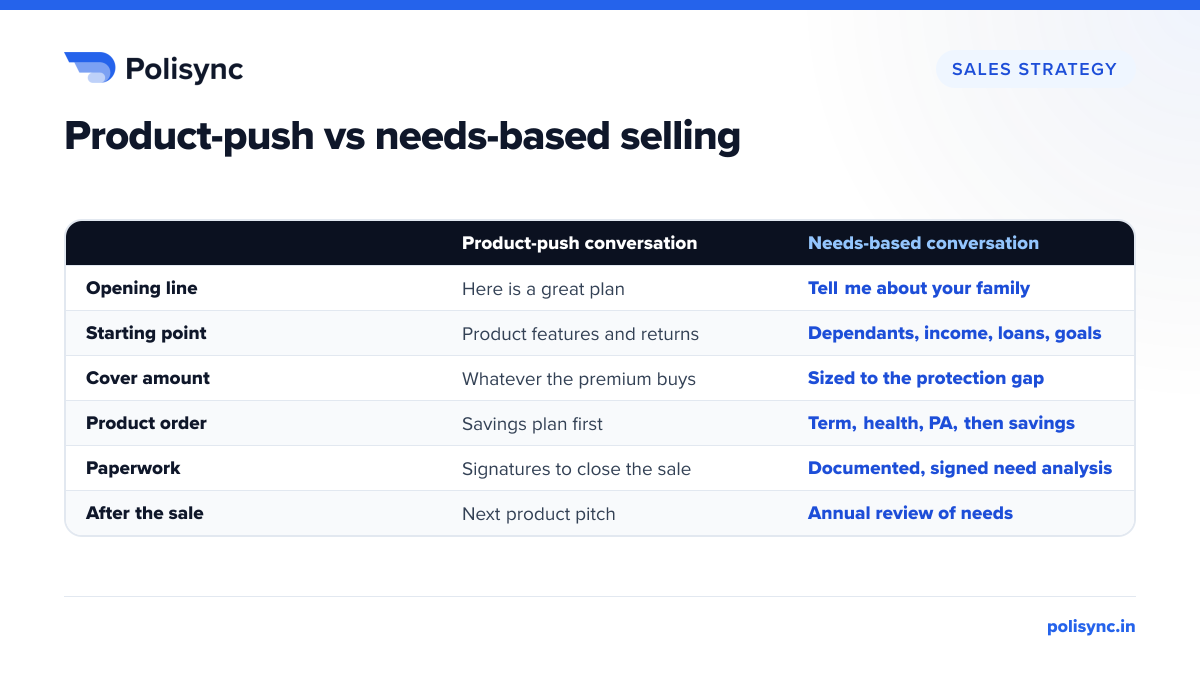
Needs-based selling is the sales approach built on that analysis. Instead of opening with a plan and its returns, you open with the family. The product appears only after a need has been identified, sized and agreed with the client.
IRDAI's own vocabulary is close to this. Its Master Circular on Protection of Policyholders' Interests, 2024 defines 'suitability information' as a prospect's age, income, family status, life stage, financial and family goals, investment objectives and the insurance portfolio already held. That list is, in effect, the skeleton of a good fact-find.
Does IRDAI require a needs analysis before selling a policy?
Yes for savings and annuity products, and the point-of-sale paperwork around it covers most other life sales too. The Master Circular (ref. IRDAI/PP&GR/CIR/MISC/117/9/2024, dated 5 September 2024) was issued under the IRDAI (Protection of Policyholders' Interests, Operations and Allied Matters of Insurers) Regulations, 2024, notified in March 2024. These are the point-of-sale duties that matter most to agents:
- Suitability assessment is mandatory for savings-related life insurance products and annuity products, except annuities bought from NPS proceeds or an employer-offered superannuation fund.
- The agent collects the reason for buying insurance, income and affordability, the needs to be met, the expected benefits and the type of benefits needed, confirmed by both the prospect and the salesperson.
- The need analysis must be documented, with a copy given to the prospect, and it becomes part of the policy document. In online sales, consent can be taken by OTP from the prospect's registered mobile number or email.
- A customised benefit illustration must be given at the point of sale, in addition to the prospectus, for all life products except a few listed in Schedule B of the circular, such as regular-premium pure term plans and group term plans. The prospect signs it once satisfied that the benefits meet their needs, and the authorised salesperson signs it too.
- Within 15 days of accepting a proposal, the insurer sends the policy document with a free-look covering letter, a copy of the proposal form, the benefit illustration, the Customer Information Sheet (CIS) and the need analysis document, if any.
The circular also sets a fair-treatment standard: where customers receive advice, "the advice is suitable and takes account of their needs and circumstances". Each life insurer must have a Board-approved suitability policy that also covers measures to curb mis-selling and force-selling, so use your insurer's suitability form wherever one exists.
The final choice stays with the client. The circular says a prospect is free to choose a product other than the one recommended. Business Today's summary of the circular lists the same documents from the policyholder's side, and TeamLease RegTech's note records that it introduced a CIS for all insurance segments.
Why does needs-based selling matter for agents right now?
Because complaints about how policies are sold are rising. Table II.16 of IRDAI's Annual Report 2024-25 shows that while total complaints against life insurers stayed flat at about 1.20 lakh, those classed as unfair business practices rose to 26,667 in FY25 from 23,335 in FY24. Their share of all complaints against life insurers went up from 19.33% to 22.14%, as Insurance Business Asia also reported.
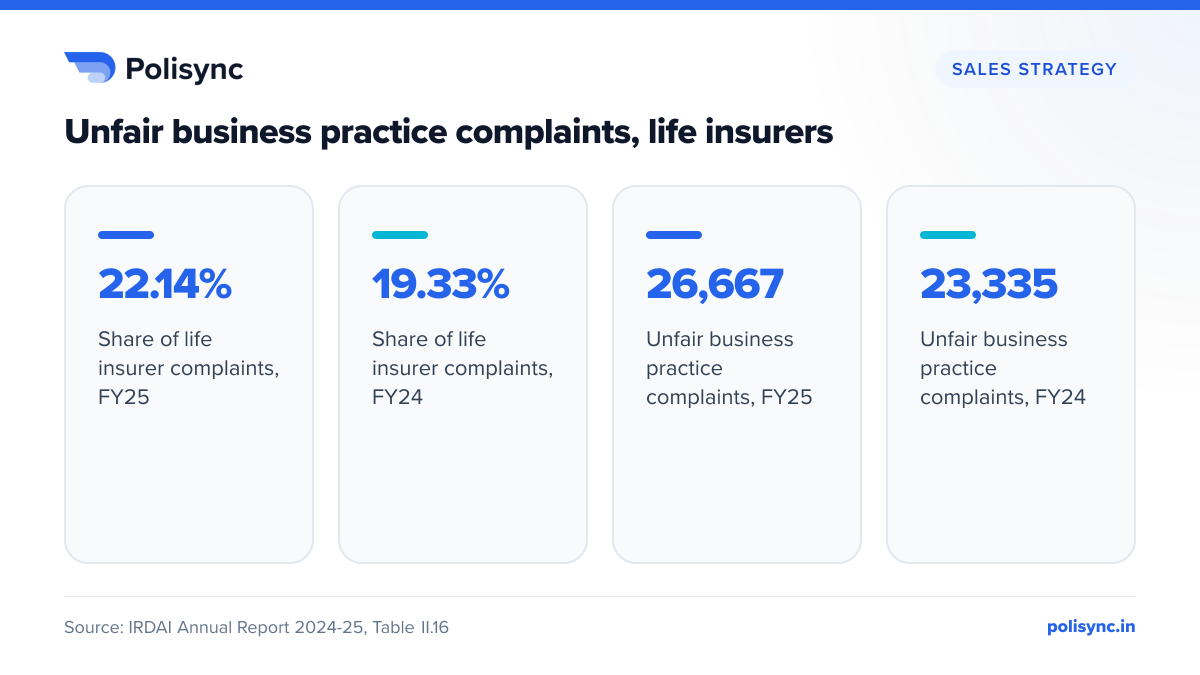
Speaking at the CII's InsureInd conference, IRDAI member Deepak Sood said that selling correctly is an imperative for every salesperson, distributor and insurer, Insurance Business Asia reported on 27 February 2026. In the same annual report, IRDAI describes mis-selling as selling without proper disclosure of terms, conditions or suitability, and says insurers have been advised to assess product suitability and implement distribution channel-specific controls, which means closer scrutiny of how agents sell.
For you, a documented FNA is both protection and a sales tool. It is evidence that the recommendation fitted the client, and it uncovers more needs (health, accident, a spouse's cover) than a single-product pitch. Our guide on how to avoid insurance mis-selling covers the red lines in more detail.
What are the 6 steps of a financial needs analysis?
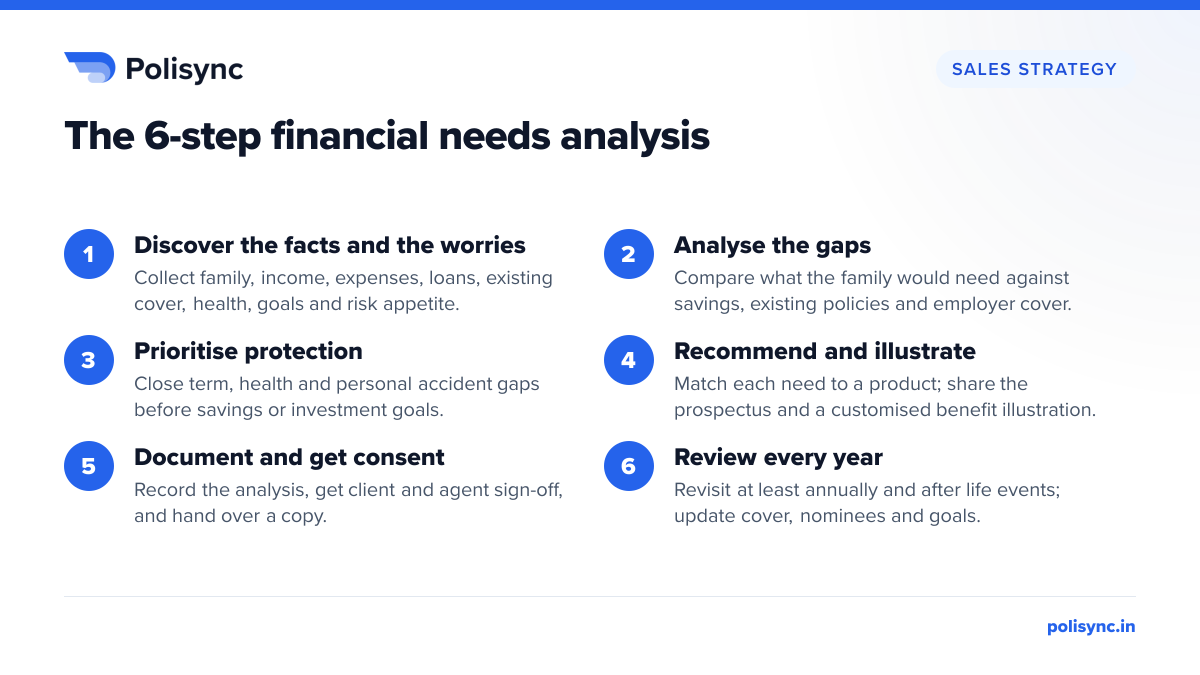
Use the same six steps with every client, at a first meeting or a renewal visit.
What questions should you ask in a fact-find?
Group your discovery questions by theme so nothing is missed. Ask open questions first to understand what worries the client, then pin down the numbers.
Family and dependants
- Who depends on your income today, and who will in ten years?
- Are your parents or in-laws financially dependent on you, or likely to be?
- Does your spouse earn? What would change at home if either of you could not work?
- Do any children have long education plans or special needs?
Our family insurance planning guide for agents shows how to map cover across every member of the household once you have these answers.
Income, expenses and liabilities
- What is your monthly take-home income, and how stable is it?
- What does the household spend each month, including rent or EMIs, school fees and support to parents?
- Which loans are outstanding (home, car, personal, education), and for how many more years?
- What savings and investments exist today, such as FDs, mutual funds, EPF or PPF?
Goals, existing cover, health and risk appetite
- Which goals matter most (children's education, marriage, a home, retirement), when, and what would they cost in today's money?
- Please show me every policy you hold, including employer group cover: type, insurer, sum assured, premium, term and nominee.
- Any existing illnesses, ongoing treatment or family medical history? (These must be disclosed truthfully in the proposal form.)
- How would you feel if an investment fell in value for a year or two? Do you need access to this money before maturity?
- What premium can you comfortably commit every year, even in a bad year?
Why should protection come before savings and retirement?
A savings goal assumes the earner stays alive, healthy and working long enough to fund it. Protection covers the situations where that assumption breaks, so it comes first.
Term insurance, as IRDAI's life insurance FAQs explain, pays a benefit to dependants if the life assured dies during the term, and normally nothing if they survive it. That pure-protection design is why it anchors the first layer of any plan. Map each need to a product in this order:
- Income replacement if the earner dies: term insurance sized to the protection gap. See our guide on how much life insurance cover a client needs.
- Hospital bills: individual or family floater health insurance in the client's own name, not only employer group cover, which is tied to the job. Our health insurance cross-selling guide covers how to raise it.
- Accidental death or disability: personal accident cover, with attention to its disability benefits.
- Serious illness: critical illness cover or riders, where the budget allows after the core layers.
- Education, marriage and retirement goals: savings, pension or investment products, only after protection is in place, with a suitability assessment for savings and annuity plans.
Size cover to real, documented income. IRDAI's FAQs note that insurers ask for income proof to judge premium-paying capacity and to prevent disproportionately high sums assured, and the Master Circular asks insurers to spell out financial underwriting requirements that assess a prospect's continued capacity to pay premiums for the full premium-paying term.
What should a one-page fact-find template include?
Copy this onto a single page, or use your insurer's suitability form where it provides one, and fill it in during the first meeting:
- 1. Client details: names, dates of birth, occupation, city, smoker or non-smoker.
- 2. Dependants: spouse, children with ages, dependent parents or in-laws.
- 3. Income: each earner's monthly take-home, other income, stability of employment.
- 4. Expenses: monthly household spend, school fees, support to relatives.
- 5. Assets: bank balances, FDs, mutual funds, EPF, PPF, NPS, property.
- 6. Liabilities: each loan with outstanding amount, EMI and remaining tenure.
- 7. Existing insurance: every policy with insurer, type, sum assured, premium, term and nominee, plus employer group cover.
- 8. Health: pre-existing conditions, ongoing treatment, family history.
- 9. Goals: each goal with target year and cost in today's money, ranked by priority.
- 10. Risk appetite and liquidity: comfort with market-linked products, need for early access to money.
- 11. Premium budget: annual amount the client can sustain, preferred payment frequency.
- 12. Sign-off: recommendations made, products the client chose or declined, signatures of client and agent, date and next review date.
Worked example: how does an FNA become a product mix?
The case below is illustrative. Names and numbers are hypothetical, and actual premiums and acceptance will depend on the insurer, age, health and underwriting.
What the fact-find shows (hypothetical):
- Rohan, 32, salaried in Pune, is the main earner. Priya, 30, looks after their daughter, aged 3.
- Household expenses: ₹55,000 a month, or ₹6.6 lakh a year.
- Home loan outstanding: ₹40 lakh.
- Savings and mutual funds: ₹9 lakh. Existing cover: a ₹5 lakh endowment policy and a ₹3 lakh employer group health cover.
- Goals: the daughter's higher education in about 15 years, estimated at ₹25 lakh in today's money, and retirement.
Step 2, the protection gap, using a simple needs-based method (cross-check it with the human life value calculator):
- Clear the home loan: ₹40 lakh.
- Fund the education goal: ₹25 lakh.
- Replace household expenses for 15 years: ₹6.6 lakh x 15 = ₹99 lakh (a simple multiple, with no adjustment for inflation or returns).
- Total need: ₹1.64 crore. Less existing resources of ₹14 lakh (₹9 lakh savings + ₹5 lakh endowment) = gap of ₹1.5 crore.
Step 3, the recommendation, in priority order:
- 1. Term cover of about ₹1.5 crore on Rohan, running to the end of his working years, with Priya as nominee. Discuss a smaller term cover on Priya too, since replacing her childcare work would cost money.
- 2. A family floater health policy in the family's own name (say ₹10 lakh, illustrative), so cover does not depend on Rohan's employer.
- 3. Personal accident cover on Rohan with disability benefits, because an accident that stops him working would hit the EMI first.
- 4. The education goal, only once the protection premiums fit the budget Rohan set. If a life insurance savings plan is considered, complete the insurer's suitability assessment and walk through its signed benefit illustration.
- 5. The existing endowment policy: leave it in place. Never suggest surrendering a policy without comparing its surrender value and remaining benefits in writing.
Notice what the analysis changed. Without it, the obvious pitch was a child savings plan. With it, the biggest risks turned out to be ₹1.5 crore of unfunded protection and health cover tied to one employer.
How should you present recommendations and get informed consent?
Present the gap before the product. Show clients their own numbers, then explain how each recommendation closes a specific gap. Then follow the point-of-sale rules step by step:
- Use only the insurer's approved prospectus. The Master Circular's anti mis-selling mechanism requires salespersons to do so.
- Walk through the customised benefit illustration line by line. Except where every benefit is fixed in absolute amounts at the outset, the 2024 Regulations require it to show guaranteed and non-guaranteed benefits (illustrated at 4% and 8% gross returns under Schedule B of the circular). Get it signed by the client and by you.
- Let the client complete the proposal form truthfully. It is available in Hindi or English, and in a regional language on request. If the client is not familiar with the form's language, explain it and obtain their declaration that it was explained.
- Do not split one need into several policies unless the client specifically asks; the circular allows splitting only at the prospect's request, with consent recorded.
- Record the client's decisions, including any recommendation they declined, on the fact-find itself.
- Explain the free look period: 30 days from receipt of the policy document for life policies with a term of one year or more. Our free look period guide covers refunds and deductions.
Clients will push back on cover amounts and premiums. Because your recommendation rests on their own numbers, objections become a discussion about priorities rather than price. Our guide to handling client objections in insurance sales has scripts for the common ones.
A fact-find holds sensitive personal and financial data, so store it securely and collect only what you need; see our DPDP Act guide for insurance agents. Whether you use a paper file, a spreadsheet or agency software such as Polisync, keep the signed analysis against the client record so the next review starts from facts, not memory.
What this means for insurance agents
Needs-based selling is no longer only good practice. For savings and annuity products it is a documented regulatory step, and for every other product it is your best evidence of suitable advice. A needs analysis also goes stale: marriage, a new child, a home loan or a job change can all open new gaps, so treat the annual review as the second half of the FNA.
Your action checklist:
- 1. Adopt one fact-find template for every client, and use your insurer's suitability form for savings and annuity plans.
- 2. Split the process into two meetings: a fact-find, then a recommendation with the numbers.
- 3. Size and recommend protection (term, health, personal accident) before any savings product.
- 4. Never skip the signed benefit illustration where the product requires one, and make sure the client gets a copy of the need analysis.
- 5. Record declined recommendations and the client's own choices, signed and dated.
- 6. Store fact-finds securely and set a review date for each client.
- 7. Review every client at least once a year and after any major life event, updating cover, nominees and goals.