

Under IRDAI's Protection of Policyholders' Interests regulations, in force since 1 April 2024, buyers of life insurance and new individual health insurance policies with a term of one year or more get a 30-day free-look period from receipt of the policy document, electronic or physical. The insurer must refund the premium within 7 days of the request, minus only proportionate risk premium, medical examination costs and stamp duty.
This guide, current as of 31 July 2026, explains which policies qualify, when the clock starts, what can be deducted (with a clearly illustrative refund calculation), how a client cancels, and how agents should handle a free-look request without damaging trust or breaking the rules.
What is the free-look period in insurance?
The free-look period is a cooling-off window in which a new policyholder can read the policy, decide it does not suit them and return it for a refund, without surrender charges. It exists because the policy document, not the sales conversation, is the contract, and the buyer needs time to check that the two match.
The rule sits in Regulation 20 of the IRDAI (Protection of Policyholders' Interests, Operations and Allied Matters of Insurers) Regulations, 2024, notified in the Gazette of India in March 2024 and in force from 1 April 2024. IRDAI set out the policyholder-facing detail in its Master Circular on Protection of Policyholders' Interests, 2024, dated 5 September 2024 (Ref: IRDAI/PP&GR/CIR/MISC/117/9/2024).
Two features matter most in practice. The insurer must accept the request irrespective of the reason the policyholder gives, and the permitted deductions are listed in the rule itself. Nothing outside that list may be taken out of the refund.
How long is the free-look period in India: 15 days or 30 days?
It is 30 days for every eligible policy, however it was sold. Under the earlier 2017 regulations the window was 15 days for most life policies, with 30 days only for electronic policies and those sold through distance modes, as Shardul Amarchand Mangaldas noted in September 2024.
IRDAI first proposed a uniform 30-day window in its February 2024 exposure draft (Business Today, 15 February 2024), and the final 2024 regulations adopted it.
Who gets the 30-day window under Regulation 20:
- Life insurance policies with a term of one year or more: term, traditional savings and unit linked plans alike.
- New individual health insurance policies with a tenure of one year or more: the regulation speaks of new policies, so on a plain reading a routine renewal of an existing health policy does not open a fresh window.
- Not covered: policies with a tenure of less than a year.
- General insurance such as motor or home cover: Regulation 20 does not give these a free-look period; cancellation follows the cancellation clause in the policy wording.
- Condition: the policyholder must not have made a claim under the policy.
Health insurance follows the same 30 days. IRDAI's Master Circular on Health Insurance Business, dated 29 May 2024, gives policyholders 30 days from receipt of the policy document to review and cancel policies with a term of one year or more. The permitted deductions and the 7-day refund come from Regulation 20, which covers health and life alike.
Did the government ask for a one-year free-look period?
Yes, but as a request, not a rule. On 17 February 2025, Finance Minister Nirmala Sitharaman said the government had asked insurers to extend the free-look period from one month to one year, so that customers who were mis-sold a policy could return it for a refund of premium (Moneylife, 17 February 2025). The government also urged private insurers to make post-sale follow-up calls to check whether customers were satisfied with the product.
As of 31 July 2026, that request has not been written into IRDAI's rules: Regulation 20 and both master circulars still provide 30 days. Always read the free-look clause printed in the actual policy document and covering letter, which is the version your client is entitled to rely on.
When does the free-look clock start?
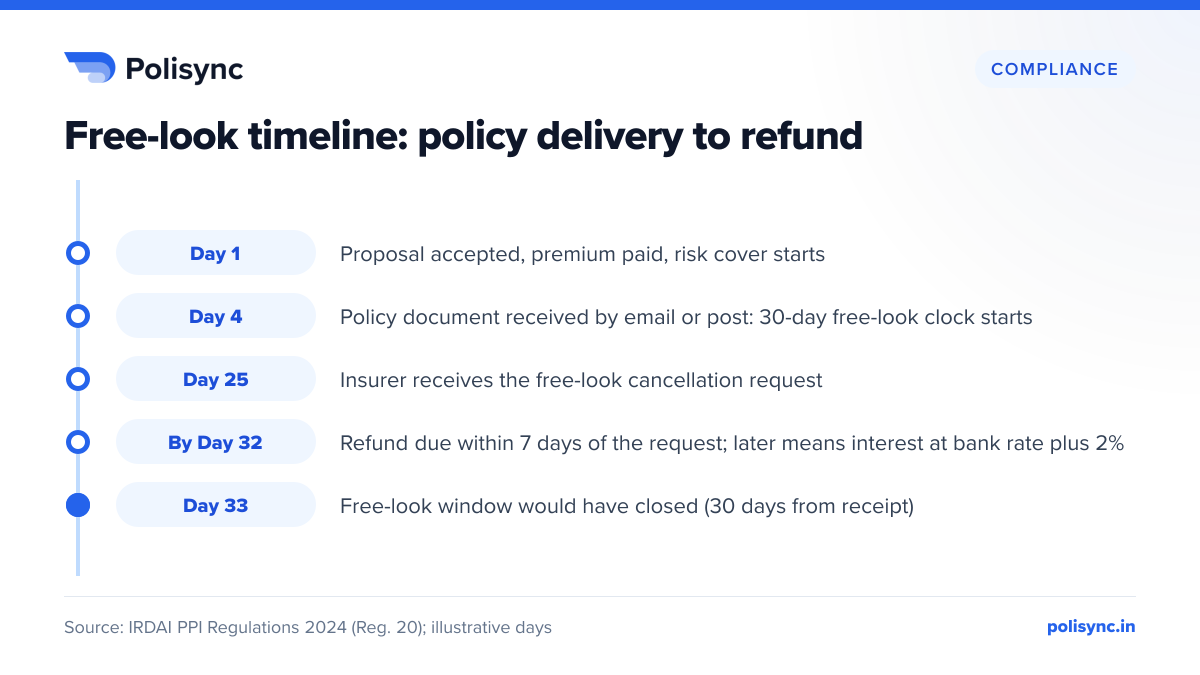
The 30 days begin on the date the policyholder receives the policy document, whether it arrives electronically or otherwise. The clock does not start on the proposal date, the premium payment date or the date risk cover commenced.
According to the Master Circular, insurers issue policies in electronic form (with a physical copy if the customer asks) and must send the policy kit within 15 days of accepting the proposal. For life policies the kit includes a covering letter informing the buyer of the free-look period, the policy document, a copy of the proposal form, the benefit illustration, the Customer Information Sheet and, where applicable, the needs analysis done under suitability assessment. For health policies it is the policy document, a copy of the proposal form, the Customer Information Sheet and any medical reports.
Practical ways to pin down the receipt date:
- E-policy: keep the email carrying the digitally signed policy; its timestamp is your best evidence.
- Physical policy: keep the courier or speed post delivery record.
- Both copies sent: if they arrive on different days, ask the insurer in writing which date it will use, and never let the client assume the later one.
- Your records: note the delivery date in the client file on the day it happens, not weeks later.
What can the insurer deduct from a free-look refund?
Regulation 20(4) allows three deductions and no others. Proportionate risk premium means the part of the premium that paid for the insurance cover during the days the policy was in force.
- Proportionate risk premium: because cover runs from the risk commencement date, this is counted on days of cover, not days since the document arrived.
- Medical examination costs: only if the insurer incurred them on the proposer's medical tests.
- Stamp duty: the stamp duty charges on the policy.
For unit linked plans, Regulation 20(5) adds one more step: the insurer repurchases the units at the Net Asset Value (NAV) on the date of cancellation. If markets fall between purchase and cancellation, the refund falls with them; if they rise, it rises. That market exposure is one reason a ULIP needs more explaining at the point of sale, as our comparison of endowment, ULIP and term plans sets out.
How is a free-look refund calculated? An illustrative example
The numbers below are hypothetical, chosen only to show the method. Real risk premium, medical and stamp duty amounts vary by insurer, product, age and sum assured, and the insurer's own calculation is what applies.
Suppose Ramesh, 35, buys a traditional savings plan with an annual premium of ₹60,000. The insurer paid ₹2,500 for his medical tests and ₹200 in stamp duty. Assume ₹4,380 of the yearly premium is the risk premium, which works out to ₹12 a day. His cover started on Day 1, the e-policy arrived on Day 4, and the insurer received his free-look request on Day 25, so he was covered for 25 days.
Illustrative calculation (hypothetical figures):
- Premium paid: ₹60,000
- Less proportionate risk premium: 25 days x ₹12 = ₹300
- Less medical examination cost: ₹2,500
- Less stamp duty: ₹200
- Refund: ₹57,000, due within 7 days of the insurer receiving the request
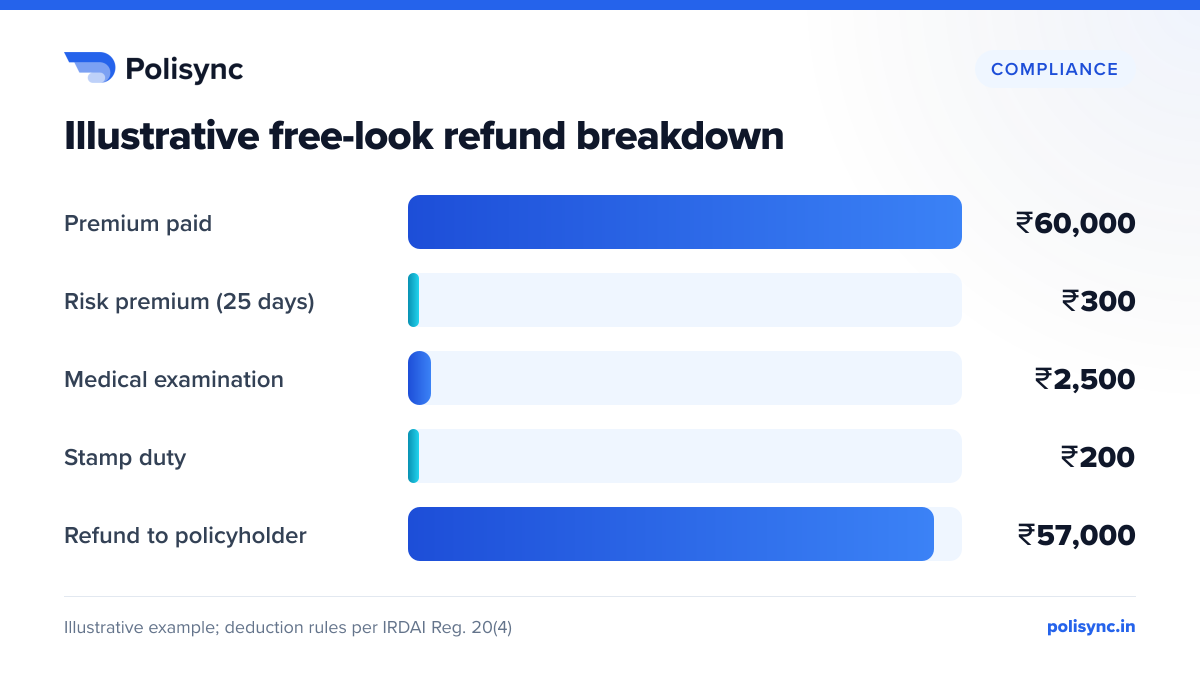
In this example the medical cost is the largest deduction; on a policy issued without medical tests that line would be zero. The risk premium is small because it is prorated by days of cover rather than charged for the whole year. For a ULIP, the invested portion comes back at the value of the units repurchased at the cancellation-date NAV, so the final figure can be higher or lower than this, with the same three deductions applied.
How quickly must the insurer refund, and what if it is late?
Within 7 days of receiving the request. The Master Circular adds a penalty for delay: the insurer must pay interest at the bank rate plus 2 percent on the refundable amount, from the date it received the request until the date of refund. It must pay this interest on its own, without the policyholder having to ask, and it is without prejudice to any other penalty IRDAI may levy.
The Citizens' Charter annexed to the circular lists free-look cancellation and refund with a turnaround time of 7 days from receipt of the request, for both life and health insurers.
How does a client cancel a policy during the free-look period?
The regulation only requires the policyholder to return the policy stating the reasons. Insurer processes differ in detail, but a clean request usually follows the steps below.
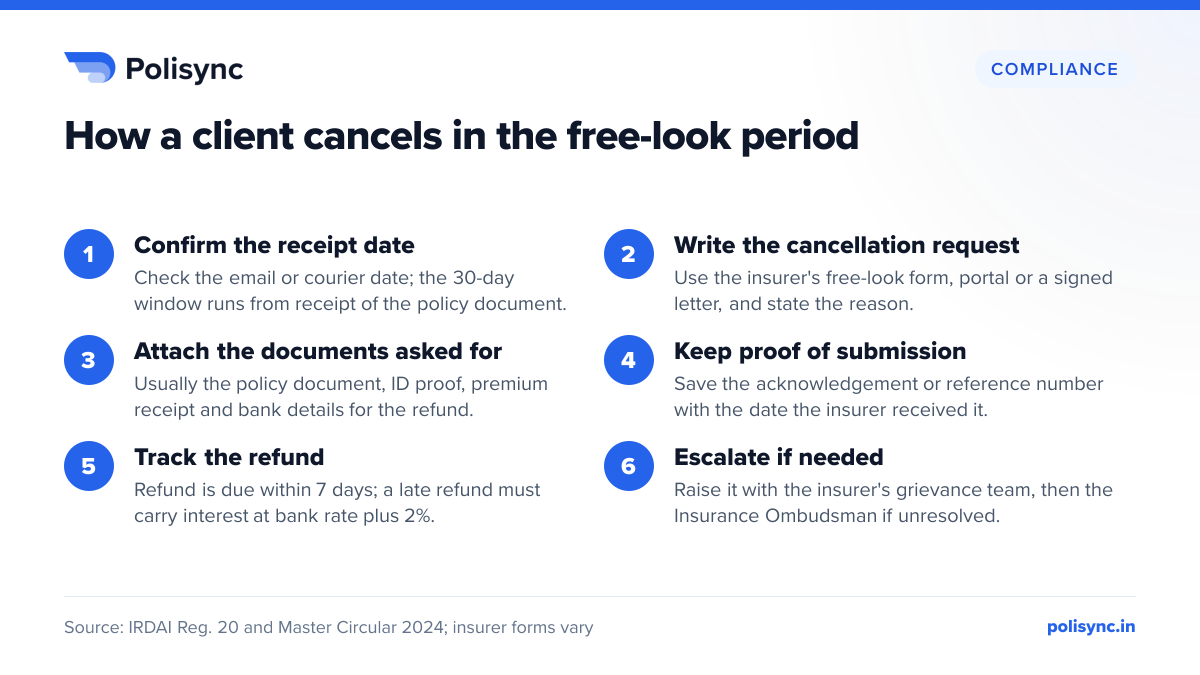
Insurers typically ask for the original policy document, identity proof, the first premium receipt and a reason for cancelling, though they cannot deny the request because of the reason given (Edelweiss Life). Some insurers also let policyholders raise the request online through their customer account.
What does a free-look cancellation mean for insurance agents?
A free-look cancellation is the clearest early signal that a sale went wrong somewhere: the wrong product, the wrong premium, misunderstood features or a client who felt pushed. It is a policy-level warning sign of the mis-selling the regulator watches closely.
That scrutiny is rising. The IRDAI Annual Report 2024-25 recorded 26,667 unfair business practice grievances against life insurers in FY25, up from 23,335 in FY24, even as total grievances against life insurers stayed almost flat at 1,20,429. Their share rose to 22.14% from 19.33%, and IRDAI advised insurers to carry out root cause analysis of mis-selling on a periodic basis.
Commission follows the premium. When a premium is refunded in free look, expect the commission paid on it to be reversed or recovered under your insurer's commission policy and your agency agreement, and confirm the exact treatment with the insurer in writing.
The better response is upstream. Our guides on how to avoid insurance mis-selling and building long-term client trust cover the needs analysis and disclosure habits that make free-look requests rare.
How should agents handle a free-look request ethically?
- Respond the same day and do not argue. The right is unconditional. Talking a client out of it or slowing down the paperwork is a fast route to a complaint.
- Ask why, once, and listen. If the reason is a genuine misunderstanding, for example reading assumed returns in the benefit illustration as guaranteed, explain it clearly and then let the client decide.
- Help them file correctly. Share the insurer's form, confirm the receipt date and make sure the request reaches the insurer well inside 30 days.
- Recommend a replacement only if the need is real. If the client still needs cover but the product was wrong, redo the needs analysis. For health cover, explain that a fresh policy brings fresh health insurance waiting periods.
- Set expectations on money. Tell the client which deductions apply and that the refund is due within 7 days of the insurer receiving the request.
What should agents do now? A 7-point free-look checklist
- 1. Explain the free-look right at the point of sale. Tell every client about the 30-day window and the permitted deductions before they sign; it builds credibility rather than inviting cancellations.
- 2. Log the policy delivery date for every policy. Whether you use a register, a spreadsheet or agency software such as Polisync, record the email or courier date the day it happens.
- 3. Walk the client through the document within the window. A short call or meeting after delivery to go through the Customer Information Sheet catches mismatches while they can still be fixed.
- 4. Keep the needs analysis on file. It is part of the policy kit and is your best evidence that the recommendation was suitable.
- 5. Handle requests fast and neutrally. Same-day help with the form, no pressure, reason recorded.
- 6. Check your commission terms. Find out, in writing, how your insurer treats commission on free-look cancellations.
- 7. Review every cancellation. Look for patterns by product, premium size or lead source, and fix the pitch, not the client. Our IRDAI compliance checklist for agents covers the wider record-keeping.
Common mistakes to avoid
- Counting from the premium date. The window runs from receipt of the policy document.
- Quoting a full refund. Proportionate risk premium, medical costs and stamp duty may be deducted, and ULIP refunds move with the NAV.
- Using old 15-day figures. Brochures or scripts written before April 2024 may still say 15 days; update them.
- Promising free look on motor or home cover. Regulation 20 covers life and new individual health policies of a year or more.
- Treating the refund timeline as flexible. Seven days is the rule, and delays cost the insurer interest.