

IRDAI's commission consultation paper, released on 23 September 2026, proposes to bring back hard caps on insurance commissions. For long-term life policies, first-year commission would be capped at 25% for individual agents and 20% for distribution entities. Individual health would be capped at 20% and 15% on a first sale, and new-vehicle third-party motor at 2.5% and nil. Comments are open until 25 October 2026.
This explainer is written as of 25 September 2026. Everything below is a proposal, not a final regulation, checked against IRDAI's press release and the paper itself.
What is IRDAI's commission consultation paper?
The paper is titled Recalibrating Economics of Insurance Distribution. According to IRDAI's press release of 23 September 2026, it sets out a framework of reforms covering distribution structure, expenses, commissions, market conduct, transparency and digital infrastructure. IRDAI says the reforms are anchored in the Sabka Bima Sabki Raksha (Amendment of Insurance Laws) Act, 2025.
It comes in two parts. Part 1 and Part 2 are published on IRDAI's website: Part 1 sets out the proposed reforms, and Part 2 contains the data analysis on distribution costs and commissions that IRDAI used to justify them.
The headline proposals that matter most to agents are:
- Statutory commission caps for each segment, line of business, channel and premium type, replacing today's insurer-set commission policies.
- Lower Expenses of Management (EoM) limits with a five-year glide path. EoM is the total of commissions and operating expenses an insurer may spend as a share of premium.
- All-inclusive commission: rewards, incentives, reimbursements, gifts and trips would all count towards the cap.
- A simpler distributor structure with three types: Insurance Distribution Entities (IDEs), Insurance Distribution Persons (IDPs) and Market Infrastructure Institutions (MIIs) such as Bima Sugam.
- Mis-selling safeguards, including commission claw-back and linking the seller's identity to every policy.
Why is IRDAI bringing back commission caps?
IRDAI's paper notes that commission caps were removed in 2023. Insurers were instead allowed to set commissions through a Board-approved policy, as long as total spending stayed within an overall EoM limit. The IRDAI (Expenses of Management, including Commission, of Insurers) Regulations, 2024 combined these rules, took effect on 1 April 2024, and require every insurer to have a written, Board-approved commission policy.
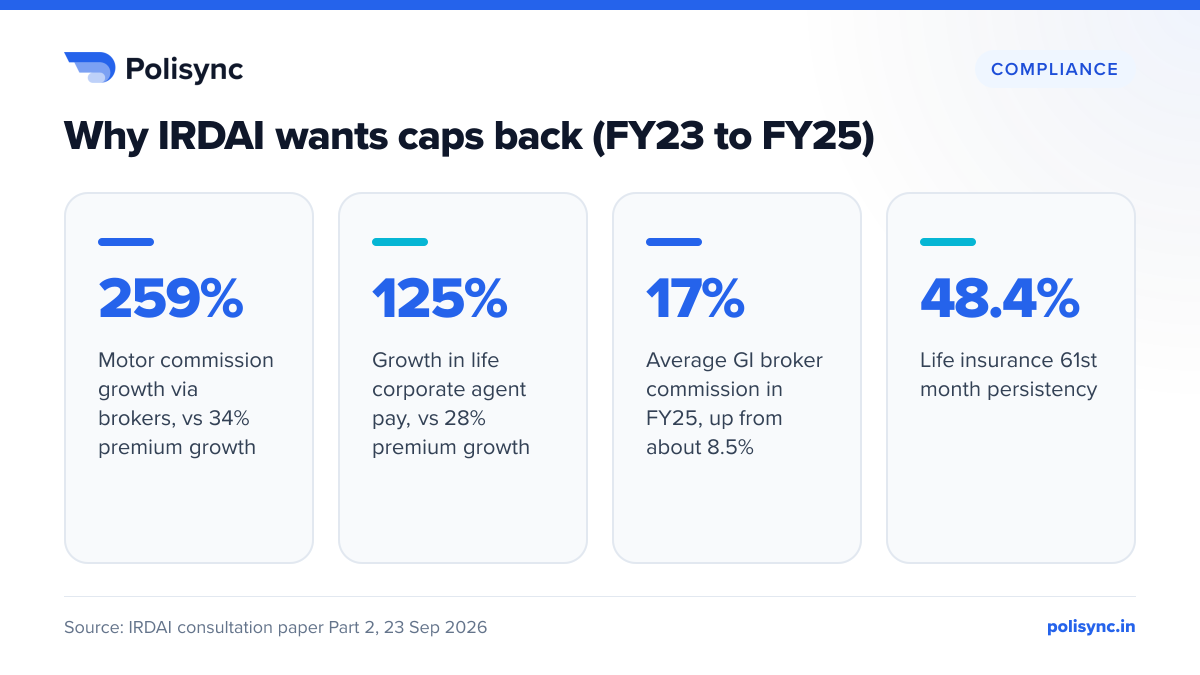
IRDAI's view in Part 1 is blunt: Board approval 'has often been a formality', and the inability to control costs under the flexible EoM regime 'makes a compelling case for hard caps'. The paper backs this with FY23 to FY25 data from Part 2:
- Motor: in IRDAI's broker-channel analysis, motor premium grew by about 34% while motor commission grew by about 259%, and the average rate rose from about 9% to about 25%.
- General insurance brokers overall: premium rose about 37% while commission including rewards rose about 173%. The average commission rate went from about 8.5% to 17%.
- Life corporate agents (banks, NBFCs and others): new business premium grew about 28% while total distributor pay, including rewards and incentives, grew about 125%. It now works out to about 27% of first-year premium.
- Persistency: 61st-month persistency in life insurance is only 48.4%, meaning more than half of policyholders stop paying before completing five years.
Notice where the growth was highest: bancassurance, NBFC loan-linked sales and dealer-led motor sales. The paper notes that the public sector life insurer, which relies mostly on individual agents, paid an average commission of only 5% in FY26. The cost growth IRDAI highlights points mainly at large entities rather than at the traditional agent.
What are the proposed commission caps for life insurance?
For individual regular-premium policies (non-linked par, non-par and ULIPs), Box 4B of Part 1 links the first-year cap to the premium payment term (PPT). A longer PPT allows a higher first-year cap. The paper also proposes that the policy term cannot be less than 10 years or the PPT, whichever is higher.
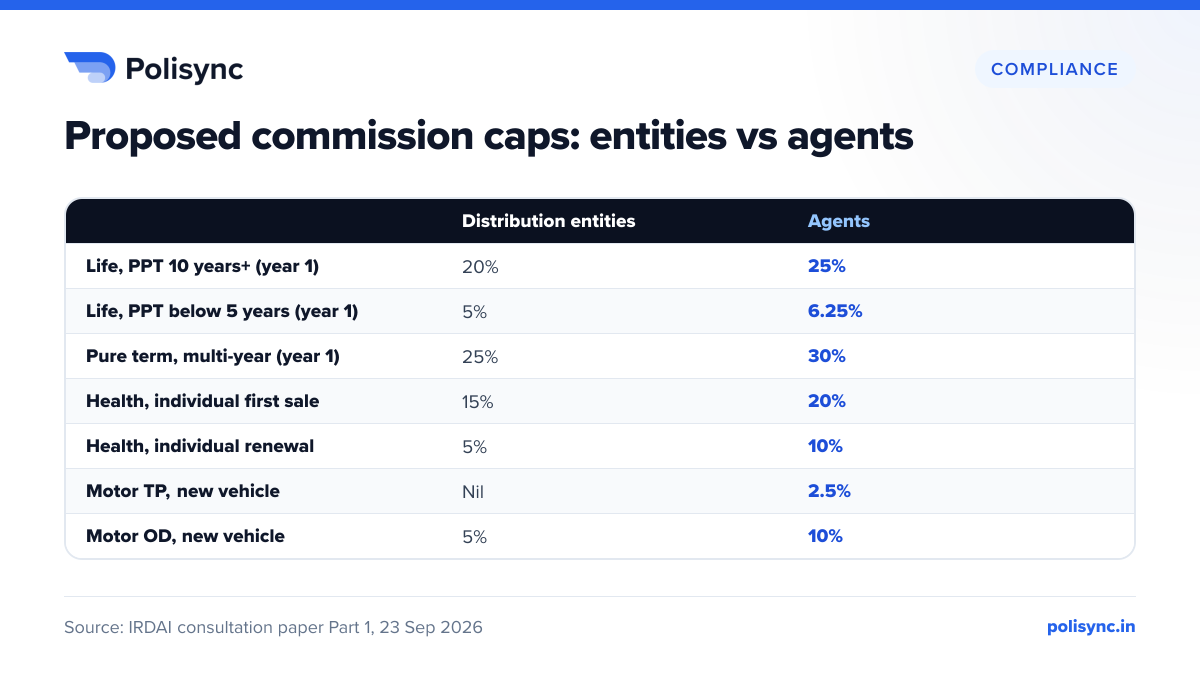
Proposed maximum first-year commission (distribution entities / individual agents):
- PPT below 5 years: 5% / 6.25% (only non-par non-linked products allowed)
- PPT of 5 years: 10% / 12.5%
- PPT of 6 to 8 years: 14% / 17.5%
- PPT of 9 years: 18% / 22.5%
- PPT of 10 years and above: 20% / 25%
Renewal commission rewards persistency
Renewal commission would be 2% to 3% for entities (depending on PPT) and 5% for agents. From the sixth policy year, it would rise by 0.5 percentage point once every three years (5.5% in years 6 to 8, then 6%), up to a maximum of 7%. Upstox reported the same renewal structure on 24 September. The stated aim is to reward persistency on multi-year payment plans, not just the first-year payment.
Single premium, term and pension products
- Individual savings, single premium: 1% (entities) / 2% (agents).
- Individual pure term, single premium: 7.5% / 10%.
- Individual pure term, multi-year premium: 25% / 30% in year one, and 7.5% / 10% on renewal. 5paisa's summary reports the same figures.
- Pension or deferred annuity, multi-year: 5% / 6.5% in year one. Single-premium annuity: 0.5% / 0.75%, and no commission on annuity purchase from NPS.
- Pure term cover packaged with a loan by the lender: capped at 2% (single premium) and 2.5% first year / 1% renewal (multi-year).
Illustrative example (hypothetical numbers): a client buys a regular-premium endowment plan with an annual premium of ₹50,000 and a 10-year PPT through you. Under the proposed caps, the most the insurer could pay you is ₹12,500 in year one (25%) and ₹2,500 a year on renewal (5%), rising to ₹2,750 (5.5%) from year six. You can run your own scenarios with our insurance commission calculator.
What are the proposed caps for health and motor insurance?
Box 4A of Part 1 covers general and health insurance. The idea is that mandatory or near-mandatory products need little selling effort, so they should carry nil or very low commission. Renewals of well-understood products should also pay far less than a first sale.
Health insurance
- Individual, first sale: 15% (entities) / 20% (agents and associates).
- Individual, renewal: 5% / 10%.
- Individual, porting: 5% / 10%. The paper says commission-led portability should be discouraged.
- Group health: 2.5% / 5%, subject to a maximum of ₹100 lakh.
Motor insurance
- New vehicle, third party: nil (entities) / 2.5% (agents).
- New vehicle, own damage, PA or legal liability: 5% / 10%.
- Old vehicle, third party: 2.5% / 5% (2.5% for garages).
- Old vehicle, own damage, PA or legal liability: 10% / 15% (10% for garages).
- Motor packaged with a loan: nil on third party and 5% on own damage for lending entities.
Motor dealers acting as Motor Insurance Service Providers (MISPs) would have to register as IDEs, or become PoSPs of an IDE or associates of one insurer. They would also have to show customers the option to buy on an MII platform such as Bima Sugam. If motor is a big part of your book, our motor insurance guide for agents is a useful refresher on where the value lies beyond third-party cover.
Rural and small-town top-up: for individual policies, business from towns and cities with population below 10 lakh could earn an extra 10% of the applicable first-year limit. Business from towns below 50,000 and all rural areas could earn an extra 20%. For example, a 25% first-year cap would become 27.5% or 30%.
How would the Expenses of Management glide path work?
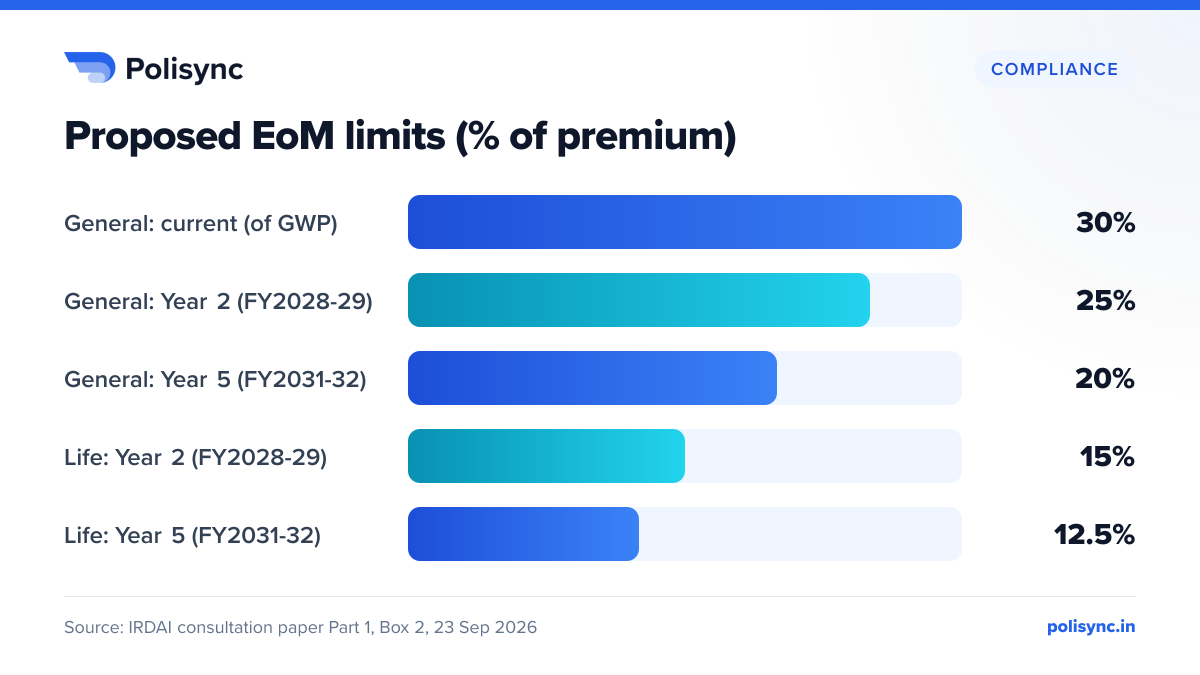
Commission caps sit inside a tighter overall expense limit. Per Box 2 of Part 1, life insurers would move to a company-level EoM limit of 15% of premium within two years and 12.5% within five years. Insurers already below this in FY25 would have to reach 10% in five years.
General insurers would switch from Gross Written Premium (GWP) to domestic Gross Direct Premium Income (GDPI). Their limit would fall from 30% of GWP to 25% within two years and 20% within five years. FY2027-28 is proposed as Year 1, with a cut required every year. Business Today's 25 September report carries the same EoM targets.
The paper also proposes cutting IRDAI's regulatory fee on insurers from 0.05% to 0.04% of premium, capped at ₹20 crore. It adds mandatory annual cost audits for all insurers and for IDEs with insurance commission income above ₹100 crore.
What else does the paper propose?
- No work-arounds: any payment to a distributor, by any name (incentive, award, reimbursement, brand payment to a related party, gift or visit), counts as commission. Outsourcing to a distributor's related parties is restricted.
- Seller identity on every policy: IDEs would tag each policy with the unique functional identity of the person who sold it. See our explainer on IRDAI salesperson tagging on every policy.
- Claw-back for mis-selling: mis-selling incidents would lead to commission claw-back by insurers, and incidents would be placed in the public domain.
- Commission disclosure: insurers and large distribution entities would publish their commission policies and structures. Commercial policies with cover above ₹50 crore would show the commission on the policy document.
- Price and product information without lead capture: product sheets, premium rates and quality data would be available without asking for a name, phone number or email. IRDAI calls the current practice a dark pattern.
- Timely commission: distributors would be paid no later than the day after the free-look period ends, with insurers encouraged to pay within 7 days of receiving premium.
- Qualification and training: class 12 as the minimum qualification for new distribution persons, and at least 100 hours of training per segment (life and general).
What this means for insurance agents, brokers, corporate agents and banks
Individual agents
The paper deliberately gives agents higher caps than entities. Under the proposal, agents work in a closed architecture, representing one life, one general and one health insurer, so the higher cap compensates for having fewer products to offer. Traditional agents who sell long-PPT life plans and service them well may see relatively small change. The squeeze falls on short-PPT plans, single premium savings products, health renewals and motor third party.
Because rewards, contests and trips would count within the cap, agents who rely heavily on insurer incentives may notice a bigger impact. Agents earning ₹20 lakh or more in commission a year would also give the Public Insurance Registry standing consent to fetch their GST details.
Brokers, corporate agents, banks and NBFCs
- All would become IDEs with lower caps than individual agents, because they can offer products from many insurers.
- PoSP commission would come out of the IDE's own commission, not on top of it. Our guide to POSP vs agent vs broker explains how these roles differ today.
- Bank and NBFC staff could no longer receive volume-linked or reward-linked incentives for selling insurance, and compulsory bundling of insurance with their loans would be prohibited, though genuine package offers stay allowed.
- Entry gets easier: IDE initial capital of ₹10 lakh and permanent registration with an annual fee. This builds on the perpetual registration change for intermediaries.
What is still undecided?
As of 25 September 2026, several big questions are open for comment:
- The final numbers. Every cap and EoM limit above is a draft. IRDAI asks directly whether the limits strike a fair balance between affordability and adequate pay for distributors (Question 19).
- Timing. FY2027-28 is proposed as Year 1 for the EoM glide path, and IRDAI asks whether the sector needs more time (Question 15). No final commencement date for commission caps has been notified.
- Fee instead of commission. IRDAI asks whether the sector is ready to move from commissions paid by insurers to a fee paid directly by policyholders (Question 18).
- Motor purchase at dealerships. IRDAI asks whether new-vehicle buyers should be offered the MII option by default, with an opt-out (Question 27).
- Later review. The paper says EoM norms will be reviewed along with product reforms likely to follow during FY28.
How can agents submit feedback before 25 October 2026?
Sections 17 and 18 of Part 1 invite views from the public, policyholders, insurers, distributors and agents. There are three ways to do it, and you should use only one per submission to avoid duplicates:
- Web form: answer the 32 consultation questions directly on the IRDAI consultation portal.
- Excel upload: download the prescribed Excel template from the portal, fill it in and upload it there.
- Email: send the filled Excel template to drfeedback@iib.gov.in with the subject line Reforms for Recalibrating Economics of Insurance Distribution.
Specific, data-backed feedback carries more weight than general objections: show your real servicing cost per policy, your persistency record, or the effort involved in selling in a small town.
What should insurance agents do now?
A practical checklist for the next four weeks:
- 1. Read the source, not the forwards. Download both parts of the paper from IRDAI's website and read Boxes 2, 4A and 4B yourself.
- 2. Map your income by product and year. Split last year's earnings into first-year, renewal, rewards and incentives for each line. A clean commission tracking system makes this easy. Agency software such as Polisync can help keep these records organised.
- 3. Model the proposed caps. Re-run your top 20 policies at the proposed caps to see how much of your income is at risk, and from which products.
- 4. Double down on persistency. Renewal commission and the step-up after year five reward clients who keep paying. Revisit your renewal and lapse-reduction routine.
- 5. Document suitability. Needs analysis, recorded advice and the new seller tagging are central to the paper. Brush up on how to avoid mis-selling.
- 6. Prepare clear answers for clients. Explain that nothing is final and that IRDAI's stated aim is lower distribution costs and better value for policyholders.
- 7. Submit feedback by 25 October 2026. Respond yourself on the portal, or through your insurer, agents' association or industry body.
The direction is clear even if the numbers may change. IRDAI wants to pay distributors for effort, advice and persistency, not for controlling the point of sale. Agents who build long-term, well-serviced client relationships are best placed for whatever version becomes final.