

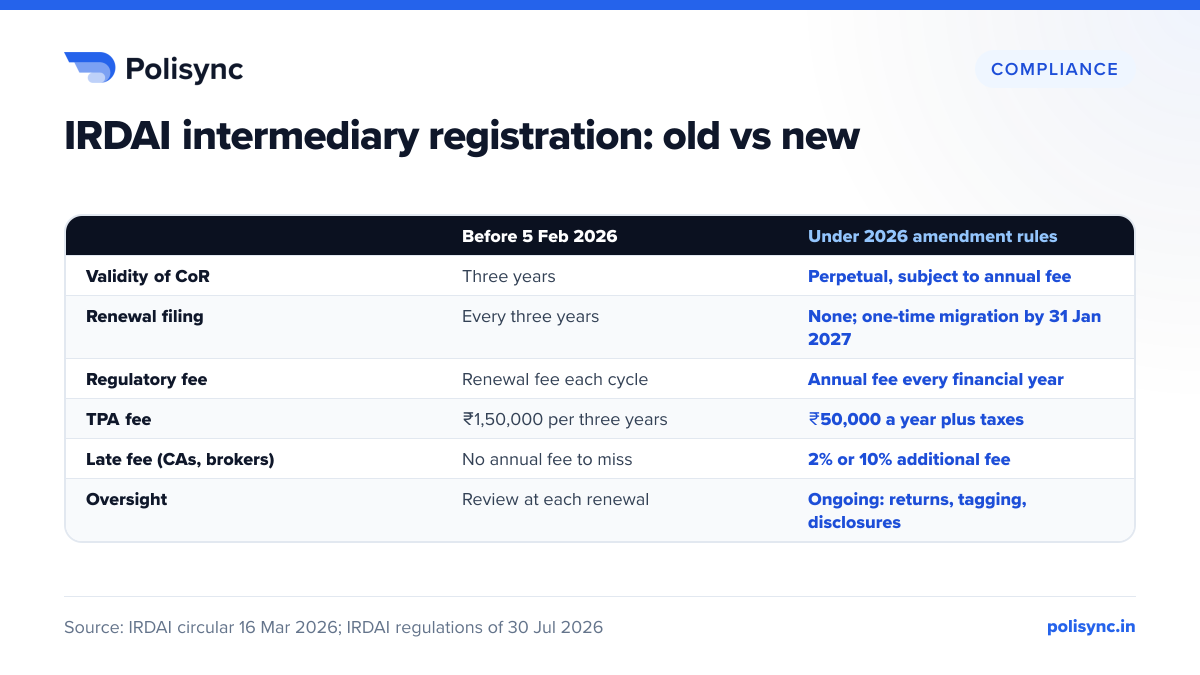
As of 21 September 2026, IRDAI-registered intermediaries such as brokers, corporate agents, IMFs, web aggregators, TPAs and surveyors no longer renew registration every three years. Their certificate stays in force while they pay an annual fee: for corporate agents and brokers, the higher of ₹10,000 or 0.04% of the previous year's commission and other receipts. Existing firms must switch over by 31 January 2027. Individual tied agents pay IRDAI nothing.
The legal switch happened on 5 February 2026, when the Sabka Bima Sabki Raksha (SBSR) Act came into force. IRDAI's 137th Authority meeting in Hyderabad on 28 July 2026 then approved the amended rules, as announced in its press release of 29 July 2026. The IRDAI (Insurance Intermediaries) (Amendment) Regulations, 2026 were published in the Gazette of India on 30 July 2026 and took effect from that date.
This guide explains who is covered, how the fee is worked out, what happens if you miss a payment, the deadlines for moving across, and what agents and intermediaries should do before 2027.
What is perpetual registration for insurance intermediaries?
Perpetual registration means an IRDAI certificate of registration (CoR) has no expiry date. It stays valid until IRDAI suspends or cancels it, or the intermediary surrenders it, as long as the annual fee is paid on time.
The legal basis is a new sub-section (4A) in Section 42D of the Insurance Act, 1938, inserted by the Sabka Bima Sabki Raksha (Amendment of Insurance Laws) Act, 2025 (Act No. 40 of 2025, assented on 20 December 2025). The same Act lists failure to pay the annual fee as a ground on which IRDAI can suspend or cancel a registration.
IRDAI's circular of 16 March 2026 confirmed that the old system of three-year CoR validity and renewal fees ended with effect from 5 February 2026, the date the SBSR Act came into force. Law firm Trilegal describes the shift as a move from periodic renewals to continuous supervision.
Which intermediaries are covered by the annual fee regime?
The March 2026 circular applies to these categories of registered intermediaries:
- Insurance brokers (direct, reinsurance and composite)
- Corporate agents, including banks and NBFCs that sell insurance
- Insurance marketing firms (IMFs)
- Web aggregators
- Common service centres (CSCs)
- Insurance surveyors and loss assessors
- Insurance repositories
- Third party administrators (TPAs)
- Any other entity registered as an insurance intermediary under IRDAI regulations
The 30 July notification amends five sets of regulations: corporate agents (2015), insurance brokers (2018), IMFs (2015), web aggregators (2017) and common public service centres (2019). TPAs and surveyors received separate amendment regulations, also dated 30 July 2026 and listed on IRDAI's gazette-notified regulations page on 31 July 2026.
Are individual insurance agents affected?
Not by the fee. Under the IRDAI (Appointment of Insurance Agents) Regulations, 2016, an insurance agent is an individual appointed by an insurer, not an intermediary holding its own IRDAI certificate under Section 42D. Cafemutual reported in March 2026 that individual agents are exempt from the fee.
The tied model also stays. The SBSR Act dropped the open architecture proposal, so agents continue to work with one life, one non-life and one standalone health insurer, as Cafemutual reported in December 2025. If you are new to the profession, our guide on how to become an insurance agent in India covers the appointment route.
What about POSPs and specified persons?
POSPs, specified persons of corporate agents and broker qualified persons are not on the list of fee-paying entities. What does affect them is salesperson tagging: from 1 January 2027, their name and functional identity must appear on the proposal form, policy and certificate of insurance for business sold through an intermediary. The notified tagging rule amends only intermediary regulations, so it does not cover tied agents appointed directly by an insurer. Our explainer on POSP vs agent vs broker sets out how each role differs.
How much is the IRDAI annual fee for intermediaries?
The interim fee during the transition
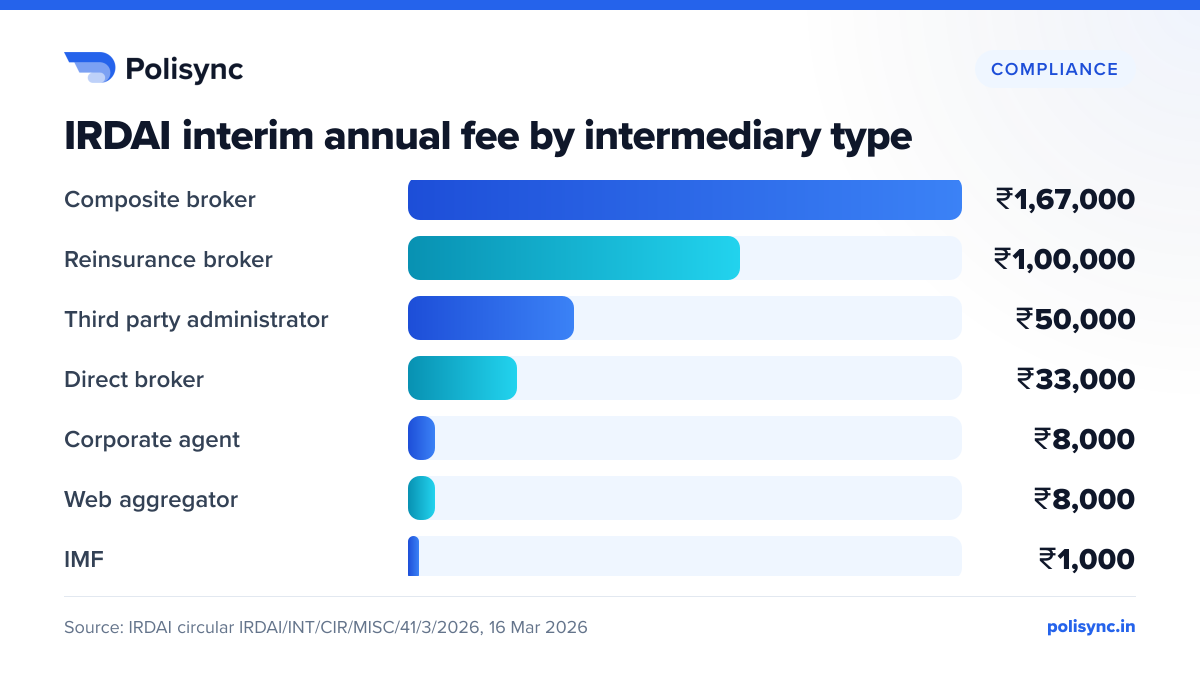
Until the new regulations were notified, IRDAI used an interim fee table. It applied to fresh registrations and renewals falling between 5 February and 30 June 2026, and a separate 7 April 2026 circular covered how it applied to surveyors. A circular of 2 July 2026 extended the window to 31 August 2026 or the notification date, whichever came first. Renewal fees already paid were adjusted against the interim fee, with any balance refunded.
The permanent formula for corporate agents, brokers, IMFs and web aggregators
Under the notified regulations, the annual fee is the higher of ₹10,000 or one-twenty-fifth of one per cent (0.04%) of commission and other receipts from insurers (for brokers, from insurers or clients) in the financial year before the year in which the fee is paid, rounded off to the next thousand, plus applicable taxes. The same structure applies to CSC special purpose vehicles (CSC SPVs).
Commission is taken from the audited financial statements. "Other receipts" covers branding, marketing, advertising, display and logo fees, and business support or shared service costs. For brokers it also includes fees for claims consultancy and risk management.
Illustrative examples (hypothetical income figures, fee before taxes):
- Commission and other receipts of ₹1 crore: 0.04% is ₹4,000, so the ₹10,000 minimum applies.
- Receipts of ₹2.5 crore: 0.04% is exactly ₹10,000, the point where the percentage starts to matter.
- Receipts of ₹3.1 crore: 0.04% is ₹12,400, rounded up to ₹13,000. With GST at 18%, as in IRDAI's interim fee table, the total is ₹15,340.
- Receipts of ₹5 crore: 0.04% gives ₹20,000.
- Receipts of ₹50 crore: 0.04% gives ₹2,00,000.
Timing matters. When IRDAI grants or migrates a certificate, the intermediary pays ₹10,000 plus taxes for the ongoing year within 15 days. After that, the fee for each financial year is paid before 31 January of the preceding financial year, so the FY 2027-28 fee falls due before 31 January 2027. On a plain reading, that payment is based on FY 2025-26 receipts, the last full year before the year of payment. A clean record of commission income, as covered in our insurance commission tracking guide, makes this calculation quick.
TPAs and surveyors
Under the TPA amendment regulations, TPAs pay a flat ₹50,000 plus taxes on or before 31 January each year for the next financial year. A TPA can still pay by 31 March with interest of 2% of the fee; after that, the certificate may be suspended or cancelled. According to IRDAI's response to public comments, this replaces a renewal fee of ₹1,50,000 for three years.
The surveyor amendment regulations set an annual fee of ₹1,000 for individual surveyors and ₹5,000 for corporate surveyors, plus taxes, paid between 1 and 31 January for the next financial year. A late payment is accepted until 31 March with an extra ₹750 plus taxes. After that, registration is suspended from 1 April, and a suspended surveyor cannot take new assignments or issue survey reports. Paying the fee plus ₹1,500 within three months revokes the suspension; otherwise registration is cancelled.
What happens if an intermediary does not pay the annual fee?
For corporate agents, brokers, IMFs, web aggregators and CSC SPVs, the notified regulations set out a graded sequence (late payments are accepted at IRDAI's discretion):
- Paid within 30 days of the due date: annual fee plus an additional 2% of the fee.
- Paid after 30 days but before the financial year ends: annual fee plus an additional 10%.
- Not paid by the end of that financial year: the CoR stands suspended from 1 April of the year the fee covers, under Section 42D(6)(v).
- Revoking the suspension: pay the annual fee plus an additional 20% within three months of suspension.
- Still unpaid after three months: the CoR stands cancelled.
One detail helps: for corporate agents, brokers, web aggregators and surveyors, a cancellation for non-payment does not trigger the usual one-year wait before a fresh application. The stakes of operating without a valid registration are high, though. New Section 105BA, inserted by the SBSR Act, sets a penalty of ₹1 lakh to ₹10 lakh for acting as an intermediary without registration, and ₹10 lakh to ₹1 crore for anyone who appoints or does business through an unregistered intermediary. Directors and officers knowingly involved face ₹1 lakh to ₹10 lakh each.
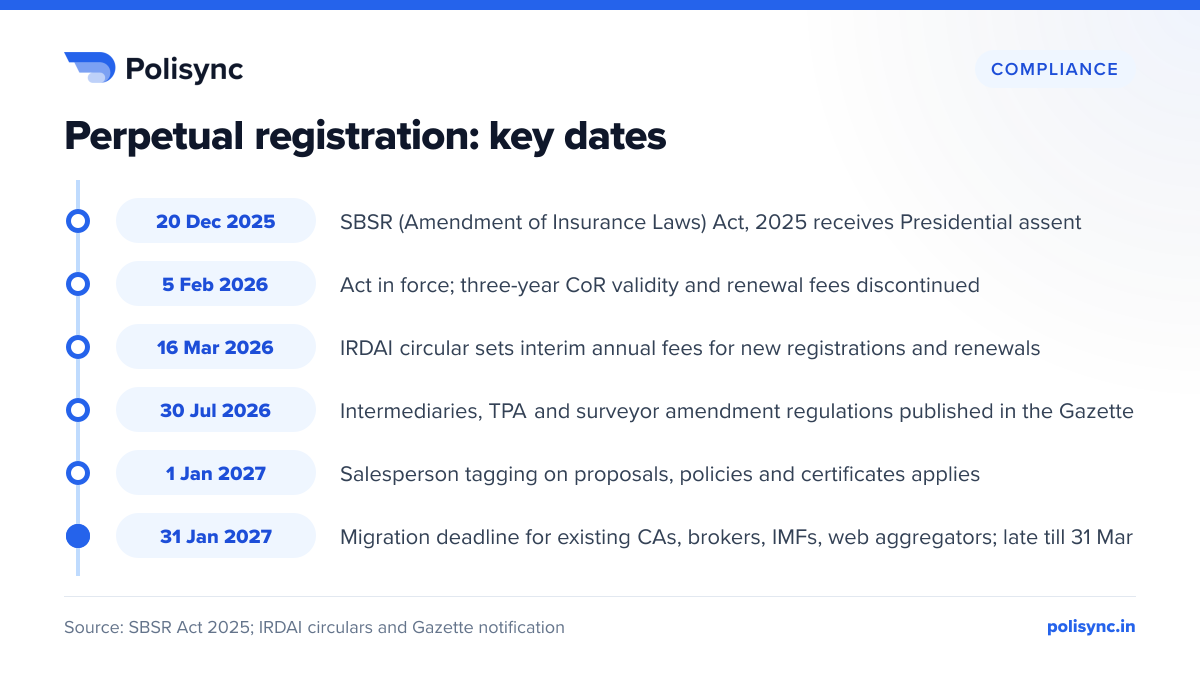
What are the key dates in the move to perpetual registration?
The change arrived in stages over 2026, with the main deadlines still ahead in early 2027.
How do existing intermediaries move to perpetual registration?
Existing corporate agents, brokers, IMFs, web aggregators and CSC SPVs holding three-year certificates must apply for a new CoR before 31 January 2027, paying the annual fee with the application. The new certificate takes effect from the date IRDAI grants it, and the old one is then treated as invalid.
- Late window: an application can still be filed by 31 March 2027, with reasons for the delay and an additional ₹750 fee. IRDAI may accept it if refusing would cause undue hardship, so the late route is discretionary.
- Missed both dates: the intermediary must stop acting as one after 31 March 2027 and apply afresh.
- Migrating between 31 January and 31 March 2027: pay the ₹10,000 fee and ₹750 (plus taxes) for the current year, plus the next financial year's fee upfront.
- TPAs: apply within 90 days before the existing CoR expires, or up to 90 days after expiry with a ₹750 additional fee.
- Surveyors: an existing licence stays valid until its expiry date. Apply online for conversion within 90 days before expiry, with a processing fee of ₹5,000 (individual) or ₹25,000 (corporate) plus taxes; IRDAI may accept a late application up to six months after expiry with ₹750 plus taxes.
What compliance duties remain after perpetual registration?
Removing the renewal does not reduce supervision. The same regulations add several ongoing duties, set out here for corporate agents, with parallel provisions for other intermediaries:
- Salesperson tagging from 1 January 2027: record the name and functional identity (based on a Central Government-issued unique identity) of whoever sold the policy, plus the branch's mobile number and email, on the proposal, policy and certificate. Direct digital sales show the Principal Officer's contact details instead.
- Remote-access records: keep records of every policy solicited in a form IRDAI can access remotely.
- Training: the Principal Officer and specified persons must complete at least 25 hours of training every three years.
- Letters of Enrolment: specified persons need a valid Letter of Enrolment from IRDAI. A specified person moving to another corporate agent needs a no-objection certificate, deemed granted if the current one does not respond within 30 days.
- Returns and penalties: inaccurate or incomplete regulatory returns attract penalties under Section 102 of the Insurance Act.
- Professional indemnity cover: required for corporate agents earning more than half their revenue from insurance intermediation.
- Disclosures: corporate agents with majority foreign shareholding or annual commission above ₹10 crore must publish commission, related party transactions, profits and dividends.
These sit alongside existing obligations such as KYC and grievance handling, plus the data protection duties of the Digital Personal Data Protection (DPDP) Act, which come into force in May 2027 under G.S.R. 843(E) and are good practice to follow now. Our IRDAI compliance checklist for insurance agents and DPDP Act guide cover the wider picture.
What this means for insurance agents and intermediaries
For individual tied agents, nothing changes in your appointment and there is nothing to pay IRDAI. The bigger shift is in the intermediary channel. If you also sell as a POSP or through a bank, broker or IMF, from 1 January 2027 the client will see your name and functional identity on the policy, and a complaint can trace back to you, as explained in our guide to the insurance ombudsman and Bima Bharosa.
For corporate agents, brokers and IMFs, the fee now scales with income, and the deadline is annual rather than every three years. Anyone building a team of POSPs or specified persons, as described in our guide on building a sub-agent team, needs clean records of enrolment, identity and who sold which policy before 1 January 2027.
When clients ask, keep it simple: the change affects how firms are licensed, not the validity of their policies. Whatever you use, from a spreadsheet to agency software such as Polisync, keep one reliable record of the seller behind every policy.
What should agents and intermediaries do now?
A practical checklist, in order:
- 1. Confirm your category. Check whether you hold an IRDAI certificate of registration (intermediary) or an insurer's appointment (individual agent). Only the first pays the annual fee.
- 2. Mark 31 January 2027. Existing corporate agents, brokers, IMFs, web aggregators and CSC SPVs should file the migration application well before this date. Do not plan around the discretionary 31 March window.
- 3. Work out your fee. Take audited commission and other receipts from insurers for the relevant year, apply 0.04%, round up to the next thousand, compare with ₹10,000 and add taxes. TPAs and surveyors pay flat fees instead.
- 4. Reconcile interim payments. If you renewed or registered after 5 February 2026, check that your earlier renewal fee was adjusted and any refund received.
- 5. Build a salesperson register. For every specified person, POSP or broker qualified person, record name, functional identity, enrolment status and NOC history before tagging starts on 1 January 2027.
- 6. Update documents and digital journeys. Proposal forms, policy documents and certificates need space for the seller's identity and branch contact details.
- 7. Diary the recurring items. Training hours, professional indemnity cover, audited accounts and disclosures now run on their own cycles, with no renewal to prompt them.
- 8. Individual agents: brief your clients. Explain that the change concerns intermediary licensing, not their policies, and keep your appointment letter and ID ready for any verification.

