

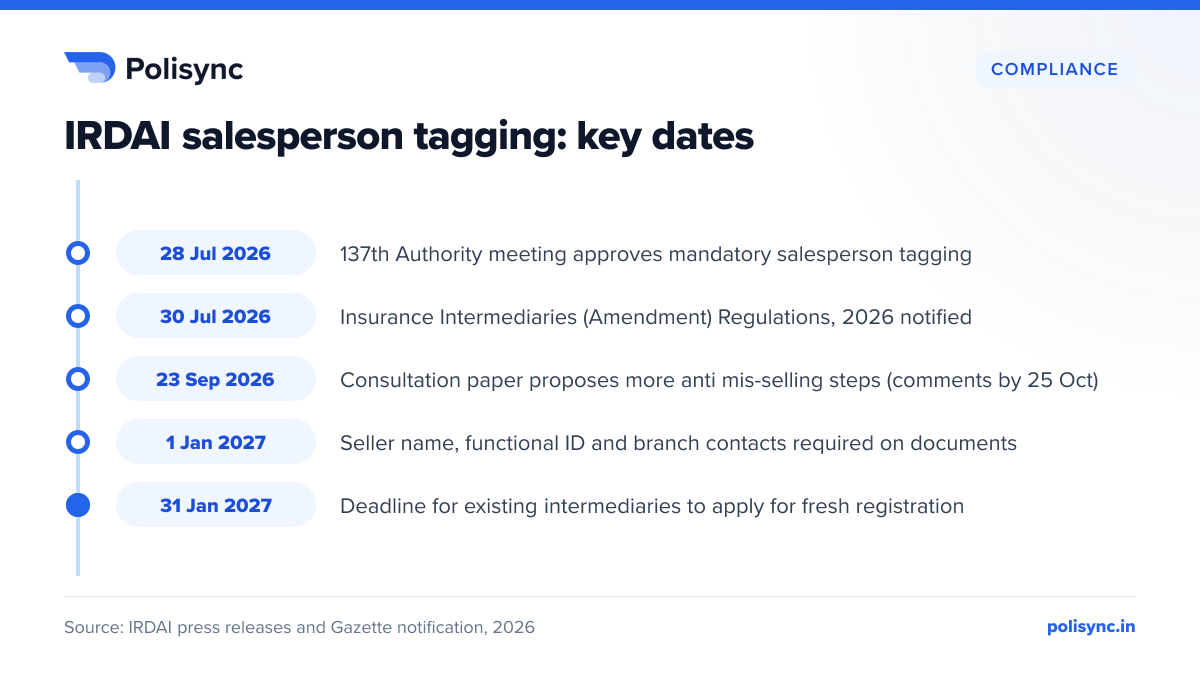
From 1 January 2027, every proposal form, insurance policy and certificate of insurance sourced through a corporate agent, broker, insurance marketing firm, web aggregator or common service centre must carry the name and functional identity of the salesperson who sold it, plus the mobile number and email of the sourcing branch. IRDAI notified this on 30 July 2026.
The rule was approved at IRDAI's 137th Authority meeting on 28 July 2026 and is part of a wider overhaul of intermediary regulations under the Sabka Bima Sabki Raksha (Amendment of Insurance Laws) Act, 2025. This guide explains, as of 23 September 2026, exactly what will be printed on your clients' documents, who is covered, why the date confusion exists, and what you should do in the three months left.
What exactly has IRDAI made mandatory?
In its press release of 29 July 2026, IRDAI described the key reform as the mandatory tagging of the authorised sales person to every insurance proposal, policy and certificate of insurance. Salesperson tagging simply means that the person who actually sold the policy is named on the policy paperwork and linked to it in the intermediary's records.
The notified text in the IRDAI (Insurance Intermediaries) (Amendment) Regulations, 2026 sets out three separate obligations for each type of intermediary:
- On the documents: the proposal form, the policy and the certificate of insurance must record the name and functional identity of the person who sold the policy, along with the mobile number and email address of the branch or office through which it was solicited.
- In the records: the intermediary must keep records of all policies solicited through it, including the seller's name and functional identity, in a manner that lets IRDAI access them remotely.
- On the ID itself: the functional identity is assigned by the intermediary, based on a unique identity issued by the Central Government. The regulation does not say which government ID is to be used.
A functional identity is the internal identification number the intermediary gives each of its salespersons, so that a policy can be traced to one specific individual rather than just to a bank, broker or branch.
When does salesperson tagging start: June 2026 or 1 January 2027?
The correct date is 1 January 2027. In the English text, the tagging clauses for corporate agents, brokers, IMFs and web aggregators each end with the same proviso: the requirements relating to tagging apply with effect from 1st January, 2027. The CSC chapter carries that proviso in the Hindi text of the Gazette but not in the English text, so CSC operators should confirm their start date with IRDAI. The rest of the amendment came into force on publication in the Gazette of India (Extraordinary) of Thursday, 30 July 2026. Outlook Money and law firm Trilegal both report the 1 January 2027 start date.
At least one news report of 23 June 2026 spoke of a June 2026 deadline for digital tagging. That report predates the 137th Authority meeting and the final regulation. Where a news report and the Gazette text disagree, the Gazette text is what insurers, intermediaries and IRDAI inspectors will apply, so plan your work around 1 January 2027.
Who is covered by the salesperson tagging rule?
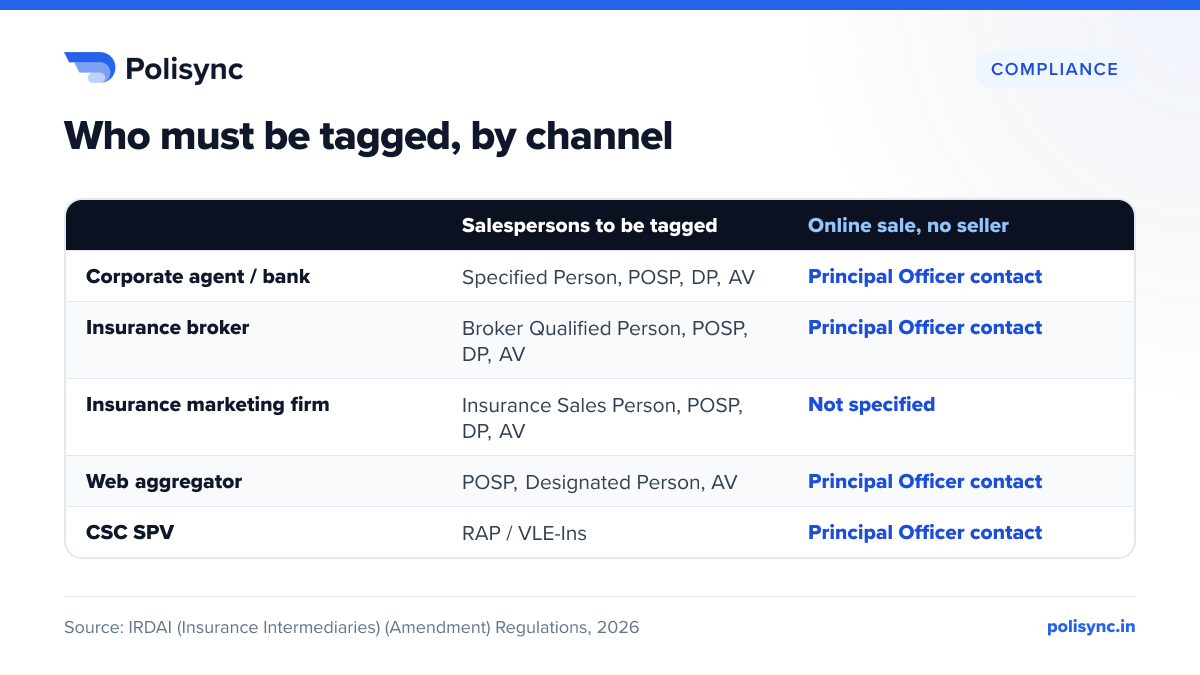
The amendment changes five sets of regulations, so the rule reaches every major intermediary channel. Each chapter names the specific people who must be tagged in that channel:
- Corporate agents, including banks and NBFCs: Specified Persons, Point of Sales Persons (POSPs), Designated Persons, Authorised Verifiers or any other authorised salesperson.
- Insurance brokers: Broker Qualified Persons, POSPs, Designated Persons, Authorised Verifiers or any other authorised salesperson.
- Insurance marketing firms (IMFs): Insurance Sales Persons, POSPs, Designated Persons, Authorised Verifiers or any other authorised salesperson.
- Web aggregators: POSPs, Designated Persons, Authorised Verifiers or any other authorised salesperson.
- Common public service centres (CSC SPV): the RAP/VLE-Ins who solicited or sold the policy.
The terms Point of Sales Person, Designated Person and other authorised salesperson carry the meaning IRDAI has given them in its existing instructions. If you are unsure how these roles differ from a tied agent, our explainer on POSP vs agent vs broker walks through each one.
What about individual tied agents?
The notified amendment changes only the corporate agent, broker, IMF, web aggregator and CSC regulations. It does not amend the IRDAI (Appointment of Insurance Agents) Regulations, 2016 that govern individual agents appointed directly by an insurer, so the new functional identity, branch contact and remote-access record requirements do not apply to tied agents as notified. Some early coverage, such as Cafemutual, read the press release as covering agents and insurers' own sales executives too, but the Gazette text is narrower.
That does not make tied agents anonymous. IRDAI's Master Circular on Protection of Policyholders' Interests, 2024 already requires every life insurance policy to state the name, code number and contact details of the person involved in the sales process, and general and health policies to state that person's contact details. Life insurance benefit illustrations must also be signed by the authorised sales person. On top of this, IRDAI's 23 September 2026 consultation paper on distribution reforms proposes linking the identity of the individual with the policy sold. That paper is only a proposal, open for comments until 25 October 2026.
Why is IRDAI tagging salespersons to every policy?
IRDAI's stated reason is that tagging enhances accountability and traceability across the distribution process, strengthens regulatory oversight and promotes transparency for policyholders. Cafemutual reported the change in those terms two days after the press release. Outlook Money adds that the aim is to make responsibility easier to trace when customers complain of mis-selling, incorrect promises or inadequate disclosure.
In practice, a bank branch or a large broker may have dozens of people selling the same products. Today a complaint often stops at the entity level. From January 2027 the policy itself will show which individual sold it and which branch they worked from, so an insurer, the intermediary or IRDAI can go straight to the right person.
This builds on rules that already exist. IRDAI's 2024 master circular requires insurers and distribution channels to run an anti mis-selling mechanism that includes punitive action, including blacklisting the sales person who indulges in unhealthy solicitation practices. Tagging gives that mechanism a reliable name to act on.
How does tagging link to mis-selling complaints and grievance handling?
Under the same 2024 master circular, a policyholder can complain to the insurer or register the complaint online on IRDAI's Bima Bharosa portal, and insurers should resolve complaints within 14 days. Life policies with a term of one year or more, and health policies, also carry a 30-day free look period, as summarised by Shardul Amarchand Mangaldas. Once tagging is live, each of these routes starts with the seller's name printed on the document.
Here is a hypothetical example of how that plays out. A client buys a savings plan at a bank branch in Pune in February 2027 believing it is a fixed deposit. When she complains, the policy already shows the Specified Person's name, functional ID and the branch email, so the insurer can pull that person's sales record and the bank's related records without guesswork.
The consultation paper of 23 September 2026 goes further. It proposes placing information on mis-selling incidents in the public domain, providing for commission claw-back in cases of mis-selling, documenting customer needs and suitability, and prohibiting volume-linked incentives for bank and NBFC staff selling insurance. None of this is final. For practical ways to stay on the right side of these rules, see our guide on how to avoid insurance mis-selling and our walkthrough of Bima Bharosa and Insurance Ombudsman complaints.
What happens when a policy is bought online with no salesperson?
The regulation handles this separately. Where a policy is bought directly through the digital platform of a corporate agent, broker, web aggregator or CSC SPV, without any salesperson involved, the proposal form, policy document and certificate of insurance must instead show the telephone number and email address of that intermediary's Principal Officer.
So no policy sold through these channels is left without a named, reachable person. For assisted digital sales, where a POSP shares a link and the client pays online, the safer reading is that a salesperson was involved and should be tagged. Confirm the exact process with your intermediary before January.
What else changed for intermediaries in the same notification?
Salesperson tagging arrived alongside several other changes that affect the people who will be tagged. As summarised by Trilegal and confirmed in the regulation text:
- Perpetual registration: the three-year renewal cycle is replaced by registration that continues while an annual fee is paid. Existing intermediaries must apply for a fresh certificate before 31 January 2027, or by 31 March 2027 with reasons and an additional fee of ₹750. Our post on IRDAI perpetual registration for intermediaries covers this in detail.
- Annual fee: the higher of ₹10,000 or 0.04% of commission and other receipts.
- One Specified Person per branch: a corporate agent cannot solicit from a branch unless a Specified Person is assigned exclusively to it, with enough Specified Persons for the branch's volume.
- Training: the Principal Officer and Specified Persons of a corporate agent must complete at least 25 hours of training from an approved institution every three years.
What this means for insurance agents and POSPs
If you sell through a bank, broker, IMF or aggregator, your name will be on every document you source from 1 January 2027. That is good news for honest advisors: your work becomes visible, and a client can find you again at renewal time. It also means any shortcut you take is traceable to you personally.
Expect these practical effects:
- Your intermediary is likely to ask for your details so it can assign a functional identity based on a unique identity issued by the Central Government. Keep your KYC documents current.
- Sales records will be audited more closely, because IRDAI can access them remotely.
- Clients will contact the branch you sold from. The branch mobile number and email printed on the policy must be monitored and answered.
- Complaints will name you. A clear needs record and disclosure trail becomes your best defence.
What should agents do before 1 January 2027?
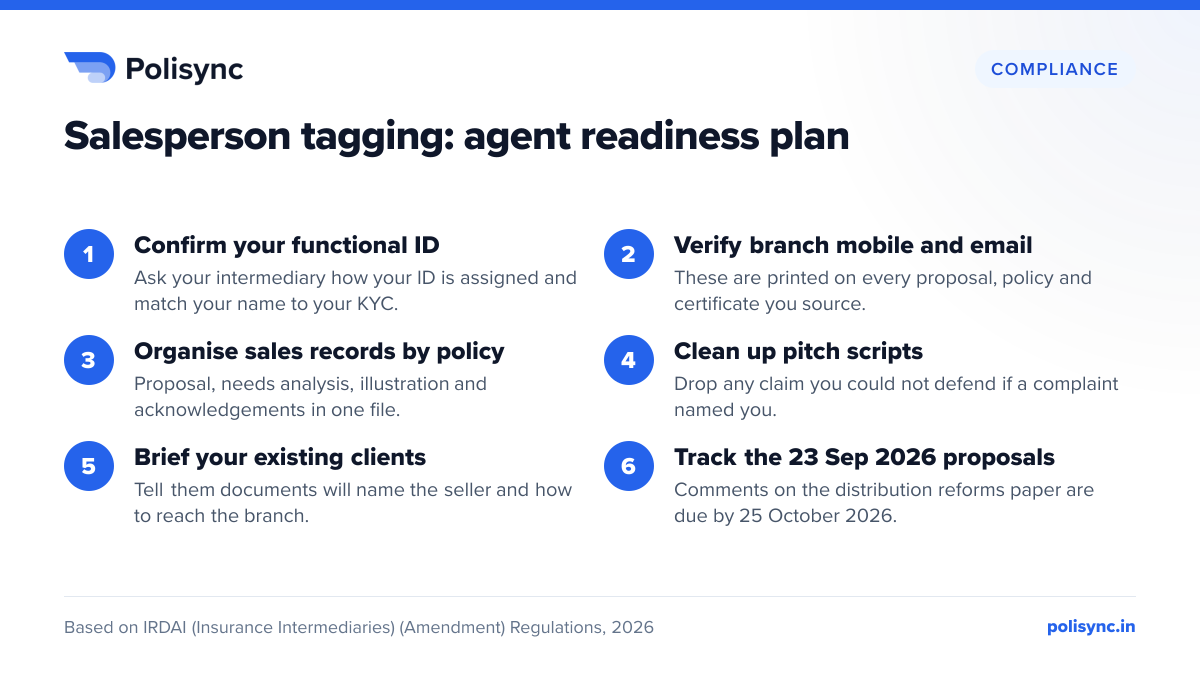
Use this checklist over October to December 2026:
- Confirm your functional ID. Ask your corporate agent, broker, IMF or aggregator what ID it will assign you and check that your name is spelt exactly as on your KYC documents.
- Check the branch contact details. Make sure the branch or office mobile number and email that will be printed on policies are correct and actually monitored.
- Tidy your sales records. For every policy you source, keep the proposal, needs analysis, benefit illustration and client acknowledgements together, filed by policy number.
- Review your pitch scripts. Remove anything that overstates returns or blurs the line between insurance and deposits.
- Tell existing clients. Explain that from January their documents will show who sold the policy and how to reach the branch.
- Watch the consultation. Read the 23 September 2026 distribution reforms proposals and send comments by 25 October 2026 if they affect you.
Agency software can help keep proposals, client notes and renewal dates organised in one place so you can answer any query on a tagged policy quickly; Polisync is one such tool. Whatever you use, pair it with our IRDAI compliance checklist for insurance agents.
How should agents explain salesperson tagging to clients?
Keep it short and positive. Clients rarely read regulations, but they understand accountability. You might say: "From January 2027, every policy will carry the name of the person who sold it and the branch contact. If you ever have a question, you will know exactly who to call, and that person is responsible for what was promised."
Used this way, tagging becomes a trust signal rather than a compliance burden. For more ideas on turning transparency into loyalty, read our guide on building client trust as an insurance agent.