

When an Indian insurer rejects a claim or ignores a complaint, the policyholder must first complain to the insurer, which has 14 days to resolve it under IRDAI's 2024 Master Circular on Protection of Policyholders' Interests. The client can also use IRDAI's Bima Bharosa portal, then approach the Insurance Ombudsman, a free forum that can award up to ₹50 lakh. These rules apply as of 19 September 2026.
Clients rarely know where to complain, which deadline applies or what papers to keep, and a claim rejection is when they decide whether to trust you again. This guide covers each step, the time limits in the rules, IRDAI's latest complaint numbers, a pending draft amendment, and how to help without filing on the client's behalf.
What is the insurance complaint escalation ladder in India?
A grievance, or complaint, is a policyholder's formal objection to something an insurer, agent or intermediary did or failed to do, from a delayed claim to a policy that does not match the proposal form. The insurer always gets the first chance to fix it.
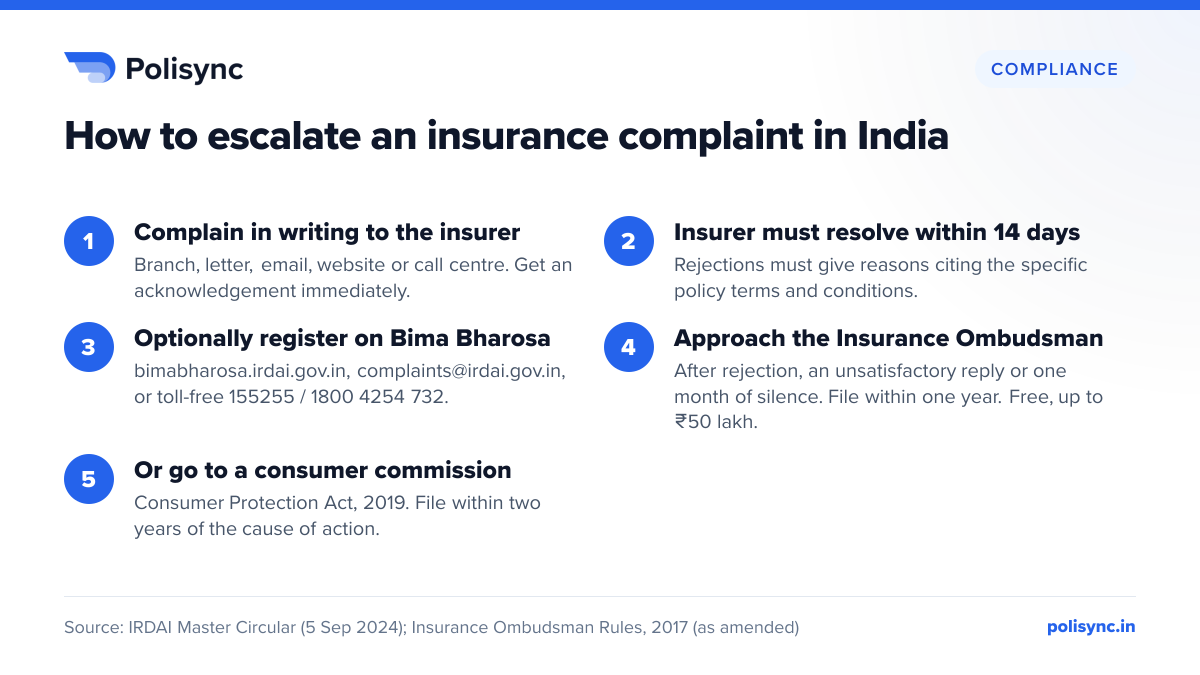
The usual ladder has four rungs:
- Insurer's grievance redressal cell: lodge the complaint at a branch, by letter or email, on the insurer's website or through its call centre. The insurer must acknowledge it immediately and resolve it within 14 days.
- Bima Bharosa (IRDAI): the policyholder can register or track the same complaint on IRDAI's portal, by email or on the toll-free line, and IRDAI takes it up with the insurer. This step is optional: it is not a precondition for going to the Ombudsman.
- Insurance Ombudsman: an independent forum under the Insurance Ombudsman Rules, 2017 that can mediate or pass an award binding on the insurer, free of charge, for amounts up to ₹50 lakh.
- Consumer commission or court: an alternative route under the Consumer Protection Act, 2019, usually slower and more formal, but with no ₹50 lakh ceiling.
Step 1: How does the insurer's grievance redressal process work?
Every insurer has a grievance redressal officer, and IRDAI publishes their email IDs. The IRDAI Master Circular dated 5 September 2024 (IRDAI/PP&GR/CIR/MISC/117/9/2024) says the complainant must get an acknowledgement immediately and the insurer should provide a resolution within 14 days, along with the reasons for not accepting the complaint with specific reference to the relevant policy terms and conditions.
That last part matters. A one-line "claim not payable" reply does not meet the standard. If the client receives one, the reply itself becomes useful evidence later at the Ombudsman.
The same circular requires insurers to mirror their grievance portals with Bima Bharosa in real time, so a complaint lodged with the insurer can be tracked on IRDAI's system too. The resolution letter and the policy document must name the Ombudsman with jurisdiction.
Step 2: What is Bima Bharosa and how do clients use it?
Bima Bharosa is IRDAI's Integrated Grievance Management System (IGMS), which IRDAI's About Us page says it established in 2010. It lets policyholders file and track grievances online and lets IRDAI monitor how insurers dispose of them. The portal tells users that a complaint will be attended to within 14 days.
According to IRDAI's grievance redressal page, a policyholder can reach IRDAI's grievance cell in four ways:
- Register and track the complaint on bimabharosa.irdai.gov.in.
- Email complaints@irdai.gov.in.
- Call the toll-free numbers 155255 or 1800 4254 732.
- Write to the General Manager, Policyholders' Protection and Grievance Redressal Department, IRDAI, Gachibowli, Hyderabad.
Two points agents often get wrong. First, IRDAI expects the policyholder to go to the insurer's grievance cell first. Second, IRDAI's page says only the insured or claimants may complain, and its grievance cell "shall not entertain complaints written on behalf of policyholders by advocates or agents" or other third parties. Help the client prepare, but the complaint must come from the client.
Bima Bharosa is not an adjudicating body. IRDAI takes the matter up with the insurer but does not pass an award on a claim dispute. For a binding decision, the client needs the Ombudsman or a consumer commission.
How many complaints does IRDAI receive?
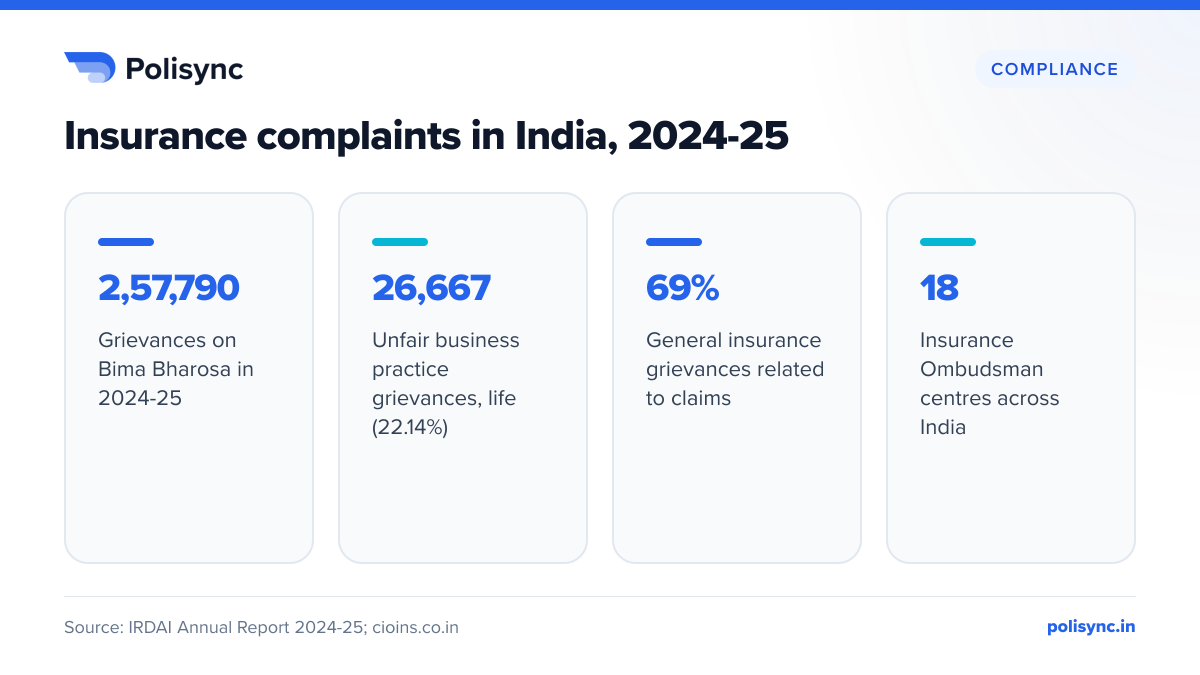
IRDAI's Annual Report 2024-25 gives the latest detailed breakdown. In 2024-25, Bima Bharosa recorded 2,57,790 grievances: 1,20,429 against life insurers and 1,37,361 against general and health insurers. The total was 2,15,569 in 2023-24.
A few numbers stand out for agents:
- Mis-selling complaints are rising. Unfair Business Practices (UFBP) grievances against life insurers rose from 23,335 in 2023-24 to 26,667 in 2024-25, or 22.14% of all life grievances.
- Most resolved UFBP grievances went against the policyholder: of 26,495 resolved in 2024-25, 9,613 were decided in the policyholder's favour, 1,797 partly and 15,085 against.
- Life grievances cluster in three areas: close to 64% related to survival claims, policy servicing and unfair business practices.
- General and health grievances are mostly about claims: about 69% were claims-related, or 88,841 claims grievances against 11.26 crore claims. Life had 33,280 claims grievances against 26.68 lakh claims.
Newer, less detailed figures show complaints still rising. IRDAI data cited in a Lok Sabha reply, reported by Cafemutual on 10 August 2026, put complaints received on Bima Bharosa in 2025-26 at 2,97,468: 1,19,027 life, 60,462 non-life and 1,17,979 health. Of these, 2,87,496 were disposed of and 9,972 were pending.
Claims and mis-selling drive most complaints, and a careful agent can prevent both. Our guide on how to avoid insurance mis-selling covers the sales side; this post covers what to do once a dispute exists.
Step 3: What is the Insurance Ombudsman and when can a client approach it?
The Insurance Ombudsman is an independent forum set up under the Insurance Ombudsman Rules, 2017, administered by the Council for Insurance Ombudsmen (CIO). The Rules cover complaints on all personal lines of insurance, group insurance policies, and policies issued to sole proprietorships and micro enterprises. Since the March 2021 amendment, complaints can also be made against insurance brokers.
What can a client complain about?
Rule 13 lists the grounds, including:
- Delay in settling claims beyond the time allowed by IRDAI regulations.
- Partial or total repudiation (rejection) of a claim by a life, general or health insurer.
- Disputes over premium paid or payable.
- Misrepresentation of policy terms and conditions.
- Policy servicing grievances against insurers and their agents and intermediaries.
- A policy issued that does not match the proposal form, or no policy issued after premium was received.
When is a complaint admissible?
Under Rule 14(3), the client must first have complained in writing, by email or online to the insurer, and then one of these must be true:
- The insurer rejected the complaint.
- The client received no reply within one month of the insurer receiving the complaint.
- The client is not satisfied with the insurer's reply.
The complaint must then be filed within one year of the rejection, the unsatisfactory reply, or the end of that one-month period, though the Ombudsman can condone delay after hearing the insurer's objections. It is not maintainable if the same subject is pending before, or already decided by, a court, consumer forum or arbitrator.
How much can the Ombudsman award, and does it cost anything?
The original Rules capped compensation at ₹30 lakh. The Insurance Ombudsman (Amendment) Rules, 2023, notified by the Department of Financial Services on 9 November 2023, raised it to ₹50 lakh, including relevant expenses, and the award cannot exceed the loss actually suffered. The CIO website says the Ombudsman charges no fee, and the IRDAI Master Circular confirms a policyholder can approach it without any charge or fee.
How do you file a complaint with the Insurance Ombudsman?
There are 18 Ombudsman centres: Ahmedabad, Bengaluru, Bhopal, Bhubaneswar, Chandigarh, Chennai, Delhi, Guwahati, Hyderabad, Jaipur, Kochi, Kolkata, Lucknow, Mumbai, Noida, Patna, Pune and Thane. The client can file with the office covering either the insurer's branch or office complained against, or the client's own place of residence.
Filing options and process:
- Online at the CIO's complaint portal, which also lets the client track status; in person; or in writing by post or email.
- Who files: the aggrieved person, or their legal heirs, nominee or assignee. This is relevant after a death claim rejection.
- What to include: name and address, the insurer branch complained against, the facts, supporting documents, the loss suffered and the relief sought.
- Hearing: the Ombudsman must give both sides a reasonable opportunity to be heard, and the Rules allow hearings by video-conference.
- Mediation: with both parties' written consent, the Ombudsman recommends a settlement within one month. If the client accepts it in writing within 15 days, the insurer must comply within 15 days.
- Award: if mediation does not settle it, the Ombudsman passes a reasoned written award within three months of receiving all requirements from the complainant.
What happens if the insurer does not pay the award?
Under Rule 17, the award binds the insurer, which must comply within 30 days and report compliance to the Ombudsman, and the client is entitled to interest from the date the claim ought to have been settled. Under the 2024 Master Circular, an insurer that does not honour the award within 30 days owes the complainant a penalty of ₹5,000 per day of delay on top of penal interest, unless it chose to appeal within those 30 days and informed the policyholder.
What changes are proposed to the Insurance Ombudsman Rules?
On 25 November 2025 the Department of Financial Services published the draft Insurance Ombudsman (Amendment) Rules, 2025 (G.S.R. 864(E)) and invited objections within 45 days of the draft being made public. These are proposals only. As of 19 September 2026 they had not been notified as final, a status also noted by Cyril Amarchand Mangaldas in June 2026, so the current Rules, including the ₹50 lakh cap, still apply.
The main proposed changes:
- Appeals: an Appellate Authority set up by IRDAI, which either party could approach within 30 days of an award, with a decision due within three months.
- Compensation limit: the proviso that now holds the ₹50 lakh ceiling would be replaced by a limit tied to the loss suffered, subject to the maximum payable under the policy.
- Penalties for bad conduct: for unjust, arbitrary or mala fide action, the insurer or broker could be ordered to pay the complainant up to 100% of the award (maximum ₹20 lakh) for consequential loss, plus ₹1 lakh for mental harassment.
- Faster registration: Ombudsman offices would have to register every complaint within one working day of receipt.
Explain what applies today, and do not promise clients outcomes based on the draft until final rules appear in the Gazette.
Insurance Ombudsman vs consumer commission: which should a client choose?
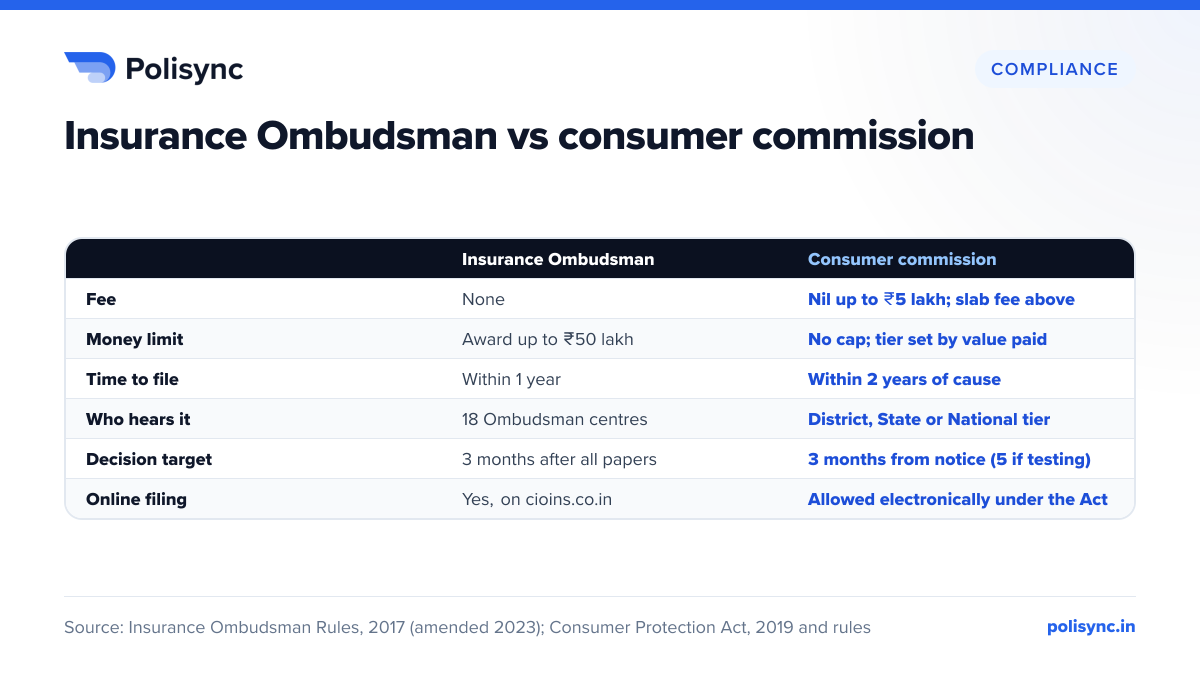
Consumer commissions under the Consumer Protection Act, 2019 are the main alternative. Under the 2023 fee rules, filing is free where the value paid as consideration is up to ₹5 lakh, with a slab fee above that starting at ₹200. Complaints can be filed electronically, and commissions should try to decide them within three months of notice to the insurer (five months if testing is needed).
Since the jurisdiction rules notified on 30 December 2021, as announced by PIB, District Commissions hear complaints where that value is up to ₹50 lakh, State Commissions above ₹50 lakh up to ₹2 crore, and the National Commission above ₹2 crore. Section 69 of the Consumer Protection Act, 2019 requires filing within two years of the cause of action, though delay can be condoned for sufficient cause.
A practical way to explain the choice to clients:
- Most retail claim disputes up to ₹50 lakh fit the Ombudsman well: no fee at any value, the client can file it personally, and a defined three-month award target.
- Larger disputes above ₹50 lakh, or cases needing detailed evidence and cross-examination, may suit a consumer commission or civil court better. Suggest the client takes legal advice.
- Pick one forum per issue. The Ombudsman will not hear a matter on the same subject already pending before, or decided by, a court or consumer forum.
What this means for insurance agents
An agent is not a party to the complaint, but you are usually the first person the client calls, and how you handle a rejection often decides whether they renew. As our guide to building client trust as an insurance agent argues, credibility is built in the bad moments.
Where agents add the most value:
- Explain the rejection. Read the insurer's letter against the policy wording and tell the client honestly whether the decision looks wrong, debatable or correct.
- Prevent avoidable disputes. Many health claim disputes start with confusion between cashless and reimbursement routes; see our explainer on cashless vs reimbursement health claims.
- Support nominees. After a death claim rejection, the nominee or legal heir can complain. Walk them through it alongside our life insurance death claim process guide.
- Set expectations with data. Before sale, use the insurer's claim settlement ratio and complaint record as part of an honest comparison.
How can agents help clients draft a complaint and keep records?
Use this checklist whenever a client's claim is rejected or a complaint is stuck:
- 1. Get the rejection in writing. Ask the client to obtain the insurer's written decision with the specific clause relied on.
- 2. Build a dated timeline. Policy issue date, claim intimation, documents submitted, queries raised, and each reply.
- 3. Collect the documents. Policy document, proposal form, claim form, hospital or medical records, correspondence and payment proofs.
- 4. Draft the insurer complaint. Short, factual, and ending with a specific request (pay the claim, reconsider, correct the policy). Send it by email or portal so there is a timestamp.
- 5. Diarise the deadlines. 14 days for the insurer's resolution, one month after the insurer receives the complaint for the "no reply" trigger, and one year for the Ombudsman filing.
- 6. Register on Bima Bharosa if needed. The client can file or track the complaint there using the insurer complaint reference.
- 7. Prepare the Ombudsman complaint. Pick the right office, attach the insurer's reply and the timeline, and state the relief sought within the ₹50 lakh limit.
- 8. Follow up on compliance. If an award goes the client's way, track the 30-day payment window and the ₹5,000 per day penalty.
Keep every letter, email and complaint ID in the client's file. Agency software can keep these records organised against each policy (see our features page), but a disciplined folder works too. Nothing should depend on memory when a deadline is a year away.