

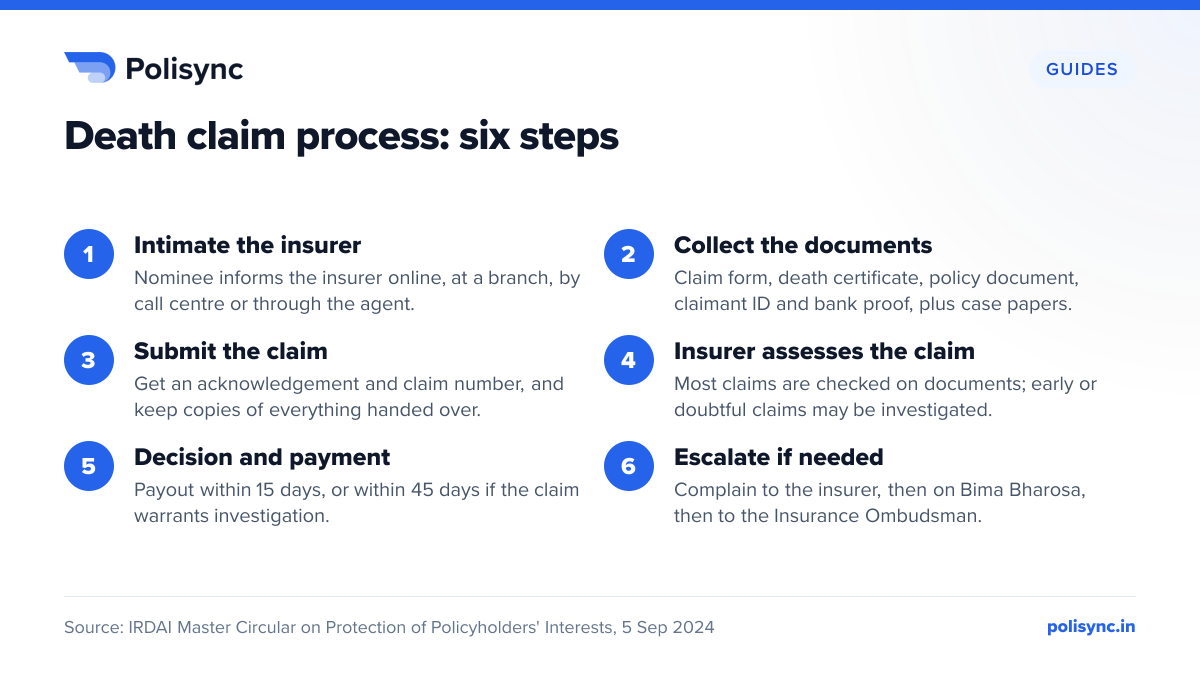
To make a life insurance death claim in India, the nominee informs the insurer and submits the claim form, death certificate, policy document, ID and bank details, plus medical, FIR or post-mortem papers where relevant. As of 24 August 2026, IRDAI rules require insurers to settle death claims within 15 days of intimation, or 45 days if investigation is warranted, with interest for any delay.
Those timelines come from IRDAI's Master Circular on Protection of Policyholders' Interests, 2024 (IRDAI/PP&GR/CIR/MISC/117/9/2024, dated 5 September 2024). This guide walks through every step, the documents insurers ask for, how early claims and missing persons are handled, and what an agent can do to make a painful process smoother for the family.
How does the life insurance death claim process work, step by step?
A death claim is the request a nominee or legal claimant makes to the insurer to receive the death benefit after the life assured dies. The master circular says the policyholder or claimant should intimate the insurer at the earliest possible time, either in person or online, through the distribution channel (such as the agent), through the insurer's call centre or any other mode in the policy document.
Two protections matter from day one. First, the circular states that no claim shall be rejected or closed for want of documents or for delayed intimation. Second, if the intimation reaches an agent, broker or other distribution channel, that intermediary must have a system to forward it to the insurer immediately.
What documents are needed for a life insurance death claim?
IRDAI requires every insurer to state the claim documents in the policy document and display them on its website, so always check the specific insurer's list. The master circular names the common ones: the claim form, death certificate, First Information Report and post-mortem report in a claim due to accident, and discharge summary where death happened in hospital.
Documents needed in almost every claim
LIC's claim settlement requirements page is a useful reference because it is the largest insurer's published list. For a standard death claim it asks for:
- Claim Form A, the claimant's statement giving details of the deceased and the claimant.
- Certified extract from the death register, that is, the official death certificate.
- Documentary proof of age of the life assured, if age was not admitted when the policy was issued.
- Evidence of title to the deceased's estate, only if the policy has no nomination, assignment or MWP Act cover.
- Original policy document.
On top of these, insurers ask for the claimant's identity and address proof and bank account details for the payout. The master circular warns that missing or outdated contact and bank details delay settlement and can leave money lying with the insurer as an unclaimed amount.
Extra documents depending on the cause of death
- Death in hospital or after illness: the hospital discharge summary, plus any further medical records of the last illness that the insurer asks for.
- Accidental death: a copy of the FIR and the post-mortem report. LIC notes that these are normally insisted upon for accident benefit claims too.
- Early claim (within three years): LIC asks claimants to contact the servicing branch for additional requirements, because these claims may be investigated.
- Assigned policy (for example, against a home loan): the nominee should verify the assignment and the outstanding loan, consent to the lender receiving only the dues, and ensure the balance is paid to the nominee's own bank account.
How long does an insurer have to settle a death claim?
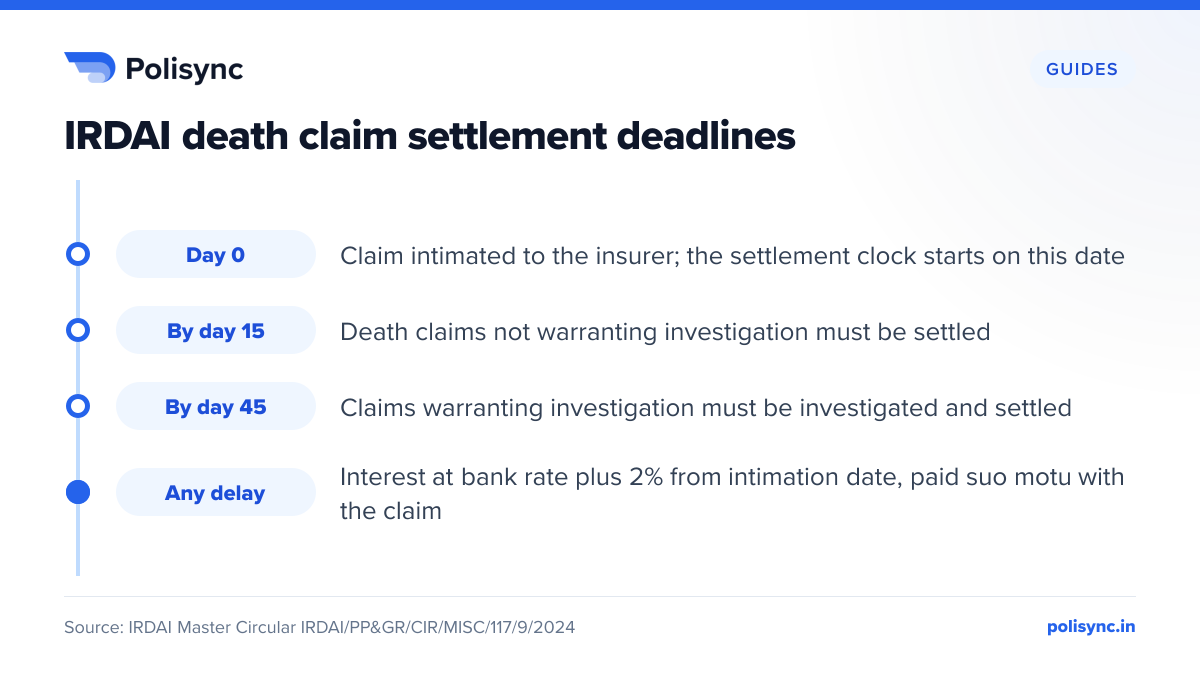
The 2024 master circular sets a turnaround time (TAT) table for life insurers. A death claim that does not warrant investigation must be settled within 15 days from the date of intimation. A death claim that warrants investigation must be settled within 45 days from the date of intimation, which includes the investigation itself. Law firm Tuli & Co's analysis of the new TATs reads the 15-day limit as assuming all documents listed in the policy have been received. The same analysis notes that the earlier 2017 rules allowed 30 days from receipt of all papers, and up to 90 days for investigation followed by 30 days to settle, so the 2024 limits are much tighter.
If the insurer misses these deadlines, the claimant is entitled to interest at bank rate plus 2% from the date the intimation was received till the date of payment. The circular says this interest must be paid suo motu, meaning automatically, along with the claim amount. The family does not have to ask for it.
What is Section 45 and why are early death claims investigated?
Section 45 of the Insurance Act, 1938 is the rule that makes a life policy indisputable after three years. As per the consolidated Insurance Act text, no life policy can be called in question on any ground whatsoever after three years from the date of issuance, commencement of risk, revival or rider, whichever is later. The current wording dates from the 2015 amendment, and the Sabka Bima Sabki Raksha (Amendment of Insurance Laws) Act, 2025, in force from 5 February 2026, did not change Section 45.
Within that three-year window, the insurer can question the policy on two grounds:
- Fraud, such as deliberately stating something untrue or actively concealing a fact to get the policy issued. The insurer must give the grounds in writing, and cannot repudiate if the insured can prove the misstatement was true to the best of their knowledge, there was no deliberate intention to suppress, or the insurer already knew the fact. Where the policyholder has died, the onus of disproving fraud lies on the beneficiaries.
- Misstatement or suppression of a material fact in the proposal. A fact is material only if it has a direct bearing on the risk, and the insurer must show it would not have issued the policy had it known. If the policy is repudiated on this ground rather than fraud, premiums paid till repudiation must be refunded within 90 days.
This is why the industry separates early claims (death within three years of issue, risk start or revival) from non-early claims. The master circular's TAT annexure specifically lists early death claims requiring investigation under the 45-day limit. An IRDAI clarification on Section 45 (28 October 2015) adds that the three years run regardless of whether or when a claim is intimated: if death happened within three years but the claim is intimated after the window closes, the insurer can no longer call the policy in question for misstatement or suppression.
Revival restarts the clock, but only for what was declared at revival. The same 2015 clarification says a revival can be questioned within three years only for misstatements made at the time of revival, not for non-disclosure in the original proposal once three years from issue have passed, and not at all if the policy was revived without any health declaration or medical. This is worth explaining to anyone you help with reviving a lapsed policy.
Who receives the claim money: the nominee or the legal heir?
The master circular describes nomination as mandatory to facilitate claim payment, and allows more than one nominee with a percentage share for each. Where a nominee is a minor, the policyholder can appoint a person (an appointee) to receive the money during the minority.
Under Section 39(7) of the Insurance Act, if the policyholder nominated their parents, spouse or children, those nominees are beneficially entitled to the money, unless it is proved that the policyholder, given the nature of their title to the policy, could not have conferred that benefit. For other nominees, and for policies with no nomination at all, the position is more complex. Our guide on nominee vs legal heir and beneficial nominees explains who ends up owning the money.
How do you claim life insurance if the policyholder is missing?
When there is no body and no death certificate, the family usually needs a court to presume death. Section 111 of the Bharatiya Sakshya Adhiniyam, 2023 says that if a person has not been heard of for seven years by those who would naturally have heard of them, the burden of proving they are alive shifts to whoever says so. The Adhiniyam repealed the Indian Evidence Act, 1872 (where the same rule sat in Section 108) and came into force on 1 July 2024.
Aditya Birla Sun Life's guide to missing-policyholder claims sets out a practical sequence:
- File a missing person report with the local police as soon as possible.
- After seven years, petition the competent court for a legal presumption of death.
- Submit the claim with the missing person report, policy copy, claimant's identity and address proof, the court's presumption of death and a legal heir certificate if required.
Agents should also ask the insurer early how premiums must be handled during the waiting period, because a policy that lapses for non-payment may pay a reduced benefit or nothing at all, depending on its terms.
How many death claims do life insurers actually pay?
According to Table I.11 of the IRDAI Annual Report 2024-25 (dated 30 December 2025 on IRDAI's website), life insurers handled 10,34,455 individual death claims in 2024-25 and paid 10,11,880 of them, or 97.82% by number. By amount, ₹33,697 crore of ₹34,995 crore was paid, or 96.29%.
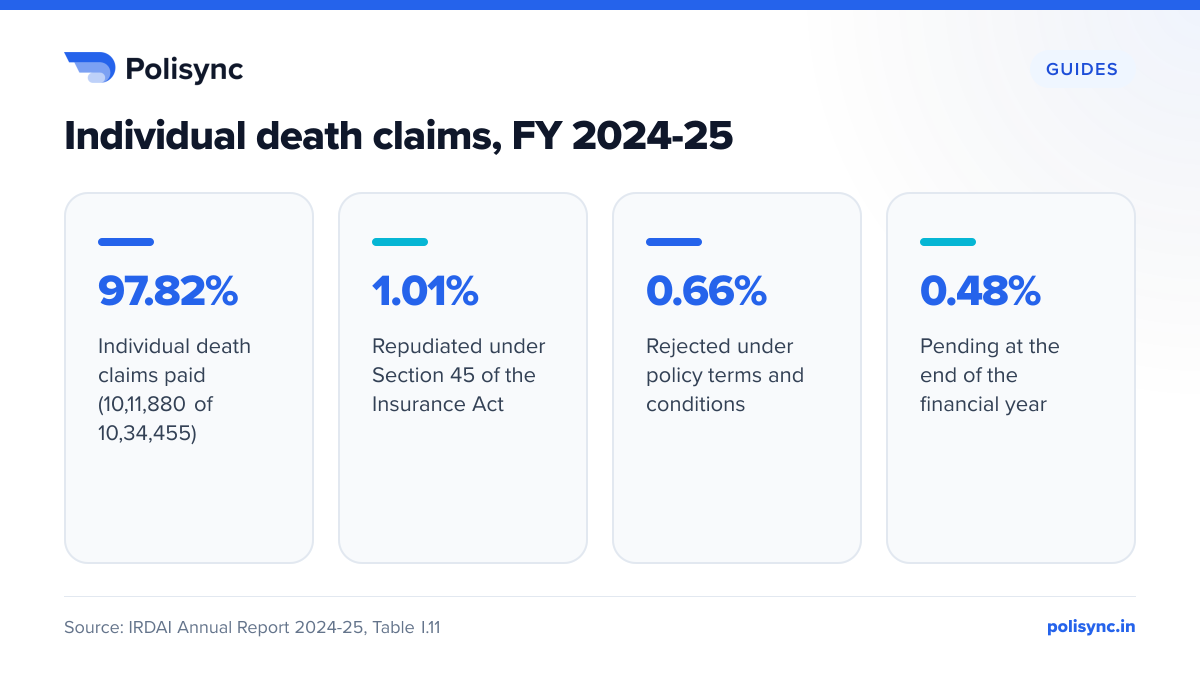
The report draws a useful distinction. Repudiated claims (10,494, or 1.01%) are those that cannot be considered under Section 45, meaning disclosure problems. Rejected claims (6,839, or 0.66%) fail on policy terms and conditions, such as an exclusion. Group business did even better, with 99.68% of lives' claims paid. For how to read insurer-wise figures with clients, see our explainer on the claim settlement ratio.
What can the family do if a death claim is delayed or rejected?
The master circular lays out a three-level grievance route:
- Insurer first: complain at a branch, by letter or email, on the insurer's website or through its call centre. The insurer must acknowledge immediately and resolve within 14 days, giving reasons with reference to the policy terms if it does not accept the complaint.
- Bima Bharosa: the complaint can also be registered and tracked on IRDAI's Bima Bharosa portal, which insurers' grievance systems must mirror in real time.
- Insurance Ombudsman: if the insurer rejects the complaint, sends an unsatisfactory reply or does not reply within one month, escalate to one of the 18 Ombudsman centres, free of charge, for compensation up to ₹50 lakh. The cap was raised from ₹30 lakh by the Insurance Ombudsman (Amendment) Rules, 2023, notified on 9 November 2023. The Council for Insurance Ombudsmen says the complaint must be filed within one year of the insurer's rejection, or of the end of that one-month period.
Insurers must comply with an Ombudsman award within 30 days. If they neither comply nor appeal within that time, the master circular imposes a penalty of ₹5,000 per day payable to the complainant, on top of penal interest under the Insurance Ombudsman Rules, 2017.
What this means for insurance agents
The death claim is the moment the policy was sold for. Families remember who stood with them, and how you handle a claim shapes referrals for years. It is also where building client trust becomes concrete: showing up, staying calm and doing the paperwork so the family does not have to.
Good claim support starts long before anyone dies:
- At the sale: record health, habits and other insurance honestly in the proposal. Section 45 repudiations are, by definition, about misstatement, suppression or fraud in the proposal. The section also treats the person who solicits and negotiates the contract as the insurer's agent, so what you record matters. Our guide on avoiding mis-selling covers why this protects you as well as the client.
- During the policy: keep nominees, appointees, mobile numbers and bank details current. An annual policy review meeting is the natural time to check this.
- When the family calls: be sensitive. Offer condolences first, avoid paperwork talk at the funeral, and agree a time to sit down with the nominee.
Agency software can help keep nominee records, policy copies and claim follow-up dates organised in one place; Polisync is built for Indian agents with that in mind.
Agent checklist for a death claim
- 1. Intimate the claim to the insurer the same day you hear of it, and note the date, because the 15 or 45 day clock runs from intimation.
- 2. List every policy the deceased held, across insurers, including term, endowment and group cover through an employer.
- 3. Download the insurer's current claim document list and send the family a simple checklist in plain language.
- 4. Help obtain the certified death certificate early, and the discharge summary, FIR or post-mortem report where relevant.
- 5. Check the policy date, revival date and any assignment, so you can tell the family whether it is an early claim or a loan is outstanding.
- 6. Submit a complete file, keep copies and the claim number, and follow up in writing every few days.
- 7. If day 15 or day 45 passes, ask the insurer for a written status and confirm interest at bank rate plus 2% will be added.
- 8. If the claim is rejected or stuck, help the nominee complain to the insurer, then Bima Bharosa, then the Ombudsman.
One last point for client conversations: families often discover policies only after a death. The master circular explains that unclaimed amounts can be searched across insurers on Bima Bharosa, move to the Senior Citizens' Welfare Fund after 10 years, and remain claimable for 25 years after that transfer. Explaining the difference between term and whole life cover while the client is alive, and making sure the family knows where the policies are, prevents this problem entirely.