

Under Section 39 of the Insurance Act, 1938, as amended in 2015, a nominee is usually just the person the insurer pays. But when a policyholder nominates a parent, spouse or child, that beneficial nominee is entitled to keep the money unless the policyholder's title was defective. Legal heirs inherit under succession law. As of 14 August 2026, courts still disagree on how far beneficial title goes.
Whether a life claim reaches the person your client intended depends on who is named, how that person is related to the client and whether the nomination is kept up to date. This guide explains the law in plain language so you can explain it to clients and record it correctly.
What is the difference between a nominee, a beneficial nominee and a legal heir?
Three terms decide who ends up with a life insurance claim:
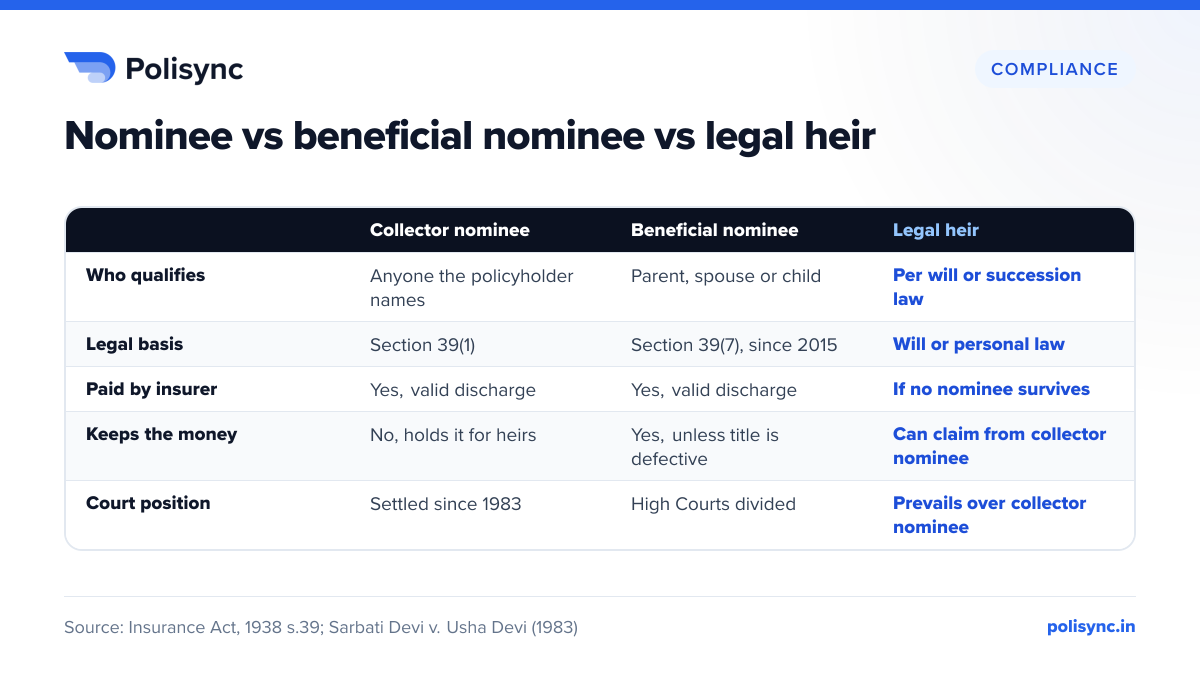
- Nominee (collector nominee): the person named under Section 39 to receive the policy money. The insurer gets a valid discharge by paying them, but the nominee may have to hold the money for the legal heirs.
- Beneficial nominee: a parent, spouse or child (or spouse and children) nominated by a policyholder on his or her own life. Under Section 39(7), they are beneficially entitled to the amount paid.
- Legal heir: a person entitled to the deceased's estate under a will or under succession law, such as the Hindu Succession Act, 1956, the Indian Succession Act, 1925 or the personal law that applies to the family.
The clash usually happens inside one family. Under the Hindu Succession Act, 1956, the Class I heirs of a Hindu man who dies without a will include his son, daughter, widow and mother. So if he nominates only his wife, his mother and children may also have a claim to the money, depending on what kind of nominee the wife is.
What does Section 39 of the Insurance Act say?
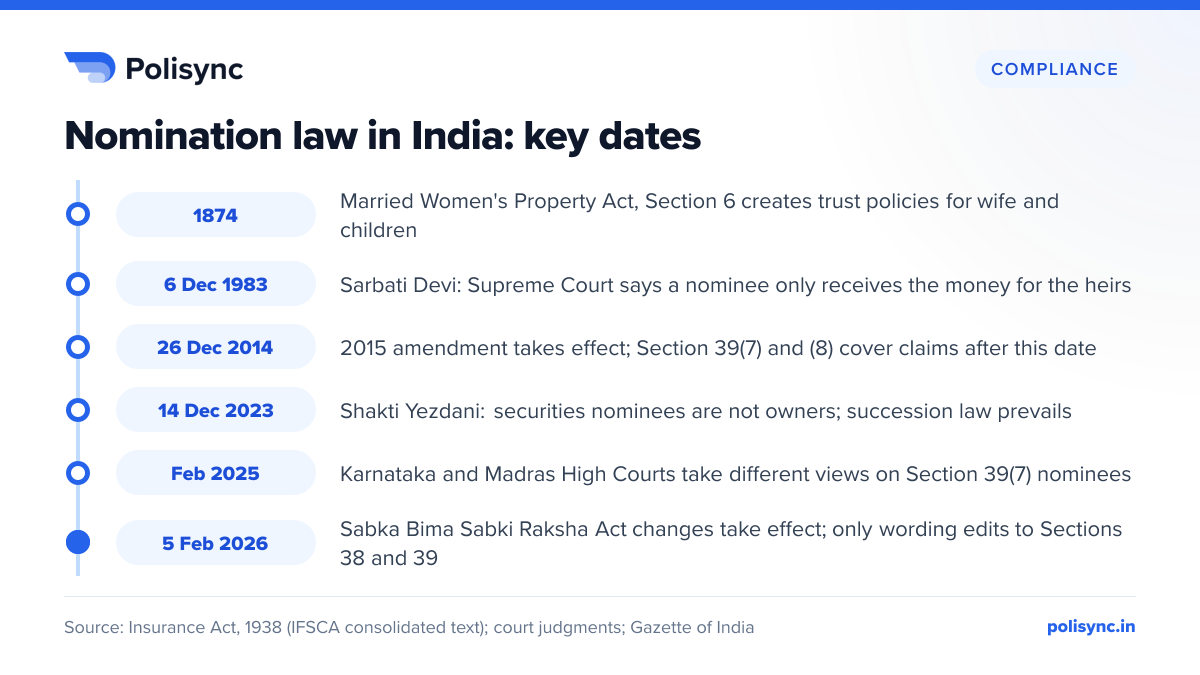
Section 39 lets the holder of a life insurance policy on their own life nominate one or more persons to receive the money if they die. The nomination can be made when the policy is taken or at any time before it matures. The current wording was substituted by the Insurance Laws (Amendment) Act, 2015, which is deemed to have come into force on 26 December 2014. You can read it in the consolidated text of the Insurance Act, 1938 hosted by IFSCA, updated as on 15 April 2026.
The core rules every agent should know:
- The nomination can be written into the policy itself, or endorsed on the policy, communicated to the insurer and registered in its records.
- It can be cancelled or changed at any time before maturity, by an endorsement, a further endorsement or a will.
- The change only binds the insurer once written notice reaches it. Until then, a bona fide payment to the person in the insurer's records discharges the insurer.
- The insurer must give the policyholder a written acknowledgement of registering the nomination, change or cancellation.
- Under sub-section (9), the beneficial nominee rules do not defeat the right of any creditor to be paid out of the policy proceeds.
- An assignment under Section 38 automatically cancels the nomination. An assignment for a loan, whether to the insurer or another lender, does not cancel it but affects the nominee only to the extent of the lender's interest, and a nomination cancelled by assignment revives when the policy is reassigned on repayment of the loan.
Service timelines matter too. LIC's Policy for Protection of Interests of Policyholders, 2024, revised on 15 October 2024 after IRDAI's Master Circular on Protection of Policyholders' Interests dated 5 September 2024, lists a regulatory turnaround of 7 working days for registration or change of nomination and assignment.
Who counts as a beneficial nominee under Section 39(7)?
Sub-section (7) says that where a policyholder on their own life nominates their parents, or spouse, or children, or spouse and children, or any of them, the nominees are beneficially entitled to the amount payable. The only exception is where it is proved that the policyholder could not have conferred such beneficial title, having regard to the nature of their own title to the policy.
Sub-section (8) adds that if a nominee dies after the policyholder but before their share is paid, that share goes to the nominee's own heirs or legal representatives. Under sub-section (10), both sub-sections apply to all life policies maturing for payment after the 2015 Act commenced, that is, after 26 December 2014. So older policies are covered too if the claim arises after that date.
Anyone outside that list, such as a brother, sister, niece, friend or business partner, remains a collector nominee. The Madras High Court applied this in K.R. Sakthi Murugeswari (2023), treating a nominated brother as a collector nominee who holds the money subject to the heirs' claims. That is a key point to raise with unmarried clients who often nominate a sibling.
Do courts treat beneficial nominees as absolute owners?
The 1983 baseline: Sarbati Devi v. Usha Devi
Before 2015, the leading case was the Supreme Court's judgment of 6 December 1983 in Sarbati Devi v. Usha Devi. The deceased had nominated his widow, and his mother and son claimed a share. The Court held that a nomination does not give the nominee any beneficial interest; it only "indicates the hand which is authorised to receive the amount". The heirs could claim the money under their succession law.
The 2023 reaffirmation: Shakti Yezdani
On 14 December 2023, a bench of Justices Hrishikesh Roy and Pankaj Mithal decided Shakti Yezdani v. Jayanand Jayant Salgaonkar (Civil Appeal No. 7107 of 2017). The case was about shares and securities nominated under the Companies Act, 1956 and the Depositories Act, 1996, not insurance. The Court held that such nominees do not become owners, that nomination is not a third mode of succession, and that a will prevails. It relied on Sarbati Devi along the way.
Shakti Yezdani did not rule on Section 39(7). But its caretaker reasoning is already reaching insurance cases: the Karnataka High Court relied on it in February 2025, and Trilegal's commentary on nominee rights notes that it is influencing how High Courts read insurance nominations.
High Courts are split on Section 39(7)
- Madras High Court, A. Devika v. Senior Branch Manager, LIC (28 February 2025): a mother challenged LIC paying her son's wife, the nominee. The court observed that a valid beneficial nominee under Section 39(7) can claim the entire amount, but disposed of the case on the wife's offer to share one-third with the mother, as the judgment records.
- Karnataka High Court, Neelavva v. Chandravva (20 February 2025): the policyholder had nominated his mother before he married. Relying on Shakti Yezdani, the court held that a Section 39(7) nominee cannot claim absolute ownership once other Class I heirs claim, and upheld equal one-third shares for the mother, widow and minor son, as the judgment shows.
- The Madras ruling also cites an Andhra Pradesh High Court decision (Mallela Manimala, 2023) favouring a wife as beneficial nominee, while Trilegal lists an Allahabad High Court ruling (Kusum v. Anand Kumar, 2025) protecting other heirs.
In practice, a beneficial nomination gives a strong claim, but other heirs may still challenge it in some states. A will that matches the nomination reduces that risk considerably.
What happens with minors, multiple nominees and a nominee who dies first?
Section 39 answers most of the what-if questions clients ask:
- Minor nominee: the policyholder may appoint any person (the appointee) to receive the money if the policyholder dies while the nominee is still a minor. The manner of appointment is laid down by the insurer.
- Several nominees: if some nominees survive the life assured, the money is paid to the survivors. IRDAI's Master Circular on Protection of Policyholders' Interests, 2024 says a policyholder may nominate one or more persons with a percentage of the claim for each, and that nomination is mandatory to facilitate payment of a death claim.
- All nominees die before the policyholder: the proceeds go to the policyholder or their heirs, legal representatives or the holder of a succession certificate. The family then has to prove title, which is slower.
- Nominee dies after the policyholder but before payment: under Section 39(8), that nominee's share goes to the nominee's own heirs or legal representatives.
- Policyholder dies after maturity but before being paid: the nominees are entitled to the proceeds.
How is nomination different from assignment and an MWP Act policy?
Assignment under Section 38
Assignment transfers the rights in the policy itself, wholly or in part, usually to a lender. It is made by an endorsement on the policy or a separate instrument, signed by the assignor and attested by at least one witness, and it binds the insurer only after written notice. The insurer may decline to act on an assignment it believes is not bona fide, not in the policyholder's interest, not in public interest or meant for trading the policy, and must record and communicate reasons within 30 days.
An absolute assignment cancels the nomination. A loan assignment only overrides it to the extent of the lender's interest, and the nomination revives once the loan is repaid. Clients who assign a policy for a home loan should check their nomination after closing the loan.
Section 6 of the Married Women's Property Act, 1874
Under Section 6 of the MWP Act, a policy taken by a married man on his own life and expressed on its face to be for the benefit of his wife, or wife and children, is a trust for them. It is not subject to the husband's control or his creditors and does not form part of his estate. The proceeds go to the Official Trustee of the state unless special trustees are appointed. The protection does not cover a policy taken with intent to defraud creditors.
Under Section 39(12), Section 39 does not apply to a policy covered by Section 6 of the MWP Act. But if a nomination of the wife, or wife and children, is expressed as made under Section 39, the MWP Act is deemed not to apply, so the policy must be clearly issued under the MWP Act. An ordinary nomination, even a beneficial one, does not defeat creditors; a genuine MWP trust keeps the money out of the husband's estate.
Did the Sabka Bima Sabki Raksha Act, 2025 change Section 39?
The Sabka Bima Sabki Raksha (Amendment of Insurance Laws) Bill, 2025 passed the Lok Sabha on 16 December and the Rajya Sabha on 17 December 2025, according to PRS Legislative Research. The gazetted Act received Presidential assent on 20 December 2025 and was published on 21 December 2025.
Its headline changes include 100% foreign investment in insurers and IRDAI-specified commission limits, as summarised by Vinod Kothari Consultants. In the gazetted text, no clause is aimed at Section 38 or 39. The only change touching them is clause 2, an Act-wide edit replacing "he", "him" or "his" with "it" or "its" where they refer to the insurer. The IFSCA consolidated text shows this in force from 5 February 2026, with the substance of Section 39 unchanged.
What this means for insurance agents
Nomination is not a form field to rush through. It is the last step of needs-based selling: if the cover was sized to protect a spouse and two children, the nomination should point the money there. The same logic applies when you build a family insurance plan or explain term vs whole life insurance to a young couple.
Illustrative example (hypothetical): a client with a ₹1 crore term plan nominated his brother before marriage and never updated it. The brother is a collector nominee, so the widow and child may have to recover the money from him. Catching this at an annual review costs one endorsement form; missing it can cost the family years.
Explain the limits honestly. A nomination does not replace a will, and complex estates need a lawyer, especially where there is a second marriage, a business or a family dispute. That candour is part of building client trust and belongs in your IRDAI compliance checklist. Keeping nominee details, relationships and endorsement dates in one place, whether in a spreadsheet or agency software, makes reviews much faster.
Nomination checklist: what should agents do now?
Use this at every new proposal and every policy review:
- Map the family first. Note the spouse, children, parents and dependants the cover is meant to protect.
- Explain the two kinds of nominee. A parent, spouse or child is a beneficial nominee; anyone else only collects the money for the heirs.
- Split shares clearly. With several nominees, record a percentage for each that adds up to 100%.
- Name an appointee for any minor. Choose an adult the client trusts and record the details as the insurer requires.
- Discuss the MWP Act where creditor protection matters. For married male clients with business or loan exposure, explain Section 6 so they can decide with full information.
- Get the acknowledgement. File the insurer's written acknowledgement of every nomination or change.
- Review after life events. Re-check after marriage, divorce, childbirth, a nominee's death, or a loan assignment and its closure.
- Suggest a matching will. A will that agrees with the nomination reduces the chance of a dispute.

What documents will the family need at claim time?
For a death claim, LIC's claim requirements list the claimant's statement (Claim Form A), a certified extract from the death register, proof of age if not already admitted and the original policy document. Crucially, the list also asks for evidence of title to the deceased's estate if the policy is not nominated, assigned or issued under the MWP Act. If death occurs within three years of the date of risk or revival, the claimant is asked to contact the servicing branch for additional requirements.
That single line explains why nomination matters. With a valid nominee, the insurer can pay quickly; LIC's policyholder protection policy sets regulatory turnarounds of 15 working days for death claims that do not need investigation and 45 working days for early death claims that do. Without a nominee, the family may first need a succession certificate or other proof of title. Help clients by keeping a list of their policies, nominees and servicing branches where the family can find it.