

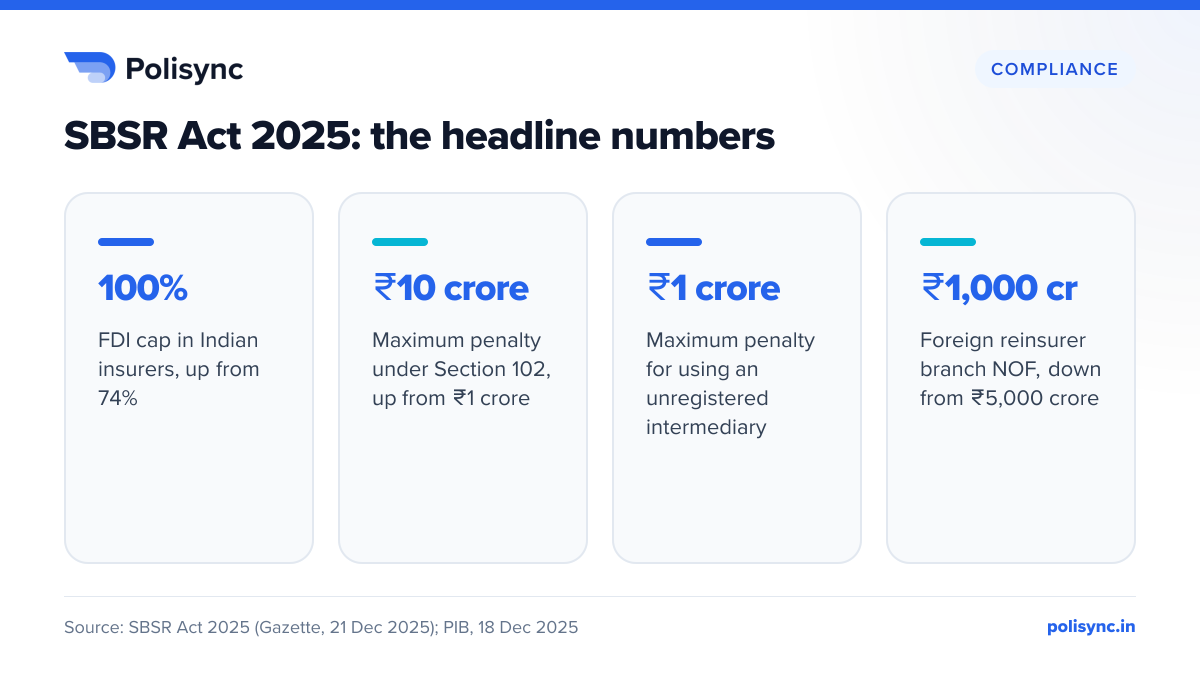
The Sabka Bima Sabki Raksha (Amendment of Insurance Laws) Act, 2025 amends the Insurance Act, the LIC Act and the IRDA Act. Parliament passed it on 17 December 2025, the President assented on 20 December and most of it took effect on 5 February 2026. It allows up to 100% FDI in insurers, raises the maximum penalty to ₹10 crore and lets IRDAI set limits on agent commission.
This guide explains what the Act actually says, what was left out, how IRDAI has implemented it as of 1 October 2026, and what it changes for insurance agents and intermediaries in day-to-day work.
What is the Sabka Bima Sabki Raksha Act?
It is Act No. 40 of 2025, a single amending law that changes three statutes at once: the Insurance Act, 1938, the Life Insurance Corporation Act, 1956 and the Insurance Regulatory and Development Authority Act, 1999. The name roughly means "insurance for everyone, protection for everyone", and it is often shortened to the SBSR Act.
The Bill was introduced and passed in the Lok Sabha on 16 December 2025 and passed by the Rajya Sabha on 17 December 2025, according to PRS Legislative Research. Business Standard reported that the Rajya Sabha cleared it by voice vote, with Finance Minister Nirmala Sitharaman saying consultations had taken place for nearly two years.
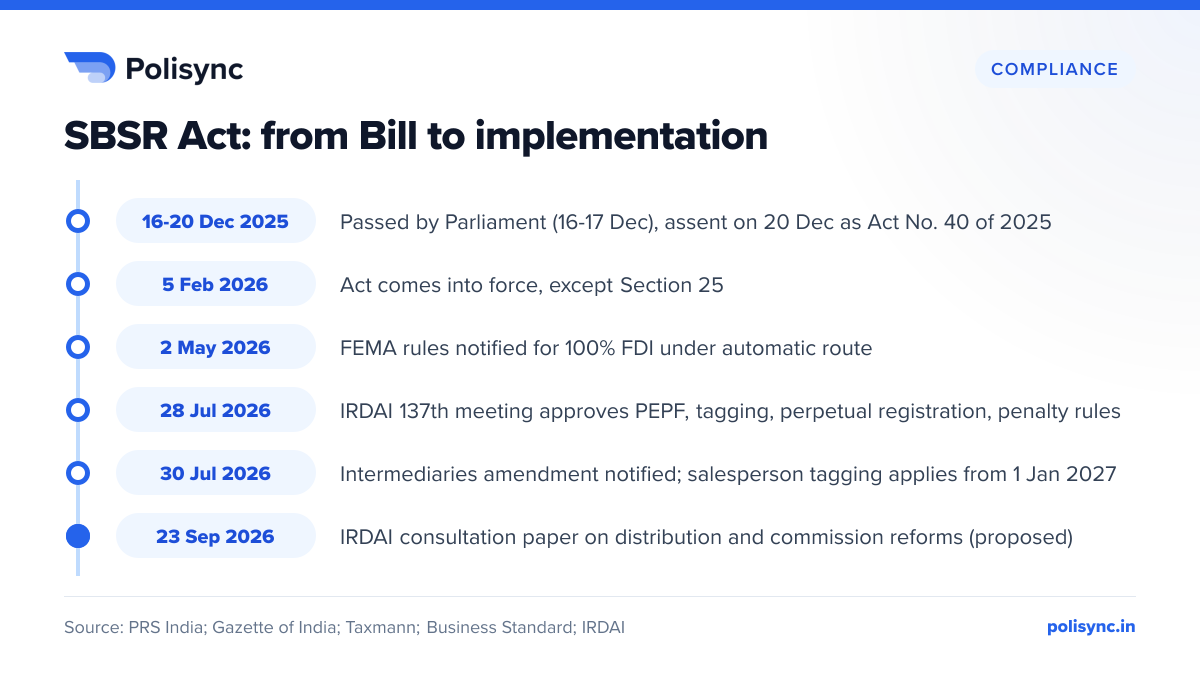
The President gave assent on 20 December 2025 and the Act was published in the Gazette of India the next day. On 3 February 2026 the Centre notified 5 February 2026 as the date the Act comes into force, except Section 25, which will be notified separately, as Taxmann noted. Section 25 rewrites Section 32A, which bars a director or officer of an insurer from holding the same role in another insurer in the same class of business, a bank or an investment company.
What are the key provisions of the Act?
The PIB release of 18 December 2025 groups the reforms under deeper coverage, ease of doing business and stronger regulatory oversight. For agents and intermediaries, these are the provisions that matter most:
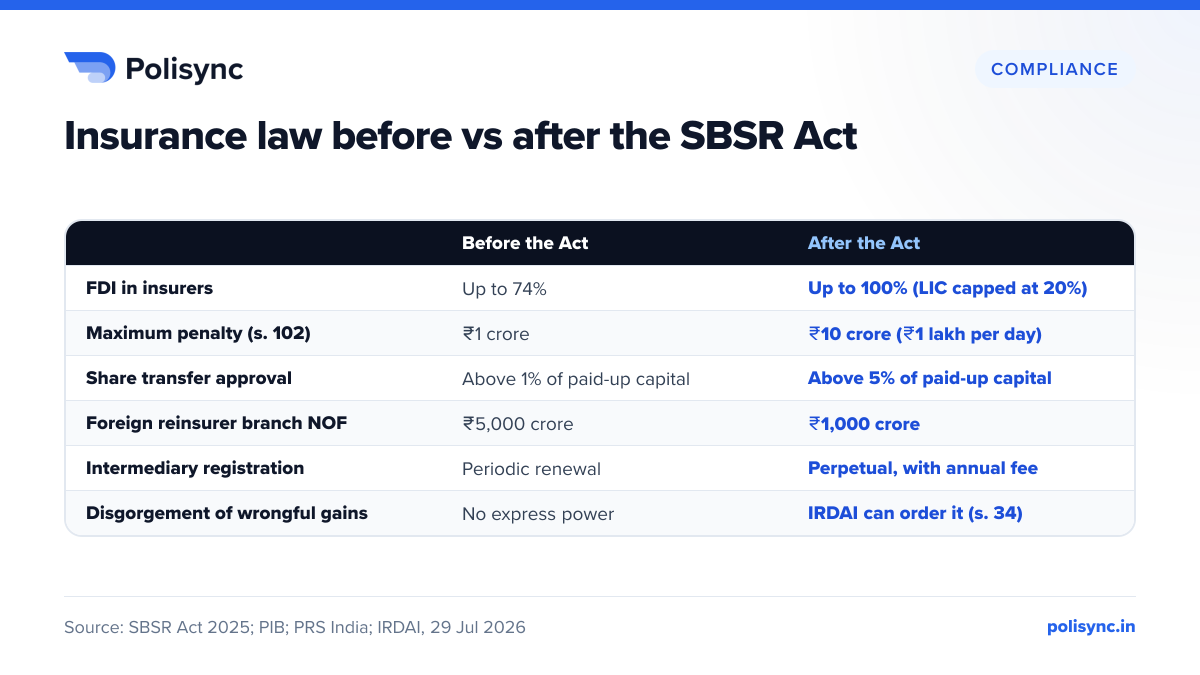
- 100% FDI in insurers: new Section 3AA of the Insurance Act lets foreign investors, including portfolio investors, hold up to 100% of an Indian insurer's paid-up equity, on conditions the Centre prescribes.
- Power to cap commission: new Section 40(2A) lets IRDAI specify, by regulations, limits on "any commission, remuneration or reward in any form" payable to an insurance agent or intermediary, how it is paid and how it must be disclosed.
- Higher penalties: failures such as not filing returns, not following IRDAI directions or not maintaining solvency now attract up to ₹1 lakh per day, capped at ₹10 crore.
- Penalties for unregistered selling: new Section 105BA penalises anyone acting as an intermediary without registration, and anyone who appoints or transacts business through such a person.
- Disgorgement: IRDAI can direct any person who made a profit or avoided a loss by breaking insurance law to give up an amount equal to that wrongful gain.
- One-time registration: intermediary registration under Section 42D now stays in force, subject to an annual fee, until IRDAI suspends or cancels it. PIB calls this one-time licensing, with suspension available instead of straight cancellation.
- Policyholders' Education and Protection Fund (PEPF): new Section 16A of the IRDA Act creates a fund, fed partly by penalties IRDAI collects, for policyholder education and protection.
- Ease for insurers: the prior-approval threshold for share transfers rises from 1% to 5% of paid-up capital, and the net owned fund needed by foreign reinsurance branches falls from ₹5,000 crore to ₹1,000 crore.
- Data and governance: PIB says policyholder data must be collected and protected in line with the DPDP Act, 2023, whose consent and data fiduciary duties come into force in May 2027 under G.S.R. 843(E); IRDAI must also publish draft regulations for public comment before finalising them.
How does 100% FDI in insurance work now?
The Act only opened the door; the foreign investment rules had to follow. Business Standard reported that the Finance Ministry notified the Foreign Exchange Management (Non-debt Instruments) (Second Amendment) Rules, 2026 on 2 May 2026, allowing 100% FDI in insurance companies and intermediaries, including brokers, under the automatic route. According to the same report, DPIIT had notified the 100% limit in February 2026.
The main conditions, as summarised by SCC Online:
- Automatic route: no prior government approval, but the investment is still subject to IRDAI approval and verification.
- Resident Indian leadership: at least one of the Chairperson, Managing Director or CEO must be a resident Indian citizen.
- LIC is different: foreign investment in LIC stays capped at 20%.
Early movement is visible. In its 137th meeting press release, IRDAI said two insurers, one life and one general, had already raised foreign shareholding beyond the earlier 74% threshold, and that its approval of ProTec General Insurance was the fourth registration it had granted in calendar year 2026.
What are the new penalties under the Act?
Penalties are where the Act bites hardest. The figures below are taken from the Act as published in the Gazette.
Penalties on insurers and intermediaries
Under the substituted Section 102, an insurer or intermediary that fails to file a required document or return, follow IRDAI directions, maintain its solvency margin or comply with directions on insurance treaties can be fined up to ₹1 lakh for each day the failure continues, up to a maximum of ₹10 crore. Law firm Phoenix Legal notes the previous ceiling was ₹1 crore.
Penalties for unregistered intermediaries
New Section 105BA sets minimum and maximum penalties for selling without registration under Section 42D:
- Acting as an intermediary without registration: ₹1 lakh to ₹10 lakh.
- Appointing an unregistered person as an intermediary, or transacting insurance through one: ₹10 lakh to ₹1 crore.
- Directors, managers, officers or partners knowingly party to the breach by a company or firm: ₹1 lakh to ₹10 lakh each.
How IRDAI decides the amount
New Section 105E lists the factors IRDAI must weigh: the nature, gravity and duration of the default, whether it is repeated, any unfair gain, the loss to policyholders, how many policyholders were hit, mitigation steps taken and whether the penalty is proportionate. A brief of each penalty order must be published as a press release on IRDAI's website within 30 days, so enforcement against an intermediary becomes public.
Penalties collected by IRDAI are credited to the PEPF under Section 16A. Separately, the new disgorgement power in Section 34 lets IRDAI recover the wrongful gain itself, over and above any penalty.
What changed compared with the old law?
This comparison sets the main provisions before and after the Act, using the Act text, PIB, PRS and IRDAI's July 2026 release. Only provisions with a clearly sourced "before" position are included.
What was left out of the Act?
Several ideas from the Finance Ministry's 2024 draft amendments did not make it into the final law. Law firm TTA lists these omissions:
- Open architecture for agents: the 2024 draft would have ended the tied-agency model, under which an individual agent can work with only one life, one general and one health insurer. That limit stays.
- Lower entry capital: the proposed cut in minimum capital for insurers from ₹100 crore to ₹50 crore was not retained.
- Wider business scope: the proposal to let insurers offer non-insurance financial products such as guarantees and indemnities was dropped.
- Composite licences, only indirectly: the Act does not expressly allow one insurer to write life and general business together, but it lets the Centre, in consultation with IRDAI, notify a new "class of insurance business". TTA says this is generally read as enabling composite licensing later.
Some of these themes have returned through IRDAI's own proposals rather than the Act, as the next section shows.
How has IRDAI implemented the Act so far in 2026?
Most of the Act works through regulations that IRDAI must frame, consult on and notify. As of 1 October 2026, the key milestones run from Parliament in December 2025 to a major consultation in September 2026.
The 137th Authority meeting (28 July 2026)
IRDAI's press release of 29 July 2026 says the Authority approved, among other things:
- IRDAI (Policyholders' Education and Protection Fund) Regulations, 2026: to fund insurance awareness, stronger grievance redressal, technology for policyholder services and tracing of unclaimed amounts.
- Mandatory salesperson tagging: amendments to the intermediary regulations require the authorised salesperson to be tagged to every insurance proposal, policy and certificate of insurance. See our explainer on salesperson tagging on every policy.
- Perpetual registration: the same amendments replace periodic renewals with perpetual registration backed by an annual fee, a change IRDAI says also covers third-party administrators and surveyors. Our guide to perpetual registration for intermediaries covers the details.
- IRDAI (Manner and Procedure for Imposition of Penalties) Regulations, 2026: a structured process for starting proceedings, issuing show-cause notices and passing reasoned orders.
- Insurer-side changes: amendments to the regulations on actuarial, finance and investment functions and on registration, capital structure, transfer of shares and amalgamation of insurers, to give insurers more investment and restructuring flexibility.
IRDAI then notified the IRDAI (Insurance Intermediaries) (Amendment) Regulations, 2026 in the Gazette of India dated 30 July 2026. They amend the regulations for corporate agents, brokers, insurance marketing firms, web aggregators and common service centres and came into force on publication, but the tagging requirement applies only from 1 January 2027. Corporate agents and brokers holding three-year certificates must apply for a fresh certificate under the new regime before 31 January 2027.
The September 2026 distribution consultation paper (proposed)
On 23 September 2026, IRDAI released a consultation paper titled "Recalibrating Economics of Insurance Distribution", which its press release says is anchored in the SBSR Act. These are proposals only, and comments are open until 25 October 2026.
Among the proposals:
- Life insurers' expense of management limit moving to 15% of gross direct premium within two years and 12.5% within five years; general insurers moving from 30% of gross written premium to 20% of domestic gross direct premium within five years.
- Commission limits that vary by segment, line of business, channel, product complexity and selling effort, with possible extra rewards for sales in under-served areas.
- All forms of remuneration, direct or indirect, counted as commission; commission claw-back for mis-selling; and linking the individual seller's identity to each policy.
- Bima Sugam identified as a market infrastructure institution for digital distribution.
Read our breakdown of the IRDAI commission consultation paper 2026 and the Bima Sugam update for agents for the detail.
What does the Act mean for insurance agents?
The Act does not, by itself, change any agent's commission. What it does is give IRDAI firm legal footing to regulate pay, track every sale and punish misconduct more heavily. Here is how that plays out:
- Commission is now squarely a regulatory matter. Section 40(2A) covers rewards "in any form" and disclosure, so any future caps or disclosure rules will rest directly on the statute.
- Every sale becomes traceable. From 1 January 2027, policies sold through corporate agents, brokers, insurance marketing firms, web aggregators and common service centres must name the salesperson, and the September 2026 paper proposes linking the seller's identity to policies more broadly.
- Mis-selling costs more. Disgorgement, penalties up to ₹10 crore and public penalty press releases raise the stakes for principals, who will pass stricter controls down to their sales teams. Our guide on how to avoid insurance mis-selling is a good refresher.
- Unregistered selling is expensive for everyone. With insurers facing up to ₹1 crore for transacting through an unregistered intermediary, expect tighter onboarding and licence checks.
- Registration becomes lighter but not automatic. Perpetual registration removes three-yearly renewals for intermediaries such as corporate agents and brokers, but unpaid annual fees or breaches can still lead to suspension or cancellation.
- Client data rules are tightening. The alignment with the DPDP Act, 2023 means consent and data handling will carry insurance-law weight too once the DPDP Act's consent and notice duties come into force in May 2027. Following them now is good practice. See our DPDP Act guide for insurance agents.
What should agents do now? A checklist
Practical steps to take as of 1 October 2026:
- Check your licence or registration status. If you run or work for a corporate agent or broker with a three-year certificate, make sure it applies for the new certificate before 31 January 2027 and diarise the annual fee.
- If you sell through an intermediary, check your tagging details. Your name and functional identity should be recorded correctly on proposals and policies from 1 January 2027.
- Document needs and suitability for each sale, including why the product fits the client, and keep the record with the proposal.
- Never let an unregistered person sell or collect proposals on your behalf, given the new Section 105BA penalties.
- Read the September 2026 consultation paper and send comments through IRDAI's consultation process before 25 October 2026 if the proposed commission changes affect you.
- Review how you store client data and consent records against the DPDP Act, 2023, so you are ready before its consent and notice duties apply from May 2027.
- Keep your records organised and audit-ready. Agency management software such as Polisync can help keep policy, client and commission records in one place.
- Run through a full compliance review using our IRDAI compliance checklist for insurance agents.
When clients ask what the new law means for them, the honest short answer is: more insurers may enter over time, and IRDAI now has stronger tools to act on mis-selling and fund policyholder education.