

As of 30 September 2026, Bima Sugam, IRDAI's not-for-profit digital insurance marketplace, has still not opened for public transactions. In remarks reported on 27 September 2026, IRDAI chairman Ajay Seth said it is likely to launch by November, while IRDAI's 23 September consultation paper expects it to become operational within 4 to 6 months. For agents, it adds a self-serve channel rather than replacing advice.
Bima Sugam has been "coming soon" since 2022, so it is easy to tune out. That would be a mistake this time. The launch now sits inside a much bigger conversation about how insurance distribution is paid for, and the regulator has openly linked the two. This guide explains where the project stands, what it will do, how agents fit in, and what you should do before it goes live.
What is Bima Sugam?
Bima Sugam is a single online marketplace where policyholders will be able to discover, buy, service and claim life, health and general insurance from multiple insurers. It is often described as the "UPI moment" for insurance because it is being built as shared digital public infrastructure rather than as one company's app.
It is run by Bima Sugam India Federation (BSIF), a not-for-profit company formed under Section 8 of the Companies Act, 2013. According to BSIF's own website, BSIF was set up under the IRDAI (Bima Sugam - Insurance Electronic Marketplace) Regulations, 2024 dated 20 March 2024, and its shareholding is widely held among life, general and health insurers with no single entity holding a controlling stake.
BSIF says the platform will ultimately serve as:
- A unified insurance marketplace for products across insurers.
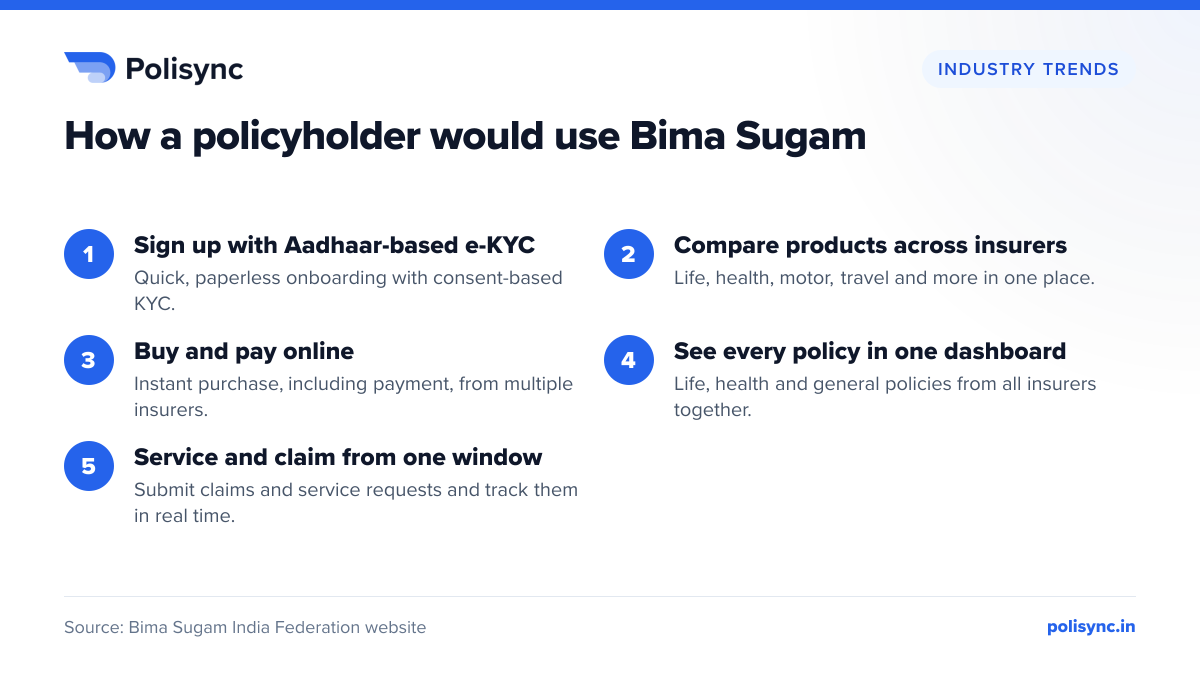
- A digital policy repository, so a customer can see policies from different insurers in one dashboard.
- An e-KYC and consent utility, using Aadhaar-based e-KYC for paperless onboarding.
- A real-time claims servicing gateway for claim intimation and tracking.
IRDAI's latest consultation paper describes Bima Sugam as a Market Infrastructure Institution (MII), meaning shared plumbing for the sector, similar to what stock exchanges and depositories are for securities. The paper notes that all insurers except three are shareholders in BSIF. Business Standard reported in June 2026 that BSIF has authorised capital of ₹500 crore and paid-up capital of around ₹310 crore.
When will Bima Sugam launch? The latest status
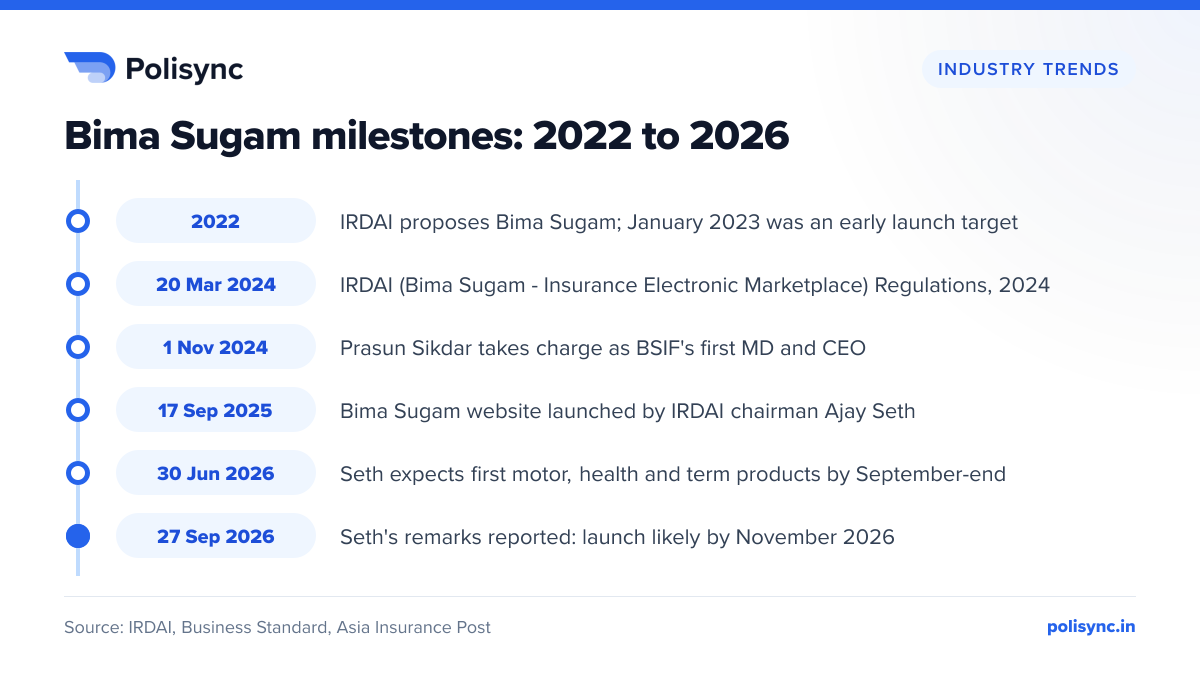
The short answer: there is no fixed launch date yet, and the latest official guidance ranges from "by November" to "within four to six months". Seth told Moneycontrol that Bima Sugam is likely to launch by November, as reported by Asia Insurance Post on 27 September 2026. In an email interview published on 30 September 2026, he told Business Standard that Bima Sugam is expected to be launched shortly, "within four to six months". IRDAI's consultation paper uses the same 4 to 6 month window.
The two statements are not identical. November is the earliest target Seth has mentioned, while four to six months from late September points to roughly February or March 2027. The BSIF website itself carries a note that services are under phased implementation and may be rolled out progressively as industry readiness, regulatory approvals and system integration milestones are met, and its marketplace section still reads "coming soon".
Why has the launch been delayed so often?
The project has a long record of slipping dates. Business Standard reported in January 2025 that the idea, first proposed by IRDAI in 2022, had already missed projected launch dates of January 2023, June 2024, August 2024 and April 2025. The same report said the capital requirement had grown to ₹500 crore from an earlier estimate of ₹100 crore to ₹200 crore, and that insurers wanted more clarity on timelines.
The information website went live on 17 September 2025, launched by Seth at IRDAI's headquarters in Hyderabad, according to Asia Insurance Post, with real transactions to follow as insurers completed integrations. Business Today reported at the time that media reports pointed to a first phase in December 2025. Then on 30 June 2026, Seth told an industry event the project was "behind schedule" but that the first products, motor, health and term insurance, should be available by September-end. That date has now moved again.
How will a policyholder use Bima Sugam?
Detailed user journeys have not been published yet, but BSIF's list of consumer features gives a clear picture of the intended flow. Treat this as the planned design, not a live product.
Is Bima Sugam free for policyholders?
Yes. The 2024 regulations state that consumers shall not be charged for availing the services of the marketplace, and BSIF's FAQs say buying, viewing, servicing, claims and grievance redressal will all be free for policyholders. Instead, the regulations require BSIF to follow a self-sustainable revenue model. Seth has described Bima Sugam as a "commission-neutral" institution "operating on a nominal fee-based model", in his Business Standard interview.
Free to use does not automatically mean every policy will be cheaper. Whether premiums on Bima Sugam end up lower depends on how insurers price products for that channel, which is exactly what IRDAI's new consultation paper is trying to shape.
Can insurance agents and intermediaries sell through Bima Sugam?
Yes, on paper agents are part of the design. The regulations list consumers, insurers, intermediaries or insurance intermediaries and insurance agents as the stakeholders the marketplace serves. BSIF says the platform will enable both do-it-yourself and assisted journeys, and its FAQs say licensed intermediaries, including agents, corporate agents, brokers and web aggregators, will be integrated as key participants. Its website also has a dedicated "For Intermediaries" section.
BSIF's "For Intermediaries" section promises:
- A unified dashboard to access and manage multiple partner-insurer offerings.
- Partner-insurer product discovery, quote generation and policy selling.
- Higher productivity through seamless digital onboarding of customers.
- Built-in compliance with IRDAI norms and regulatory standards.
There is one more clue. Business Standard's June 2026 report says Bima Vahaaks, IRDAI's women-centric distribution force, will sell Bima Vistaar, the rural composite product, through the Sugam platform. So assisted selling on the marketplace is clearly intended.
What has not been published yet is the operational detail: how an individual agent registers, which products they can sell, and how remuneration flows when an agent-assisted sale is completed on Bima Sugam. Until BSIF or IRDAI publishes those rules, treat any specific claim about agent onboarding or payouts with caution.
How could Bima Sugam affect agent commissions?
This is the question most agents are really asking, and the honest answer is that nothing is final. What we do have is IRDAI's consultation paper on distribution reforms, released on 23 September 2026, which makes Bima Sugam a central part of its plan. Per IRDAI's press release, the last date for comments is 25 October 2026. We cover the wider commission proposals in our explainer on IRDAI's commission consultation paper.
What the consultation paper proposes about Bima Sugam and similar platforms (all proposals, open for comment until 25 October 2026):
- Preferred status with lower fees (Section 13): market infrastructure institutions like Bima Sugam "may have preferred distribution status" but should operate with a transparent fee structure much lower than current distribution commission rates.
- A 5% fee ceiling for motor (Section 12): to promote digital motor purchases for new and old vehicles, not-for-profit platforms set up by insurers should not charge a fee of more than 5% of the premium to recover platform cost.
- Possible default option for new vehicles: IRDAI asks (Question 27) whether buyers of new vehicles should mandatorily be offered the marketplace option, with an opt-out. Motor dealers would also have to display the platform option, including a QR code.
- Lower prices expected: the paper expects insurers to offer products at lower rates on such platforms because of lower distribution cost.
- More marketplaces: IRDAI sees scope for more not-for-profit platforms promoted by groups of at least 11 insurers, supported by a regulator-owned Public Insurance Registry (PIR).
In the Business Standard interview, Seth said the proposals are not final and that feedback backed by sound economic or business logic will be considered. Draft regulations will then be placed for another round of public comment before final rules are notified. He also said the intention is for insurers to compete on the price and quality of their products rather than on their ability to pay higher distribution costs. Per Asia Insurance Post, IRDAI is weighing 1 January or 1 April 2027 as the effective date for the new distribution framework, with the final date to be decided after consultation.
Open questions agents should watch
- Will an agent who assists a sale on Bima Sugam earn commission at normal rates, a lower rate, or a different fee?
- Will the same product carry a different premium on Bima Sugam than through an agent?
- Will motor renewals of new vehicles shift towards the marketplace if a default option is adopted?
- How will servicing responsibility be split when a customer buys directly but calls their agent for a claim?
Motor is the segment to watch first: it is one of the three products prioritised for launch and the only one with a proposed platform fee ceiling. Our motor commission playbook covers how motor-heavy agents can diversify.
Agent vs marketplace: who does what best?
A self-serve marketplace is excellent at transactions: comparing, paying, storing documents and tracking requests. It is not built to sit with a family, work out how much cover they need, or argue their case when a claim gets stuck. That difference is where agents keep their value.
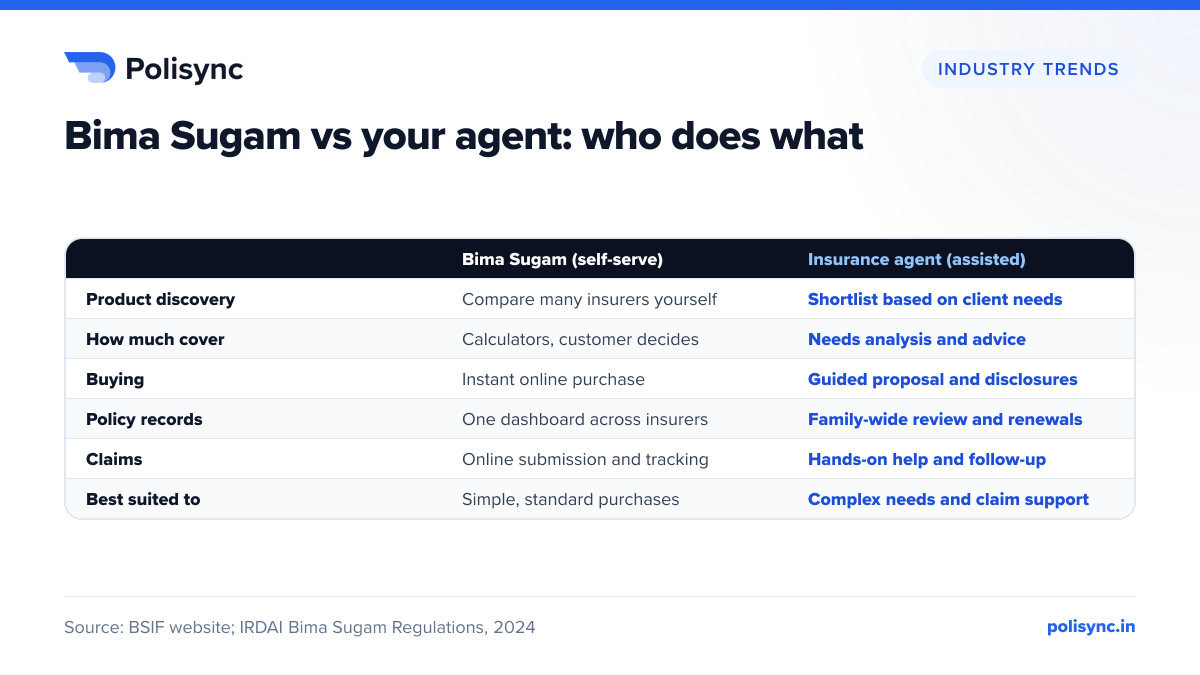
The two roles can also overlap. Because BSIF plans assisted journeys, an agent may end up using Bima Sugam as one more tool, much like agents already use insurer portals. The self-serve trend is not new either; see our guide on customer portals and self-service in insurance.
What this means for insurance agents
- Simple, standard products face the most pressure. Motor, term and health are the three products Seth said were being prioritised first, and they are also the easiest to buy without help.
- Transparency goes up. Seth has said the Public Insurance Registry will provide comparable information on products, premiums, benefits, exclusions and insurer performance, so clients will arrive better informed. Be ready to discuss claim settlement ratios and exclusions openly.
- Advice and claims help become the product. Clients will still need someone to explain riders, waiting periods, nominee choices and claim paperwork.
- Nothing changes overnight. The launch is phased and the commission proposals are still open for comment, so you have time to adapt.
What should agents do now? A 6-step checklist
Use the months before launch to get ready:
- 1. Clean your client records. Make sure every client's policies, renewal dates, nominees, contact details and KYC status are complete and accurate. Agency software can help keep these records organised; see what Polisync offers.
- 2. Help clients consolidate their policies. Run a family policy review and list every cover each client holds across insurers. When the Bima Sugam dashboard goes live, you will already be the person who knows the full picture.
- 3. Go digital in your own workflow. Get comfortable with e-KYC, online proposals and digital payments. Our guide to digital transformation for insurance agencies has a practical roadmap.
- 4. Position yourself as the advice layer. Talk to clients about needs, cover gaps and claims support, not just price. Consistency here is what builds long-term client trust.
- 5. Reduce dependence on commoditised products. If most of your income comes from motor, start adding health, life and family planning conversations now.
- 6. Track official updates and give feedback. Follow BSIF and IRDAI announcements, and consider responding to the consultation paper at iib.gov.in/dr by 25 October 2026, directly or through your insurer or agents' association.
Technology can also free up time for the advisory work that a marketplace cannot do. Our piece on AI for insurance agents in India shows practical ways to cut admin time.
How to explain Bima Sugam to your clients
Clients will see headlines and ask whether they should wait for Bima Sugam or switch their policies. A calm, factual answer builds more trust than dismissing it.
Points you can share:
- It is a regulator-backed marketplace run by an insurer-owned not-for-profit company, and it is free for customers to use.
- As of 30 September 2026 it has not opened for public transactions, so there is no reason to delay buying needed cover.
- The platform is designed to show policies from all insurers in one dashboard, so it can sit alongside the cover they already hold.
- Whichever way they buy, you can still help them choose the right cover and support them at claim time.