

Insurance agents show up in ChatGPT, Gemini and Google AI Overviews the same way they earn visibility in ordinary search: a complete, verified Google Business Profile, a crawlable website or public profile that clearly states who they are, which insurers they represent and where they serve, genuine reviews, and useful answers to real client questions. As of 1 August 2026, Google says no special AI markup or files are needed.
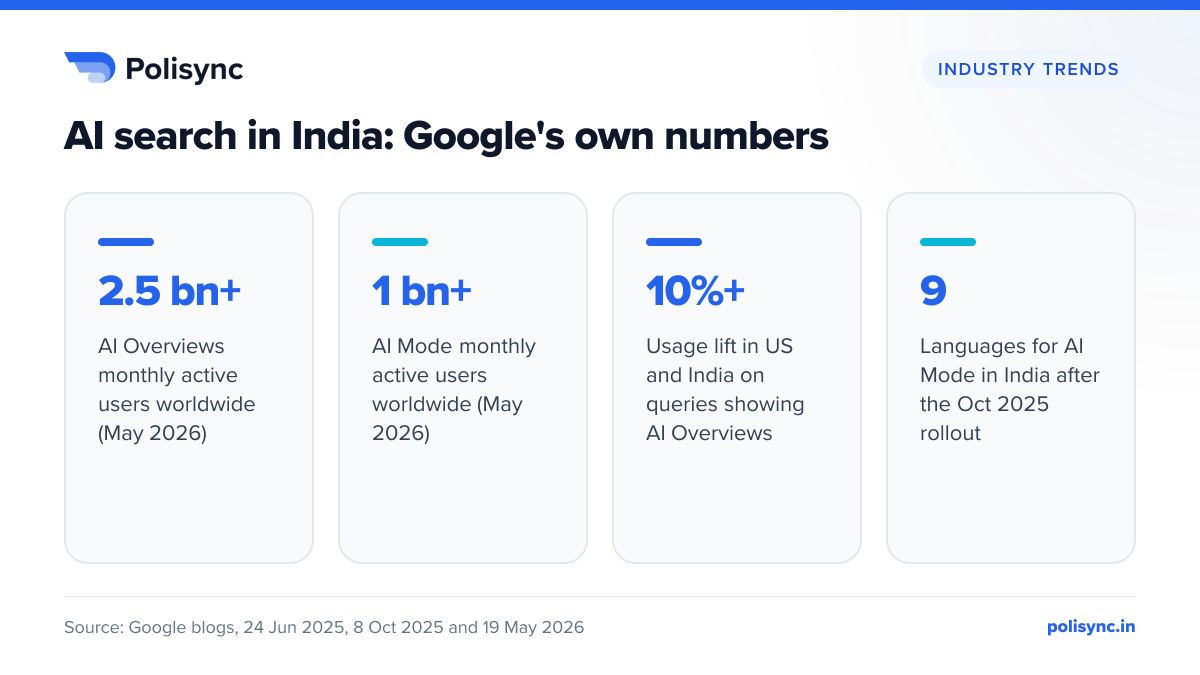
This matters in India more than most places. When Google introduced AI Mode in India on 24 June 2025, it said AI Overviews were driving a more than 10% increase in usage for the queries where they appear in its biggest markets, such as the US and India. It began rolling AI Mode out to everyone in India on 8 July 2025, and on 8 October 2025 started rolling it out in seven more Indian languages to English and Hindi, including Tamil, Marathi and Bengali.
At Google I/O on 19 May 2026, Sundar Pichai said AI Overviews had over 2.5 billion monthly active users and AI Mode had passed 1 billion.
What is Generative Engine Optimisation (GEO) for insurance agents?
Generative Engine Optimisation (GEO) is the practice of making your business easy for AI answer engines to find, understand and cite. For an insurance agent, it means making sure ChatGPT, Gemini and Google's AI features have accurate, public, consistent information about you to draw on.
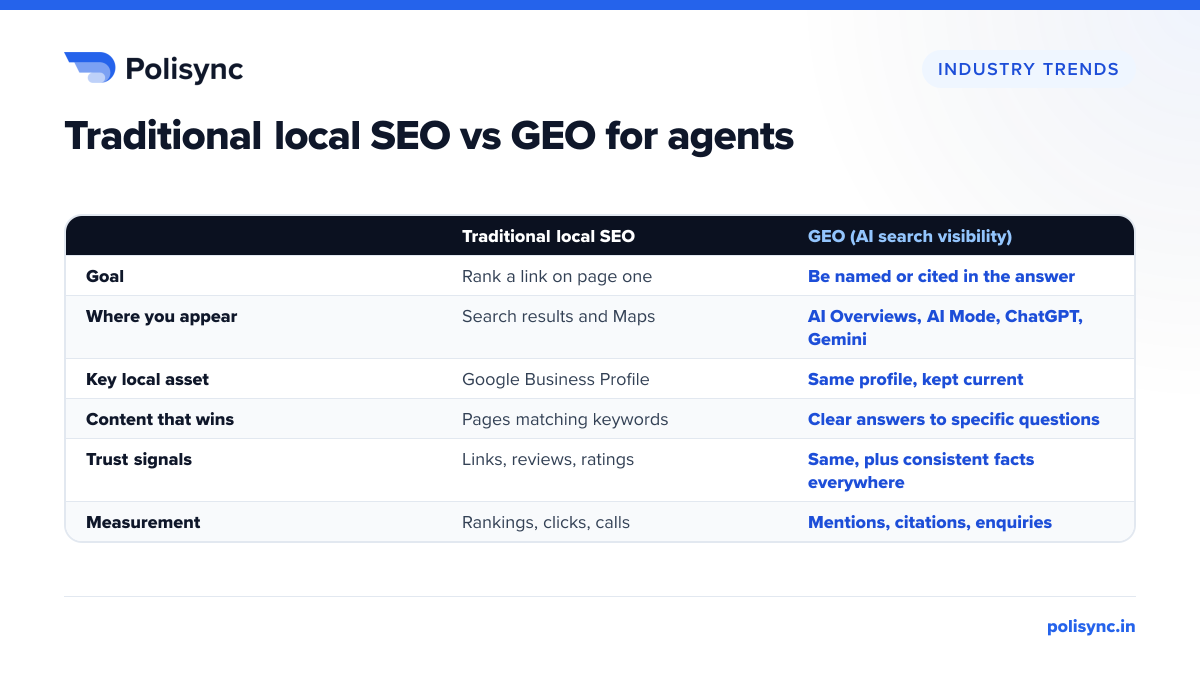
GEO is not a replacement for search engine optimisation (SEO). Google's guide to optimising for generative AI search says SEO best practices continue to be relevant because its generative AI features are rooted in its core Search ranking and quality systems, and that, from Google's perspective, optimising for generative AI search is still SEO. The difference is mostly in the goal: instead of chasing a blue link, you want to be the named, quoted source inside an answer.
How do ChatGPT, Gemini and Google AI Overviews find local insurance agents?
Each assistant works differently, but all three lean on public web information. None has a private list of good agents; they look for sources they can crawl, trust and link to.
Google AI Overviews and AI Mode
Google's page on AI features and your website states there are no additional requirements to appear in AI Overviews or AI Mode, and no special optimisations are necessary. To be shown as a supporting link, a page must be indexed and eligible to appear in Google Search with a snippet. Both features use a query fan-out technique, issuing multiple related searches across subtopics and data sources, which can surface a wider set of links than a normal results page.
The same page lists ordinary best practices: allow crawling, use internal links, offer a good page experience, keep important content in text, support it with good images and video, make sure structured data matches visible content, and keep your Business Profile information current.
ChatGPT search
OpenAI's overview of its crawlers says OAI-SearchBot surfaces websites in ChatGPT's search features; sites that opt out will not be shown in ChatGPT search answers, though they can still appear as navigational links. GPTBot is a separate crawler for content that may train OpenAI's models, and the two settings are independent. ChatGPT-User visits pages when a user asks ChatGPT something, and OpenAI says robots.txt rules may not apply to it. Search changes to robots.txt take about 24 hours to reflect.
The practical point: if your website builder blocks AI crawlers by default, ChatGPT cannot cite your site. You can allow OAI-SearchBot for search while still blocking GPTBot from training.
Gemini
Google's Gemini Apps help page says Gemini may provide links to sources and related content, including public websites, though not every response includes them. For a local agent, that means the information you want Gemini to find and link to has to be published openly on the web.
Why does your Google Business Profile matter so much for AI search?
Google's generative AI guide specifically points local businesses to Google Business Profiles as a way to make their information visible in AI responses and search results. Your profile is often the most structured, verified record of your practice that exists anywhere online.
According to Google's tips to improve local ranking, local results are mainly based on relevance (how well a profile matches the search), distance (how far the business is from the searcher) and prominence (how well known the business is, including how many websites link to it and how many reviews it has). Google adds that businesses with complete and accurate information are more likely to show up, and that there is no way to request or pay for a better local ranking.
Google's guidelines for representing your business include several points that apply directly to agents:
- Use your real-world name. No taglines, service descriptions (such as best health insurance agent) or phone numbers in the business name.
- Insurance agents count as individual practitioners. You may have your own profile if you are public-facing and reachable at the verified location during stated hours; lead generation agents for corporations are not eligible.
- Branded solo practitioners share one profile, named in the format brand: practitioner name (Google's example is Allstate: Joe Miller).
- Service-area businesses should hide their address. If you mostly meet clients at their homes or offices, set a service area instead.
One Indian caution: before using an insurer's brand in your profile name, check with the insurer you are appointed with, because IRDAI requires insurers to approve agent advertising (covered below).
How do reviews affect AI visibility, and how can agents earn them ethically?
Reviews feed the prominence signal Google describes and give AI assistants specific language about your service, such as a client describing help with a cashless hospitalisation. Google says replying to reviews shows that you value customer feedback.
Google's Maps user-contributed content policy is strict. Businesses must not offer payment, discounts or free goods or services for reviews, discourage negative reviews, selectively ask only happy customers, or pressure people to review while on the premises. Reviews based on a conflict of interest, such as from employees or family, are not allowed. On 24 July 2026 Google also added a review snippet guideline on fake and undisclosed incentivised reviews.
Ethical ways to build reviews:
- Ask every client at a natural moment, such as after a settled claim or a smooth renewal, not only those you expect to be happy.
- Share the direct review link with no gift, discount or other reward attached.
- Reply to every review, including critical ones, without revealing policy or health details.
- Never write your own reviews or ask staff, relatives or friends who are not genuine clients.
Reviews and referrals come from the same place: clients who felt looked after. Our guides on building client trust as an insurance agent and how to get insurance referrals cover the service habits behind both.
What should an insurance agent's website or public profile include?
AI assistants can only repeat what they can read. A simple one-page website, or a well-filled public profile, beats an elaborate site that hides key facts in images or PDFs. Google's AI features page specifically recommends making important content available in text form.
Put these facts in plain text, worded identically everywhere you appear online:
- Name, phone and address or service area exactly as they appear on your Google Business Profile.
- Your role, for example individual agent, corporate agent or POSP, and the insurer or insurers you are appointed with.
- Registration details such as your agent code or licence reference, as issued to you, so clients can verify you.
- Lines of business you handle: life, health, motor, home, commercial.
- Cities, localities or districts you serve, and whether you visit clients.
- Languages you speak with clients.
- What you help with after the sale: renewals, claim support, nominee updates, portability questions.
- Working hours and a real photo of you or your office.
Consistency is the quiet superpower here. When your name, phone number and locality match across your Business Profile, website, LinkedIn, insurer locator pages and directories, AI systems have fewer conflicting facts to reconcile.
Do not ignore LinkedIn: a complete profile with a clear headline, your locality and the insurance lines you handle is another public page AI tools can read. For the wider picture, see our guide to digital transformation for insurance agencies in India.
What kind of content helps AI assistants cite you?
Google's generative AI guide asks for valuable, non-commodity content with a unique perspective. It also says there is no need to break content into tiny pieces for AI or to write in a special way for generative AI search. In other words: write helpfully for people, and the machines follow.
For a local agent, the most citable content answers the questions clients actually ask you, with local detail generic sites cannot match:
- Which hospitals near our area are commonly on cashless networks, and how do I check my own policy?
- What documents do I need for a motor claim after an accident in the city?
- How does health insurance portability work if I change jobs?
- What happens if I miss my premium due date?
Keep answers short, factual and dated where rules change, and never promise returns or claim outcomes. AI tools can help you draft such pages, as covered in our guide to AI for insurance agents in India, but check every fact yourself before publishing.
Do insurance agents need schema markup or an llms.txt file?
Short answer: helpful for some purposes, but not required for AI search. Google's generative AI guide says structured data is not required for generative AI search and there is no special schema.org markup to add. It also says you do not need new machine-readable files, AI text files or Markdown to appear in Google Search.
LocalBusiness and InsuranceAgency markup
Structured data is code that labels facts on a page (name, address, phone) so search engines read them reliably. Schema.org has an InsuranceAgency type under LocalBusiness and FinancialService. Google's LocalBusiness documentation requires name and address, recommends telephone, url and opening hours, advises the most specific sub-type, and recommends review markup only for sites reviewing other businesses. Its general guidelines say markup must match visible content, must never include fake reviews, and does not guarantee a rich result.
What happened to FAQ markup?
According to Google's documentation updates log, FAQ rich results stopped appearing in Google Search from 7 May 2026 (the deprecation notice was added on 8 May 2026), and on 15 June 2026 Google removed the FAQ rich result documentation entirely. FAQPage markup therefore no longer earns an expandable FAQ display in Google. The visible questions and answers on your page are what still matter.
What is llms.txt?
llms.txt is a proposal published by Jeremy Howard on 3 September 2024 for a Markdown file at a website's root that gives AI tools background and curated links. It is not an official standard. On 15 June 2026 Google clarified that such files are not needed for Google Search and will neither help nor hurt rankings, though keeping one for other services is fine. For a small agent, it is a low-priority extra.
What do IRDAI rules mean for agents promoting themselves online?
Visibility must not come at the cost of compliance. The IRDAI (Protection of Policyholders' Interests, Operations and Allied Matters of Insurers) Regulations, 2024, notified on 20 March 2024 and in force from the later of Gazette publication or 1 April 2024, contain the current advertisement rules. Regulation 28 says every advertisement must be approved by the insurer in writing before it is issued if it is issued by a distribution channel representing the insurer, which includes an agent.
Regulation 27 of the same regulations adds points that apply directly to your online presence:
- Distribution channels may advertise only as soliciting products offered by insurers, never implying the products are their own.
- Advertisements must be fair and true, must not hide risks or exclusions, and must not contain fabricated facts or figures.
- Content posted on a social media platform or page must comply with the regulations.
Law firm Tuli and Co, writing on Mondaq on 17 September 2024, notes this principle-based framework replaced the Insurance Advertisements and Disclosure Regulations, 2021 and addresses social media. The safe practice: keep your profile factual, and get written insurer approval before publishing product names, premium illustrations, benefit claims or comparisons online. Our IRDAI compliance checklist for insurance agents covers the wider rules. This is general information, not legal advice.
What this means for insurance agents: an AI visibility checklist
Most of this is one-time setup followed by small monthly habits, in this order of priority.
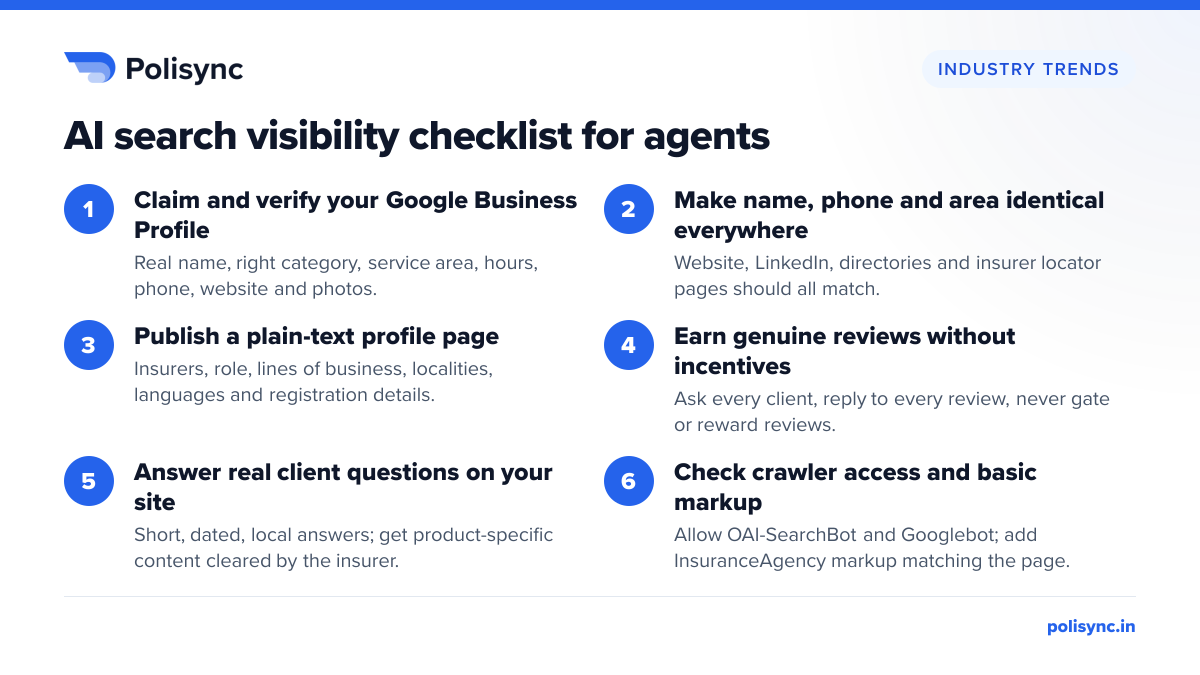
Your step-by-step action list:
- Week 1: Claim or update your Google Business Profile, pick the most accurate category, and set a service area if you visit clients.
- Week 1: Fix one master version of your name, phone number (with +91) and locality, and make every profile match it.
- Week 2: Publish a one-page website or public profile in text, and ask your web provider whether robots.txt blocks OAI-SearchBot or Googlebot.
- Week 3: Start asking every client for an honest review after key service moments, with no incentives.
- Week 4: Add three to five short answers to common client questions, clearing anything product-specific with your insurer.
- Every month: Reply to reviews, refresh hours and holiday timings, and add one new question and answer.
How can you check whether AI assistants mention you?
Test it the way clients would. Ask ChatGPT, Gemini and Google's AI Mode who is a good health insurance agent in your locality, or who can help with a motor claim in your city. Answers vary by location, device and account, so try a few phrasings and note which sources each tool links.
If an assistant gets a fact wrong, such as an old phone number, fix it at the source it cites. If you have a website, verify it in Google Search Console, where Google says AI Overviews and AI Mode traffic is included in the Performance report. Finally, ask new clients how they found you, because an enquiry that started in an AI chat often looks like a direct call.