

To get more referrals as an insurance agent in India, ask at five moments of proof (policy delivery, claim help, annual review, renewal and life events), use a specific low-pressure script, get a permission-backed introduction, follow up within 48 hours, track every referral, and thank referrers without cash or gifts, because the Insurance Act, 1938 bars rebates and unlicensed commissions (as of 29 July 2026).
Why do referrals work so well for insurance agents?
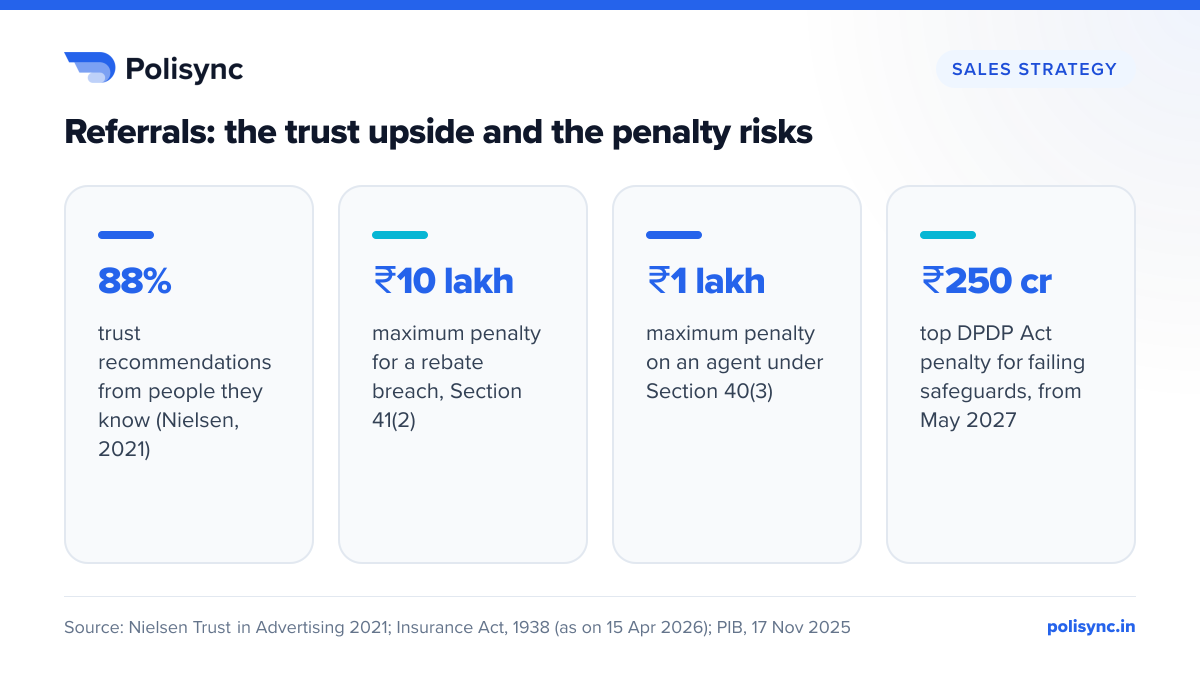
Insurance is a trust purchase: the client pays today for a promise that may be tested years later. A recommendation from someone they know lowers that trust barrier before you even meet. In Nielsen's 2021 Trust in Advertising study, 88% of global respondents said they trust recommendations from people they know more than any other channel.
A referral is an introduction to a potential client made by someone who already knows and trusts you, usually an existing client. Referrals come from good service plus a clear, well-timed ask. If your service is patchy, fix that first; our guide on building client trust as an insurance agent covers the foundations.
What is a repeatable referral system?
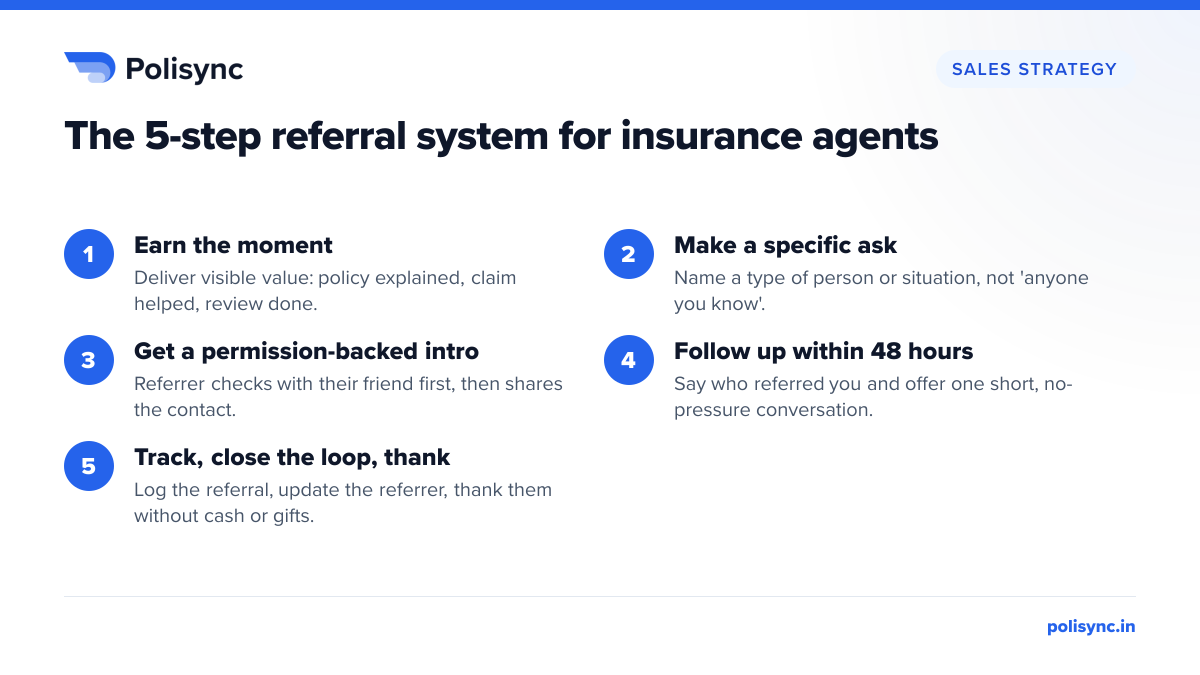
Most agents ask for referrals only when their pipeline runs dry, which makes the ask sound desperate. A system makes it routine. It has five steps that you repeat with every client, every year.
When is the best time to ask for a referral?
Ask when the client has just experienced your value, not when you need business. These five moments work across life, health and general insurance.
1. At policy delivery
When you hand over the policy document, walk the client through the cover, exclusions and nominee details. Clients rarely get this explanation, so it stands out. End with a gentle ask for someone who might be in a similar stage of life.
2. After you help with a claim
A claim is when the promise is tested, and your support is remembered for years. Helping a family with documents, hospital coordination or explaining why health insurance waiting periods apply builds deep goodwill. Wait until the claim is settled and the client is calm, then ask.
3. At the annual review
A yearly review of cover, sum insured and nominees shows you are not a one-time seller and surfaces life changes (a new job, a child, ageing parents) that naturally lead to names of siblings, colleagues or friends in the same situation.
4. After a smooth renewal
A renewal done on time, with no lapse and no surprises, is a small proof point. Strong renewal habits also keep clients with you long enough to refer; see our customer retention strategies for insurance agents.
5. At life events
A wedding, a new home, a promotion or a retirement changes what a client and their circle need. Congratulate first and review the client's own needs; ask for a referral only after you have been useful.
What should you say when asking for a referral?
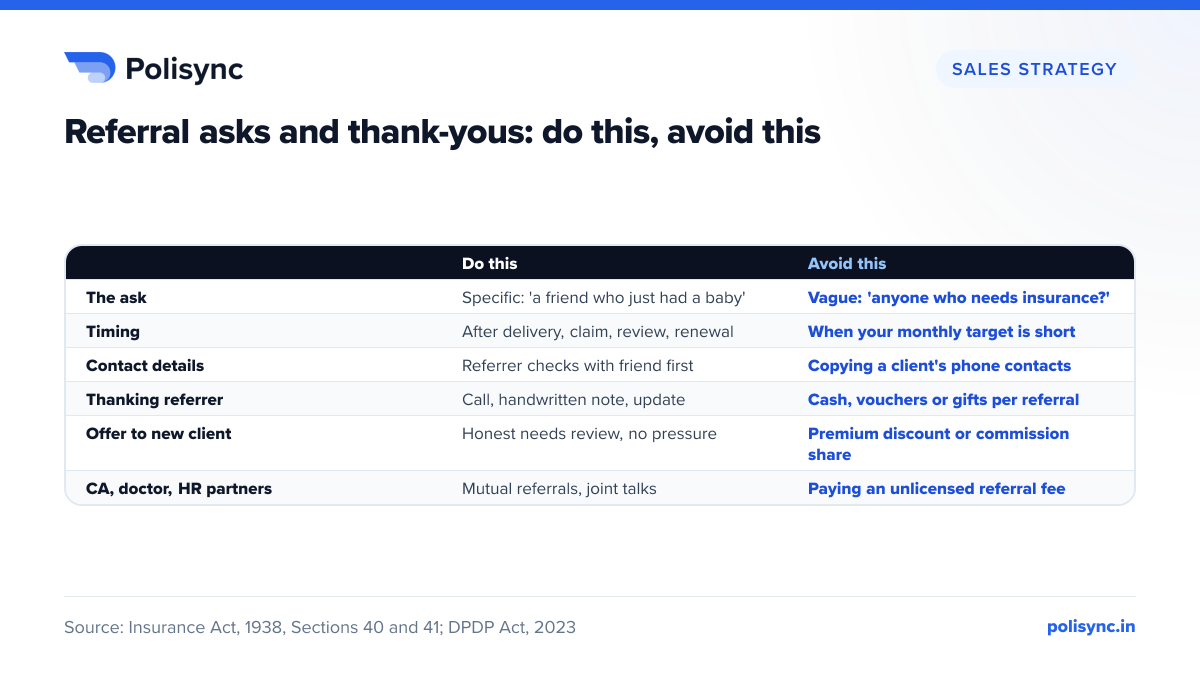
Good scripts are specific, short and give the client an easy way to say no. Vague asks like "Do you know anyone who needs insurance?" make people think of nobody.
Scripts you can use (English):
- After policy delivery: "I'm glad the policy is clear now. Most of my clients come through people like you. Is there a colleague or friend who has recently started a family and may not have term cover yet? If so, could you check with them whether they'd be open to a 15-minute call?"
- After a claim: "I'm relieved the claim is settled. If anyone in your family or building ever needs help understanding their health cover, I'd be happy to review it for them, no obligation."
- At the annual review: "You mentioned your brother just moved jobs. Group cover often changes when people switch employers. Would he find a quick review of his cover useful?"
- When the client hesitates: "No problem at all. If someone comes to mind later, just tell them about me and share my number. I won't contact anyone without their okay."
A few Hinglish lines that feel natural in many Indian conversations:
- "Aapke office mein koi hai jiski nayi shaadi hui ho ya baby aaya ho? Unhe term plan ke baare mein ek baar samjha dun, bas itna hi."
- "Aap pehle unse pooch lijiye, agar woh haan bolein toh hi number share kijiye. Main unhe bilkul pressure nahi karunga."
- "Aapke parents ka health cover review hua hai? Society mein aur bhi families hongi jinke senior members ka cover kam hai."
Notice what every script avoids: discounts, gifts for names and pressure. That keeps you on the right side of the law, as explained below.
How do you get referrals from family groups and workplaces?
Indian families often make insurance decisions together, so one well-served client can open a whole family group. When you insure a couple, ask about parents' health cover and siblings' term cover as part of the needs review, not as a sales pitch.
Practical ways to widen the circle:
- Family reviews: offer a single sitting where you review cover for the whole household, including parents who may depend on the client's employer policy.
- Workplace colleagues: clients who explain their own cover to colleagues are powerful advocates. Offer to answer questions at a lunch-hour session only if the employer or HR has approved it.
- New joiners and job changers: people switching employers often lose or change group health cover, a natural reason for a review.
- Housing societies: a short, educational talk on health cover or home insurance, organised with the committee's permission, positions you as the helpful expert in the building.
Which centres of influence can send you referrals?
A centre of influence (COI) is a professional or community figure whom many people trust for advice, and who can point them towards you. For Indian agents, the most useful COIs are:
- Chartered accountants and tax consultants: clients ask them about tax-saving and protection every filing season. Offer to explain policy details so the CA can stay focused on tax.
- Doctors and clinic managers: they see families struggling with hospital bills. The doctor should only suggest that a patient contacts you; they should never share patient details with you.
- HR managers: they field questions about group cover gaps, top-ups and cover for parents. Educational sessions, approved by the company, are the right format.
- Housing society committees and RWAs: they organise residents' events and can host awareness talks.
- Other professionals: property dealers, car dealers and wedding planners meet people at life events that change insurance needs.
The crucial rule: you cannot pay a COI for business. Section 40(1) of the Insurance Act, 1938 says no person shall pay or contract to pay any remuneration or reward, by way of commission or otherwise, for soliciting or procuring insurance business to anyone except an insurance agent or insurance intermediary. Build COI relationships on mutual value instead: you refer your clients to a good CA, they refer theirs to you. If a COI wants to earn from insurance, they need to get licensed themselves.
How should you follow up and track referrals?
A referral goes cold fast, and the referrer has put their reputation on the line, so a slow or pushy follow-up hurts two relationships at once.
An illustrative follow-up cadence (adjust to your market):
- Day 0 to 2: first contact, by call or a personal message. Mention the referrer by name and how you got the number, and ask whether a short conversation would be useful.
- Day 5 to 7: if there is no reply, one polite reminder. Keep it short and easy to decline.
- Day 14: a final, low-key message offering help whenever they are ready. After this, stop.
- If they say no at any point: thank them, stop contacting them and delete their details, unless they ask you to stay in touch.
Personal one-to-one messages work well for the first contact; our guide to WhatsApp for insurance agents covers tone and etiquette. Never add a referred person to a broadcast list without their clear agreement.
What should you track for each referral?
- Referrer's name and the moment you asked (delivery, claim, review, renewal, life event).
- Prospect's name, contact details and a note that they agreed to be contacted.
- Stage: introduced, contacted, meeting held, proposal, policy issued, declined.
- Next step and date.
- Whether you have closed the loop with the referrer.
Over a few months, this record shows which moments and clients produce the best introductions. A spreadsheet works to begin with; agency management software such as Polisync can help keep client records organised in one place. For the full pipeline, from first contact to issued policy, see our insurance lead management guide, and for other sources of new clients, our guide on prospecting to find new insurance clients.
How do you thank referrers without breaking IRDAI rules?
Two sections of the Insurance Act, 1938 matter most.
- Section 41 (prohibition of rebates): no person may allow or offer, directly or indirectly, as an inducement to take out, renew or continue a policy, any rebate of the commission or of the premium shown on the policy, and the policyholder must not accept one. The penalty for default can extend to ₹10 lakh under Section 41(2).
- Section 40 (payment for procuring business): commission or any other reward for soliciting or procuring insurance business can be paid only to an insurance agent or insurance intermediary. An agent who contravenes this can face a penalty of up to ₹1 lakh under Section 40(3).
The Sabka Bima Sabki Raksha (Amendment of Insurance Laws) Act, 2025 (Act No. 40 of 2025, in force from 5 February 2026) made limited changes here. In Section 41, it widened the agent's own-policy exception: an agent may now accept commission on a policy of any class taken out for their own life, health or property. In Section 40, it added sub-section (2A), letting IRDAI specify limits on commission and other rewards paid to agents and intermediaries. The ban on rebates to clients and the penalty amounts of ₹1 lakh and ₹10 lakh are unchanged in the consolidated Act as on 15 April 2026.
A cautious reading is that cash, vouchers, gifts tied to a referral converting, or a "first premium discount" for the new client all risk being treated as a rebate or a reward for procuring business. Thank referrers with gratitude and service instead: a phone call, a handwritten note, and a short update that you have spoken to their friend (without sharing anything the friend told you). If you are unsure whether a gesture is allowed, check with your insurer's compliance team before offering it.
Do referral posters and WhatsApp forwards count as advertisements?
Possibly. The IRDAI (Protection of Policyholders' Interests, Operations and Allied Matters of Insurers) Regulations, 2024 define an advertisement as a communication, through any mode or medium, addressed to the public or a section of it, whose purpose is to influence the opinion or behaviour of prospects towards the sale of insurance products. Regulation 28 says every advertisement issued by a distribution channel representing the insurer must be approved by the insurer in writing before it is issued, and Regulation 27(6) extends the advertising rules to content on your social media pages. So a product flyer you hand out at a society event, or a product poster you forward to groups, should go through your insurer first. A personal conversation with one referred person is a different matter, but keep it factual and never overstate benefits.
What does the DPDP Act mean for referred prospects' data?
When a client gives you a friend's name and number, you now hold that friend's personal data, but the friend has not agreed to anything. PIB's explainer on the DPDP Rules, 2025 describes a Data Fiduciary as an entity that decides why and how personal data is processed, which is what an agent does with a prospect list.
Under Section 6(1) of the DPDP Act, 2023, consent must be free, specific, informed, unconditional and unambiguous with a clear affirmative action, and limited to the personal data necessary for the specified purpose. The DPDP Rules, 2025 were published in the Gazette on 13 November 2025 (announced by PIB on 14 November) with an eighteen-month phased timeline: the rules on the Data Protection Board applied at once, Consent Manager registration follows after one year, and the consent notice and most other obligations apply after eighteen months. The Act's own notice and consent provisions, including Section 6(1), commence on the same 18-month timeline, in May 2027, under the commencement notification G.S.R. 843(E). So, as of July 2026, these duties are not yet legally enforceable, but building consent habits now is good practice and prepares you for them.
Referral habits that fit the DPDP Act:
- Ask the referrer to check with their friend before sharing the number (the permission-backed introduction).
- In your first message, say who you are, who referred you and why you are reaching out, and ask whether they are happy to talk.
- Record the date and form of their agreement, and use the details only for the purpose they agreed to.
- If they decline or withdraw, stop and delete their details; Section 6(6) says processing must cease within a reasonable time after consent is withdrawn, and Section 8(7) requires the data to be erased.
- Never scrape contacts from a client's phone, a society directory or a WhatsApp group.
For a fuller walkthrough of notices, consent records and data security, read our DPDP Act guide for insurance agents.
What does this mean for insurance agents? Your referral action checklist
Here is a checklist to put the system in place this month.
- 1. List your five moments of proof and add a referral ask to each one: delivery, claim, review, renewal, life event.
- 2. Write two scripts in your own words, one in English and one in the language your clients speak at home, and practise them aloud.
- 3. Switch from asking for numbers to asking for permission-backed introductions.
- 4. Pick three centres of influence (for example a CA, an HR manager and a society committee) and offer each a useful, no-fee collaboration.
- 5. Set up a referral tracker with source, consent note, stage, next step and loop-closed fields.
- 6. Follow up every referral within 48 hours, stop after three touches, and delete details of anyone who declines.
- 7. Remove any cash, voucher, gift or discount from your referral thank-yous, and clear any printed or forwarded product material with your insurer.
- 8. Review your tracker every quarter to see which moments and clients generate the best introductions.