

On 23 September 2026, IRDAI released a consultation paper, Recalibrating Economics of Insurance Distribution, proposing hard caps on motor insurance commission. For individual agents, the proposed caps are 2.5% on new-vehicle third-party (TP) cover, 5% on old-vehicle TP, 10% on new-vehicle own damage (OD) and 15% on old-vehicle OD. Distribution entities would get nil to 10%. Comments are open until 25 October 2026.
This post explains exactly what has been proposed as of 29 September 2026, why the regulator is focusing on motor, and what a general insurance agent with a motor-heavy book can do about it this quarter. For the full paper across life, health and general insurance, read our breakdown of the IRDAI commission consultation paper 2026.
What has IRDAI proposed on motor insurance commission?
According to IRDAI's press release, the paper sets out reforms to distribution structure, expenses, commissions and market conduct. The motor caps sit in Box 4A of Part 1 of the consultation paper. They separate new vehicles from old (renewing) vehicles, and individual agents from Insurance Distribution Entities (IDEs), the proposed single category for brokers, corporate agents and other entity distributors.
The proposed maximum motor commission, as a percentage of premium, is:
- TP, new vehicle: 2.5% for agents and associates, nil for distribution entities.
- TP, old vehicle: 5% for agents, 2.5% for distribution entities and 2.5% for garages.
- OD, personal accident and legal liability, new vehicle: 10% for agents, 5% for distribution entities.
- OD, personal accident and legal liability, old vehicle: 15% for agents, 10% for distribution entities and 10% for garages.
- Motor packaged with a loan or credit: nil on TP (new or old vehicle) and 5% on OD, PA and legal liability, for lending-cum-distribution entities such as banks and NBFCs.
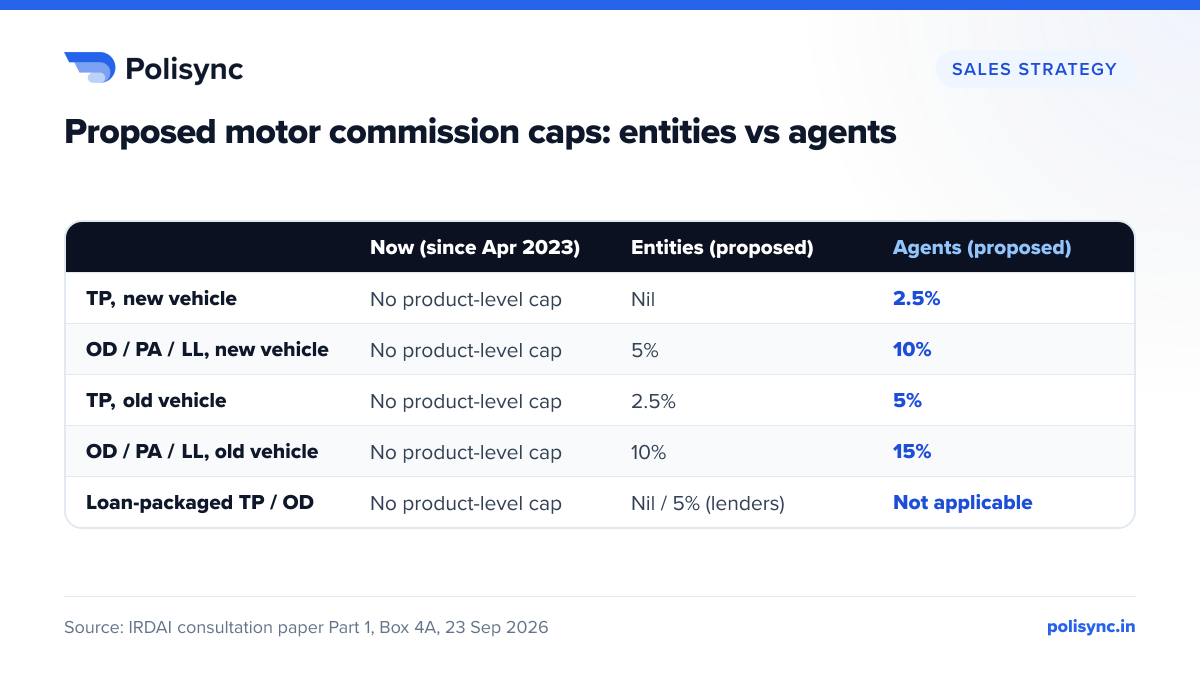
Read the loan-linked row carefully. Some early summaries described nil TP commission on loan-linked sales as a cap for agents, but in the paper that nil rate sits in a separate table for lending-cum-distribution entities. The same paper also proposes to prohibit compulsory bundling of insurance with loans by banks and NBFCs.
What is the difference between motor TP and OD insurance?
Third-party (TP) insurance is the compulsory part of motor cover: it pays for death, injury or property damage the insured vehicle causes to others. Section 146 of the Motor Vehicles Act, 1988 prohibits using a motor vehicle in a public place without valid TP insurance.
TP premiums are not priced by insurers. The Ministry of Road Transport and Highways notifies them in consultation with IRDAI. The Motor Vehicles (Third Party Insurance Base Premium and Liability) Rules, 2022, in force from 1 June 2022, set for example ₹2,094 a year for private cars up to 1,000 cc and ₹3,416 for cars above 1,000 cc up to 1,500 cc.
These are the latest notified base premiums we could trace as of 29 September 2026. A revision has been under discussion: Business Standard reported in June 2025 that MoRTH and IRDAI were discussing a hike of up to 10%. Always check the currently notified rate for the vehicle class at renewal.
Own-damage (OD) insurance covers damage to or loss of the policyholder's own vehicle. It is optional, priced by the insurer, and it is where the no claim bonus and most add-ons come in. Our motor insurance guide for agents covers the product basics in more depth.
The distinction matters because the regulator's logic rests on it. The paper says mandatory products should carry nil or very low commission because they need no selling effort, and it calls new-vehicle TP a nil-effort product. OD and renewals of older vehicles, which need more advice and servicing, keep higher proposed caps.
Why is IRDAI targeting motor insurance commissions?
Commission caps were removed in 2023. From 1 April 2023, insurers could pay commission under a board-approved policy, as long as total spending stayed within their overall expenses of management (EoM) limit, as Cafemutual explained at the time. The consultation paper argues that this flexibility pushed motor payouts sharply higher.
Figures from the paper, also reported by Upstox:
- In IRDAI's broker-channel analysis, motor premium grew about 34% between FY23 and FY25, while motor commission grew about 259%.
- The average commission rate on broker-placed motor business rose from about 9% to about 25% over the same period.
- Average commission on mandatory motor TP, where premiums are regulated, rose from 4.3% in FY23 to 22% in FY25.
- Motor commission averaged 24% overall, in a range of 13% to 50%.
- On new vehicles, motor dealers (motor insurance service providers, or MISPs) averaged 38% and OEM-linked brokers 27%. MISPs still averaged 12% on old vehicles.
- In FY25, OEM brokers and MISPs were paid almost ₹7,050 crore in commission on about ₹29,000 crore of premium.
- Banks and NBFCs that finance vehicles and insist on bundling the loan with insurance still earn 16% commission.
Section 12 of the paper calls motor 'a prime example of lack of transparency driving high commissions', despite the product being simple and partly mandatory. In other words, the heaviest reported payouts sit with dealer, broker and lender channels, especially on new vehicles, not with the traditional agent.
Motor caps are one part of a wider cost reset. For general insurers, the proposed EoM limit would move from 30% of gross written premium to 25% of domestic gross direct premium income within two years and 20% within five years, per Box 2 of Part 1. The paper also proposes that dealers show buyers the option to buy motor cover on a market infrastructure platform such as Bima Sugam.
What is still only a proposal?
As of 29 September 2026, treat every number in this post as draft:
- Comment window: IRDAI is taking feedback until 25 October 2026, according to IRDAI's press release and Section 18 of the paper.
- No effective date: FY2027-28 is proposed as Year 1 of the EoM glide path, but no commencement date for commission caps had been notified when this post was published.
- Numbers can change: caps, categories and the new-vs-old vehicle split may be revised after consultation.
- Other lines are in scope too: the same paper proposes, for example, agent caps of 20% on a first-time individual health policy and 10% on renewal.
- Conduct rules: proposals include tagging each policy with the identity of the person who sold it and commission claw-backs where mis-selling is found.
That point on other lines matters for diversification. Moving into health or life is not a way to escape regulation, since those lines face proposed caps as well. It is a way to spread income across more products and more years of the same client relationship.
How much could a motor-heavy agent lose? An illustrative model
Every insurer pays differently today, so the only honest way to size the impact is to model your own book. Here is a hypothetical example to show the method. The premiums (excluding GST) and today's commission rates below are assumptions, not market data.
Illustrative book of 300 private car renewals (old vehicles), all comprehensive:
- Assumed average TP premium: ₹3,500 per policy, so ₹10,50,000 in total.
- Assumed average OD premium: ₹8,000 per policy, so ₹24,00,000 in total.
- Assumed current commission: 10% on TP and 20% on OD, giving ₹1,05,000 + ₹4,80,000 = ₹5,85,000 a year.
- At the proposed old-vehicle agent caps (5% TP, 15% OD): ₹52,500 + ₹3,60,000 = ₹4,12,500, a fall of ₹1,72,500 (about ₹1.73 lakh, or roughly 29%).
- For comparison, if the same premiums were earned on new vehicles, the proposed new-vehicle agent caps (2.5% TP, 10% OD) would pay ₹26,250 + ₹2,40,000 = ₹2,66,250.
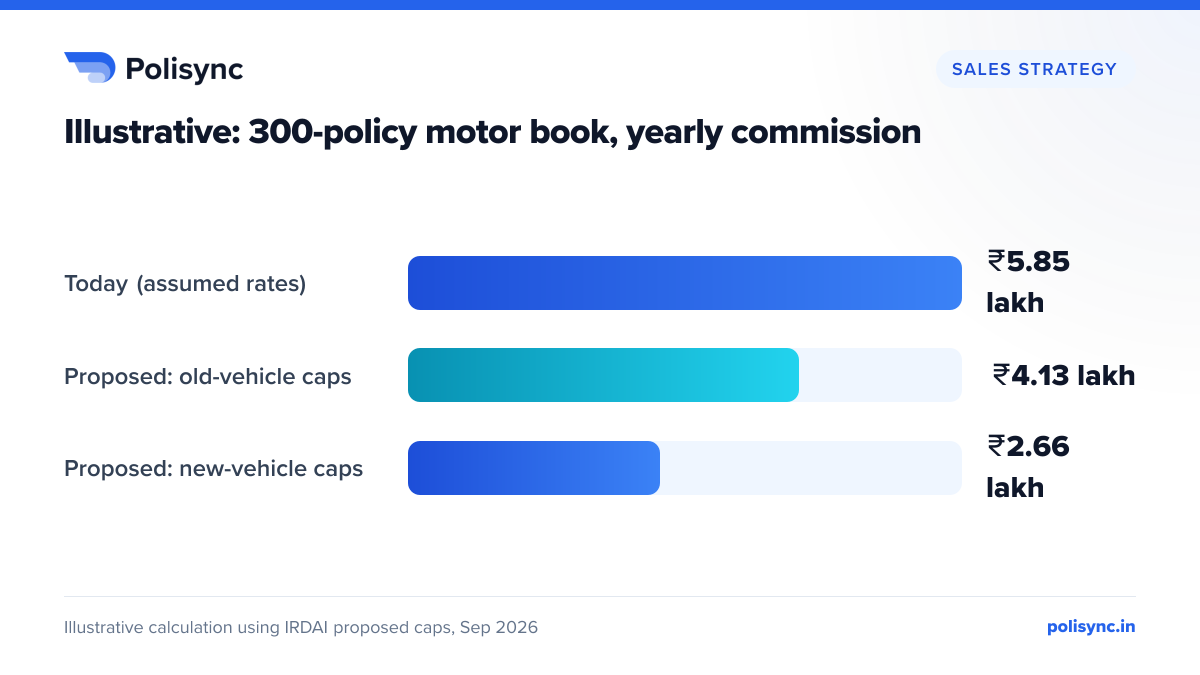
Now look at the offset. Still hypothetically, if 30 of those 300 families (10%) bought a first-time individual health policy with a ₹25,000 premium, the proposed 20% cap would pay ₹1,50,000 in year one, about 87% of the illustrative ₹1,72,500 motor gap. From year two, the proposed 10% renewal cap would pay ₹75,000 a year on the same policies. You can sanity-check typical car premiums with our car insurance premium calculator before you build your own model.
What this means for insurance agents
- TP-only clients become close to zero income. At the proposed 5% old-vehicle cap, a TP renewal at the 2022 notified rate of ₹3,416 would earn about ₹171.
- Loan-linked motor gets cheaper to distribute. Lenders packaging motor cover with a loan would be capped at nil on TP and 5% on OD, and compulsory bundling would be prohibited, so borrowers may have more freedom to buy elsewhere. Whether that brings business to agents is a possibility, not a certainty.
- OD and add-ons carry the income. Advising on the right OD cover and add-ons becomes the part of motor that pays.
- Agents keep a higher cap than entities. The paper gives agents and associates higher limits because they work in a closed architecture with fewer insurers to offer, while dealer and broker entities face the lowest caps.
- Relationship value beats transaction value. A motor client who also holds health, life and personal accident cover is worth far more than a single annual renewal.
The 5-step playbook for motor-heavy agents
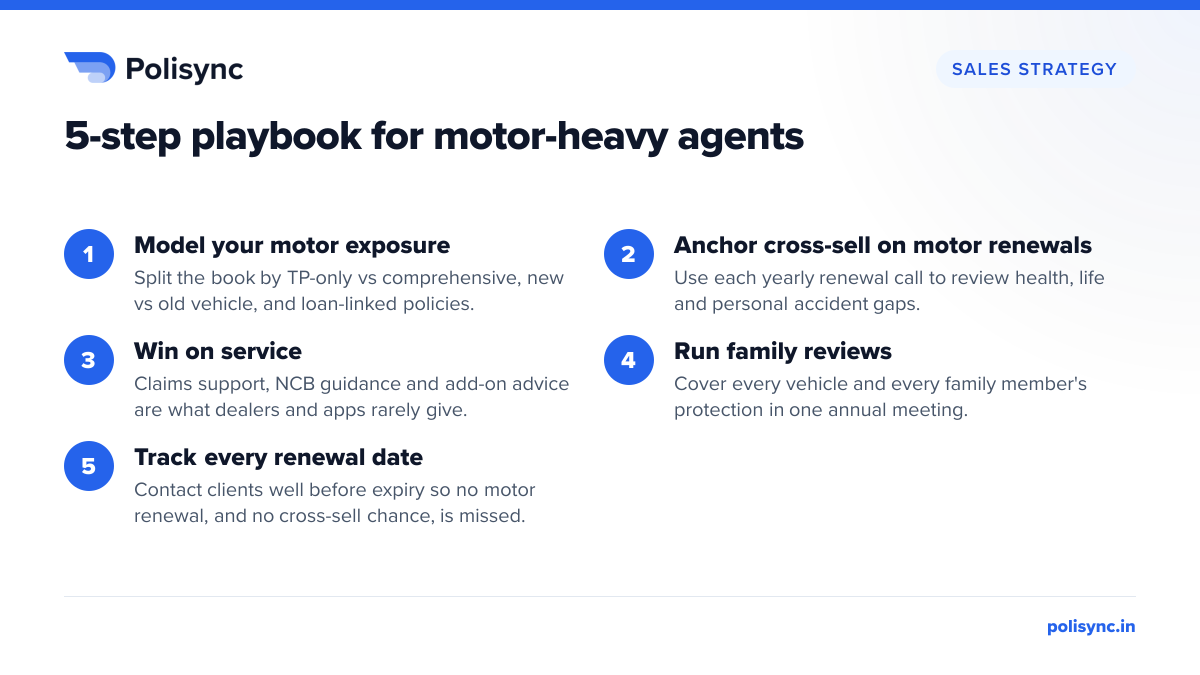
Step 1: Model your motor exposure
Export your motor book and tag each policy: TP-only or comprehensive, new or old vehicle, loan-linked or not. Apply the proposed caps from the table above to your actual premiums. The result tells you how much income you need to replace, and from how many clients.
Step 2: Use motor renewals as the cross-sell anchor
Because TP cover is compulsory, a motor client always has a legal reason to renew. That makes the renewal conversation a natural, recurring door-opener. Use it to ask about family health cover, term life and income protection, following our health insurance cross-selling guide.
Two-wheeler riders and daily commuters are natural prospects for personal accident insurance, which is simple to explain and fits the same conversation about road risk. Keep advice needs-based: record what the client told you and why the product suits them.
Step 3: Win on service, not discounts
Service is what a dealer desk or a price-comparison app rarely offers. Make it visible:
- Claims help: be the first call after an accident, and walk the client through intimation, survey and garage paperwork.
- NCB guidance: explain how the bonus is earned, protected and transferred, using our no claim bonus explainer, so clients do not lose it by switching carelessly or claiming small repairs.
- Add-on advice: recommend only the add-ons that fit the car's age and use, with our motor insurance add-ons guide as a reference.
Step 4: Bundle family reviews
Offer one annual review per household that covers every vehicle plus every member's health, life and accident cover. One meeting, one summary sheet, one set of renewal dates. It deepens trust and replaces several small transactions with a single relationship.
Step 5: Track every renewal date
When each motor policy pays less, losing one to a lapse or a late switch hurts more, and so does missing the cross-sell conversation that comes with it. Keep expiry dates, vehicle details and family policies in one place; agency management software such as Polisync can keep these records organised and send email reminders ahead of renewal.
How can agents respond during the consultation?
Section 18 of Part 1 invites comments from the public and all stakeholders until 25 October 2026, in one of three modes: answering the consultation questions on the IRDAI consultation portal, uploading the prescribed Excel template there, or emailing the filled template to drfeedback@iib.gov.in. Use only one mode per submission. Feedback routed through your insurer's agency team or an agents' association can also carry weight.
Useful, evidence-based points to raise:
- The servicing work agents do on old-vehicle renewals: claim support, NCB transfers, endorsements and inspections.
- Whether a separate cap is needed for two-wheeler and commercial vehicle renewals, where premiums and commission amounts are small.
- Practical timelines for moving existing books to new caps.
- Keep comments factual and specific; generic objections to lower commission are unlikely to change the outcome.
What should agents do before 25 October 2026?
A practical checklist:
- Read Section 12 and Box 4A of the consultation paper on IRDAI's website, not just headlines.
- Export your motor book and tag TP-only, comprehensive, new, old and loan-linked policies.
- Model your income at the proposed caps and write down the gap you need to replace.
- List every motor client with no health, life or personal accident policy with you.
- Script a short protection review for each upcoming motor renewal call.
- Set renewal reminders well ahead of each expiry date.
- Send your comments, directly or through your insurer or association, before 25 October 2026.
The proposal may be revised, but the direction is clear: compulsory, low-effort products are being repriced, and advice and service are what the regulator wants distribution to be paid for. Agents who turn every motor renewal into a family protection conversation will be the least exposed, whatever the final numbers are.

