

Motor insurance add-ons are optional covers bought with a comprehensive or standalone own damage car policy to close gaps the base policy leaves open. As of 7 September 2026, the three that matter most are zero depreciation (no deduction on replaced parts, normally 50% on plastic and rubber), engine protect (water ingress and hydrostatic lock) and return to invoice (invoice price on total loss or theft).
This guide explains what each common add-on pays for, the standard depreciation rates that drive most claim shortfalls, an illustrative claim with and without zero depreciation, and a simple way for agents to recommend add-ons without overselling. For the base policy itself, start with our motor insurance guide for agents.
What are motor insurance add-ons?
An add-on is an optional extension, bought for an extra premium, that widens the own damage (OD) section of a car policy. It cannot be bought on its own: IRDAI described even the newer usage-based covers as add-ons "to the basic policy of Motor OD" in its 6 July 2022 press release.
Add-ons exist because the standard private car policy, still modelled on the erstwhile India Motor Tariff (IMT), carries some blunt exclusions. The IMT policy wording says the insurer will not pay for:
- Consequential loss, depreciation, wear and tear, and mechanical or electrical breakdown, failures or breakages.
- Tyres and tubes, unless the vehicle is damaged at the same time, and even then only 50% of the replacement cost.
- A compulsory deductible on every OD claim. New India Assurance's private car customer information sheet lists ₹1,000 for cars below 1,500 cc (and EVs) and ₹2,000 above 1,500 cc.
Each popular add-on targets one of these gaps. Terms like IDV, deductible and constructive total loss are defined in plain language in our insurance glossary.
How does depreciation work in a car insurance claim?
On a partial loss (a repair, not a write-off), the insurer deducts depreciation on every part it replaces. The rates come from GR 9 of the IMT, as modified by an IRDA order dated 8 January 2013 (IRDA/NL/ORD/MISC/006/01/2013) for policies starting on or after 1 February 2013. The tariff itself was de-notified with effect from 1 April 2024 by IRDAI's notification of 20 March 2024, but its depreciation and IDV schedules live on in insurers' filed policy wordings, so always check the client's own policy wording.
Depreciation by material, regardless of the car's age:
- Rubber, nylon and plastic parts, tyres and tubes, batteries and airbags: 50%.
- Fibreglass components: 30%.
- Glass parts: nil.
- Painting: 50% on the material cost only. Where the bill is consolidated, material is treated as 25% of total painting charges.
Metal and all other parts (including wooden parts) are depreciated by the age of the vehicle, from nil in the first six months up to 50% for cars over 10 years old. Labour is not on the depreciation list. A separate schedule (GR 8) depreciates the Insured Declared Value (IDV), which is the maximum the insurer pays on a total loss or theft.
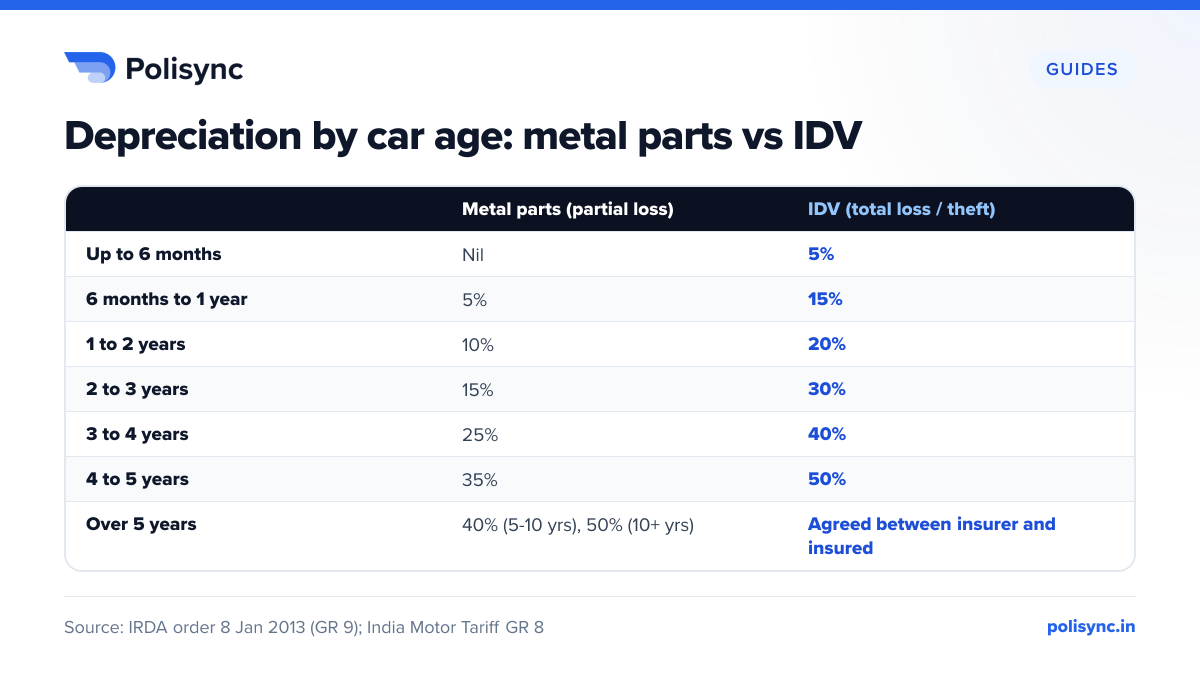
The practical point for clients: a modern car's bumpers, grilles, mirror housings and trims are largely plastic, so even a one-year-old car loses half the value of those parts in a claim. That is the gap zero depreciation fills.
What does zero depreciation cover pay, and when is it worth it?
Zero depreciation (also sold as nil depreciation, depreciation reimbursement or parts depreciation protect) removes the depreciation deduction on replaced parts in a partial loss claim. The deductible still applies, and a total loss is still settled on IDV.
Illustrative claim with and without zero depreciation
The figures below are illustrative and hypothetical, using the GR 9 rates above. Assume a car of 1,400 cc that is 3 years and 6 months old (25% on metal parts) with a ₹1,000 compulsory deductible (New India's figure for cars below 1,500 cc).
Hypothetical repair bill of ₹55,000:
- Front bumper (plastic), ₹12,000: depreciation 50% = ₹6,000.
- Grille and wheel-arch lining (plastic), ₹4,000: depreciation 50% = ₹2,000.
- Bonnet (metal), ₹15,000: depreciation 25% = ₹3,750.
- Windscreen (glass), ₹10,000: depreciation nil.
- Painting, ₹8,000: material treated as 25% (₹2,000), depreciated at 50% = ₹1,000.
- Labour, ₹6,000: no depreciation.
Without zero depreciation, total depreciation is ₹12,750 (₹6,000 + ₹2,000 + ₹3,750 + ₹1,000). The insurer pays ₹55,000 minus ₹12,750 minus the ₹1,000 deductible, which is ₹41,250. The client pays ₹13,750 out of pocket.
With zero depreciation, the insurer pays ₹55,000 minus the ₹1,000 deductible, which is ₹54,000. The client pays ₹1,000. If the garage also charged for engine oil, clips and coolant, those would be paid only under a separate consumables add-on.
Limits clients should know about
- Car age: eligibility is insurer-specific. Business Standard reported in August 2025 that zero dep is usually available for cars up to five years old, with some insurers extending to seven years.
- Number of claims: most wordings cap zero dep claims per policy year. New India Assurance and Digit both pay for the number of claims shown in the policy schedule.
- Tyres and batteries: this varies. New India's nil depreciation cover includes tyres, tubes and rubber or plastic parts, while Digit's add-on wording excludes depreciation on tyres and batteries.
- Cost: the same Business Standard report put the extra premium at typically 10% to 20% over a standard policy. Use the car insurance premium calculator to show clients the base premium before discussing add-ons.
- Repair network: some wordings impose a co-payment if the car is repaired outside the insurer's approved garages. Digit, for example, applies an extra 20% co-payment on the zero depreciation claim amount.
Zero depreciation usually earns its premium on new and nearly new cars, premium cars with costly plastic and composite parts, and households with new drivers or heavy city use.
Why does engine protection cover matter in the monsoon?
A hydrostatic lock happens when water enters a running engine. Because water does not compress, the pistons can bend or crack. Tata AIG explains that standard policies treat this as consequential loss, since the damage is caused by starting or running a waterlogged engine rather than by the flood itself.
Engine protect pays for that consequential damage. Digit's wording covers internal engine parts, the gearbox, differential and transmission damaged by water ingression, lubricating oil leakage or undercarriage impact, including labour and consumables used in the repair. Conditions are strict. In Digit's wording, for example:
- Evidence that the car was stopped in a waterlogged area, or that an undercarriage hit caused the oil leak.
- A maximum of one claim per policy period.
- Notice within 3 days, which the insurer may condone on merits.
- No cover for extra damage caused by delay in retrieving the car or starting repairs.
Engine protect suits clients in flood-prone cities, low-slung cars and anyone who drives through monsoon waterlogging. The single most useful advice an agent can give: never try to restart a car that has stood in water. Call the insurer and have it towed.
Who needs return to invoice cover?
On a total loss or theft, the base policy pays the IDV, which under GR 8 is already 15% below the manufacturer's listed selling price after six months and 50% below in the fifth year. Return to invoice (RTI) pays the gap up to the original invoice price.
New India Assurance's RTI pays the on-road price: ex-showroom price, accessories included in the IDV, road tax, registration charges and first-year premium. Under the IMT, a car is a constructive total loss when the cost of retrieval and repair exceeds 75% of the IDV. Digit's wording adds two conditions agents should flag: theft claims are paid only after the police final report and not before 90 days, and a financier noted on the policy must agree in writing.
RTI is most useful for new cars, cars bought on a loan where the outstanding balance may exceed IDV, and areas with high vehicle theft.
Which other motor add-ons are worth considering?
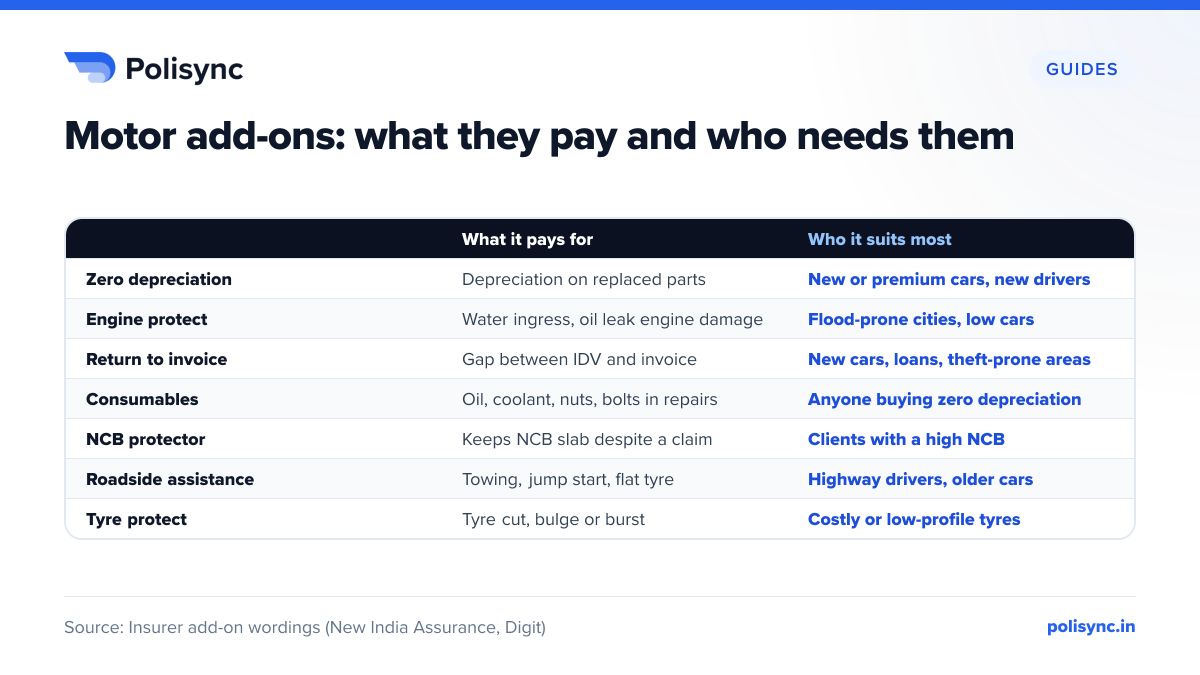
Consumables cover
Pays for items used up in a repair that the base policy ignores. New India's and Digit's wordings list items such as nuts, bolts, engine oil, coolant, AC gas, oil filters and bearings, and both exclude fuel. It pairs naturally with zero depreciation.
Roadside assistance
Provides help when the car is immobilised: towing, flat-tyre support, battery jump start, keys locked in and fuel delivery (fuel paid by the client). New India's basic plan covers these, and its gold plan adds cab, hotel and medical coordination with charges borne by the customer. Digit limits towing to 50 km and uses to four per policy period.
Key replacement
Pays for new keys and locksets after loss, theft or damage, including locksmith charges. Digit's wording says a claim admissible only under this add-on does not affect the NCB.
NCB protector
Protects the client's No Claim Bonus after an OD claim, but what it protects varies. New India's version lets the client move to the next NCB slab despite up to two OD claims, while some other insurers' versions only keep the current slab. It suits clients sitting on a high NCB; our guide to the no claim bonus in motor insurance explains the slabs and compares protector wordings.
Tyre protect
Pays for tyres damaged by a cut, bulge or burst even when the car itself is not damaged. Digit's version scales the payout by remaining tread, from 100% of a new tyre at 7 mm or more to nil below 3 mm, up to four tyres per policy period, and excludes puncture repair.
Personal belongings
Covers bags and personal items lost or damaged in the car. New India's add-on goes up to ₹50,000, including electronics such as laptops and phones. In Digit's wording, theft is covered only if the car was locked and entry was forced.
What are pay-as-you-drive and pay-how-you-drive add-ons?
In its 6 July 2022 press release, IRDAI permitted general insurers to introduce three technology-enabled concepts for motor OD cover, all to be provided as add-ons to the basic OD policy:
- Pay as you drive: the OD premium is linked to how much the vehicle is driven.
- Pay how you drive: the premium is linked to driving behaviour.
- Floater policy: one cover for two-wheelers and private cars belonging to the same individual owner.
The fine print matters. Under Digit's pay-as-you-drive add-on, the client picks a kilometre plan, the odometer or a telematics device is recorded at inception, and an OD claim is not payable once the car exceeds the opted kilometres, except a total loss from theft. Extra kilometres can be bought mid-term. These plans suit low-mileage clients, but agents must explain the kilometre cap clearly.
Is personal accident cover for the owner-driver an add-on?
No. Compulsory personal accident (CPA) cover for the owner-driver is required under both liability-only and package policies under GR 36 of the IMT, a legacy rule still carried into insurer wordings. It covers the owner-driver while driving, getting into or out of the vehicle, or travelling in it as co-driver. Only a registered owner with an effective driving licence can hold it, so a car owned by a company does not carry it.
IRDAI's circular of 20 September 2018 (IRDAI/NL/CIR/MOTP/158/09/2018) raised the minimum capital sum insured to ₹15 lakh for all classes of vehicles, at a premium of ₹750 a year for an annual policy, with higher cover available as an option. Its circular of 11 December 2018 (IRDAI/NL/CIR/MOTP/200/12/2018) allowed a standalone CPA policy from 1 January 2019, which covers the owner-driver on every vehicle they own. The same circular says an owner-driver who already holds a 24-hour personal accident cover of at least ₹15 lakh against death and permanent disability does not need a separate CPA. New India's information sheet still states the ₹15 lakh limit. Insurers also sell optional PA cover for passengers and paid drivers.
What this means for insurance agents
Add-ons are where motor claims are won or lost in the client's mind. A client who paid for a "comprehensive" policy and then receives ₹41,250 on a ₹55,000 bill will blame the agent, not GR 9. Explaining depreciation before the sale is the best protection against complaints and against mis-selling.
- Recommend add-ons from the client's car age, usage and location, not from the longest list on the quote.
- Name the limits out loud: age caps, claim counts, co-payments and notice deadlines.
- Record which add-ons the client accepted or declined. A spreadsheet works, and agency software such as Polisync can keep these notes with each policy.
- Revisit add-ons at every renewal, because zero dep eligibility and RTI value change as the car ages. Build this into your annual policy review meeting.
How should agents choose add-ons with a client?
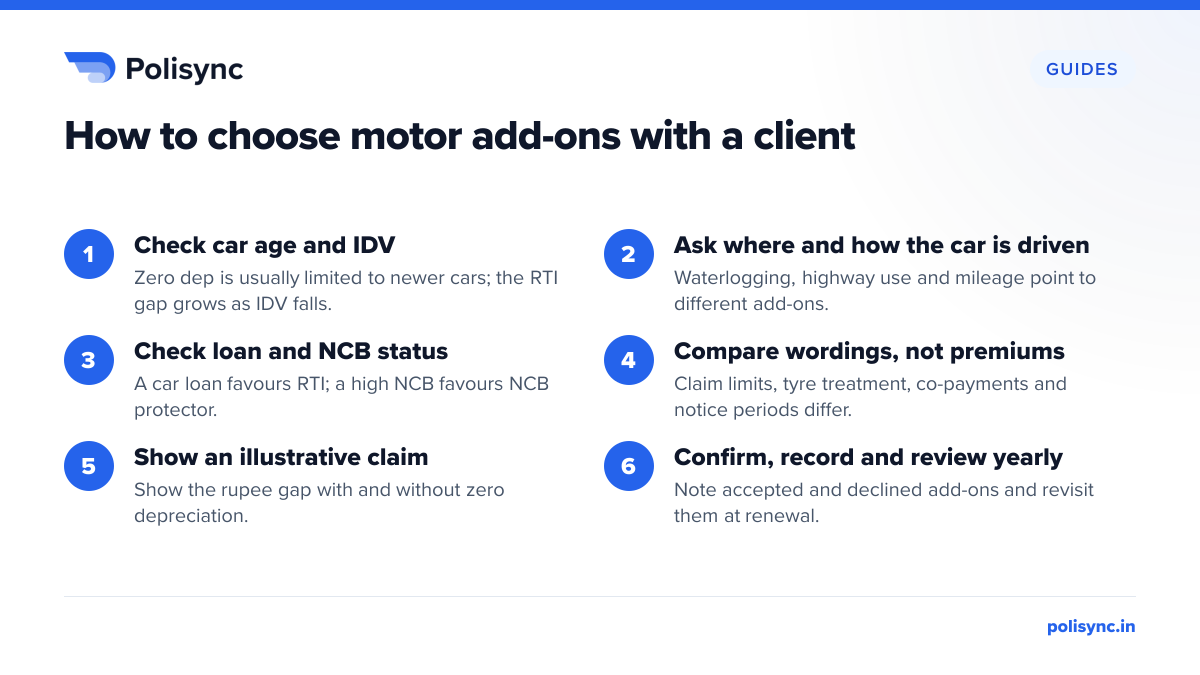
Use this checklist at each new sale or renewal:
- 1. Check the car's age and IDV. Zero depreciation is usually limited to newer cars, and the RTI gap grows as the IDV falls each year.
- 2. Ask where and how the car is driven. Waterlogging points to engine protect; long highway drives to roadside assistance; low mileage to pay as you drive.
- 3. Check finance and NCB. A loan points to RTI; a high NCB points to NCB protector.
- 4. Compare wordings, not just premiums. Look at claim limits, tyre and battery treatment, co-payments and notice periods.
- 5. Show the illustrative claim. Walk through a with and without zero depreciation example so the client sees the rupee gap.
- 6. Confirm and record. Note the client's choices and set a renewal reminder to review them.
Handled this way, the add-on conversation becomes a service moment rather than an upsell, and it gives you a natural reason to call before every motor renewal.