

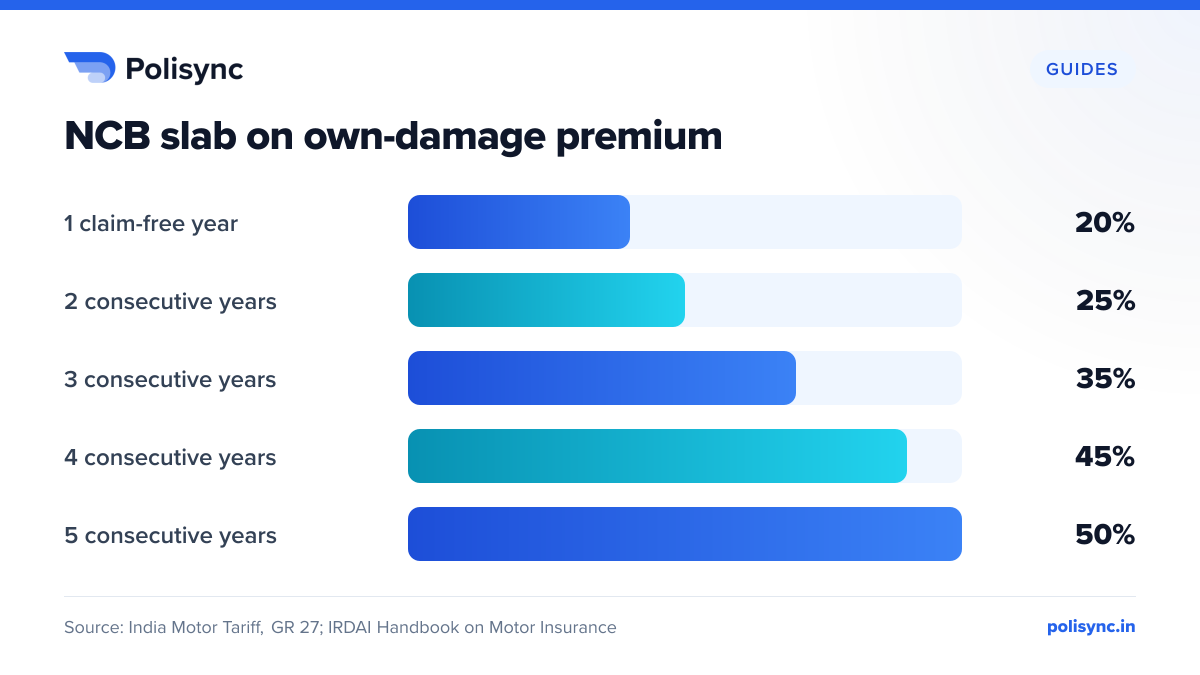
No Claim Bonus (NCB) is a renewal discount on the own-damage (OD) part of a motor premium: 20% after one claim-free year, rising to 25%, 35%, 45% and a maximum of 50% after five consecutive claim-free years. As of 4 September 2026, insurers follow legacy India Motor Tariff rules: NCB belongs to the owner, not the vehicle, and is lost after a claim or a renewal over 90 days late.
These rules come from General Regulation 27 (GR 27) of the India Motor Tariff (IMT). The tariff itself was de-notified with effect from 1 April 2024, but its NCB grid lives on in insurers' filed policy wordings. This guide explains how the slab works, who owns the bonus, how to move it to a new vehicle or a new insurer, and when a claim is worth losing it.
What is No Claim Bonus in motor insurance?
NCB is a renewal discount that rewards a policyholder for a year without claims. IRDAI's Handbook on Motor Insurance describes it as the benefit accrued to an insured for nil claims during the previous policy period, applied on the own-damage premium and not on the liability premium.
Under GR 27 of the India Motor Tariff:
- NCB can be earned only in the own-damage section of policies for all classes of vehicles, including private cars, two-wheelers and commercial vehicles.
- It is not available on motor trade policies or on policies covering only fire and/or theft.
- An insured becomes entitled to NCB only at renewal, after the full 12 months of the policy have run.
- The percentage is computed on the OD premium required for renewal, after deducting any rebate for a vehicle that was laid up.
Is the India Motor Tariff still in force?
Not as a regulation. When tariffs were withdrawn in 2006, IRDA's notification of 4 December 2006 said the tariff's general regulations (other than premium rating), terms, conditions and wordings would continue until further orders. IRDAI's notification of 20 March 2024 ended that: the All India Motor Tariff stands "entirely de-notified and no longer in force" from 1 April 2024, and cover is now governed by the IRDAI (Insurance Products) Regulations, 2024 and IRDAI's Master Circular on General Insurance Business of 11 June 2024.
The same notification bars insurers from withdrawing, discouraging or declining to offer the tariff products that existed before it, and filed wordings still carry the grid. SBI General's Bundled Private Car Insurance Policy prints the same NCB table and 90-day rule, while New India Assurance's 2024 private car customer information sheet still refers to NCB slabs "as per IMT 2002". Neither the 2024 Products Regulations nor the general insurance master circular sets a separate NCB scale, so always check the client's own policy wording.
How much is the NCB slab for each claim-free year?
The slab climbs with each consecutive year in which no claim was made or pending. The words "or pending" matter: a claim still open at renewal also blocks the bonus. If a claim is lodged, the IRDAI handbook notes that the NCB is lost in the next policy period, and the client starts again from nil.
Why NCB never reduces the third-party premium
A package policy has two parts: own damage (the client's vehicle) and third-party liability (injury or damage to others). NCB is applied only to the OD part. Third-party premium rates continue to be regulated under the Motor Vehicles Act, 1988 and the Central Government's rules, as the 2024 master circular notes, so a clean record does not reduce them. The same circular allows stand-alone own-damage (SAOD) cover only when a motor third-party policy already exists or is bought alongside it, and NCB is earned on that OD cover.
So when a client says "my NCB is 50%, why is my premium not half?", the answer is that half of the OD premium was waived, not half of the total. A quick way to show this is to run the numbers in a car insurance premium calculator with and without NCB.
Does NCB belong to the car or the owner?
The owner. GR 27(d) says the entitlement "shall follow the fortune of the original insured and not the vehicle or the policy". The IRDAI handbook puts it plainly: on transfer of the vehicle, the policy can go to the new owner but the NCB cannot, and the original owner can use it on a new vehicle.
Three tariff rules agents should know:
- Same class only: NCB can be applied to a substituted vehicle only if it is of the same class as the vehicle on which it was earned, so a car's NCB does not move to a two-wheeler.
- Death of the insured: if an individual insured dies and the vehicle's custody and use pass to the spouse, children or parents, the NCB passes to them.
- Company car bought by an employee: NCB earned on an institution's vehicle allotted to and exclusively used by an employee can pass to that employee when ownership is transferred, with a letter from the employer.
How do you transfer NCB to a new vehicle?
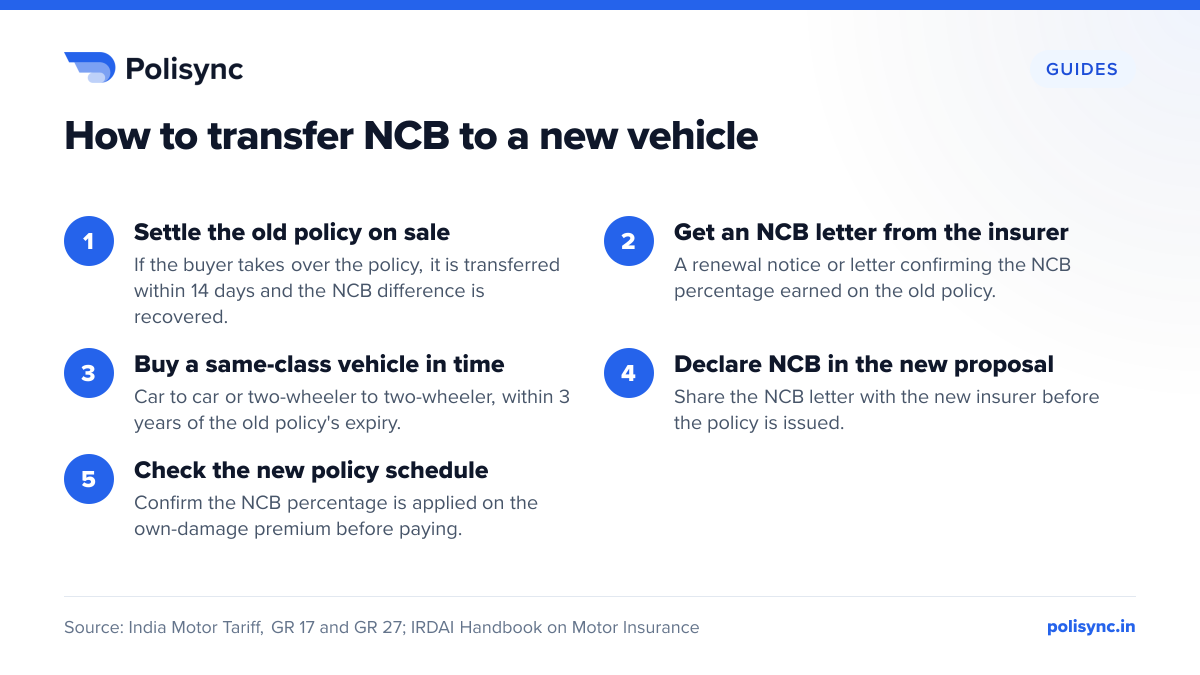
The client needs proof of the NCB earned. Under GR 27(f), evidence can be a renewal notice or a letter from the previous insurer confirming the NCB entitlement. Insurers and agents commonly call this an NCB certificate or NCB retention letter.
Timing is generous. Under GR 27(g), if a vehicle is sold and not replaced immediately, or laid up, NCB can be granted on a fresh policy taken within 3 years of the expiry of the previous insurance. The rate is the one earned at the expiry of the last 12-month period of insurance, so the bonus does not keep growing while the client has no vehicle.
What happens to NCB when a client sells the vehicle?
For the buyer, GR 17 of the tariff says liability cover is deemed transferred from the date of transfer, but the own-damage section moves only on the buyer's request with the seller's consent. If the buyer is not entitled to the NCB shown on the policy, or to a lower rate, the difference is recovered before the transfer, and a fresh proposal form is needed.
The IRDAI handbook adds that transfer of ownership in comprehensive policies has to be recorded within 14 days, failing which no own-damage claim is payable, and that a nominal fee and pro-rata NCB recovery apply. A seller who keeps the policy instead should tell the insurer promptly about the sale; the handbook explains that a new car can then be substituted in the old policy for its remaining period, on paying the pro-rata premium for any higher IDV. Either way, collect the NCB letter before the old policy is handed over or cancelled.
Can you keep NCB when switching insurers?
Yes. Under GR 27(f), the new insurer may allow the same NCB rate the client would have received from the previous insurer, against a renewal notice or confirmation letter. If neither is available, the client can sign a declaration that no claim arose in the expiring policy.
That declaration carries risk. The tariff wording says that if it is found incorrect, all benefits under Section I (own damage) stand forfeited. The new insurer is expected to write to the previous insurer within 21 days, and the previous insurer to reply within 30 days. Agents should never let a client overstate NCB to win a cheaper quote.
When is NCB lost?
- A claim is made during the policy year: NCB falls to nil at the next renewal.
- A claim is pending at renewal: the "no claim made or pending" condition is not met.
- Renewal is more than 90 days late: GR 27(i) allows no NCB when a policy is not renewed within 90 days of expiry, except the 3-year rule for vehicles sold or laid up.
- The policy ran less than 12 months: NCB is earned only at renewal after a full year.
- The new vehicle is of a different class, such as moving from a car to a two-wheeler.
The 90-day window is not a grace period for cover. The IRDAI handbook warns that no insurer offers a grace period for paying the premium, and a lapse of even one day means the vehicle must be inspected before cover restarts. Our policy renewal process guide covers how to stay ahead of these dates.
Should a client claim for small damage or pay and keep the NCB?
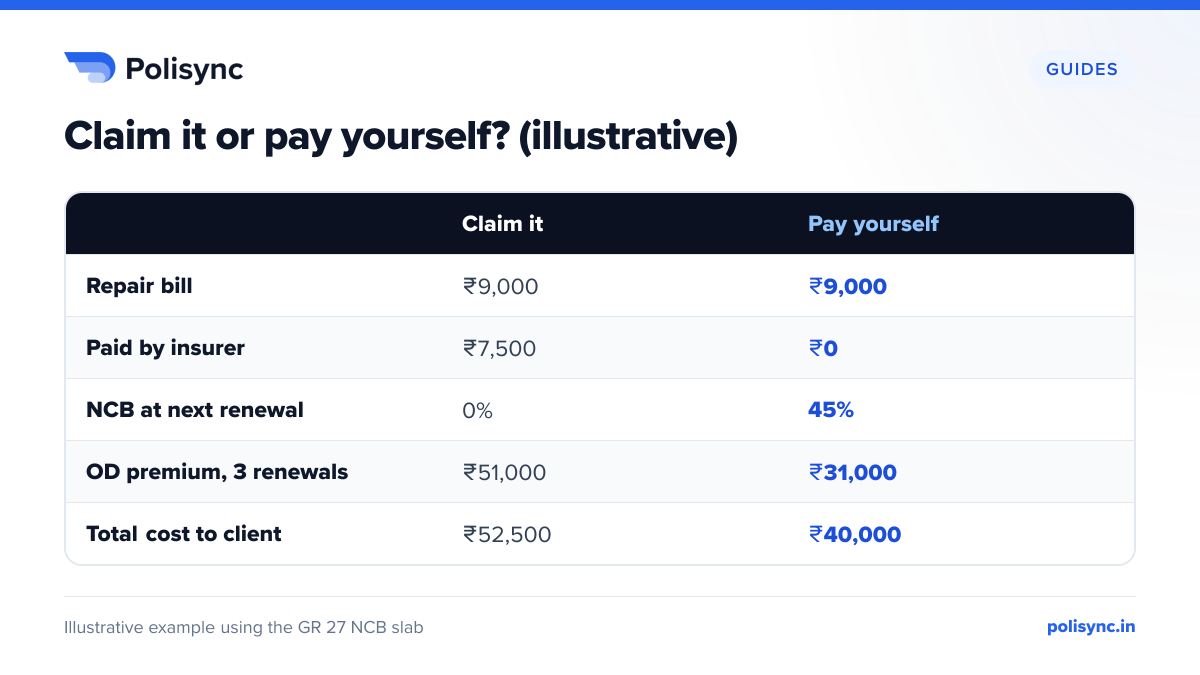
Often it is cheaper to pay. Take a hypothetical client on 35% NCB with an OD premium of ₹20,000 before NCB. Assume the premium before NCB stays flat (in reality IDV and rates change), no further claims on either path, figures before GST, and a ₹9,000 repair for a minor scrape on which the insurer would pay ₹7,500 after an assumed deductible and depreciation on parts.
Illustrative comparison over the next three renewals:
- If the client claims: NCB goes to 0%, then 20%, then 25%. OD premiums are ₹20,000, ₹16,000 and ₹15,000, a total of ₹51,000.
- If the client pays: NCB rises to 45%, then 50%, then 50%. OD premiums are ₹11,000, ₹10,000 and ₹10,000, a total of ₹31,000.
- Result: claiming saves ₹7,500 on the repair but adds ₹20,000 in OD premium, so the claim costs the client about ₹12,500 more overall. The gap keeps growing: the claim path only regains 50% at the sixth renewal, so the extra OD premium reaches ₹24,000 over five renewals.
A simple rule of thumb for clients: claim when the amount the insurer will pay clearly exceeds the NCB discount they would lose over the next two or three renewals. Large accident repairs, theft and total loss are usually worth claiming; scratches and small dents usually are not. Real numbers depend on IDV, deductibles, add-ons and the insurer's pricing, so work it out case by case.
How does an NCB protector add-on work?
An NCB protector (also called NCB retention or NCB protection cover) is an optional add-on that keeps the client's current NCB slab even after a claim. The details vary sharply between insurers, which is why agents should read the filed wording rather than the brochure.
Three filed wordings show the range:
- Royal Sundaram's NCB Protector Cover allows up to 2 own-damage claims a year while keeping the same slab on renewal with Royal Sundaram, needs existing NCB of 20% or more and renewal within 90 days, and stops operating once the vehicle is transferred.
- Raheja QBE's NCB Retention Cover maintains the current NCB for one approved accidental claim, excludes total and constructive total loss, and does not apply if the policy is not renewed with Raheja QBE within 90 days.
- New India Assurance's No Claim Bonus Protection Cover goes further: its customer information sheet says the insured moves to the next NCB slab even with up to 2 OD claims in the current policy.
So a protector may freeze the current slab or, in some wordings, still move the client up a slab, and several tie the benefit to renewing with the same insurer, which matters if the client plans to switch. Explain which version the client is buying, and point clients to other add-ons only where their own wordings say a claim will not affect NCB.
What this means for insurance agents
NCB is one of the few motor topics where good advice saves a client real money every year, and it is a strong reason for them to stay with you. A missed renewal or a careless small claim can wipe out five years of bonus, so NCB belongs at the centre of your customer retention strategy and your motor insurance practice.
Record each client's NCB percentage, expiry date and vehicle class, and raise it in the annual policy review meeting. Agency management software such as Polisync can help keep these records and renewal dates organised, but the conversation with the client is what protects the bonus.
NCB action checklist for agents
Use these steps with every motor client:
- 1. Note the current NCB percentage and the date it was earned for every motor policy you service.
- 2. Start renewal follow-ups well before expiry using renewal reminder message templates, and never rely on the 90-day NCB window.
- 3. Before a client lodges a small claim, show the illustrative claim-versus-pay maths with their own premium.
- 4. When a client sells a vehicle, collect the NCB letter and diarise the 3-year deadline for reuse.
- 5. When switching insurers, attach the renewal notice or NCB letter instead of relying on a self-declaration.
- 6. Check the NCB percentage on every new policy schedule, especially after a vehicle change or transfer. New India's customer information sheet, for example, asks policyholders to report NCB errors within 15 days of receiving the policy.
- 7. Compare NCB protector wordings on claims allowed, total loss exclusions and same-insurer renewal before recommending one.