

Personal accident (PA) insurance pays a fixed sum if an accident causes death or disability. IRDAI's standard PA product, Saral Suraksha Bima, launched on 1 April 2021 with a sum insured of ₹2.5 lakh to ₹1 crore, and insurers still sell it. As of 14 September 2026, PA is the cleanest way to protect a client's income against accidents, which MoRTH says killed 1,77,175 people on Indian roads in 2024.
Most clients assume their health policy or a government scheme has them covered. Health insurance pays hospital bills; it does not pay rent, EMIs or school fees while the earner cannot work. This guide covers what PA pays, how it compares with PMSBY and motor CPA, how to size it, and what to say when you raise it.
What does personal accident insurance cover?
Under the standard product wording, an accident is "a sudden, unforeseen and involuntary event caused by external, visible and violent means", and injury excludes illness or disease, so a heart attack is not a PA claim. The IRDAI Guidelines on Standard Personal Accident Insurance Product (25 February 2021) set out four building blocks that most Indian PA policies still use.
- Accidental death: 100% of the sum insured, if death occurs within 12 months of the accident.
- Permanent total disablement (PTD): 100% of the sum insured for losses such as sight of both eyes, use of both hands or feet, one hand and one foot, one eye plus a hand or foot, or an injury that permanently stops the person from doing any work at all.
- Permanent partial disablement (PPD): a fixed percentage of the sum insured for a specific lasting loss, such as 50% for one entire hand, read from a scale of benefits.
- Temporary total disablement (TTD): a weekly payment while an injury completely stops the insured from working, then ends when they return to work.
Death, PTD and PPD share a single sum insured, and the total payable for multiple disablements is capped at it. If the accident happens during the policy year, the benefit is payable even if death or disablement follows after the policy ends, within 12 months of the accident.
How does the PPD scale of benefits work?
PPD surprises clients most, because it pays for injuries they survive and return to work from. The standard product lists each loss with a fixed percentage; anything not listed is paid at the percentage assessed by an independent medical practitioner.
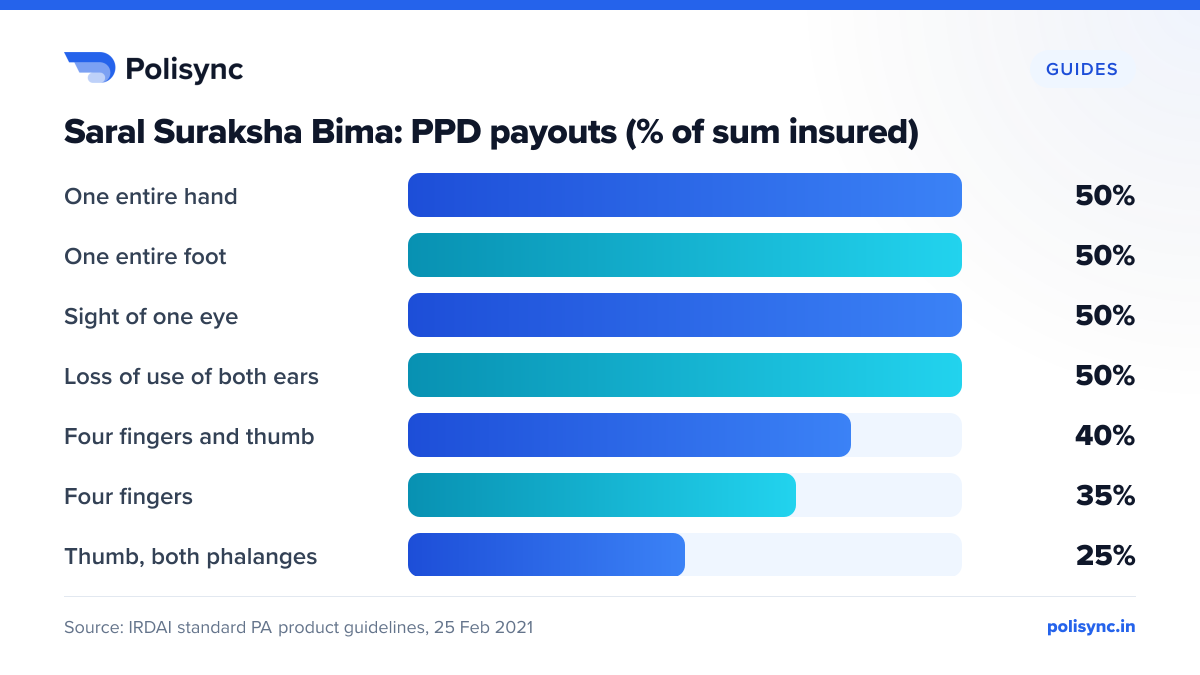
Make it concrete in the meeting. Illustrative: on a ₹50 lakh sum insured, the loss of one hand pays ₹25 lakh and the loss of a thumb (both phalanges) pays ₹12.5 lakh, regardless of what the hospital bill was.
What is Saral Suraksha Bima?
Saral Suraksha Bima is the standard individual PA product IRDAI designed in 2021 so that covers and wording would be uniform across insurers. The 2021 guidelines required every general and standalone health insurer to offer it from 1 April 2021, under the name "Saral Suraksha Bima, (insurer name)". As designed in those guidelines:
- Sum insured: minimum ₹2.5 lakh, maximum ₹1 crore, in multiples of ₹50,000.
- Entry age: 18 years, with maximum entry age of at least 70; dependent children from 3 months to 25 years.
- Mandatory base covers: death, PTD and PPD.
- Optional covers: TTD at 0.2% of the base sum insured per week (payable when disablement exceeds 4 weeks, for up to 100 weeks), hospitalisation expenses due to accident up to 10% of the base sum insured, and a one-time education grant of 10% of the base sum insured per dependent child after a death or PTD claim.
- Cumulative bonus: 5% of the sum insured for each claim-free year, up to 50%.
- Family cover: offered on an individual basis, and the chosen sum insured applies to each family member separately.
- No deductibles, no plan variants, one-year policy, with a 30-day grace period for yearly premium and 15 days for other modes.
Are the 2021 Saral Suraksha Bima guidelines still in force?
No, not as a standalone rulebook. IRDAI's Master Circular on Health Insurance Business of 29 May 2024 supersedes every circular listed in its Annexure-6, and that list includes the 25 February 2021 Saral Suraksha Bima guidelines and their 23 March 2021 modification. The circular also asked insurers to align existing products with the IRDAI (Insurance Products) Regulations, 2024 by 30 September 2024.
Insurers still sell products under the Saral Suraksha Bima name, but each now runs on its own filed wording. For example, Magma's revised wording, effective 1 October 2024, keeps the PPD scale, the 10% hospitalisation limit, the education grant and the 5% cumulative bonus, but pays weekly TTD "as specified in the policy schedule" and gives 15 days' grace only for monthly premiums. Treat the 2021 features as the reference design and quote from the current wording of the product you sell.
Premiums are set by each insurer, so quotes differ for the same cover. Compare price, claim service, the weekly TTD benefit and the insurer's rules on entry age and occupation.
How is PA different from PMSBY and the motor CPA cover?
Clients often say "I already have accident cover". They usually mean one of two things. PMSBY (Pradhan Mantri Suraksha Bima Yojana) is a government-backed scheme for bank and post office account holders aged 18 to 70. According to the PIB release of 9 May 2026, it costs ₹20 a year, auto-debited, for cover from 1 June to 31 May. It pays ₹2 lakh for death or loss of both eyes, both hands or feet, or one eye plus a hand or foot, and ₹1 lakh for loss of one eye, hand or foot. As on 29 April 2026, PMSBY had over 58.09 crore cumulative enrolments and had paid ₹3,667.52 crore on 1,84,662 claims.
Compulsory Personal Accident (CPA) cover is the owner-driver cover attached to motor insurance. IRDAI's circular of 20 September 2018 raised the minimum capital sum insured to ₹15 lakh for all vehicle classes, at a premium of ₹750 a year for the bundled cover. It applies while the owner-driver is driving, mounting into or dismounting from the vehicle, or travelling in it as co-driver. Its disability payouts follow the scale of the India Motor Tariff, which IRDAI's notification of 20 March 2024 de-notified with effect from 1 April 2024; that scale lives on as a legacy rule in insurers' filed policy wordings.
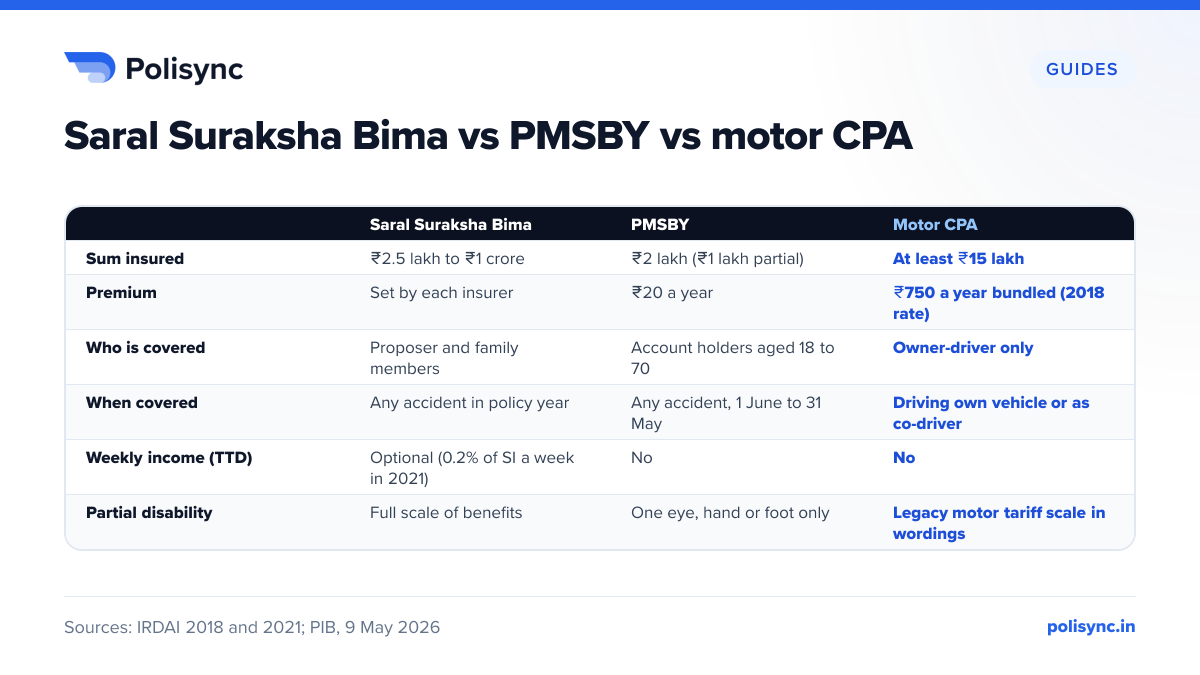
There is a useful link between the two. Under IRDAI's circular of 11 December 2018, standalone CPA policies were allowed from 1 January 2019, covering the owner-driver on every vehicle they own, and an owner-driver who already holds a 24-hour PA cover of at least ₹15 lakh for death and permanent disability need not buy a separate CPA. Tell clients to confirm what proof their motor insurer needs.
Why does every earning client need it? The road accident numbers
The Ministry of Road Transport and Highways released Road Accidents in India 2024 in June 2026. Police reported 4,87,707 road accidents in 2024, which killed 1,77,175 people and injured 4,71,441. Compared with 2023, accidents rose 1.5%, deaths 2.5% and injuries 1.9%.
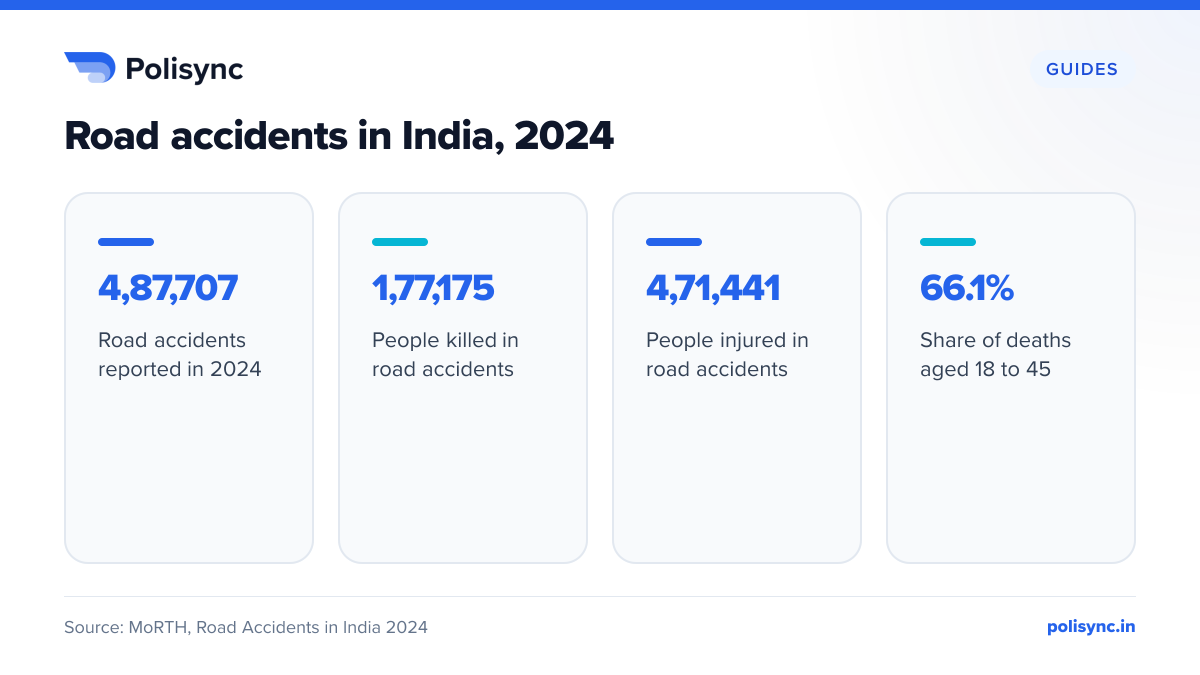
The report also shows who is at risk. People aged 18 to 60 made up 83.3% of road deaths, two-wheeler riders 46.2% and pedestrians 20.6%. Over-speeding, the most common traffic rule violation, accounted for 70.3% of persons killed. These are your clients, in their earning years.
What about treatment costs? The government's PM-RAHAT scheme, launched on 13 February 2026, gives victims of road accidents involving motor vehicles cashless treatment at designated hospitals up to ₹1.5 lakh per victim, for up to 7 days from the accident, according to PIB (11 March 2026). It pays the hospital for a week. It does not pay the family if the earner dies or cannot work for months. That gap is what PA fills.
How much PA cover should a client buy?
Insurers cap PA sum insured as a multiple of income. One published example: SBI General's Individual Personal Accident prospectus limits the death and PTD sum insured to 120 times monthly gross income or 10 times annual gross earnings, up to ₹1 crore, and asks for income proof above ₹25 lakh. Other insurers set their own limits, so check the proposal form.
A simple way to explain sizing (illustrative figures only):
- Start with income: a client earning ₹8 lakh a year could be eligible for up to ₹80 lakh at a 10 times multiple, subject to the insurer's rules.
- Check the weekly benefit: on a ₹40 lakh base sum insured, TTD at the 2021 standard rate of 0.2% pays ₹8,000 a week. SBI General's prospectus instead pays 1% of the death sum insured, capped at ₹10,000 a week, for up to 104 weeks.
- Cover the spouse and parents separately: the 2021 Saral Suraksha Bima design gives each member the chosen sum insured, but other products cap non-earning members; SBI General limits them to 20% of the primary insured's sum insured or ₹10 lakh, whichever is less.
- Revisit every year: a raise, a new loan or a new child should prompt a higher sum insured at renewal.
Do occupation classes change the premium?
Yes. PA is priced by the risk of the person's work, not their age or health. In the SBI General prospectus, Category I covers mostly office or desk work, Category II hazardous work such as geologists and gym instructors, and Category III extremely hazardous work such as jockeys and lathe machine workers. Its base rate for death, PTD and PPD in metro cities rises from 0.63 per mille in Category I to 0.98 per mille in Category III. Illustrative arithmetic: on ₹50 lakh of cover that is ₹3,150 a year versus ₹4,900, before add-ons, discounts or taxes. Always declare the client's real occupation.
What does personal accident insurance not cover?
The 2021 standard wording, which revised Saral Suraksha Bima wordings such as Magma's still carry, excludes claims caused directly or indirectly by the following. Explain these at the sale, not at the claim.
- War, invasion, civil war, rebellion and similar events.
- Intentional self-injury, suicide or attempted suicide.
- Being under the influence of liquor or drugs, unless the insured was not directly responsible for the accident.
- Flying other than as a passenger in a scheduled airline, and ballooning.
- Taking part as a professional in hazardous or adventure sports such as mountaineering, rafting, motor racing, scuba diving or sky diving.
- Committing a breach of law with criminal intent, or any illegal act.
- Nuclear radiation, nuclear weapons material, and nuclear, chemical or biological terrorism.
- Illness and disease, since they are not an accident.
Which documents are needed for a PA claim?
Under the standard wording, the insurer should be told within 30 days of the accident, and within 24 hours of an emergency hospitalisation. The insurer can relax these limits on merit, but late intimation slows claims down.
- All claims: claim form, photo ID of the insured, FIR or panchnama or police inquest report and medico-legal certificate where the circumstances require them.
- Death: death certificate, post-mortem report if conducted, and the nominee's ID proof, or a succession or legal heir certificate if no nominee was filed.
- PTD or PPD: treating doctor's certificate describing the disablement, discharge summary, disability certificate and medical reports.
- TTD: doctor's certificate advising rest, discharge summary, employer's leave certificate if employed, and a fitness certificate on return.
- Education grant: proof of the child's relationship and age, photo ID, and a bonafide certificate from the educational institution.
Your most useful job is prevention: check the nominee at issuance, and tell the family where the policy copy is kept.
How should agents position PA cover with clients?
PA sells best as a gap, not a product. Show the client what their current covers pay, then what they do not. Four short scripts to adapt in your own words:
- The income question: "If an accident kept you off work for three months, your health policy pays the hospital. Who pays your EMI and household bills for those three months?"
- The PMSBY reply: "PMSBY is a great ₹20 cover and you should keep it. But it pays ₹2 lakh. What is one year of your income?"
- The motor renewal reply: "Your motor CPA covers you only while you are driving this vehicle. A personal accident policy covers you walking, travelling or at work, and covers your spouse too."
- The disability reply: "Most people think about death. The policy also pays a fixed share of the sum insured for losing a hand, a foot or an eye, even if you go back to work."
Cross-selling PA with motor and health
Motor renewals are the natural trigger, because CPA is already on the table. Pair PA with a review of the client's motor insurance add-ons. In health reviews, use the health insurance cross-selling guide approach: health pays bills, PA pays the person.
Keep the product roles clear. Critical illness cover vs health insurance explains lump sums for illness; PA does the same for accidents. For life policies with an accidental death rider, explain the difference using insurance riders explained for clients, and lean on the objection handling guide if a client resists.
What should insurance agents do now?
A practical checklist for the next 30 days:
- List every client with a motor policy renewing in the next three months and flag those with no standalone PA cover.
- For each earning client, note income, EMIs and dependants, and work out an illustrative PA sum insured and weekly benefit.
- Prepare a one-page comparison of Saral Suraksha Bima, PMSBY and motor CPA using the table above.
- Get Saral Suraksha Bima quotes from two or three insurers, and read each one's current TTD and grace period terms.
- Add PA to your family insurance planning review so spouses and parents are covered separately.
- Fold PA into your festive season sales plan and raise it with every new vehicle purchase.
- At issuance, confirm the nominee and occupation, and record the renewal date so the cover never lapses.
Tracking PA, motor and health renewals for the same family in one place makes these conversations much easier; agency software such as Polisync can help keep those records organised.