

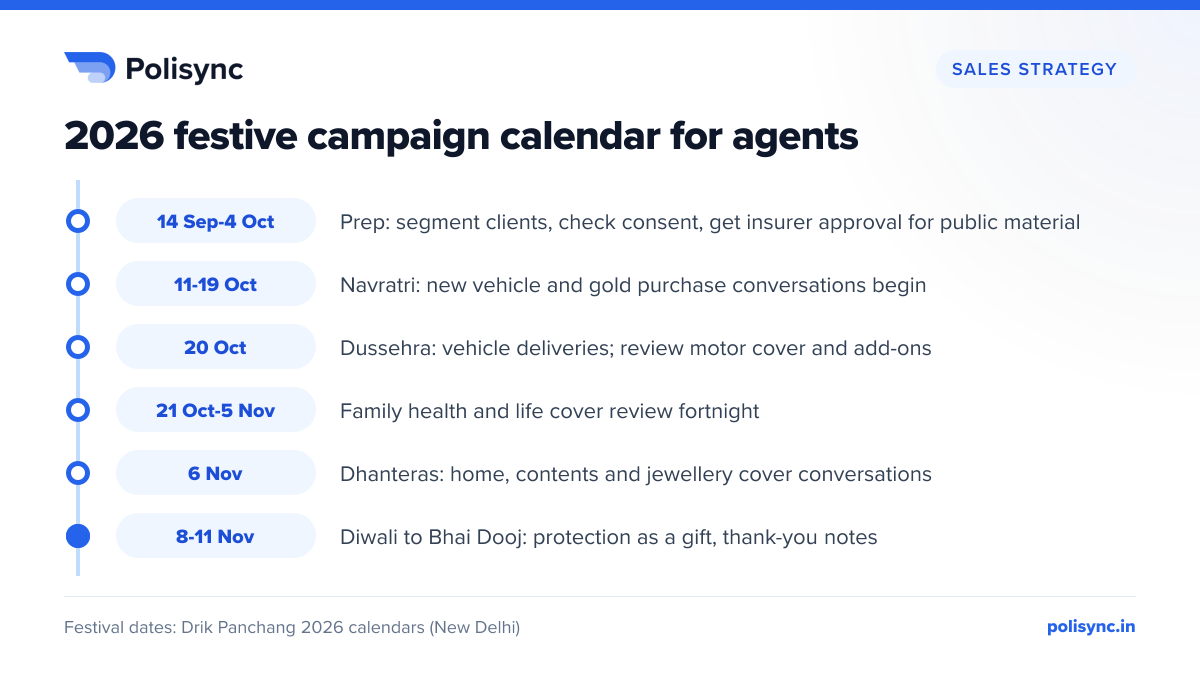
A festive season sales plan for insurance agents in 2026 should run for about six weeks: Navratri from 11 to 19 October, Dussehra on 20 October, Dhanteras on 6 November, Diwali on 8 November and Bhai Dooj on 11 November, as listed by Drik Panchang. Link each festival to one protection conversation, get insurer approval for any public promotion, and message only clients who have agreed to hear from you.
This guide, written as of 12 September 2026, gives you the calendar, the product conversations each festival opens up, ready-to-adapt messages you send personally, the compliance limits on gifts and advertising, and a simple way to measure what worked.
When are the 2026 festivals, and how much prep time do you have?
The festive season falls later in 2026 than in 2025. Last year Navratri began on 22 September, and FADA reported that vehicle retail, muted for the first three weeks of September, surged in the final week as Navratri coincided with lower GST rates (FADA, 7 October 2025). This year Ghatasthapana is on Sunday 11 October, so you have roughly four weeks from mid-September to prepare.
Key 2026 dates for New Delhi, per Drik Panchang (regional calendars can differ by a day):
- Navratri: 11 to 19 October, with Durga Ashtami and Maha Navami both on 19 October (Shardiya Navratri calendar).
- Dussehra (Vijayadashami): Tuesday, 20 October.
- Dhanteras: Friday, 6 November (Diwali puja calendar).
- Diwali (Lakshmi Puja): Sunday, 8 November.
- Govardhan Puja: Tuesday, 10 November; Bhai Dooj: Wednesday, 11 November.
Why does the festive season matter for insurance sales?
Indian households make big purchases between Navratri and Diwali, and many of those purchases need cover. In the 42-day festive period of 2025 (22 September to 2 November), vehicle retail sales rose 21% to 52,38,401 units from 43,25,632 a year earlier, according to the Federation of Automobile Dealers Associations (FADA) press release of 7 November 2025.
- Passenger vehicles: 7,66,918 units retailed, up 23%.
- Two-wheelers: 40,52,503 units, up 22%.
- Three-wheelers and commercial vehicles: up 9% and 15% respectively.
Navratri alone saw retail grow 34% in 2025, with passenger vehicles up 34.8% and two-wheelers up 36%, FADA reported. FADA linked the 2025 surge partly to GST rationalisation, so do not assume 2026 will match it. FADA counts its festive window from the first day of Navratri to 15 days after Dhanteras; on the 2026 calendar that works out to roughly 11 October to 21 November. The useful point for agents is the pattern: festive weeks bring purchases, gatherings and bonuses, and each one is a natural reason to talk about protection.
Which festive triggers lead to which insurance conversations?
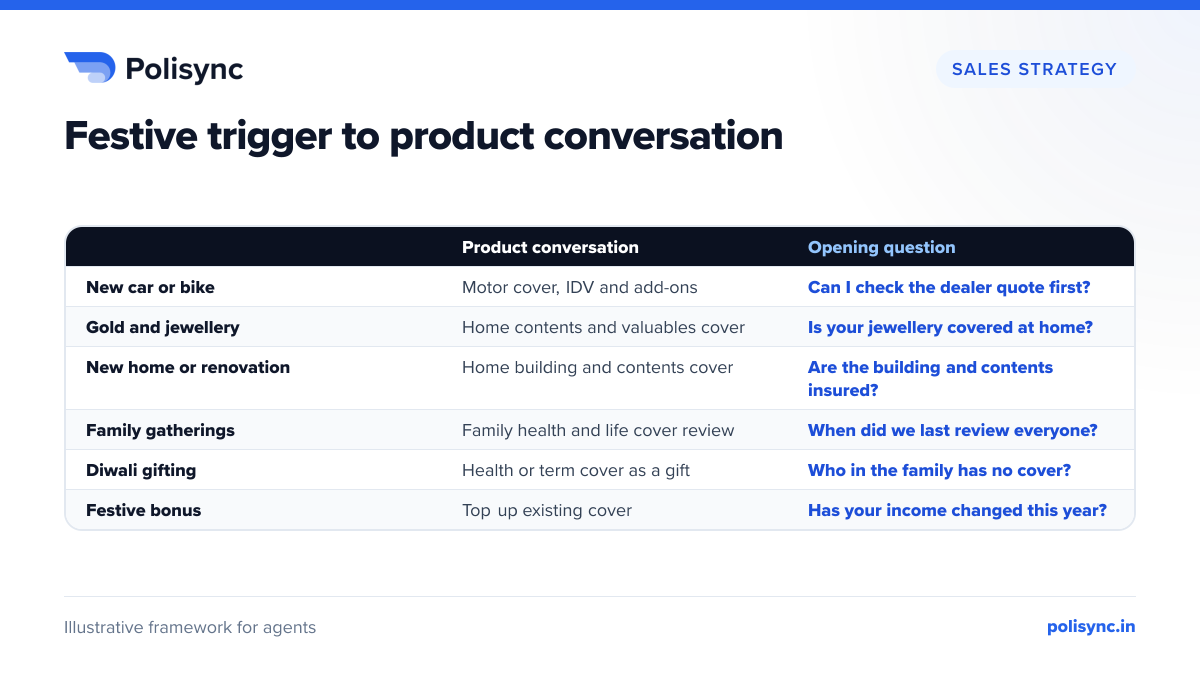
A festive trigger is a life event or purchase that makes a protection conversation feel timely rather than pushy. Pick one trigger per message so clients know exactly why you are getting in touch.
New vehicles: motor cover and add-ons
Ask clients to send you the dealer's insurance quote before they sign the delivery paperwork. Compare the declared value, the add-ons bundled in and the premium, and explain each add-on in plain language using our guide to motor insurance add-ons explained. Clients who already hold a policy may also have another vehicle in the family due for renewal.
Gold and home purchases: home insurance
When a client mentions buying gold or appliances for Dhanteras, that is a gentle opening to ask whether the client's home and its contents, including jewellery kept at home, are insured. Use our home insurance guide for India to explain building cover, contents cover and what a basic policy may exclude.
Family gatherings: health and life reviews
Festive visits often reveal gaps: a parent without health cover, a newly married couple, a child who has started working. Offer a short family review rather than a product pitch, and use the structure in our family insurance planning guide for agents.
What does a six-week festive campaign calendar look like?
Here is a week-by-week plan you can adapt to your book of clients:
- Week 0, prep (14 September to 4 October): segment clients by recent vehicle purchase, home ownership, family size and cover gaps. Send any posters, social posts or leaflets to your insurer for approval now, because approvals take time.
- Week 1 (5 to 10 October): a warm, no-sell festive greeting to all opted-in clients, plus a note that you are available to check vehicle insurance quotes.
- Week 2 (11 to 17 October), Navratri: personal messages to clients likely to buy vehicles; follow up on renewals falling due in October and November.
- Week 3 (18 to 24 October), Ashtami to Dussehra: delivery-week check-ins on motor cover; ask buyers to forward the policy once issued so you can review it.
- Week 4 (25 October to 31 October): family health and life review invitations; book short calls or home visits.
- Week 5 (1 to 7 November), Dhanteras: home and contents cover conversations; complete proposals started in week 4.
- Week 6 (8 to 14 November), Diwali to Bhai Dooj: thank-you messages with no sales ask, then a referral request to happy clients.
How do you run the campaign step by step?
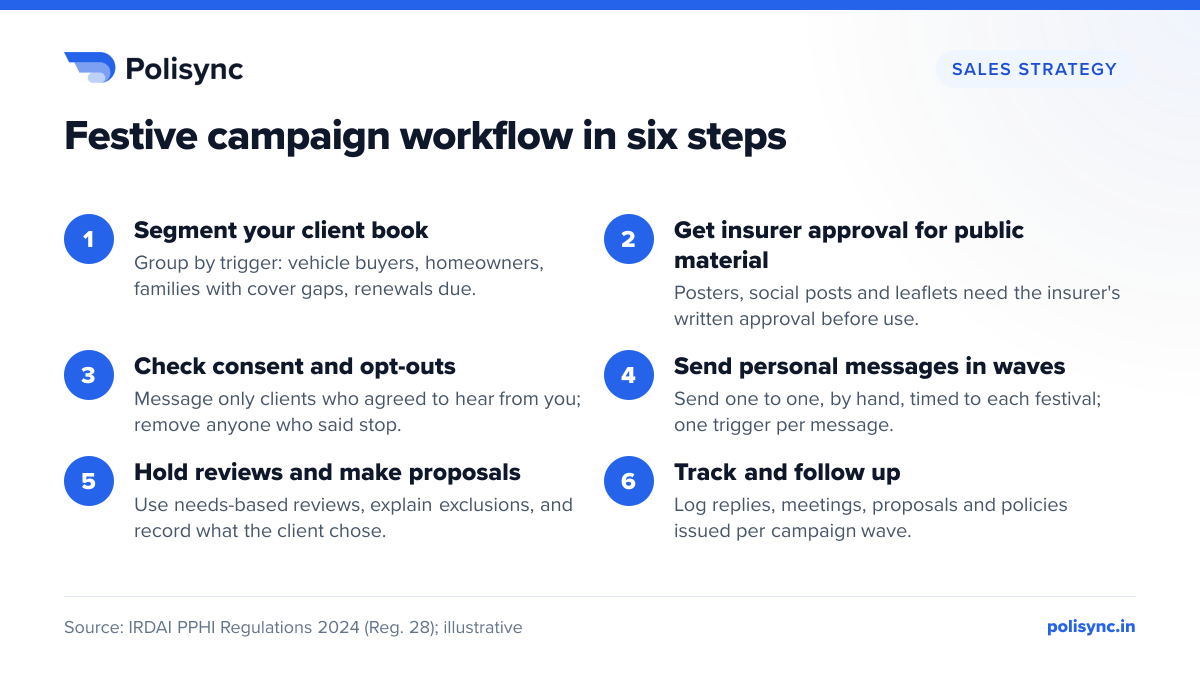
Every festive message should pass through the same simple workflow, so nothing goes out without consent, approval or a follow-up plan.
What email and WhatsApp messages can agents send?
Every message below is meant to be typed or adapted and sent by you personally, one client at a time, not pushed out by an automated tool or broadcast list. Send them only to clients who have agreed to hear from you, mention one reason for writing, and make it easy to say no. For channel tips, see our guides to WhatsApp for insurance agents and email newsletters for insurance agents. If a message is going to a group or the public and promotes a product, treat it as an advertisement and get insurer approval first (see the compliance section below).
Illustrative templates to adapt and send manually (names are hypothetical):
- Navratri, vehicle (WhatsApp): "Namaste Rohit ji, Navratri ki shubhkamnayein! If a new car or bike is coming home this season, send me the dealer's insurance quote before you sign. I will check the cover and add-ons so you pay only for what you need. Just tell me if you would prefer not to get these messages."
- Dhanteras, home (email): Subject: "A quick Dhanteras check for your home". Body: "Wishing your family a prosperous Dhanteras. If you are buying gold or appliances this week and would like, I can check whether your home and its contents are covered. A 15-minute call is enough."
- Family review (WhatsApp): "Hope the family is enjoying the festive days together. Whenever convenient, I would be happy to do a short review of everyone's health and life cover, including parents. No obligation at all."
- Diwali thank-you (personal email or WhatsApp): "Thank you for trusting me with your family's insurance this year. Wishing you a safe and happy Diwali." No product, no ask.
- Referral, after Diwali: "If a friend or relative bought a vehicle or home this festive season and wants an unbiased second opinion on their insurance, I would be glad to help." See how to get insurance referrals.
What compliance rules apply to festive promotions?
No gifts, rebates or discounts tied to a policy
Section 41 of the Insurance Act, 1938 bars any person from allowing or offering, directly or indirectly, a rebate of the whole or part of the commission or of the premium as an inducement to take out, renew or continue a policy, except rebates allowed in the insurer's published prospectuses or tables. The penalty is up to ₹10 lakh (consolidated Insurance Act, as on 15 April 2026). A "buy a policy, get a gift" Diwali offer, a cashback or a festive discount funded from your commission falls on the wrong side of this rule.
Section 40 of the same Act says no person may pay commission or any other reward for soliciting or procuring insurance business to anyone except an insurance agent or insurance intermediary, and an agent who contravenes it faces a penalty of up to ₹1 lakh. So do not promise referral fees to car dealership staff, jewellers or society office-bearers. IRDAI's Master Circular on Operations and Allied Matters of Insurers (19 June 2024, Chapter I, para 5.1) also says that, unless it is part of the product's features, an insurance advertisement shall not offer any award, reward points or discounts as an inducement.
Insurer approval for advertisements
Under Regulation 28 of the IRDAI (Protection of Policyholders' Interests, Operations and Allied Matters of Insurers) Regulations, 2024, every advertisement issued by a distribution channel representing an insurer must be approved by the insurer in writing before it is issued. The regulations define an advertisement as a communication in any mode addressed to the public or a section of it, so festive posters, society banners, leaflets and public social media posts are covered.
Other advertisement rules worth remembering in festive creatives:
- Advertise only as soliciting the insurer's products, never as if you offer them directly (Regulation 27(3)).
- Content you post on your own social media page must comply with the regulations (Regulation 27(6)).
- No exaggerated benefits, no benefits disclosed without their limitations, and no denigrating competitors (Master Circular, Chapter I, para 1.3).
- Comply with the Advertising Standards Council of India (ASCI) standards (Master Circular, Chapter I, para 4).
Consent and messaging rules
Under the government's commencement notification G.S.R. 843(E) of 13 November 2025, the Digital Personal Data Protection (DPDP) Act's notice and consent provisions and most data fiduciary duties come into force 18 months after that date, in May 2027. Building consent-based lists now is still good practice. Separately, the operations master circular (Chapter I, para 6.2) requires insurance intermediaries sending commercial communications to customers to meet Telecom Regulatory Authority of India (TRAI) requirements; for promotional calls and SMS, TRAI's customer preference regulations let people block such messages by registering a preference through 1909. Our DPDP Act guide for insurance agents explains how to record consent.
How can agents run society camps and festive events?
Housing society and office events during Navratri and Diwali can work well if they are education first and sales second. Plan them with your insurer, not around it.
- Get approvals early: written insurer approval for banners, standees and leaflets, and written permission from the resident welfare association (RWA) or office.
- Teach, do not pitch: run a 20-minute talk on how motor claims work, what home insurance covers or how to check a family's health cover.
- No lucky draws or freebies linked to buying a policy: these risk breaching Section 41 and the inducement rule above. Check any giveaway with your insurer.
- Collect leads with consent: a simple sign-up sheet that says what you will contact people about and how to opt out.
- Follow up within 48 hours: personally, by call or message, only with people who signed up.
How should agents track festive campaign results?
Track each wave separately so you know which trigger worked. Record messages sent, replies, reviews booked, proposals submitted, policies issued and premium, plus the trigger behind each sale.
Illustrative example: if 120 vehicle-buyer messages lead to 18 replies, 9 quote checks and 4 policies, your reply rate is 15% and your conversion from quote check is 44%. Compare that with your family review wave to decide where to focus next year. Whether you use a spreadsheet or agency management software such as Polisync, keep these records in one place so renewals and referrals are easy to follow up in 2027.
What this means for insurance agents: a festive action checklist
- 1. Block your calendar for Navratri (11 to 19 October), Dhanteras (6 November) and Diwali (8 November) now.
- 2. Segment your client list by festive trigger before 4 October.
- 3. Send every poster, leaflet and public post to your insurer for written approval.
- 4. Remove anyone who has opted out, and message only consenting clients.
- 5. Write one personal message per trigger and send it by hand.
- 6. Offer to check dealer insurance quotes for vehicle buyers.
- 7. Never tie a gift, discount or cashback to a policy purchase or renewal.
- 8. Book family reviews in the fortnight after Dussehra.
- 9. Send a no-sell thank-you on Diwali, then ask for referrals.
- 10. Review results per wave by the end of November and note lessons for 2027.