

An email newsletter for insurance agents works best as a short, monthly, consent-based email that teaches clients one useful thing between renewals. As of 2 September 2026, Indian agents should collect clear opt-in consent under the DPDP Act 2023, get insurer approval in writing before mailing product advertisements (IRDAI Regulation 28 of 2024), and follow the Gmail and Yahoo sender rules in force since February 2024.
This guide covers building a consented list, what to send, where IRDAI draws the line on advertising, a 12-month calendar and spam-proof sending. It is written for individual agents, POSPs and small agencies mailing a few hundred to a few thousand people.
Why should insurance agents send an email newsletter?
Most clients hear from their agent twice a year at best: at the sale and at renewal. A newsletter fills the gap with short, useful notes, so that when a claim, a new baby or a new car comes up, your name is the first one they think of.
An email newsletter is a regular, opt-in email sent to a list of clients and prospects, carrying education and updates rather than a one-off sales pitch. Email suits the content agents need to share: longer explanations, checklists and links that do not fit in a chat message. It complements the habits in our customer retention strategies for insurance agents.
How do you build a newsletter list with DPDP consent?
Under the Digital Personal Data Protection Act, 2023, an agent who decides why and how client data is used acts as a Data Fiduciary, and the client is the Data Principal. Where consent is the basis for processing, Section 6(1) says it must be "free, specific, informed, unconditional and unambiguous" with a clear affirmative action, limited to the data necessary for the stated purpose.
Section 6(4) lets the client withdraw consent at any time, with withdrawal as easy as giving it. Once consent is withdrawn, Section 6(6) says the Data Fiduciary must stop processing within a reasonable time, unless another law requires or authorises it.
What this means for your list
- Ask separately. An email address collected to issue or service a policy is not automatically permission to send a monthly newsletter. Add a distinct, unticked opt-in line to your proposal checklist, website form or meeting sheet.
- Say what they will get. For example: "A monthly email with insurance tips, seasonal reminders and claim help. Unsubscribe any time."
- Record it. Note the date, the channel and the exact wording the client agreed to. Section 6(10) puts the burden of proving that notice was given and consent obtained on the Data Fiduciary.
- Collect only what you use. Name and email are enough for a newsletter. Do not ask for income, health or family details on a sign-up form.
- Never buy or scrape lists. People on a purchased list never consented to hear from you, and they are the quickest route to spam complaints.
When do the DPDP Act and Rules start to apply?
The Act is commencing in stages under the Centre's commencement notification, G.S.R. 843(E), published in the Gazette dated 13 November 2025. Section 2 (definitions) and Sections 18 to 26 on the Data Protection Board applied from that date. Section 6(9), on registering Consent Managers, applies one year later, in November 2026. The notice and consent rules (Sections 5 and 6(1) to 6(8) and 6(10)), the duties and rights in Sections 7 to 17, and the penalty provisions apply eighteen months after publication, in May 2027.
The Digital Personal Data Protection Rules, 2025 (G.S.R. 846(E), same Gazette date) follow the same timetable: Rules 1, 2 and 17 to 21 applied from publication, Rule 4 on Consent Managers starts one year after publication, and Rules 3, 5 to 16, 22 and 23 start eighteen months after publication. Rule 3 says a consent notice must stand on its own, in clear and plain language, with an itemised description of the data, the specific purpose, and a way to withdraw consent as easily as it was given.
So, as of 2 September 2026, the consent duties are not yet enforceable, but they will be from May 2027. Building your opt-in to that standard now avoids having to re-permission your whole list later. Our DPDP Act guide for insurance agents covers the wider obligations.
What should insurance agents send in a newsletter?
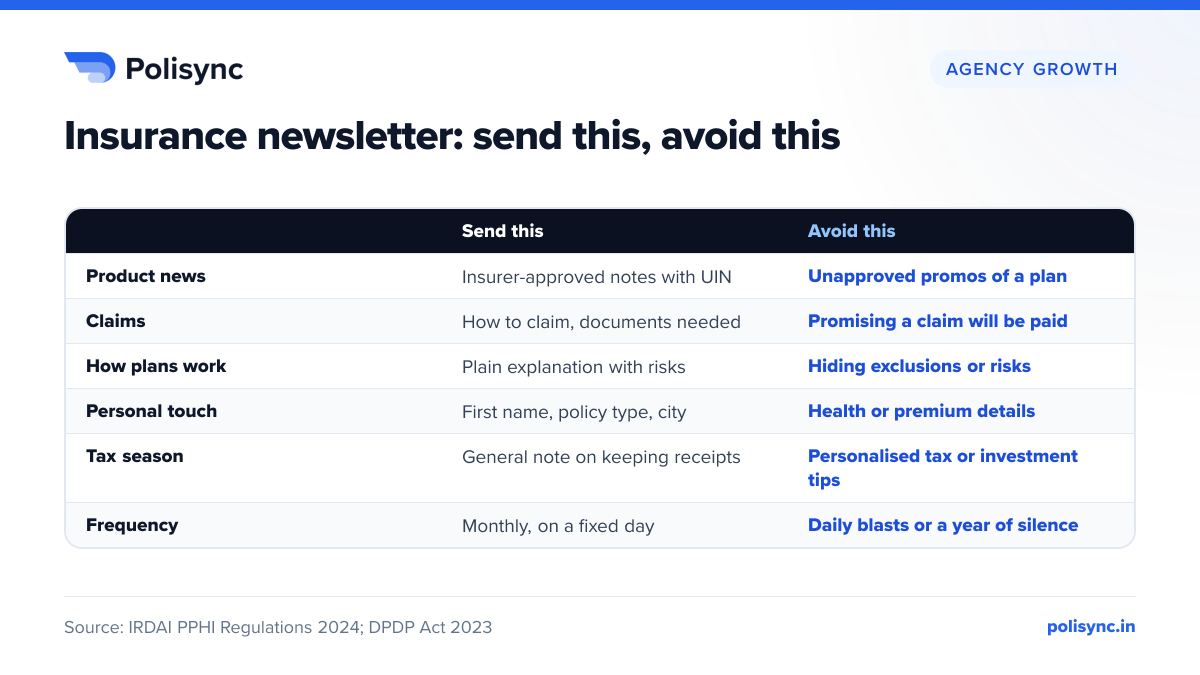
The best agent newsletters teach one useful idea per issue and make the next step obvious. Rotate between a few dependable formats so readers know what to expect.
Formats that suit insurance agents:
- The explainer: one concept in plain language, such as a waiting period, the free-look period or how a no-claim bonus works.
- The checklist: documents to keep ready for a claim, or what to look at before a renewal.
- The seasonal note: monsoon, festive season or year-end tax planning, tied back to the cover the client already holds.
- The "you asked" issue: answers to three questions clients asked you this month, with names and identifying details removed.
- The personal update: a new office, a new team member, or how you helped with a claim, shared only with the client's permission.
Keep individual renewal due dates out of the general newsletter. Those belong in one-to-one messages, and our renewal reminder message templates give ready wording. Agency software such as Polisync can send renewal reminder emails for each policy, which leaves the newsletter free for education.
If drafting is the bottleneck, let an AI tool produce a first draft, then edit it and check product facts against the insurer's own documents; see our ChatGPT prompts for insurance agents.
End every issue with one clear call to action: book a review, reply with a question, or forward the email to a family member who might find it useful. A gentle referral line costs nothing to add, and our guide on how to get insurance referrals has more ideas.
When does a newsletter become an IRDAI advertisement?
The IRDAI (Protection of Policyholders' Interests, Operations and Allied Matters of Insurers) Regulations, 2024, dated 20 March 2024 and in force from 1 April 2024, deal with advertising in Regulations 26 to 29. Regulation 26 defines an advertisement as a communication issued through any mode or medium to the public, or a section of it, meant to influence the opinion or behaviour of prospects towards the solicitation or sale of insurance. A newsletter mailed to your client list can meet that definition.
Regulation 28 is the rule agents must know: every advertisement issued by a distribution channel representing an insurer must be approved by the insurer in writing before it is issued; brokers, who represent the customer, need the same approval for anything about an insurance product. Regulation 27 adds that advertised information must be fair and true, reflect the risks in the product, and must not disguise terms, underplay risks, leave out important exclusions or contain false or fabricated figures. Distribution channels must also present products as the insurer's, not as if they offer them directly, and the same standards apply to social media content.
IRDAI's Master Circular on Protection of Policyholders' Interests of 5 September 2024 also tells prospects that insurance advertisements carry the insurer's registered name and the product's Unique Identification Number (UIN) wherever a product is advertised.
A practical way to stay on the right side of these rules:
- Keep general education, such as how claims work or why nominee details matter, separate from product promotion.
- Whenever you name or promote a specific plan, use insurer-approved material and keep the approval on file.
- If you are unsure whether an issue counts as an advertisement, ask your insurer's channel or compliance team before sending.
- Never promise returns or claim outcomes, or call a plan "the best", unless the policy wording supports it.
For the rest of your obligations, see our IRDAI compliance checklist for insurance agents.
What does a 12-month newsletter content calendar look like?
A content calendar is a simple plan of what each issue will cover, set months ahead so you are not starting from a blank page every month. The Indian year gives agents natural hooks.
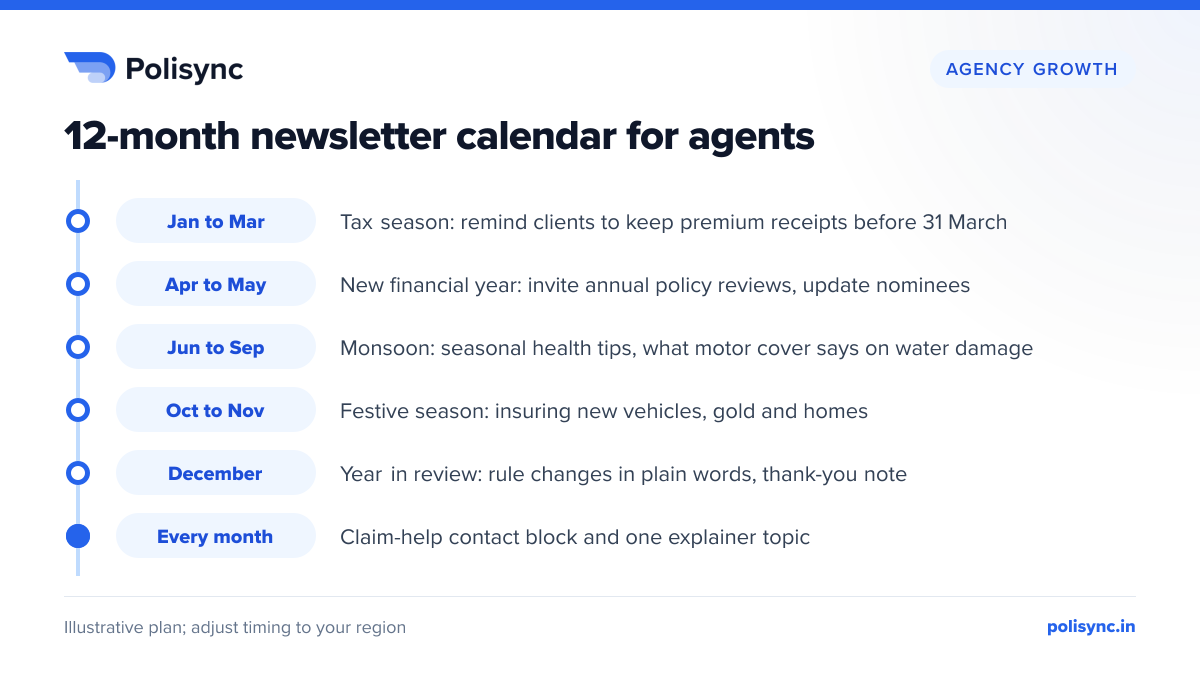
- January to March: the financial year closes on 31 March, so explain in general terms where to find premium receipts, and leave personal tax advice to their tax adviser.
- April to May: a new financial year is a good moment to invite clients to an annual policy review and to confirm nominee and contact details.
- June to September: share monsoon health tips and suggest motor clients check what their policy says about water damage.
- October to November: the festive season brings vehicle, gold and home purchases, so a short note on insuring new assets is timely.
- December: a year-in-review issue that explains, in plain words, any insurance rule changes clients should know about.
How often should insurance agents send a newsletter?
Monthly is a sensible default for most agents: often enough to be remembered, rare enough that every issue has something worth saying. Pick a fixed day, such as the first Tuesday of the month, so the habit sticks for you and for your readers.
Fortnightly can work in busy seasons such as January to March. Weekly is usually too much for a client list. Consistency matters more than volume: a list that hears nothing for a year and then receives a sales email may simply mark it as spam.
How do you write subject lines and personalise without over-collecting data?
A subject line has one job: tell the reader what is inside. Specific beats clever, and a question the client already has beats a slogan.
Illustrative subject lines you can adapt:
- Monsoon check: what does your car policy say about water damage?
- 3 documents to keep ready for a health insurance claim
- Your annual insurance review: 20 minutes, once a year
- Bought a new two-wheeler this Diwali? Read this first
- Answers to 3 questions clients asked me this month
Personalisation should use data the client already gave you for a purpose they understand. First name, city and the type of policy they hold are usually enough to split a list into health, motor and life readers.
Keep sensitive details such as medical conditions, sum insured or premium amounts out of newsletters. Emails get forwarded, and Section 6(1) of the DPDP Act limits consent to the data necessary for the specified purpose, so data collected to issue a policy should not quietly become marketing material.
How do you keep your newsletter out of the spam folder?
Deliverability is whether your email reaches the inbox at all. Three DNS records on your sending domain do most of the work:
- SPF (Sender Policy Framework) lists the servers allowed to send email for your domain.
- DKIM (DomainKeys Identified Mail) adds a digital signature so receiving servers can check the message really came from your domain.
- DMARC tells receiving servers how to treat mail that fails those checks, and ties them to the domain in your From address.
Under rules Google announced on 3 October 2023 and began enforcing from February 2024, Gmail requires bulk senders, defined as those sending more than 5,000 messages to Gmail addresses in one day, to strongly authenticate their email, offer one-click unsubscribe, process unsubscribe requests within two days and stay under a spam-rate threshold. Yahoo's sender requirements, also enforced from February 2024, point the same way: SPF and DKIM, a DMARC policy of at least p=none, a one-click list-unsubscribe header, honouring unsubscribes within 2 days, and a spam rate below 0.3%.
Most agents send far fewer than 5,000 emails a day, but the same practices protect smaller senders too:
- Send from your own domain (for example, name@yourname.in) through a reputable email service, rather than pasting addresses into BCC from a personal mailbox.
- Ask your email service or domain provider to set up SPF, DKIM and DMARC for that domain.
- Put a visible unsubscribe link in every issue and act on it within two days.
- Remove addresses that bounce, and stop mailing people who have not opened or clicked for a long time.
- Never mail anyone who did not opt in.
How should you measure newsletter results?
Open rates used to be the headline number, but they are no longer reliable. Apple's Mail Privacy Protection, announced on 7 June 2021, stops senders using invisible pixels to learn when an email is opened and masks the reader's IP address. As AWS explains, mail to Apple Mail users with the feature switched on can register an open whether or not the person read it, which inflates open rates.
Track these instead:
- Click rate: the share of recipients who click a link, the clearest sign an issue was useful.
- Replies and bookings: how many clients reply with a question or book a review after an issue.
- Unsubscribes and spam complaints: a sudden jump means the content or frequency needs a rethink.
- Business outcomes: renewals kept, referrals received and new policies you can trace back to a newsletter conversation.
Review these every quarter rather than after every issue: small lists produce noisy monthly figures, and trends tell you more.
What this means for insurance agents: a launch checklist
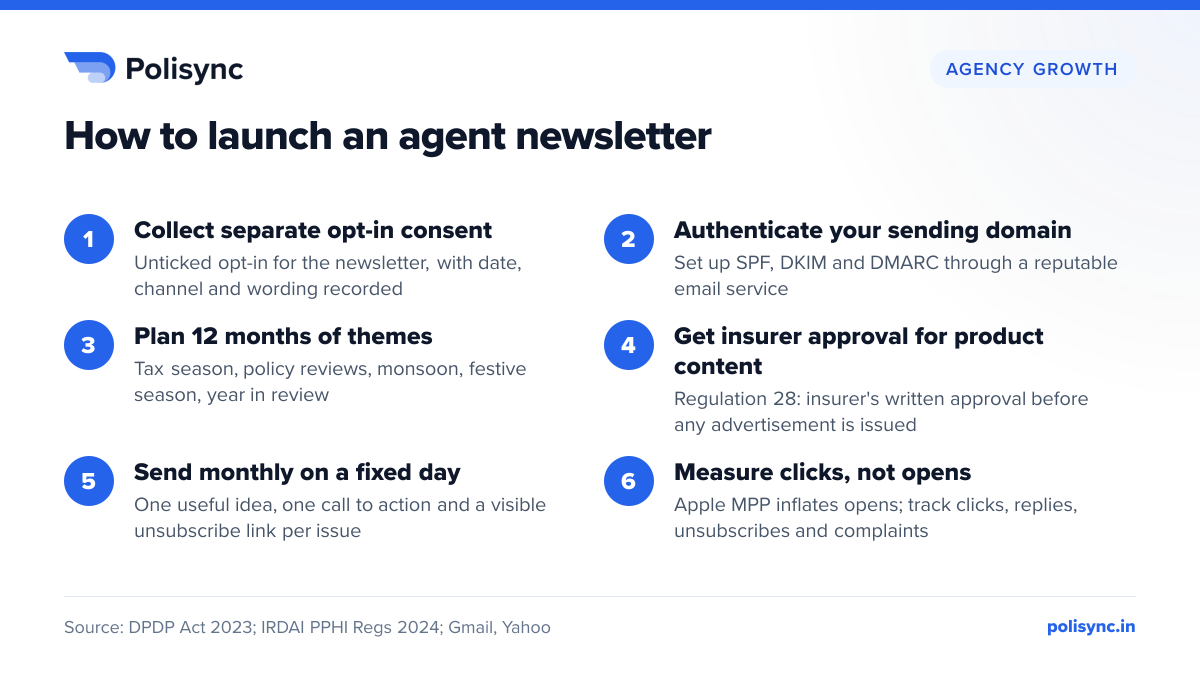
A compliant newsletter takes an afternoon to set up and an hour or two a month to run. This sequence keeps consent, insurer approval and deliverability in the right order.
Your action checklist:
- 1. Audit your list. Separate clients who opted in to marketing email from those whose addresses you hold only for policy servicing.
- 2. Fix your sign-up points. Add a clear opt-in line, a one-sentence purpose and an easy unsubscribe, and record every consent.
- 3. Set up your domain. Send from your own domain with SPF, DKIM and DMARC in place.
- 4. Plan the year. Draft a 12-month calendar of themes and write the first three issues before you send the first one.
- 5. Clear product content with insurers. Send any issue that names or promotes a specific plan to the insurer for written approval.
- 6. Send, measure, adjust. Mail monthly on a fixed day, watch clicks and replies, and act on unsubscribes within two days.