

The time management system that works best for insurance agents is a fixed weekly rhythm: protected morning power hours for prospecting, meetings clustered into set afternoons, a short daily slot for servicing and claims, renewals and admin batched into one or two sessions, and a 30 to 45 minute weekly review against your KPIs. This guide, current as of 26 August 2026, adds a sample calendar and a daily checklist.
This is practical guidance, not a regulatory requirement. Where we cite research or IRDAI rules, the link goes to the original document. All hour counts and calendars are illustrative, so adjust them to your city, product mix and whether you work full-time or part-time.
Why do insurance agents struggle to manage their time?
An agent's day mixes three very different kinds of work. There is selling (prospecting, needs analysis, presentations), reactive service (claims, endorsements, KYC updates, premium queries) and back-office admin (proposal forms, records, commission checks). Without a structure, reactive work wins every time because it arrives with a ping.
Interruptions carry a cost even when they feel productive. In a laboratory experiment presented at the CHI 2008 conference, Gloria Mark, Daniela Gudith and Ulrich Klocke asked 48 participants to answer a batch of work emails while being interrupted by phone or instant message about every two minutes. Interrupted participants finished faster with no difference in quality, but after only 20 minutes they reported significantly more stress, frustration, time pressure and effort. People cope with interruptions by rushing, and the rushing wears them down.
For agents, that wear shows up as unreturned prospect calls, renewals chased at the last minute and evenings lost to paperwork. The fix is rarely working longer. It is deciding in advance when each type of work happens.
What is time blocking, and how does it work for insurance agents?
Time blocking means dividing your working day into fixed blocks and giving each block one type of work before the day starts. Author Cal Newport described the method in a December 2013 post on his blog: he spent ten to twenty minutes each evening building the next day's schedule from his task lists and calendars, and left space beside each block to correct the plan when the day went off course. He estimated that a 40-hour time-blocked week produces as much output as a 60-plus-hour week without structure, which is his personal estimate rather than a measured result.
Newport also answers the objection every agent raises: what about work you cannot predict? His advice is to block time for reactive work like any other obligation, and to give those blocks a secondary purpose for quiet periods. For an agent, that becomes: answer client queries and claims, and if nothing comes in, update renewal records.
Six block types cover almost everything an Indian agent does:
- Prospecting: calls to new leads, referral requests, follow-ups on quotes already sent, local and social outreach.
- Meetings: needs analysis, proposal presentations, policy delivery and annual reviews.
- Servicing and claims: claim support, nominee and address changes, KYC, premium and receipt queries.
- Renewals and follow-ups: due-date lists, reminders, grace-period calls and lapsed-policy revival.
- Admin: proposal paperwork, data entry, commission checks and document filing.
- Learning: product updates, IRDAI circulars, exam preparation and sales skills.
What are power hours in insurance sales?
A power hour is a fixed, uninterrupted block, usually 60 to 120 minutes, used only for revenue-generating outreach such as prospecting calls. WhatsApp is closed, the phone is silent except for your outgoing calls, and the call list is ready before you start. It is a sales-floor habit rather than a research finding, but it applies the same idea as time blocking: one type of work, no switching.
Mornings are a common choice, because meetings and service requests have not yet filled the day. A better rule is to test: note how many calls connect in each time window for a month, then move the block to the window your prospects actually answer.
How should an insurance agent split a working week?
There is no correct ratio, but an agent who wants to grow should spend the largest share of the week in front of prospects and clients and the smallest share on admin. The chart below shows one illustrative split of about 37 hours of blocked work across a six-day week, matching the sample calendar further down. It excludes the short daily prep, the evening wrap-up and the weekly review.
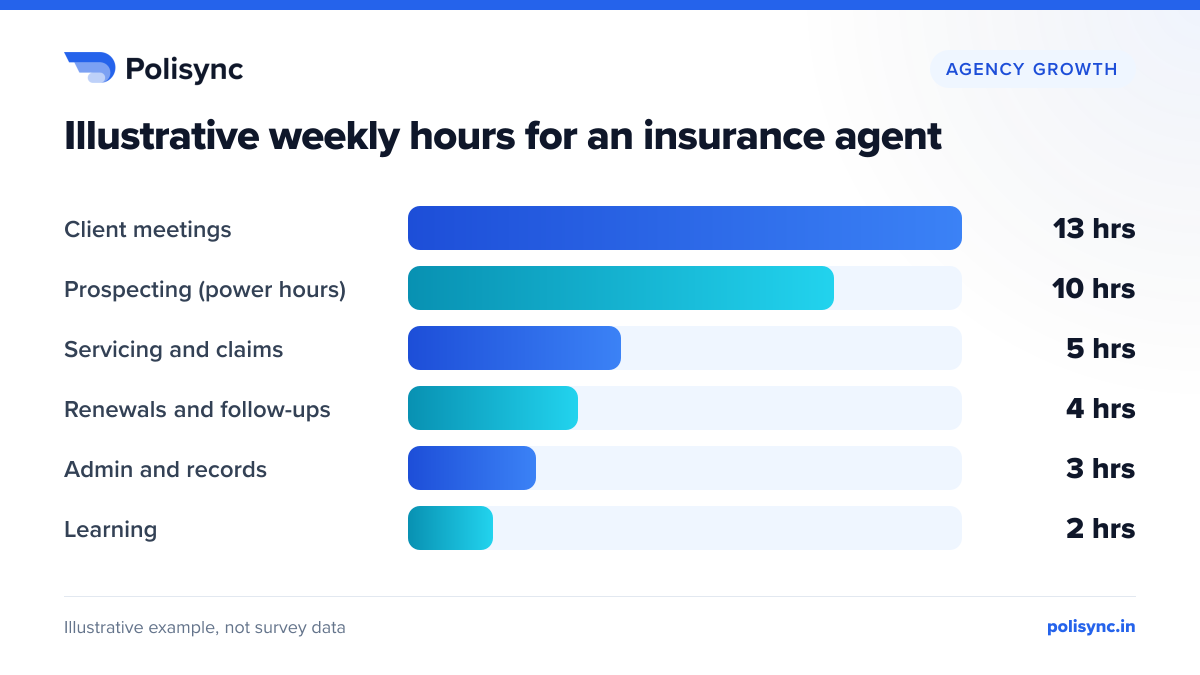
If you are new, move hours from meetings to prospecting until your pipeline fills. If you already have a large book, servicing and renewals will take more time; protect prospecting anyway, because without new clients the book stops growing.
Part-time agents can use the same proportions at a smaller scale, for example two evening power hours on weekdays and client meetings on weekend mornings.
What does a sample weekly calendar look like?
Here is an illustrative weekly calendar for a full-time agent working Monday to Saturday. Treat it as a starting template, not a rule.
- Monday: 9:00 to 9:30 weekly plan review; 9:30 to 11:30 power hours; 12:00 to 1:00 servicing and claims; 2:30 to 5:30 client meetings.
- Tuesday: 9:30 to 11:30 power hours; 12:00 to 1:00 servicing; 2:00 to 4:00 renewals batch; 4:30 to 6:30 client meetings.
- Wednesday: 9:30 to 11:30 power hours; 12:00 to 1:00 servicing; 2:30 to 5:30 client meetings.
- Thursday: 9:30 to 11:30 power hours; 12:00 to 1:00 servicing; 2:00 to 4:00 admin and commission checks; 4:30 to 6:30 client meetings.
- Friday: 9:30 to 11:30 power hours; 12:00 to 1:00 servicing; 2:00 to 4:00 learning (product updates, circulars, exams); 4:00 to 6:00 renewals and follow-up batch.
- Saturday: 10:00 to 1:00 meetings with salaried clients who are free at weekends; 2:00 to 3:00 admin and filing; rest of the day off.
- Sunday: family day. If you prefer, move the weekly plan review to a quiet 30 minutes on Sunday evening.
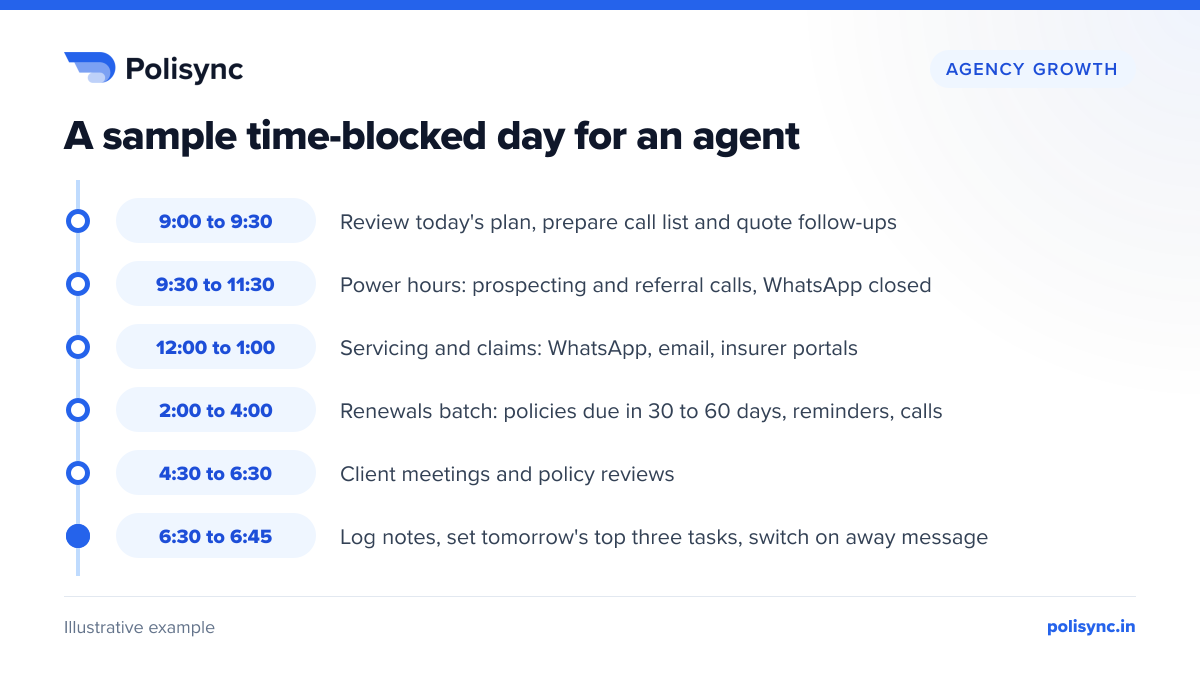
A sample day, hour by hour
Here is how the Tuesday in that template looks, including the short morning prep and evening wrap-up that sit outside the main blocks.
How do you batch renewals, follow-ups and servicing?
Batching means grouping similar small tasks into one session instead of doing each one when it occurs to you. Renewals are ideal for batching because due dates are known months in advance.
A simple renewal batch, once or twice a week:
- Pull every policy due in the next 30 to 60 days, plus anything already in its grace period.
- Send reminders in one sitting using saved renewal reminder message templates.
- Call clients who have not responded to two reminders.
- Book an annual policy review meeting for clients whose cover may need an upgrade, and log every outcome with a next follow-up date.
Servicing is different, because it cannot wait for a weekly batch. Under IRDAI's Master Circular on Protection of Policyholders' Interests, 2024, issued on 5 September 2024, insurers must decide cashless health requests within one hour and grant final discharge authorisation within three hours of the hospital's request.
The same circular requires death claims not needing investigation to be settled within 15 days of intimation (45 days where investigation is warranted) and complaints to be resolved within 14 days. When a client is in hospital or has lost a family member, you are the person they call. That is why the sample calendar gives servicing a slot every day, and why a live claim is the one interruption that should always break a block.
How do you handle WhatsApp and phone interruptions?
WhatsApp is where many Indian clients reach their agent, which makes it the biggest threat to a time-blocked day. The aim is not to ignore clients but to answer them predictably.
- Check at set times. Open WhatsApp at the start of each servicing slot and between blocks, not every time it pings.
- Use the WhatsApp Business app tools. The app offers automated greeting and away messages, saved quick replies, and labels and lists to organise chats, as described in WhatsApp's own guide for small businesses. An away message during power hours can tell clients when you will reply.
- Label every chat by status, such as new lead, quote sent, claim open or renewal due, so each servicing slot starts with the urgent ones.
- Define what is urgent. Hospital admission, a death in the family or an accident gets an immediate answer. A premium receipt or a policy copy waits for the next servicing slot.
- Tell clients your hours. Mention your service window in your WhatsApp Business profile description and in your onboarding message, so clients know when to expect a reply.
Missed calls go into the same servicing slot; a short 'in a meeting, will call you at 12' text is enough. For more on using the channel well, read our guide to WhatsApp for insurance agents.
How do you plan weekly, monthly and quarterly against KPIs and MDRT?
A calendar only drives sales if the blocks point at the right numbers. That takes a short planning ritual every week, plus a monthly and a quarterly review.
The weekly planning ritual
Set aside 30 to 45 minutes on Monday morning or Sunday evening and work through five steps.
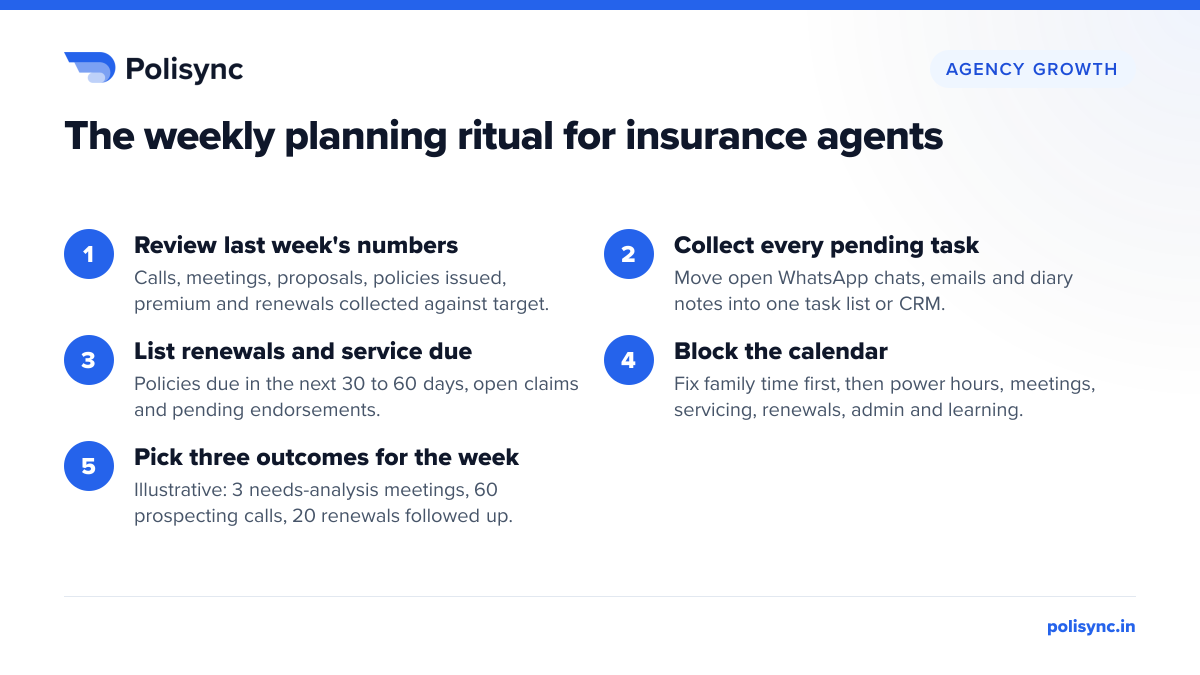
Use your insurance agent KPIs as the scorecard. Activity numbers such as calls and meetings tell you whether the blocks are being used; result numbers such as premium and persistency tell you whether they are aimed at the right people.
A working lead management system feeds the prospecting block, so each power hour starts with a ready call list instead of a blank page.
Monthly and quarterly planning
Once a month, compare activity with results and resize the blocks. If meetings convert but there are too few of them, add prospecting hours; if renewals are slipping into the grace period, add a second renewal batch.
Once a quarter, work backwards from your annual goal. If you are aiming for MDRT, the MDRT calculator shows how far you are from the qualifying figure, and our guide on how to qualify for MDRT in India explains the requirements. Then convert the remaining gap into weekly activity using your own conversion rates.
Illustrative example: you are ₹12 lakh of first-year premium short of your annual goal with 24 weeks left, so you need ₹50,000 a week. If your average policy brings ₹50,000 of first-year premium, that is one new policy a week. If one in three needs-analysis meetings closes, you need three such meetings a week, and if one in 20 prospecting calls books a meeting, about 60 calls a week, or 12 per power-hour day across five days.
AI assistants can shorten admin and preparation blocks by drafting follow-up messages, summarising brochures or outlining a review meeting. Our list of ChatGPT prompts for insurance agents is a good start, but never paste a client's personal data into a public AI tool.
How do you protect family time and avoid burnout?
Commission-based work has no natural stopping point, so agents often drift into answering messages late into the night. The World Health Organization's ICD-11 classifies burn-out as an occupational phenomenon, not a medical condition, and defines it as a syndrome resulting from chronic workplace stress that has not been successfully managed. Its three dimensions are exhaustion, mental distance or cynicism about one's job, and reduced professional efficacy (WHO, 28 May 2019).
Practical guardrails for agents:
- Block family time first. Put your weekly day off, children's events and family meals on the calendar before client blocks, and treat them as appointments.
- Set a daily shutdown. End with a 15-minute wrap-up, then switch on your away message.
- Keep one emergency rule. Claims and hospitalisations get an answer at any hour; everything else waits for the next servicing slot.
- Plan for peaks. If some months are always heavier for you, such as the festive season or financial year-end, plan them in advance and schedule lighter recovery days afterwards.
- Watch the warning signs. If you dread client calls or feel your work no longer matters, cut evening work and talk to someone you trust before it affects your health or your clients.
What this means for insurance agents: a daily checklist
Time management is a set of small, repeated habits rather than a personality trait. Run through this checklist each working day:
- Review today's blocks and top three tasks before opening WhatsApp.
- Prepare the power-hour call list: name, number, last conversation and next step.
- Complete power hours with notifications off.
- Clear urgent servicing and claims in the midday slot.
- Record every meeting outcome and next follow-up date the same day.
- Check renewals due this week and any policy in its grace period.
- Confirm tomorrow's meetings with a short message and keep the documents you need ready.
- Close the day: log notes, set tomorrow's top three, switch on your away message.
Keeping client records, due dates and follow-ups in one place makes every block faster to start. Agency management software such as Polisync can help keep those records organised, though a disciplined spreadsheet and calendar also work while your book is small.
What should agents do this week?
A seven-step action checklist to start your new routine:
- 1. Audit one week. Note what you actually did each hour for five working days, and compare it with where you think your time goes.
- 2. Choose your power hours. Fix a 60 to 120 minute prospecting window on at least four days a week.
- 3. Fix a daily servicing slot and set a WhatsApp Business away message for your power hours.
- 4. Schedule one renewal batch for every policy due in the next 60 days.
- 5. Book a recurring weekly planning session of 30 to 45 minutes in your calendar.
- 6. Pick three KPIs to track every week, such as meetings held, proposals submitted and renewals collected.
- 7. Put your day off in the calendar for the next four weeks before adding any client meetings.