

The best ChatGPT prompts for insurance agents give the AI a role, the context, a clear task, the output format and limits, then leave the agent to check and send. Below are 40 ready-to-copy prompts for prospecting, renewals, client education, objection practice, social posts, meeting prep and admin. As of 15 August 2026, use placeholders instead of client data, because it is personal data under the DPDP Act, 2023.
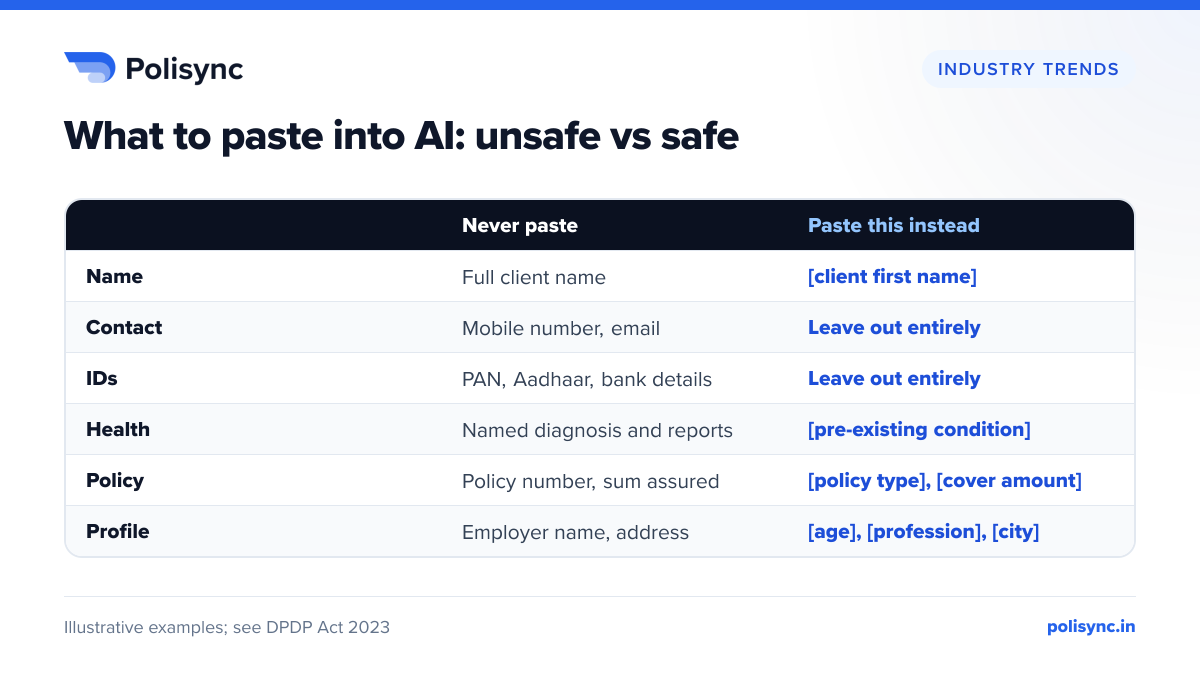
Every prompt works in ChatGPT, Gemini or Claude. Words in square brackets, such as [client age], are placeholders for generic details, never names, phone numbers or policy numbers. If you are new to AI tools, start with our overview of AI for insurance agents in India.
What makes a good ChatGPT prompt for an insurance agent?
A prompt is the instruction you give an AI chatbot. OpenAI's own prompt engineering guide suggests describing the assistant's identity and goals, giving clear instructions, adding examples and supplying the context the model needs. Anthropic's prompting best practices for Claude put it simply: treat the model as a brilliant but new employee who lacks context on your norms.
Anthropic's golden rule: if a colleague with no background would be confused by your prompt, the AI will be too. State who the reader is, what you want (a 70-word reminder) and what to avoid (no premium figures, no promises).
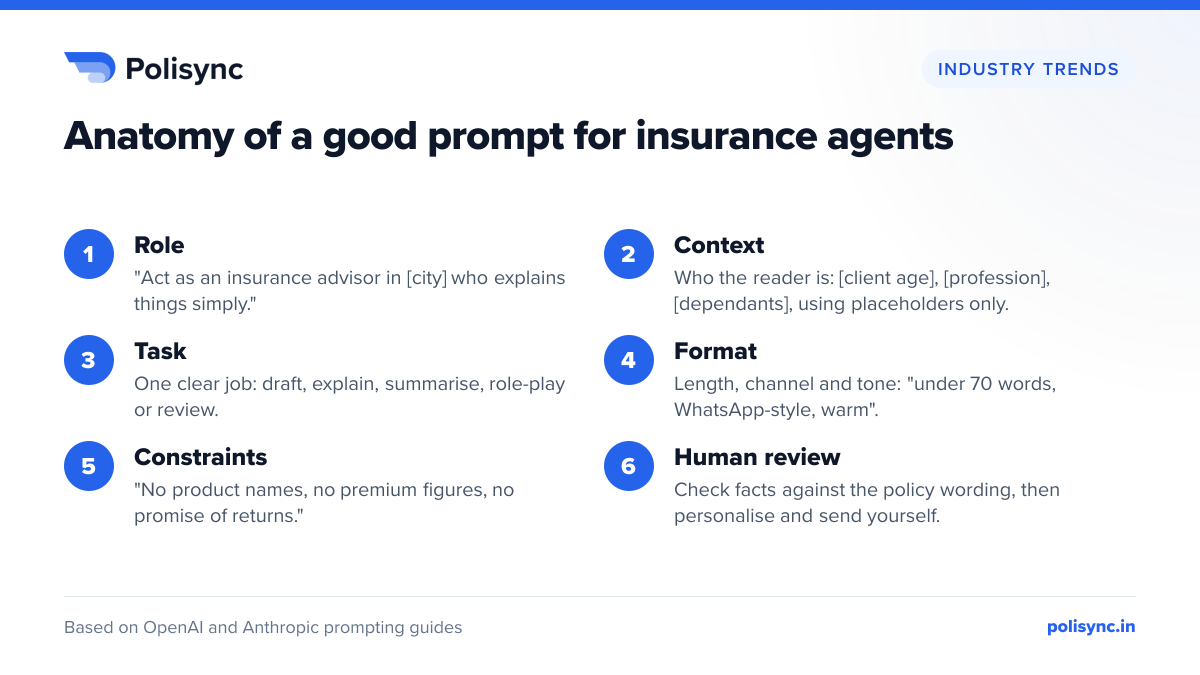
Iterate: if the answer is too long or salesy, reply "shorter" or "less pushy". Anthropic notes examples are one of the most reliable ways to steer tone, so paste one of your own past messages (details removed) and ask for more in that style.
What client data is safe to share with AI tools?
Assume anything you type into a chatbot leaves your control. Google's Gemini Apps Privacy Hub says a subset of chats is reviewed by human reviewers and asks users not to enter confidential information they would not want a reviewer to see. Whatever the tool or its settings, the safest habit is the same: share no personal data.
The Digital Personal Data Protection Act, 2023 requires a data fiduciary (anyone who decides why and how personal data is processed) to take reasonable security safeguards to prevent a personal data breach. Its Schedule sets penalties of up to ₹250 crore for failing to do so. The DPDP Rules were published in the Gazette on 13 November 2025 and announced by PIB on 14 November, and under the Act's commencement notification G.S.R. 843(E), core obligations, including security safeguards and the penalty provisions, apply from May 2027. Until then, treat them as good practice and as duties that are coming. Our DPDP Act guide for insurance agents covers consent and record-keeping in detail.
Which ChatGPT prompts help with prospecting and outreach?
Use these to open conversations. You decide who to contact and send every message yourself.
- 1. Referral intro: "Act as an insurance advisor in [city]. Write a warm WhatsApp-style message to [first name], referred by [relationship]. Say I help families with life and health cover. Under 60 words, end with one easy question." Tip: Type the real name in only after copying the draft out.
- 2. Small business email: "Write a 120-word email to the owner of a [type of business] with [number] staff in [city], introducing group health cover as an employee benefit. One call to action: a 15-minute call. No premium figures." Tip: Ask for three subject lines and pick the plainest.
- 3. Target segments: "I sell [life/health/motor] insurance in [city]. My best clients share these traits: [trait 1], [trait 2], [trait 3]. Suggest five segments to target next, with one reason each may need cover." Tip: Treat the list as brainstorming and test it against your own book.
- 4. Society talk pitch: "Draft a message to the secretary of [housing society] offering a free 30-minute talk on [topic]. Make clear it is education, not a sales pitch." Tip: Carry insurer-approved material if product questions come up.
- 5. Reconnect message: "Write three versions of a short message to reconnect with a former [colleague/classmate] I have not spoken to in [years]. I am now an insurance advisor. Personal, not salesy, under 50 words each." Tip: Add one detail only you would know.
- 6. Call openers: "Give me five opening lines for a call to a [age]-year-old [profession] who downloaded my [guide] on [topic]. Each should ask permission to continue and take under 15 seconds." Tip: Read them aloud and drop any that sound scripted.
Which prompts work for follow-ups and renewal reminders?
These produce drafts you copy and send manually from your own phone or email. For ready wording, see our renewal reminder message templates, and for etiquette on the channel itself, WhatsApp for insurance agents.
- 7. Post-meeting recap: "Turn these notes into a polite follow-up email: [notes with names and numbers removed]. List documents the client promised and the next step on [date]." Tip: Strip health details from the notes before pasting.
- 8. 30-day renewal reminder: "Write a WhatsApp-style reminder for a [policy type] policy due on [due date]. Friendly, under 70 words, mention the grace period as [grace period per policy] and invite questions." Tip: Take the grace period from the policy document, never from the AI.
- 9. Overdue premium nudge: "Write a respectful message to a client whose [policy type] premium has been due since [date]. Explain in plain words why continuous cover matters, without fear, and offer help." Tip: Send one message, not a chain of reminders.
- 10. Premium change explainer: "Draft an email explaining the renewal premium changed from [old premium] to [new premium] because [reason given by insurer]. Neutral tone, no other speculation." Tip: State only the reason the insurer has given in writing.
- 11. Renewal thank-you: "Write a short thank-you note after a client renewed their [policy type], with a gentle reminder to update nominee details if family circumstances changed." Tip: Send it within a day of renewal.
- 12. Translate a reminder: "Rewrite this reminder in simple [Hindi/Marathi/Gujarati] without changing its meaning: [English message]." Tip: Have a native speaker check it; translations can shift meaning.
Which prompts help explain insurance to clients?
Ask for plain language, then check every fact against the policy wording or insurer brochure.
- 13. Term cover basics: "Explain term insurance to a [age]-year-old [profession] with [number] dependants in under 150 words, using one everyday analogy. Define any jargon you use." Tip: Ask for a simpler second version too.
- 14. Health policy jargon: "Explain co-payment, deductible and sub-limit in health insurance with one hypothetical ₹ example each. Label the examples hypothetical." Tip: Use the client's actual policy terms when you meet.
- 15. Nominee explainer: "Write a one-page explainer on what a nominee does in a life policy and why it should be kept updated. End with three questions the client should ask me." Tip: Use the questions as your meeting agenda.
- 16. Claim document checklist: "List documents a family usually keeps ready for a health insurance claim. Mark anything that varies by insurer as 'check your policy'." Tip: Cross-check the list with the insurer's claim form.
- 17. Riders in plain English: "Explain riders to a [age]-year-old client: what they are, when they may make sense and what to check before adding one. No product names." Tip: Product-specific rider terms must come from insurer material.
- 18. Policy wording simplifier: "Rewrite this extract from a policy wording in plain English without changing its meaning, and flag anything you are unsure about: [non-personal extract]." Tip: Compare the rewrite line by line with the original.
- 19. Understanding check: "Create five simple quiz questions to check whether a client understood [topic, e.g. waiting periods]." Tip: Use them at society talks.
How can agents practise objection handling with AI?
AI is a patient role-play partner. Practise here, then use the frameworks in our guide to handling client objections in insurance sales in real conversations.
- 20. Sceptical client role-play: "Role-play a sceptical [age]-year-old client who says 'My employer already covers me.' Ask one question at a time and wait for my reply. After five exchanges, rate my clarity and empathy." Tip: Repeat with a different client age and income.
- 21. Root causes: "List common reasons a [age group] prospect may say 'insurance is a waste of money', with one honest, non-pushy question to understand each concern." Tip: Listening questions usually beat rebuttals.
- 22. Three response styles: "Give me three responses to '[objection]': one empathetic, one factual, one that asks a question. None may promise returns or exaggerate benefits." Tip: Blend the best parts into your own words.
- 23. Critique my answer: "Review my answer to '[objection]': [your answer]. Point out anything that sounds pushy, vague or like a guarantee." Tip: Run your standard pitch through this quarterly.
- 24. Early surrender talk: "Play a client who wants to surrender a policy early because [reason]. Help me practise explaining the trade-offs neutrally, without discouraging or pressuring, so the client decides." Tip: Get the actual surrender value from the insurer before any real conversation.
Which prompts work for social media and LinkedIn posts?
Social posts reach the public, so IRDAI's advertisement rules can apply (see the guardrails below). Keep them educational and check with your insurer before posting. If you want AI assistants themselves to recommend you, read how insurance agents can get found in ChatGPT and AI search.
- 25. LinkedIn explainer: "Write a 150-word LinkedIn post on [topic] for [audience]. Educational, no product names, end with a question and the line 'General information only, not advice for your situation.'" Tip: Ask your insurer whether the post needs its written approval before it goes live.
- 26. Monthly content plan: "Give me 12 educational post ideas for [audience] in [city] for one month, mixing myths, checklists and short stories. No product promotion." Tip: Batch-write them in one sitting.
- 27. Anonymised FAQ post: "Turn this client question into an anonymised FAQ-style post: [question with all identifying details removed]." Tip: Make sure the client could not recognise themselves.
- 28. Compliance pass: "Make this post clearer and shorter, and flag any line that could read as a promise of returns, a guaranteed claim or an exaggerated benefit: [draft]." Tip: Treat the flags as a first filter, not a legal review.
- 29. 60-second video script: "Write a 60-second video script explaining [topic] for [audience]: a hook, three points, a close." Tip: Keep it conversational.
- 30. Festival captions: "Suggest five captions for [festival] linking the season to family financial protection, without fear-based messaging." Tip: Skip any caption that mentions a specific plan or price.
Which prompts help with meeting prep and admin work?
Meeting preparation
- 31. Discovery questions: "I am meeting a [age]-year-old [profession], [marital status], [number] children, goals: [goals]. Give me 10 discovery questions grouped by income, dependants, existing cover and health." Tip: Pick the six most relevant; ten can feel like an interrogation.
- 32. Review meeting agenda: "Create a one-page agenda for a 45-minute annual review with a family holding [types of policies]." Tip: Share it a day before.
- 33. Topics to prepare: "For this anonymised profile: [profile], what topics should I be ready to explain and which documents should the client bring?" Tip: Keep the profile generic enough that no one is identifiable.
- 34. Circular summary: "Summarise this public insurer circular or brochure and list questions to ask my insurer's contact: [pasted public text]." Tip: Paste only public documents, never internal client files.
- 35. Comparison template: "Build a blank comparison table with the columns I should fill in when comparing two health plans: [plan A] and [plan B]." Tip: Fill every cell yourself from the brochures, not from AI memory.
Admin and productivity
- 36. Weekly plan: "Turn these tasks into a weekly plan: [task list, using initials or codes instead of client names]. Put renewals due within [days] first, then follow-ups, then prospecting." Tip: Review the plan every Monday morning.
- 37. Spreadsheet formula: "Write an Excel formula that shows days left until the renewal date in column [column] and highlights rows due within 30 days." Tip: Test it on three rows first.
- 38. Insurer status email: "Draft a polite email to an insurer's operations team asking for the status of [claim/endorsement] reference [reference], raised on [date]." Tip: Add the real reference number in your email client, not in the chatbot.
- 39. Document handling SOP: "Write a simple procedure for how my assistant should handle incoming client documents: where to save them, who can access them and when to delete copies." Tip: Align it with your consent records.
- 40. Tone and grammar check: "Check this email for tone, grammar and clarity and keep it under 120 words: [draft with personal details removed]." Tip: Read it aloud before you send it.
Keep the real client details in your own records or in agency software such as Polisync, and merge them into the draft only after it leaves the chatbot.
What do IRDAI rules mean for AI-written content?
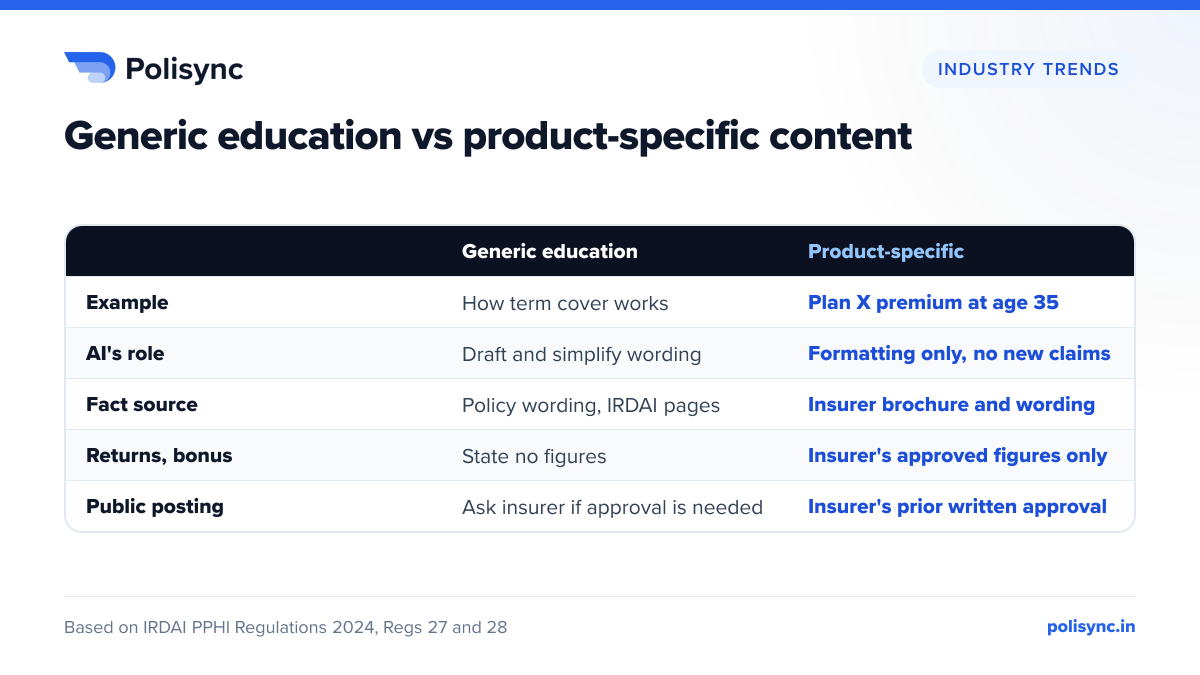
AI does not change who is responsible: you are. The IRDAI (Protection of Policyholders' Interests, Operations and Allied Matters of Insurers) Regulations, 2024, dated 20 March 2024 and in force from 1 April 2024, define mis-selling in Regulation 5(9) to include making a false or misleading statement, concealing exclusions and not taking reasonable care that a policy suits the prospect.
On advertising, Regulation 27 requires content to be fair and true, reflect product risks and not mislead. Claims beyond the reasonable expectation of policy performance are barred, and social media content must comply. Regulation 28 says an advertisement issued by a distribution channel representing the insurer, such as an agent, needs the insurer's written approval before it is issued. Advertisement is defined broadly: any public communication meant to influence prospects towards buying insurance. See also our guide on how to avoid insurance mis-selling.
AI also gets facts wrong. OpenAI's guide to optimising LLM accuracy admits models are unlikely to reach 99.999% accuracy with off-the-shelf methods and warns that too much irrelevant context can cause hallucinations, meaning confident but false answers. Google's Gemini Apps Privacy Hub likewise warns that Gemini can hallucinate and present inaccurate information as fact.
What should agents do before using these prompts?
A practical checklist to keep AI useful and compliant:
- 1. Strip personal data. No names, contact numbers, PAN, Aadhaar, health reports or policy numbers go into any chatbot.
- 2. Verify every fact. Premiums, waiting periods, grace periods, exclusions and tax rules come from the policy wording, the insurer or IRDAI, never from AI memory.
- 3. Never promise returns. Remove any line that implies guaranteed claims, guaranteed returns or benefits beyond the policy terms.
- 4. Label education as general. Add a short 'general information, not personal advice' line to public posts.
- 5. Get insurer approval for public content. Take the insurer's written approval before publishing any advertisement, and ask whether your educational posts count as one.
- 6. Send manually and personalise. Read every draft aloud, add the client's details yourself and send from your own account.