

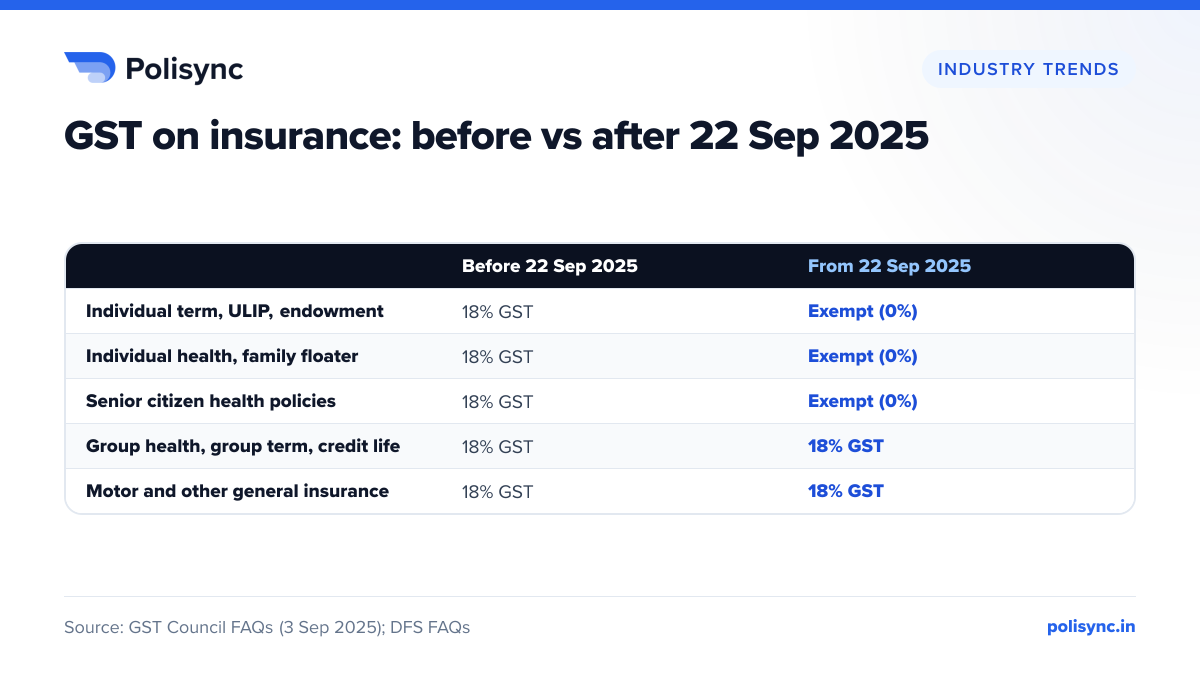
Individual life and individual health insurance premiums in India have carried zero GST since 22 September 2025, down from 18%. The 56th GST Council recommended the exemption on 3 September 2025, covering term, ULIP, endowment, family floater and senior citizen policies plus their reinsurance. Group policies and general insurance such as motor still pay 18%. As of 26 September 2026, the exemption has completed one full year.
For clients, the change was simple: the GST line on individual premium receipts disappeared. For agents, it was more complicated. Insurers lost input tax credit, several private insurers cut distributor commission, and retail health business grew sharply. This guide covers what changed in the first year, what the data shows, and how to explain it on renewal calls now that year two has begun.
What exactly did the 56th GST Council decide?
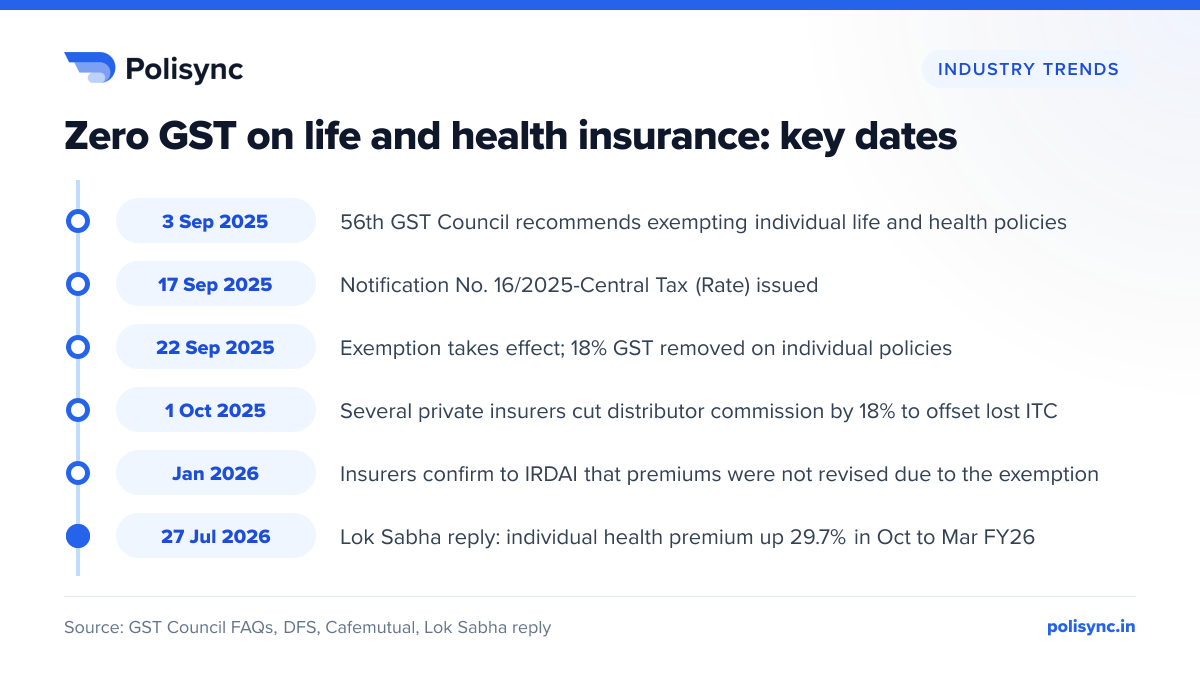
The GST Council met on 3 September 2025 and, according to the Ministry of Finance FAQs on its decisions, recommended exempting two groups of policies. The government notified the exemption through Notification No. 16/2025-Central Tax (Rate) dated 17 September 2025, effective 22 September 2025, as confirmed in the Finance Ministry's reply to Lok Sabha Unstarred Question No. 1323.
The exemption covers:
- All individual life insurance policies, including term, ULIP and endowment plans, and the reinsurance of such policies.
- All individual health insurance policies, including family floater plans and senior citizen policies, and the reinsurance of such policies.
- Individual health policies with embedded covers such as travel or personal accident cover, when sold as a single product for a single price, per the Department of Financial Services FAQ on the exemption.
- Revived policies: premiums paid for an individual life policy that lapsed before 22 September 2025 and was reinstated on or after that date are exempt.
An exempt supply is one on which no GST is charged to the customer and on which the supplier cannot claim input tax credit. That second half matters, and we come back to it below.
Which insurance policies still attract 18% GST?
The exemption applies only where the insured is an individual, not a group. The DFS FAQ confirms that group insurance policies, employer-sponsored group health and group life policies, and group credit life and group term policies continue to attract 18% GST. Motor, fire, property and other general insurance were not part of the exemption and, as ClearTax notes, continue at 18%.
How were premiums due around the changeover date treated?
The DFS FAQ says the rate depends on the date of premium payment, not the due date. A premium due on 21 September 2025 but paid on or after 22 September 2025 carried no GST. For instalment policies, each instalment is taxed by its own payment date. Where an advance was received before 22 September 2025, the exemption applies if two of three events (supply, invoice, payment) fall on or after that date.
How much did clients actually save on premiums?
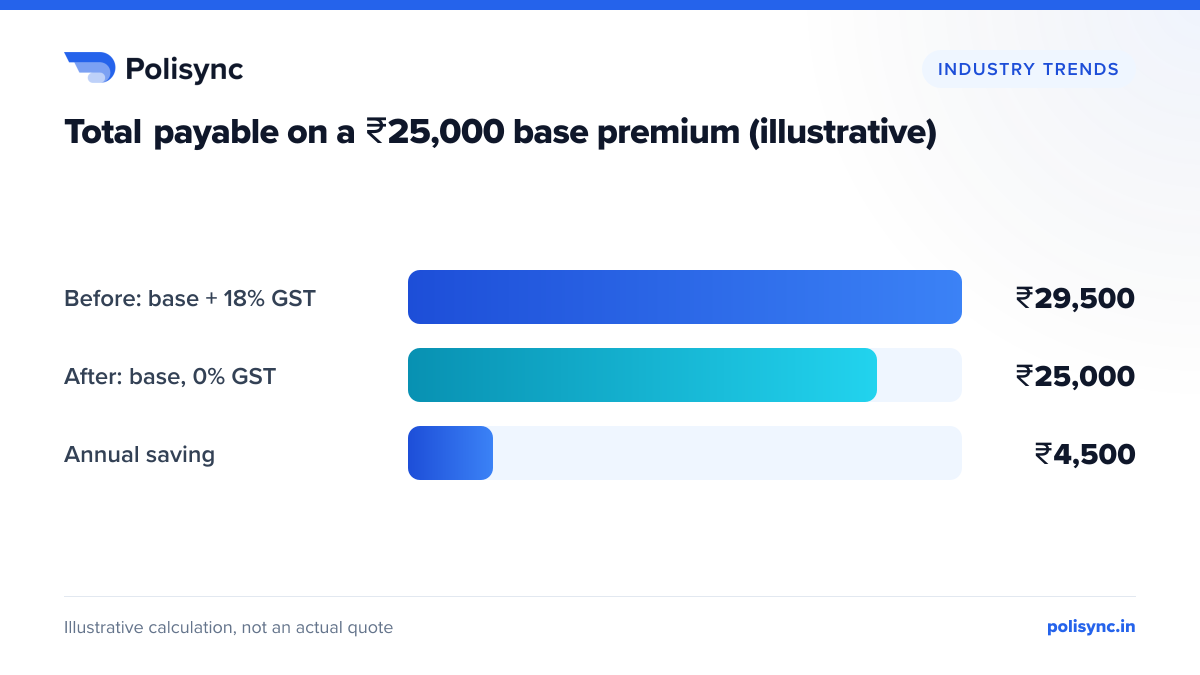
On a like-for-like basis, the saving equals the GST that used to be added on top of the base premium. Here is an illustrative, hypothetical example you can use with clients; actual premiums depend on the insurer, age, cover and any annual revision.
Hypothetical individual health policy with a base premium of ₹25,000:
- Before 22 September 2025: ₹25,000 base premium + 18% GST of ₹4,500 = ₹29,500 payable.
- From 22 September 2025: ₹25,000 base premium + ₹0 GST = ₹25,000 payable.
- Saving: ₹4,500 a year, or about 15% of the old total bill (₹4,500 ÷ ₹29,500 = 15.3%).
You can check any client's numbers with our free GST calculator. Remind clients that the saving is on GST only. Age-band changes, claims-based loading or a product-level premium revision can still move the base premium up at renewal.
What happened to input tax credit, and did insurers raise base premiums?
Input tax credit (ITC) is the credit a business gets for GST it pays on its own expenses. Once individual life and health policies became exempt, insurers could no longer use ITC on costs linked to them. The CBIC's FAQs of 16 September 2025, as reproduced by A2Z Taxcorp, said reinsurance would itself be exempted, while ITC on other inputs such as commission and brokerage would have to be reversed.
The obvious fear was that insurers would quietly raise base premiums to recover this cost. The official position is that they did not. In its Lok Sabha reply of 27 July 2026, the Finance Ministry (Minister of State Pankaj Chaudhary) said IRDAI had received confirmation in January 2026 from all general, health and life insurers that they had not revised premiums on account of the exemption, and that the relief had been passed on to policyholders, even though insurers must reverse the related ITC.
Is that what clients experienced?
Not everyone agrees. A LocalCircles survey shared with The Times of India in March 2026 (as reproduced by CAalley), with over 20,000 responses from 301+ districts, found that 48% of respondents said the full benefit was passed on. Some 36% of those who bought or renewed an individual health or life policy after the change said they got no meaningful benefit, including 26% who said insurers had raised the base price. In a November 2025 round, 43% had reported no benefit.
For agents, the practical lesson is to show clients the base premium line, not just the total. If a base premium rose, check whether it was an age-band change, a claims loading or a product revision, and explain that separately from GST.
How did the GST exemption change agent commissions?
This is where agents felt the exemption most. From 1 October 2025, Aditya Birla Health, Care Health, ICICI Lombard, Niva Bupa and Tata AIG cut distributor payouts by 18% of the gross commission amount, Cafemutual reported. Tata AIG said the removal of ITC raised its costs and led to the revision, while ICICI Lombard said it would absorb the lost credit on non-commission expenses.
Private life insurers made a similar move. The Hindu BusinessLine reported, as reproduced by A2Z Taxcorp on 6 October 2025, that private life insurers cut commission by 18% for all distributor types, including individual agents, from 1 October 2025, while an LIC official said there was no reduction of commission to agents as on that date. CAclubindia reported that public sector general insurers were also said to be absorbing the ITC loss rather than cutting agent commission.
The General Insurance Agents Federation Integrated (GIAFI) said the change had effectively shifted the burden onto distributors, and its president urged agents to unite for a collective representation to regulators and the Finance Ministry.
A hypothetical illustration: Cafemutual noted that insurers typically paid around 15% commission. On a ₹25,000 premium, that is ₹3,750; an 18% reduction lowers it by ₹675 to ₹3,075, an effective rate of about 12.3%. Actual mechanics differ by insurer and product, so check each insurer's revised commission circular.
Commission rules may change again. On 23 September 2026 IRDAI released a consultation paper, Recalibrating Economics of Insurance Distribution, covered in our explainer on the IRDAI commission consultation paper 2026. Its commission caps are only proposals, open for comments until 25 October 2026. Meanwhile, tracking commission by insurer and policy is the only way to see what the October 2025 cuts cost your book.
Did the exemption boost insurance sales in its first year?
The retail health numbers moved the most. According to the Lok Sabha reply, individual health insurance premium collection, including family floater, grew 29.7% in October to March 2025-26, against 7.0% in the same period of 2024-25. Individual life insurance premium grew 11.2% in that period, against 7.7% a year earlier.
The full-year life picture is more measured. CareEdge Ratings, using Life Insurance Council and IRDAI data, found that life insurers' new business premium rose 15.7% in FY26 to ₹4,59,713 crore, but individual new business premium grew 10.8%, slightly below FY25's 11.2%. Group new business grew faster at 19.2%, led by employer-linked products such as gratuity and group protection. CareEdge said performance was likely driven by new product launches and favourable GST changes. The two data sets measure different things, so compare trends rather than exact numbers.
What this tells agents:
- Price-sensitive retail health buyers responded quickly once 18% came off the bill.
- Individual life sales improved in the second half of FY26 but did not transform the whole year.
- Group business, which still pays GST, grew for other reasons such as gratuity and labour code provisioning, so GST was not the only driver of FY26 numbers.
What about Section 126 (earlier 80D) tax deductions?
GST and income tax are separate. Earlier, the GST paid on a health premium was eligible for the Section 80D deduction along with the premium, as ClearTax explains. Now there is simply no GST component on individual policies, so clients claim the premium they actually pay, which is lower for the same cover. Since 1 April 2026 this deduction sits in Section 126 of the Income-tax Act, 2025 (earlier 80D), and it is available only in the old tax regime, not the default new regime. How much it helps depends on the client's tax regime, covered in Section 80C and 80D under the old vs new tax regime.
What does this mean for insurance agents?
- Your pitch got easier: the 18% GST that used to sit on top of individual health and term premiums is gone, which softens a common price objection.
- Your income may be lower per policy: if you sell for private insurers that cut commission, you need more volume or better persistency to earn the same.
- Group vs individual has a new angle: employer group cover still carries 18% GST, while an individual floater carries none and stays with the client if they change jobs.
- Senior citizens benefit too: senior citizen health policies are covered, which helps when clients buy cover for parents. See our senior citizen health insurance guide.
- Year two looks different: for annual policies renewing now, last year's premium was usually paid after 22 September 2025 and was already GST-free, so any increase the client sees is almost entirely in the base premium.
How should agents explain old vs new premiums on renewal calls?
Clients often see only the total. Walk them through three numbers: the base premium on the last receipt, this year's base premium, and GST. For most annual renewals from late September 2026, GST was zero on both receipts, so the conversation is really about the base premium. Keep the tone factual and avoid promising any particular future rate.
Sample renewal script (adapt to the client):
- "Your policy renews on the 15th. Like last year, there is no GST on this individual health policy, so the premium you see is the full amount."
- "The base premium has moved from X to Y because you have moved into the next age band. I will send you last year's and this year's receipts side by side so you can see it clearly."
- "Compared with two years ago, when 18% GST was added on top, you are still paying less for the same cover. Would you like to use part of that saving for a higher sum insured or a super top-up?"
Sample upsell or new-client script:
- "Term cover used to cost 18% more because of GST. That is gone for individual policies, so the same cover costs noticeably less than it did before September 2025."
- "Your company group cover still carries GST and ends if you change jobs. A personal floater is GST-exempt and stays with you."
For ready-to-send wording before the call, adapt our renewal reminder message templates.
What should agents do now? A practical checklist
- Audit your book: list every individual life and health policy and confirm that premiums paid from 22 September 2025 onwards show zero GST.
- Flag group vs individual: mark which clients hold only group cover, since they still pay 18% and are natural prospects for individual policies.
- Check base premiums: where a client's base premium rose, identify the reason (age band, loading, product revision) before the renewal call.
- Reconcile commission: compare commission statements before and after 1 October 2025, insurer by insurer, and note any disputes.
- Reposition budgets: offer clients the option to use the GST saving for a higher sum insured, a top-up or a rider.
- Revive lapsed policies: revival premiums paid on or after 22 September 2025 on individual life policies are exempt, so revisit lapsed clients. Our guide on how to revive a lapsed life insurance policy covers the steps.
- Prepare feedback to IRDAI: if the October 2025 cuts hurt your income, note the numbers now; comments on the commission consultation paper close on 25 October 2026.
- Keep records tidy: store old and new receipts per client. Agency management software such as Polisync can help keep renewal dates and premium history in one place.
One year in, zero GST has made individual life and health cover visibly cheaper at the point of sale, and retail health demand responded strongly. The cost landed partly on distributors through lower commission at several private insurers. For a wider view of how GST applies to your own commission income, see our GST and tax guide for insurance agents.