

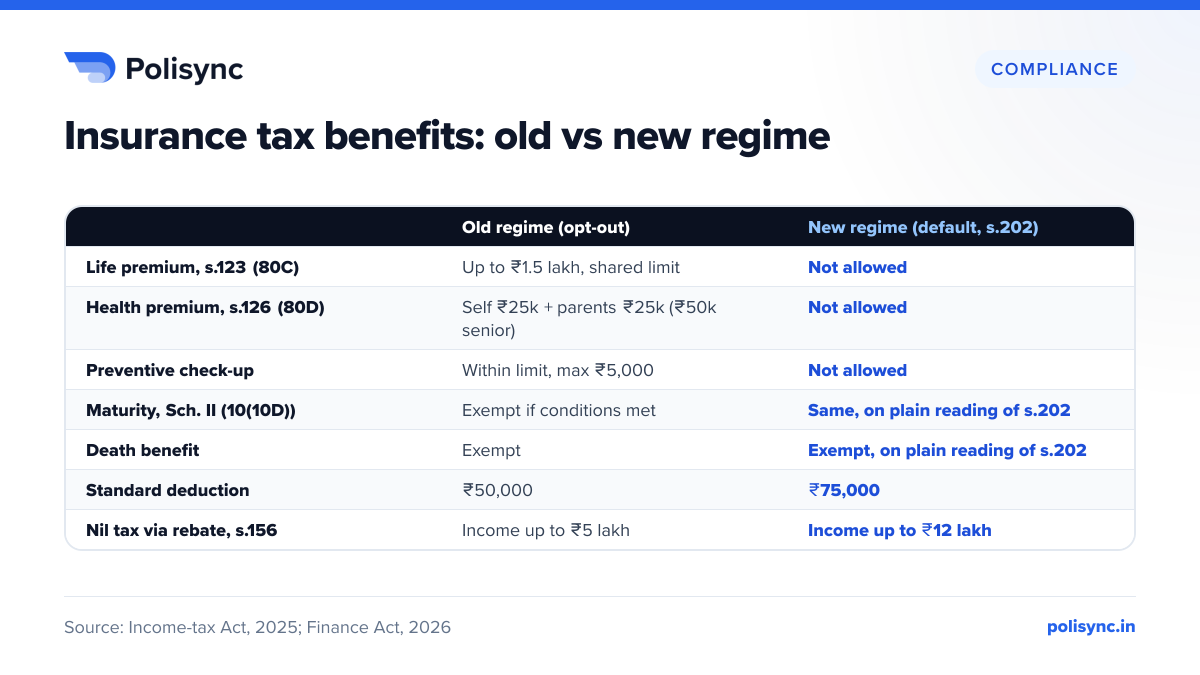
As of 18 September 2026, Section 80C and Section 80D survive only as nicknames. The Income-tax Act, 2025 replaced the 1961 Act on 1 April 2026: life insurance premiums now sit in Section 123 (₹1.5 lakh cap) and health premiums in Section 126 (₹25,000, or ₹50,000 for senior citizens). Both work only under the old regime; the default new regime (Section 202) allows neither.
For insurance agents this is a sales conversation problem, not just a renumbering exercise. Since Budget 2025, the new regime makes income up to ₹12 lakh effectively tax-free, so the old "buy this policy to save tax" pitch no longer applies to a large share of clients. This guide explains the new section numbers, what each regime allows, a worked illustrative comparison for a ₹15 lakh earner, and how to talk about tax without giving tax advice.
What replaced Sections 80C, 80D and 10(10D) in the Income-tax Act, 2025?
The Income-tax Act, 2025 (Act No. 30 of 2025) received Presidential assent on 21 August 2025 and came into force on 1 April 2026. The Budget 2026-27 speech confirmed that start date. According to the government's PIB explainer, the rewrite aimed at simpler language and structure, with no major policy changes and no change in tax rates.
The practical effect is that the familiar numbers clients know have moved. Here is the mapping for the provisions agents use most, taken from the Act text:
- Section 80C becomes Section 123, read with Schedule XV, which lists the qualifying items (life insurance premium, PPF, EPF, deferred annuity and others) under one ₹1,50,000 ceiling.
- Section 80CCC (insurer pension plans) now sits inside Schedule XV (paragraph 1(x)) as a qualifying item, so it shares the same ₹1.5 lakh ceiling.
- Section 80D becomes Section 126: deduction for health insurance premium, preventive health check-up and certain medical expenditure.
- Section 10(10D) becomes Schedule II, Serial No. 2 (read with section 11): exemption for sums received under a life insurance policy.
- Section 115BAC becomes Section 202: the new tax regime, which remains the default.
- Section 87A becomes Section 156: the rebate that makes income up to ₹12 lakh tax-free under the new regime.
The Act also drops "previous year" and "assessment year". The Income Tax Department's e-filing portal explains that a tax year is the twelve-month financial year, replacing the old two-year labels. So the current year is tax year 2026-27 (1 April 2026 to 31 March 2027), which under the old wording would have been FY 2026-27, AY 2027-28.
How much can clients claim for life insurance premiums under Section 123?
Section 123 allows an individual or HUF to deduct the aggregate of Schedule XV items, up to ₹1,50,000 in a tax year. Life insurance premium is one item among many, so a salaried client whose EPF contribution already fills the limit gets no extra tax benefit from a new policy.
Key conditions in Schedule XV that agents should know:
- Whose life: premium on the life of the individual, spouse or any child counts. For an HUF, premium on any member's life counts.
- Premium-to-sum-assured cap: for policies issued on or after 1 April 2012, only premium up to 10% of the actual capital sum assured qualifies. It is 20% for policies issued on or before 31 March 2012, and 15% for policies from 1 April 2013 covering a person with disability or a specified illness.
- Clawback on early exit: if the client surrenders or lets the policy lapse before two years of premiums are paid (or within two years for a single premium policy), all deductions already allowed become taxable income in that year.
- Pension and annuity plans: deferred annuity contracts and insurer pension plans also qualify, inside the same ₹1.5 lakh ceiling. Our guide to annuity and pension plans for retirement covers how these products work.
The clawback rule is worth repeating at the point of sale. A client who buys a high-premium plan only for the deduction and stops paying in year two loses the tax benefit as well as most of the premium.
How does Section 126 (old 80D) work for health insurance?
Section 126 keeps the 80D structure intact. A senior citizen under the Act is a resident aged 60 or more at any time during the tax year.
- Self, spouse and dependent children: up to ₹25,000 a year, rising to ₹50,000 if the insured person is a senior citizen.
- Parents: a separate ₹25,000, rising to ₹50,000 if a parent is a senior citizen.
- Preventive health check-up: counted within the above limits, capped at ₹5,000 in aggregate, and the only item that may be paid in cash.
- Payment mode: health insurance premium must be paid by a mode other than cash.
- Multi-year policies: if a premium covering more than one year is paid upfront, the deduction is spread equally over the years of cover.
- Uninsured seniors: medical expenditure on a senior citizen with no health policy can be claimed up to ₹50,000 instead.
So a client under 60 who also pays for senior citizen parents can claim up to ₹75,000, and a senior client paying for senior parents up to ₹1,00,000, but only in the old regime. For product-side guidance, see our senior citizen health insurance guide.
What does the new tax regime allow and disallow?
Under Section 202, income of an individual is taxed at the new regime rates unless the person opts out. The total income is computed without most Chapter VIII deductions, which is where Sections 123 and 126 sit. Section 202(2) keeps only a few Chapter VIII deductions, all employer-side or business-linked, such as the employer's contribution to the notified pension scheme under Section 124(1).
New regime slab rates in Section 202 for tax year 2026-27:
- Up to ₹4,00,000: nil
- ₹4,00,001 to ₹8,00,000: 5%
- ₹8,00,001 to ₹12,00,000: 10%
- ₹12,00,001 to ₹16,00,000: 15%
- ₹16,00,001 to ₹20,00,000: 20%
- ₹20,00,001 to ₹24,00,000: 25%
- Above ₹24,00,000: 30%
Section 156 gives a resident individual in the new regime a rebate of up to ₹60,000 when total income does not exceed ₹12 lakh, with marginal relief just above that level. As the PIB release on Budget 2025-26 put it, there is no tax up to ₹12 lakh of income, or ₹12.75 lakh for salaried taxpayers after the ₹75,000 standard deduction.
The old regime, under the Finance Act, 2026, taxes individuals below 60 at nil up to ₹2,50,000, 5% up to ₹5,00,000, 20% up to ₹10,00,000 and 30% above that. The nil band is ₹3,00,000 for residents aged 60 to 79 and ₹5,00,000 for those aged 80 or more. Its standard deduction is ₹50,000 (Section 19) and its rebate under Section 156(1) is capped at ₹12,500, for income up to ₹5 lakh only. Both regimes add a 4% health and education cess.
Opting out of the new regime works differently by income type:
- No business or professional income: the choice is made with the return each year, so a salaried client can compare every year.
- Business or professional income: once the client opts out, the choice continues for later years and can be withdrawn only once.
Did Budget 2026 change 80C, 80D or the tax slabs?
No. Budget 2026-27, presented on 1 February 2026, kept slabs under both regimes unchanged for tax year 2026-27, as Business Today reported. The Finance Act, 2026 (Act No. 4 of 2026) received assent on 30 March 2026, and the rate schedules in it match the earlier old-regime slabs. On our reading of its text, it did not amend Sections 19, 123, 126 or 156, or Schedules II and XV; its only change to Section 202 was a technical deletion of a business deduction (Section 144) from the excluded list.
Is the maturity amount still tax-free under Schedule II?
The old 10(10D) exemption now sits in Schedule II, Serial No. 2. Any sum received on the death of the insured is exempt without the premium conditions below (Keyman policies excepted). A maturity or survival payout is exempt only if the policy meets the conditions for its issue date:
- Older policies: issued 1 April 2003 to 31 March 2012, premium up to 20% of the sum assured; issued 1 April 2012 to 31 March 2013, up to 10%.
- Policies from 1 April 2013 onwards: the highest annual premium must not exceed 10% of the actual capital sum assured (15% for a policy on a person with disability or a specified illness).
- ULIPs issued from 1 February 2021: in addition, the aggregate annual premium across all such ULIPs must not exceed ₹2,50,000.
- Non-ULIP policies issued from 1 April 2023: in addition, the aggregate annual premium across all such policies must not exceed ₹5,00,000.
- Keyman insurance proceeds never qualify.
- If a non-ULIP policy fails these tests: only the amount received above the premiums paid (and not claimed as a deduction) is taxed, as income from other sources under Section 92(2)(l). A ULIP that fails is taxed as a capital asset instead.
Section 202(2) lists exactly what the new regime switches off: certain Schedule III exemptions, the professional tax deduction and most of Chapter VIII. Schedule II is not on that list, so a plain reading suggests clients keep both the death benefit and the maturity exemption in the new regime. This is our reading of the text, not an official clarification, so ask a chartered accountant to confirm for large policies. Our comparison of endowment, ULIP and term plans explains which products these caps usually affect.
Illustrative example: old vs new regime for a ₹15 lakh earner
The following is a hypothetical, illustrative calculation, not tax advice. Assume a resident salaried client under 60 with gross salary of ₹15,00,000, no other income, no HRA or home loan claims, tax year 2026-27, and no surcharge.
- New regime: ₹15,00,000 minus ₹75,000 standard deduction gives taxable income of ₹14,25,000. Slab tax is ₹20,000 + ₹40,000 + ₹33,750 = ₹93,750. No rebate applies above ₹12 lakh. With 4% cess (₹3,750), tax is ₹97,500.
- Old regime, Sections 123 and 126 fully used: ₹15,00,000 minus ₹50,000 standard deduction, ₹1,50,000 under Section 123 and ₹75,000 under Section 126 (₹25,000 family plus ₹50,000 for senior parents) gives ₹12,25,000. Tax is ₹1,12,500 + ₹67,500 = ₹1,80,000, plus ₹7,200 cess: ₹1,87,200.
- Old regime, Section 123 only: taxable income ₹13,00,000, tax ₹2,02,500 plus ₹8,100 cess: ₹2,10,600.
- Old regime, no deductions: taxable income ₹14,50,000, tax ₹2,47,500 plus ₹9,900 cess: ₹2,57,400.
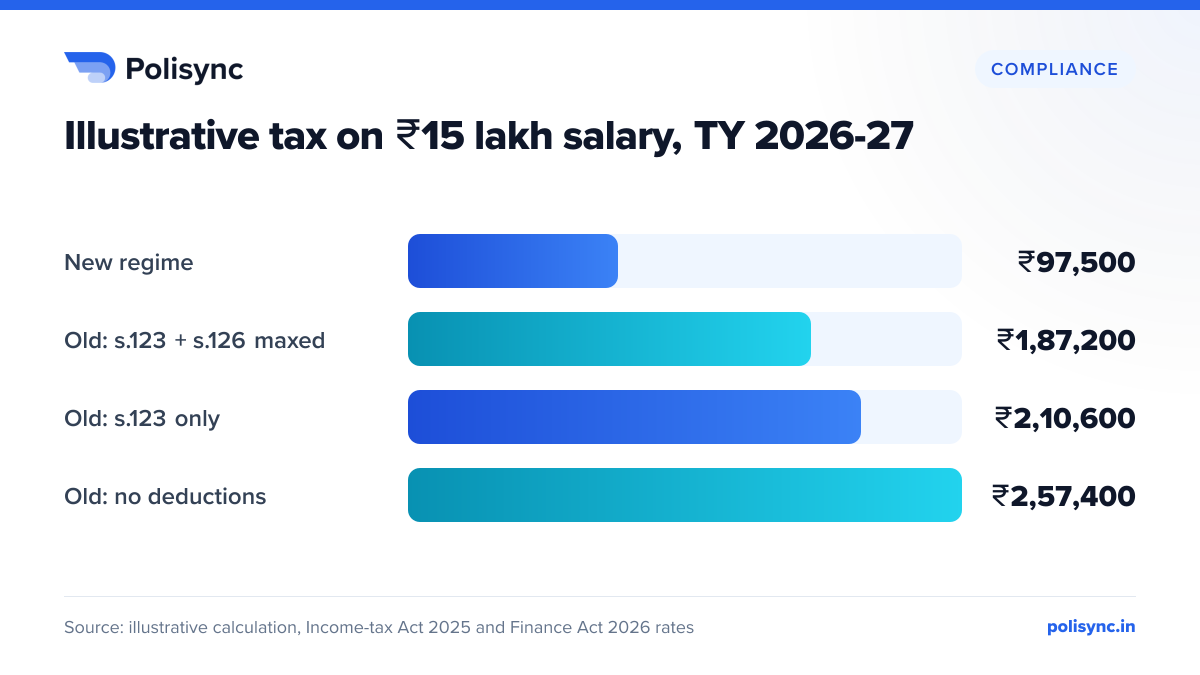
In this example the old regime only matches the new one if total deductions reach about ₹5.44 lakh on top of the ₹50,000 standard deduction. Insurance can contribute at most ₹2.25 lakh of that here, so for this client a policy has to be justified by protection, not tax. Clients can run their own numbers on our tax saving calculator.
How should agents advise clients without giving tax advice?
Agents sell insurance; they are not tax advisers. The safe and honest approach is to show how the policy is treated under both regimes, avoid promising a saving, and let the client or their chartered accountant pick the regime. Overstating tax benefits is a classic route to insurance mis-selling.
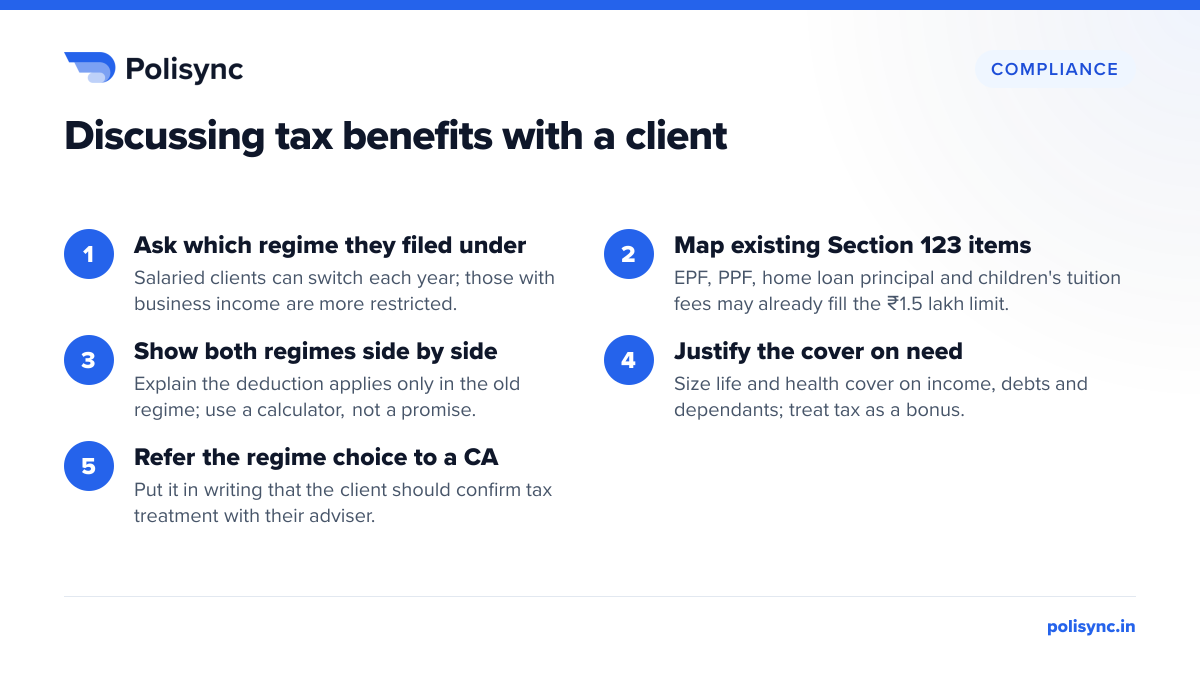
Phrases that keep the conversation accurate:
- "If you file under the old regime, this premium counts towards your ₹1.5 lakh limit under Section 123, the old 80C."
- "Under the new regime there is no deduction for this premium, but the cover works exactly the same."
- "The death benefit is tax-free under either regime as the law reads today. Maturity is tax-free only if the policy meets the premium conditions."
- "Please check the regime choice with your CA before you rely on any tax saving."
What this means for insurance agents
For many salaried clients earning up to about ₹12.75 lakh, the new regime already brings tax to nil, so a deduction adds nothing. Leading with tax will lose those conversations; leading with protection will not. Start from the client's income, loans and dependants, and use our term vs whole life insurance comparison to show what pure protection costs.
Cost has also fallen. Following the 56th GST Council decisions, all individual life policies (term, ULIP and endowment) and all individual health policies (including family floater and senior citizen plans) have been exempt from GST since 22 September 2025. That is a GST change, separate from income-tax deductions. Our GST and tax guide for insurance agents covers the agent's own tax position.
Old-regime clients still exist, typically those with large home loans, HRA and full Section 123 and 126 usage. For them, keep premium receipts and certificates organised and use the new section numbers alongside the old ones so nobody is confused at filing time.
Action checklist for agents
- Update proposal scripts and illustrations to say "Section 123 (old 80C)" and "Section 126 (old 80D)".
- Ask every client which regime they filed under last year before mentioning tax.
- Check the 10% premium-to-sum-assured rule before quoting any Section 123 or maturity benefit.
- Flag the ₹5 lakh (non-ULIP) and ₹2.5 lakh (ULIP) aggregate premium caps to high-premium buyers.
- Warn clients that lapsing within two years reverses deductions already claimed.
- Remind old-regime clients that health premium must be paid by a non-cash mode.
- Record in writing that tax treatment depends on the client's regime and should be confirmed with a CA.