

A lapsed life insurance policy can be revived by paying all unpaid premiums with interest or late fee and clearing the insurer's health checks within the revival period: five years from the first unpaid premium for non-linked plans and three years for ULIPs, under the IRDAI (Insurance Products) Regulations, 2024. Before any lapse, a grace period of 15 days (monthly premiums) or 30 days (other modes) keeps cover in force.
This guide, current as of 21 August 2026, walks through the full timeline from due date to lapse, what revival costs, the documents insurers ask for, what happens to riders, and how agents can stop lapses before they start.
What is the grace period for life insurance premiums in India?
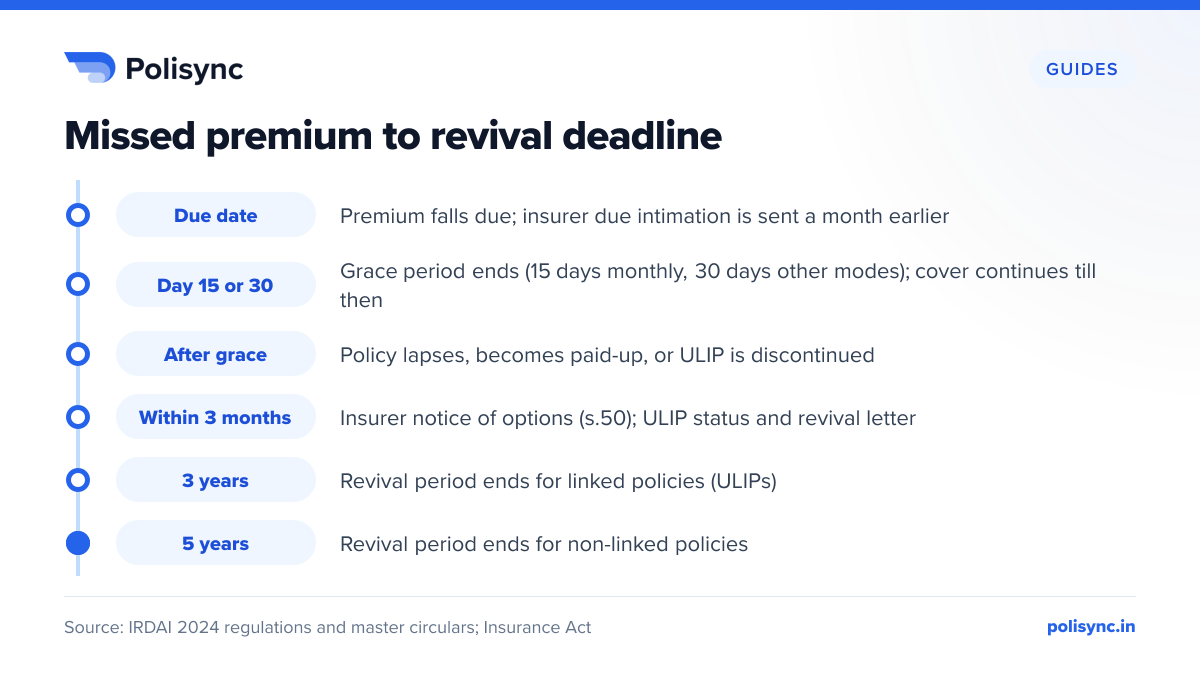
The grace period is the extra time after a premium due date during which you can still pay without penalty and the policy stays in force. Schedule I of the IRDAI (Insurance Products) Regulations, 2024 fixes it at 15 days where premium is paid monthly and 30 days in all other cases (quarterly, half-yearly or annual).
The Master Circular on Life Insurance Products dated 12 June 2024 repeats the same rule and adds that during the grace period "risk cover would be available without any interruption". In plain terms: if the life assured dies on day 20 of a 30-day grace period, the policy is still treated as in force and the claim is assessed as per the policy terms.
Key grace period points to explain to clients:
- Grace periods apply to regular and limited premium policies, not single premium policies.
- No late fee or interest is charged for payment within the grace period.
- The clock starts from the premium due date, not from the date the reminder reached the client.
- Insurers must send a premium due intimation one month before the due date, as per the Citizens' Charter in the Master Circular on Protection of Policyholders' Interests, 2024.
What happens when a life insurance policy lapses?
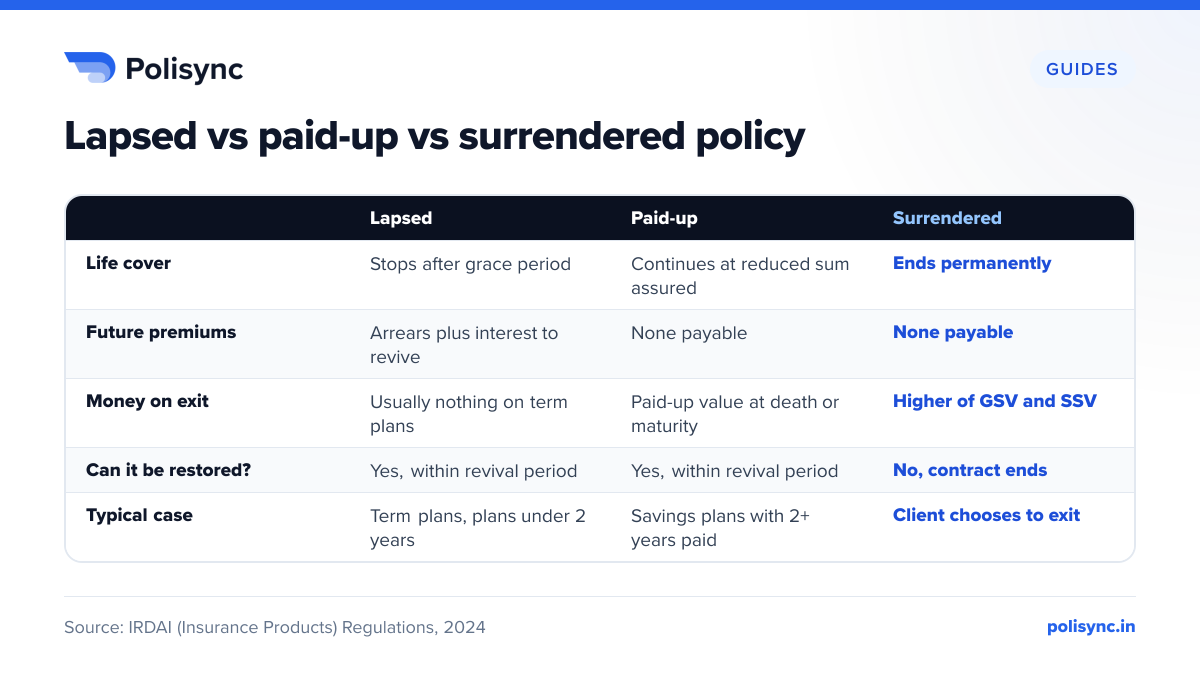
If the premium is still unpaid when the grace period ends, the policy lapses. The policyholder protection master circular describes lapse as a situation where the insured "can no longer avail the benefits and coverage" under the policy. What exactly happens next depends on the product type and how many years of premium have been paid. Separately, Section 50 of the Insurance Act, 1938 requires the insurer to notify the policyholder of the options available within three months of the unpaid due date, unless those options are already set out in the policy.
Term plans and early-stage savings plans
Pure protection (term) plans do not acquire a guaranteed surrender value under the 2024 product regulations, so on lapse the cover simply stops. The same applies to a non-linked savings plan that has not yet acquired a surrender value: under the regulations, a regular premium policy acquires a guaranteed surrender value only after at least two consecutive years of premium.
Savings plans that have acquired a surrender value: paid-up
A non-linked policy that has acquired a surrender value "shall not lapse" for non-payment; instead it is kept in force as a paid-up policy for a reduced sum assured plus any attached bonuses (IRDAI Insurance Products Regulations, 2024, Schedule I, clause 4(A)(a)(6)). This is the non-forfeiture protection. The paid-up sum assured is at least the original sum assured multiplied by the ratio of the period for which premiums were paid to the period for which they were originally payable.
As a hypothetical example, if a client has paid 6 out of 20 annual premiums, the paid-up sum assured would be at least 6/20, or 30%, of the original sum assured (before bonuses). The regulations allow very small paid-up policies (paid-up sum assured below ₹2,500, or ₹500 under micro insurance) to be terminated after the revival period by paying the surrender value.
ULIPs: discontinuance rather than lapse
For unit-linked plans the regulations use the term discontinuance. If premiums stop during the five-year lock-in, the fund value (after discontinuance charges) moves to the discontinued policy fund, risk cover and rider cover cease, and the fund earns a minimum guaranteed 4% a year, according to the Master Circular on Life Insurance Products. After the lock-in, the policy becomes reduced paid-up instead. In both cases the insurer must tell the policyholder the status within three months of the first unpaid premium and offer the revival option.
How long is the revival period for a lapsed policy?
Revival means restoring a policy that was discontinued for non-payment, with all its benefits, after the insurer receives the due premiums and charges and is satisfied about the life assured's continued insurability. The IRDAI (Insurance Products) Regulations, 2024 define two revival periods, both counted from the date of the first unpaid premium (not from the end of the grace period):
- Non-linked policies (endowment, money-back, whole life, term and other traditional plans): five consecutive complete years.
- Linked policies (ULIPs): three consecutive complete years.
Exact revival terms still come from each policy document, so agents should always read the lapse and revival clause in the client's own contract. The Customer Information Sheet format in the life products master circular includes a line titled "Lapse, paid-up and revival of the Policy", which is a quick place to check.
What does it cost to revive a lapsed policy?
For non-linked plans, the regulations require "all the premiums due and other charges or late fee if any". The policyholder protection master circular puts it more simply: the policyholder pays the unpaid premiums "along with interest or a late fee". The interest rate for revivals is a product parameter filed by the insurer, and the life products master circular lists a change in this rate as a permitted product modification, so it varies by insurer and plan and is stated in the policy terms.
ULIPs work differently. When a ULIP discontinued during the lock-in is revived, the insurer collects the due premiums without charging any interest or fee, may levy only specified charges for the discontinuance period (policy administration, premium allocation and, where a guarantee continues, guarantee charges), and must add back the discontinuance charges it deducted (Master Circular on Life Insurance Products, para 40.1.4). A ULIP revived after the lock-in is also revived without interest or fee on the base plan premiums, with only premium allocation and any continuing guarantee charges allowed (para 40.1.7).
Illustrative revival cost calculation
The numbers below are hypothetical and for illustration only. Real quotes use the interest rate, compounding method and any taxes stated by the insurer.
Assume a traditional endowment policy with an annual premium of ₹24,000 and a hypothetical revival interest rate of 9% a year (simple interest):
- Two annual premiums are unpaid: the first has been overdue for 18 months and the second for 6 months.
- Arrears: ₹24,000 x 2 = ₹48,000.
- Interest on the first premium: ₹24,000 x 9% x 1.5 years = ₹3,240.
- Interest on the second premium: ₹24,000 x 9% x 0.5 years = ₹1,080.
- Total revival amount: ₹48,000 + ₹3,240 + ₹1,080 = ₹52,320, plus any taxes or medical costs the insurer specifies.
- If this ₹4,320 interest were treated as a late fee eligible for a 30% campaign concession capped at ₹3,000 (the cap LIC used for receivable premium up to ₹1 lakh), the saving would be ₹1,296, bringing the amount to ₹51,024.
The lesson for clients: every extra month adds interest, and medical requirements tend to get stricter the longer a policy stays lapsed. Reviving early is almost always cheaper.
What documents are needed to revive a lapsed life insurance policy?
Revival is an underwriting decision. The regulations say the insurer revives the policy after being satisfied about continued insurability "on the basis of the information, documents and reports furnished by the policyholder, in accordance with Board approved underwriting policy" (IRDAI Insurance Products Regulations, 2024). The exact list therefore varies, but it usually includes:
- Revival application or request form from the insurer, signed by the policyholder.
- Declaration of good health (DGH): a signed statement by the life assured about current health, illnesses and treatment since the lapse.
- Medical examination reports, if the insurer asks for them based on age, sum assured and how long the policy has been lapsed.
- Payment of arrears with interest or late fee, through the insurer or its authorised distribution channel.
- Policy number and KYC details, plus updated contact and bank details if they have changed.
How strict the health requirement is depends on the lapse duration. Business Standard reported in 2018 that if a policy has been lapsed for less than six months, insurers typically accept a declaration of good health, while after six months they normally insist on a fresh medical check-up. Treat this as a rule of thumb and confirm the current requirements with the insurer.
One more point to flag: revival restarts the contestability clock, but only for what is declared at revival. Section 45 of the Insurance Act, 1938 (consolidated text as on 15 April 2026) says a life policy cannot be called in question on any ground after three years from the date of issue, commencement of risk, revival or rider addition, whichever is later; the life products master circular repeats the rule. Within those three years, the insurer can question the policy for fraud or for a material misstatement in the document on which it was revived, which includes the DGH. IRDAI's clarification on Section 45 (IRDA/Life/GDL/MISC/186/10/2015) limits this: after revival, the insurer can question only misstatements made at the time of revival, within three years of revival; non-disclosure in the original proposal cannot be raised once three years from issue have passed, and a policy revived without any health declaration or medical cannot be repudiated on that ground. If it repudiates for misstatement rather than fraud, it must refund the premiums collected within 90 days.
How do you revive a lapsed policy step by step?
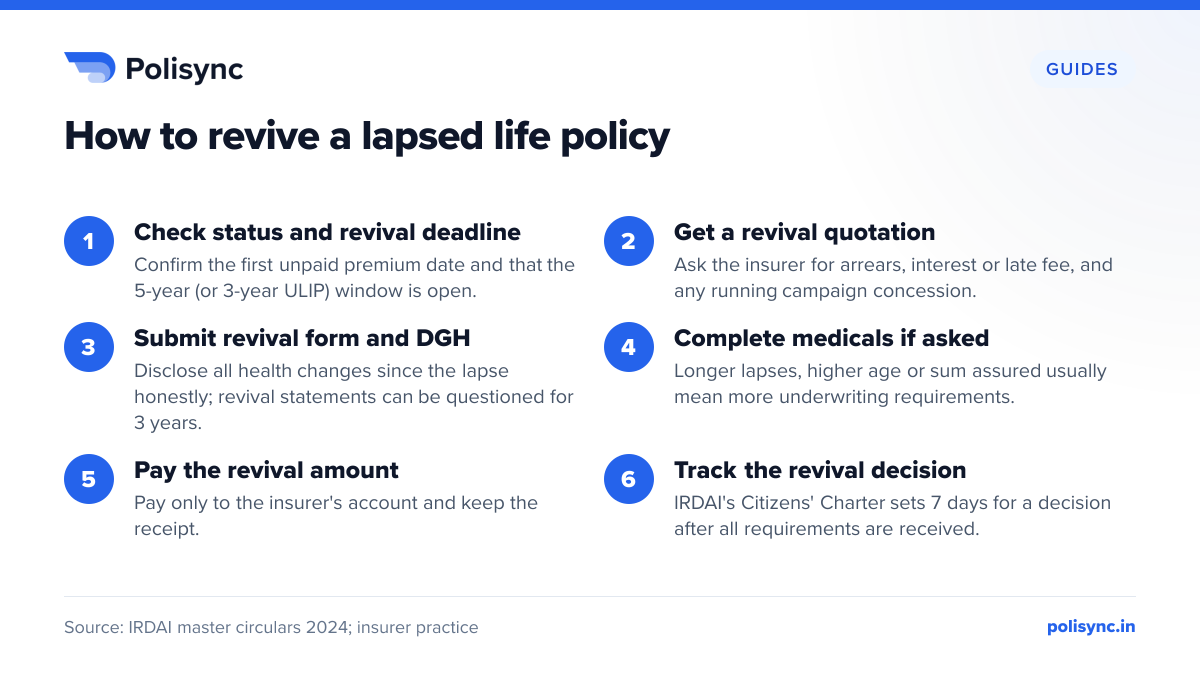
The 7-day turnaround for a decision on revival "after receipt of all requirements" comes from the Citizens' Charter (Life) in the Master Circular on Protection of Policyholders' Interests, 2024. If the insurer delays beyond that or rejects without clear reasons, the client can use the insurer's grievance process.
What happens to riders when a policy is revived?
Riders lapse with the base policy, and they do not automatically return. The regulatory definition of revival restores the policy "with or without rider benefits" as per policy terms (IRDAI Insurance Products Regulations, 2024). For ULIPs revived after the lock-in, the life products master circular says the rider "may also be revived at the option of the policyholders", and a reduced paid-up ULIP continues without rider cover.
When reviving, check each rider separately:
- Is the rider still revivable under the policy terms, or has it been withdrawn?
- Do health or critical illness riders need additional medical evidence?
- Has the rider's premium or cover changed with the client's age?
For a refresher on how each rider works, share our guide on insurance riders explained for clients.
Do insurers run special revival campaigns?
Yes. Insurers periodically run time-bound revival campaigns that cut late fees. As of 21 August 2026, LIC's latest announced campaign ran from 1 January to 2 March 2026 for individual lapsed policies, according to LIC's press release of 2 January 2026. It offered a 30% late fee concession on non-linked plans, capped at ₹3,000, ₹4,000 or ₹5,000 depending on total receivable premium, and a 100% concession for micro insurance plans.
An earlier LIC campaign ran from 18 August to 17 October 2025 on the same terms (LIC press release, 18 August 2025). Both campaigns covered policies lapsed within the premium paying term and revivable within five years of the first unpaid premium, and both stated there were no concessions on medical or health requirements. Business Standard noted that reviving an older policy can preserve lower premiums fixed at a younger entry age.
Campaigns reduce the cost, not the eligibility rules. Agents should still check each policy's revival deadline rather than waiting for the next campaign.
Should a client revive, keep it paid-up or surrender?
This is the client's decision, and agents should explain the trade-offs rather than push one option. Revival usually makes sense when the client still needs the cover, is in reasonable health and can afford premiums going forward. A paid-up policy may suit someone who cannot keep paying but wants some benefit to continue. Surrender ends the contract for a payout, which our guide to surrender value, GSV vs SSV explains in detail.
Questions to walk the client through:
- Does the family still depend on this cover, and would a new policy at today's age cost more?
- Has the client's health changed in a way that could make fresh cover hard to get?
- Can the client comfortably afford the arrears and every future premium?
- How much time is left in the revival period?
What this means for insurance agents: how to prevent lapses
Every lapse is lost protection for the client and lost renewal income for the agent. IRDAI's life products master circular asks insurers to improve persistency across all distribution channels and curb mis-selling that leads to lapses, so persistency is a regulatory focus as well as a business one. Our article on how to reduce policy lapse rates covers the bigger strategy; here is the practical checklist.
A lapse prevention checklist for agents:
- 1. Keep a list of every client's premium due dates, payment mode and grace period end date (15 or 30 days).
- 2. Send a reminder before the due date and a second one early in the grace period, using ready-made renewal reminder message templates.
- 3. Call any client who has not paid by the middle of the grace period, so there is still time to pay before the policy lapses.
- 4. The day after the grace period ends, flag the policy as lapsed and note the first unpaid premium date and the 3-year or 5-year revival deadline.
- 5. Contact lapsed clients within six months, when revival is usually cheaper and simpler.
- 6. Review lapsed and paid-up policies at every annual policy review meeting and track insurer revival campaigns.
- 7. Follow the full insurance policy renewal process so payments go only to the insurer's account and receipts are recorded.
Agency software can help here by keeping due dates and revival deadlines organised in one place; Polisync, for example, sends renewal reminders to clients by email. Strong lapse follow-up also feeds directly into customer retention strategies for insurance agents, because a client who is helped back into cover rarely forgets it.