

Surrender value is the amount a life insurer pays when a policyholder ends a savings policy before maturity. Under the IRDAI (Insurance Products) Regulations, 2024, in force from 1 April 2024, the payout is the higher of the Guaranteed Surrender Value (GSV), earned after two consecutive years' premiums, and the Special Surrender Value (SSV), which, under norms mandatory from 1 October 2024, can be paid after the first policy year.
This guide, written as of 17 August 2026, explains how each value is worked out, what changed in 2024, how ULIP surrenders differ, how surrender proceeds are taxed under the Income-tax Act, 2025, and how agents should talk a client through the decision. The numbers in the worked example are illustrative only, not any insurer's actual factors.
What is surrender value in life insurance?
The regulations define surrender value as an amount, if any, that becomes payable on surrender of a policy during its term, as per the policy's terms. In plain words, it is the exit price of a policy that has a savings element, such as an endowment, money-back or guaranteed income plan.
Pure protection plans work differently. The regulations require a guaranteed surrender value only for individual non-linked savings and protection-oriented products and deferred annuities, and specifically leave out pure risk products and immediate annuities. ULIPs follow a separate fund-value route, covered below. If you need a refresher on how these product types differ, see our comparison of endowment, ULIP and term insurance.
Surrender is also different from cancelling during the free look period. A new policyholder who is unhappy with the terms can return the policy within the free look period, which the Master Circular sets at 30 days from receipt of the policy document. That option closes quickly, so surrender is the route for anyone who wants out later.
What is Guaranteed Surrender Value (GSV)?
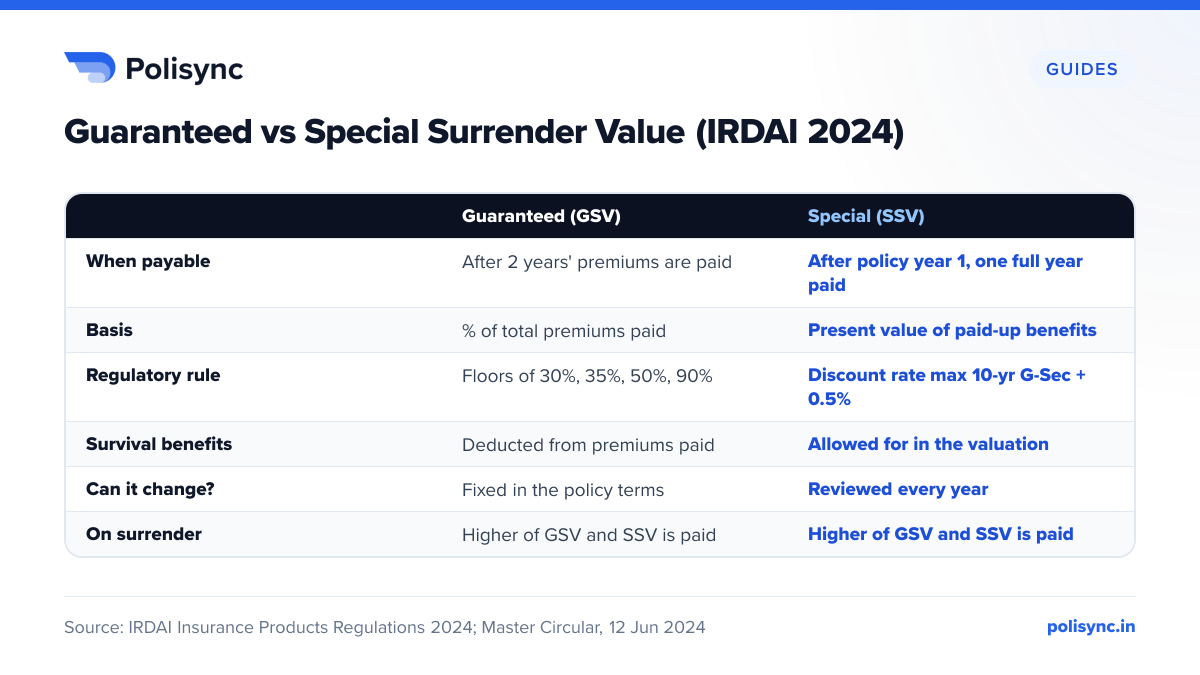
The Guaranteed Surrender Value is the minimum surrender amount the insurer contractually promises, expressed as a percentage of total premiums paid. For regular premium non-linked policies, Schedule I of the 2024 regulations says the policy acquires a GSV once premiums have been paid for at least two consecutive years.
The regulatory minimum GSV for regular premium policies is a percentage of total premiums paid, less any survival benefits already paid:
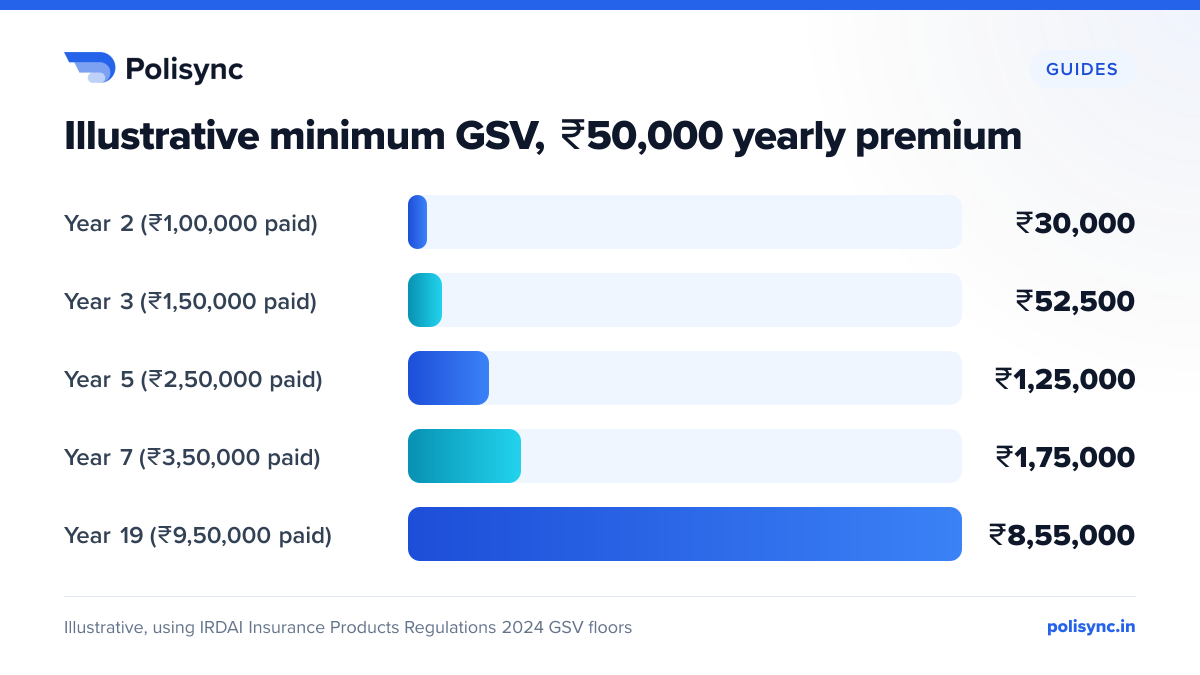
- 30% if surrendered during the second policy year.
- 35% if surrendered during the third policy year.
- 50% if surrendered between the fourth and seventh policy years, both inclusive.
- 90% if surrendered during the last two policy years, with values after year seven rising smoothly towards that level.
Single premium policies get higher floors: at least 75% of the premium (less survival benefits paid) if surrendered within the first three policy years, 90% in the fourth policy year, and at least 90% in the last two policy years. The surrender value of any subsisting bonus and accrued guaranteed additions is added on top of the GSV. Insurers may offer more than these minimums, and the Master Circular on Life Insurance Products (12 June 2024) allows GSV to vary with premium size, premium paying term, policy term and duration.
These floors were confirmed when the final regulations were announced in March 2024, and Business Today reported at the time that surrender values within the first three years were expected to stay the same or even be lower than before.
What is Special Surrender Value (SSV)?
The Special Surrender Value is a non-guaranteed amount the insurer calculates from the policy's paid-up benefits. The paid-up value is the reduced benefit a policy keeps if premiums stop: at minimum, the sum assured multiplied by the period for which premiums were paid divided by the period for which they were originally payable.
Paragraph 26.4 of the Master Circular sets the floor. SSV must be at least the expected present value of the paid-up sum assured on all covered contingencies, any paid-up future benefits such as income benefits, and accrued or vested benefits, after allowing for survival benefits already paid. The discount rate used cannot exceed the 10-year G-Sec yield plus 50 basis points, and the SSV must be reviewed every year.
For participating (with-profit) policies, the regulations say SSV should represent the policy's asset share. For non-par savings policies, it should reflect the notional asset share and the guaranteed maturity or survival benefits.
What changed with IRDAI's 2024 surrender value rules?
The 2024 package came in two steps. The Insurance Products Regulations, dated 20 March 2024 and in force from 1 April 2024, set the GSV floors above. The Master Circular of 12 June 2024 then added the SSV floor and the first-year payout, and told insurers to withdraw or modify non-compliant products by 30 September 2024.
The changes that matter most at the point of sale:
- First-year SSV: SSV becomes payable after completion of the first policy year if one full year's premium has been received. For single premium policies and those with a premium paying term under five years, it is payable immediately after the first full premium.
- GSV after two years: the guaranteed value is acquired after two consecutive years' premiums. A Grant Thornton Bharat partner quoted by Business Standard described the surrender period for traditional products as having moved from three years to two.
- Transparency: policy-year-wise GSV, SSV and the surrender value payable must be shown separately in the benefit illustration, which is signed by both the prospect and the agent or intermediary.
- Persistency duty: paragraph 26.1 asks insurers to improve persistency across channels and curb mis-selling that leads to surrenders and lapses.
- Policy loans: all non-linked savings products offering a surrender value must offer a policy loan based on the eligible surrender value.
Business Standard reported in July 2024 that insurers planned to seek a three-month extension, and on 30 September 2024 that the request had not been accepted by the regulator, with the norms effective from 1 October 2024. The September report also quoted an industry source saying insurers were considering commission clawbacks, reductions or spreading commissions over two to three years. For a policy bought before these changes, the surrender terms in that policy's own document and benefit illustration are the reference point.
How is surrender value calculated? An illustrative example
The formulas are simple once you separate the two values. GSV = GSV factor x total premiums paid, less survival benefits paid, plus the surrender value of any bonus. SSV = paid-up value x SSV factor, where the factor reflects discounting and the insurer's experience.
Illustrative example (hypothetical numbers): Ravi buys a 20-year non-par endowment with a sum assured on maturity of ₹10,00,000, an annual premium of ₹50,000 and no survival benefits. The SSV factors used below (0.35 and 0.42) are invented for this example; real factors are in the insurer's policy document and benefit illustration.
- Surrender after one premium (year 2): GSV is nil because two years' premiums have not been paid. Paid-up value = 1/20 x ₹10,00,000 = ₹50,000. SSV = ₹50,000 x 0.35 = ₹17,500. Ravi gets ₹17,500 back on ₹50,000 paid.
- Surrender after five premiums (during year 5): total premiums = ₹2,50,000. Minimum GSV = 50% x ₹2,50,000 = ₹1,25,000. Paid-up value = 5/20 x ₹10,00,000 = ₹2,50,000. SSV = ₹2,50,000 x 0.42 = ₹1,05,000. Payout = the higher figure, ₹1,25,000.
- Stop paying instead of surrendering (after five premiums): the policy becomes paid-up, with a maturity benefit of ₹2,50,000 payable at the end of year 20 and reduced death cover, rather than ₹1,25,000 now.
The bar chart applies only the regulatory minimum GSV percentages to the same hypothetical premium. It shows why early exits cost the most: the floor is 30% of premiums in year two and climbs to 90% only near maturity.
To show a client what staying invested could mean instead, you can run the same premium through our endowment maturity calculator and put the two numbers side by side.
How does surrender work for ULIPs?
ULIPs have a lock-in period of five consecutive completed years from the start of the policy, during which proceeds cannot be paid out except on death or another covered event. Promotion material must say in bold on the front page that linked products offer no liquidity in the first five years.
What happens if a ULIP is surrendered or premiums stop:
- During lock-in: the fund value, minus a capped discontinuance charge, moves to the discontinued policy fund, life and rider cover stop, and the money is paid out no earlier than the end of the lock-in. The discontinued fund earns a minimum guaranteed 4% a year.
- Charge caps (annualised premium up to ₹50,000): 20% of the annualised premium or fund value, whichever is lower, max ₹3,000 in year 1; 15%, max ₹2,000 in year 2; 10%, max ₹1,500 in year 3; 5%, max ₹1,000 in year 4; nil from year 5.
- Charge caps (annualised premium above ₹50,000): 6% (max ₹6,000), 4% (max ₹5,000), 3% (max ₹4,000) and 2% (max ₹2,000) in years 1 to 4; nil from year 5.
- After lock-in: surrender value is at least the unit fund value on the date of surrender. If premiums simply stop, the policy becomes reduced paid-up with a three-year revival window.
- Partial withdrawal is allowed only after the lock-in, which makes it a useful alternative to full surrender for older ULIPs.
Is surrender value taxable?
From 1 April 2026, the Income-tax Act, 2025 (Act No. 30 of 2025) governs tax on insurance payouts. The familiar Section 10(10D) exemption now sits in Section 11 read with Schedule II (Table: Sl. No. 2), which covers any sum received under a life insurance policy, including bonus.
Key tax points to explain to clients (they should confirm their own position with a tax adviser):
- Exemption conditions: for policies issued from 1 April 2013, the premium to sum assured ratio must be 10% or less (15% for policies on persons with specified disabilities or illnesses). ULIPs issued from 1 February 2021 also need aggregate annual premium of ₹2,50,000 or less; non-ULIP policies issued from 1 April 2023 need ₹5,00,000 or less. Sums received on death are outside these conditions.
- If the exemption fails: for non-linked policies, the amount received above the premiums paid (and not claimed as a deduction) is taxed under Section 92(2)(l) as other income. For ULIPs, the gain is taxed as capital gains under Section 67(5).
- TDS: Section 393(1) (Table: Sl. No. 8(i)), the successor to old Section 194DA, requires 2% TDS on the income part of a non-exempt payout, where the payout, or the year's aggregate payouts, exceed ₹1,00,000.
- Deduction reversal: under Schedule XV, paragraph 4 (old Section 80C(5)), if a regular premium policy is terminated before premiums have been paid for two years, or a single premium policy within two years of commencement, past Section 123 (old 80C) deductions, which are available only under the old tax regime, become taxable income in that year.
In the illustrative example above, Ravi's ₹1,25,000 payout is below the ₹2,50,000 he paid, so there is no gain to tax. A first-year surrender, though, could trigger the deduction reversal if he had claimed the premium under Section 123 in the old tax regime.
What are the alternatives to surrendering a policy?
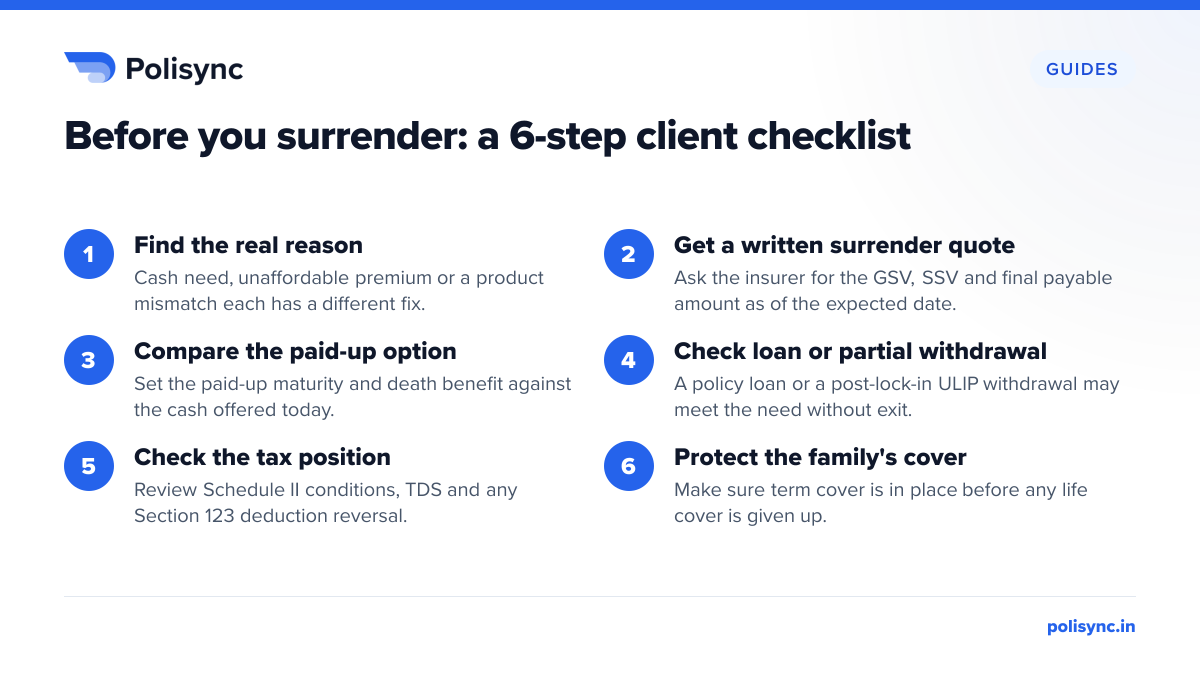
Most clients who ask to surrender have a cash need or a premium they can no longer afford. A full surrender is only one answer, and usually the most expensive one.
- Make it paid-up: once a non-linked policy has acquired a surrender value, it does not lapse for non-payment. It continues with a paid-up sum assured and existing bonuses, unless the paid-up sum assured is below ₹2,500.
- Take a policy loan: non-linked savings policies with a surrender value must offer a loan based on that value, so the client keeps the policy and repays later.
- Partial withdrawal (ULIPs): after the five-year lock-in, part of the fund can be withdrawn while the cover continues.
- Revive later: non-linked policies have a five-year revival period from the first unpaid premium, and ULIPs three years, so a temporary break need not end the policy.
- Change the premium term: insurers may allow a change in premium paying term or policy term, subject to their underwriting policy.
What this means for insurance agents
The 2024 rules make early surrenders a little less painful for clients, but they still lose money in most early exits. They also put agents on record: you sign the benefit illustration that lists surrender values for every year, and insurers have been weighing commission clawbacks linked to surrenders.
That makes surrender conversations part of retention, not just service. A client who surrenders in year two is a lost relationship, a weaker persistency record and possibly a commission clawback. Our guides on reducing policy lapse rates and customer retention strategies cover the wider playbook.
Equally, the conversation has to be honest. If a policy was a poor fit from the start, say so, and avoid pressuring clients to stay. Setting expectations at the sale, as covered in our guide to avoiding insurance mis-selling, prevents most of these calls.
What should agents do now? A practical checklist
- At the sale: walk the client through the GSV and SSV columns of the benefit illustration, especially years one to three, before you both sign it.
- Explain the lock-in: for ULIPs, show the discontinuance charge table and the five-year lock-in in writing.
- Flag missed premiums early: a client in the grace period is easier to help than one who has already filled a surrender form. Keeping renewal dates in one place, for example in agency software such as Polisync, makes this easier.
- Run the comparison: for every surrender request, put the surrender quote, paid-up value and loan option side by side on one page.
- Handle the objection with facts: use the illustration rather than opinion; our guide on handling client objections has useful framing.
- Document the advice: note what options were explained and the client's decision in their file.
- Never advise surrender to fund a new sale: a replacement policy restarts the early years, when surrender values are at their lowest.