

An annual policy review meeting is a once-a-year, roughly one-hour sit-down in which an insurance agent checks every policy a client's family holds against their current life: cover amounts, renewal dates, premiums, nominees, KYC and contact details. As of 19 August 2026, IRDAI's 2024 master circulars set the rules to check against, and the DPDP Act, 2023, whose consent duties apply from May 2027, guides record-keeping.
What is an annual policy review meeting, and why does it matter?
A policy review is a structured conversation, not a sales call. You walk the client through what they already own, confirm it still fits, fix administrative gaps, and agree on any changes.
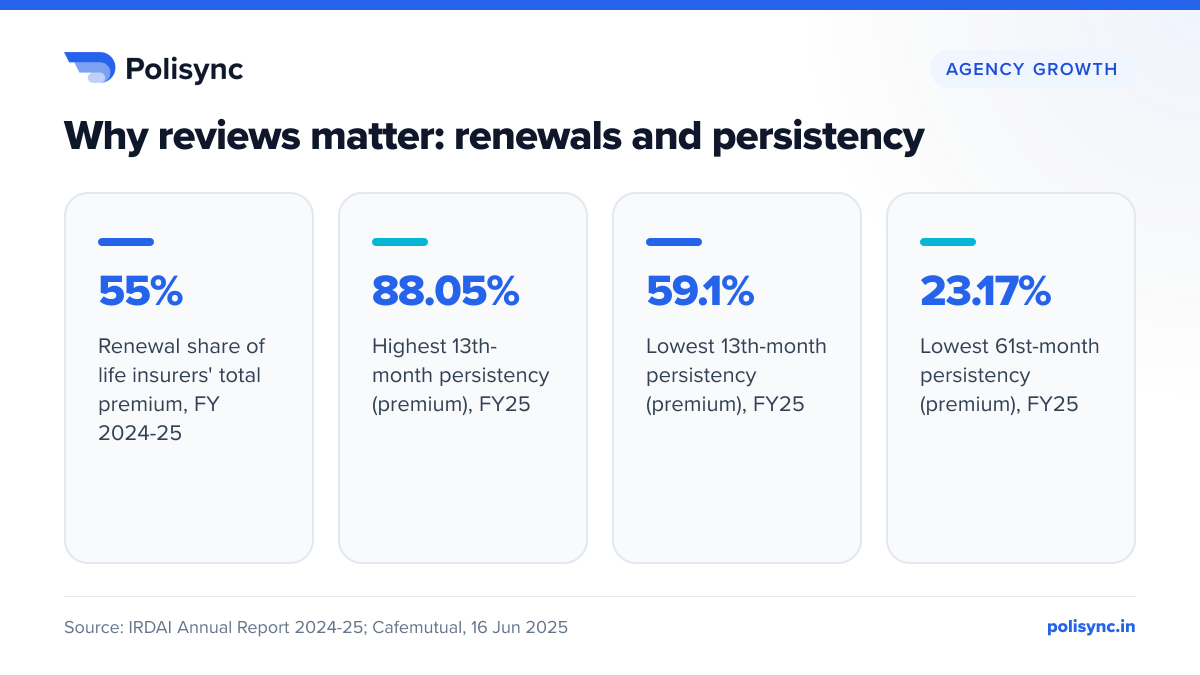
The business case is simple: most of an agent's long-term income depends on policies staying in force. According to the IRDAI Annual Report 2024-25 (Table I.9), life insurers collected ₹4,88,007.79 crore in renewal premium in FY 2024-25, out of ₹8,85,771.73 crore in total premium. That is about 55% of the industry's life premium coming from existing policies. The same table shows ₹2,33,299.01 crore paid out as surrenders and withdrawals in FY 2024-25, a reminder of how many policies end early.
Persistency is the share of policies (or premium) still being renewed at set points after sale, such as the 13th and 61st month. A Cafemutual analysis of FY25 persistency (16 June 2025) found 13th-month premium persistency ranging from 59.1% to 88.05% across the 22 life insurers it covered, while 61st-month persistency ranged from 23.17% to 67.38%. A yearly review is one habit an agent controls that targets that drop-off directly.
How should you prepare before the review meeting?
Build a single family view before the client walks in, so the meeting is spent on decisions rather than searching for papers. Whether you keep records in a spreadsheet or in agency management software such as Polisync, the aim is the same: one page per household.
Pre-meeting checklist (complete 7 to 10 days before):
- Every policy for the family: life, term, health, top-up, personal accident, motor, home and any group cover from the employer, with policy numbers and insurers.
- Dates: policy start, renewal or premium due dates, premium payment term and maturity dates.
- Premiums: amount, mode (monthly, quarterly, half-yearly, annual) and how it is paid, including any auto-debit mandate.
- Cover: sum assured or sum insured, riders and add-ons, and any no claim bonus or cumulative bonus earned.
- Nominees: names, relationship, percentage share and appointee details where a nominee is a minor.
- Client data: mobile number, email, address and bank details on record with each insurer.
- History: claims made in the last year, pending service requests and the need analysis from the original sale, if one exists.
- Your notes from last year: what the client said they would do, and what you promised to follow up.
What should the meeting agenda look like?
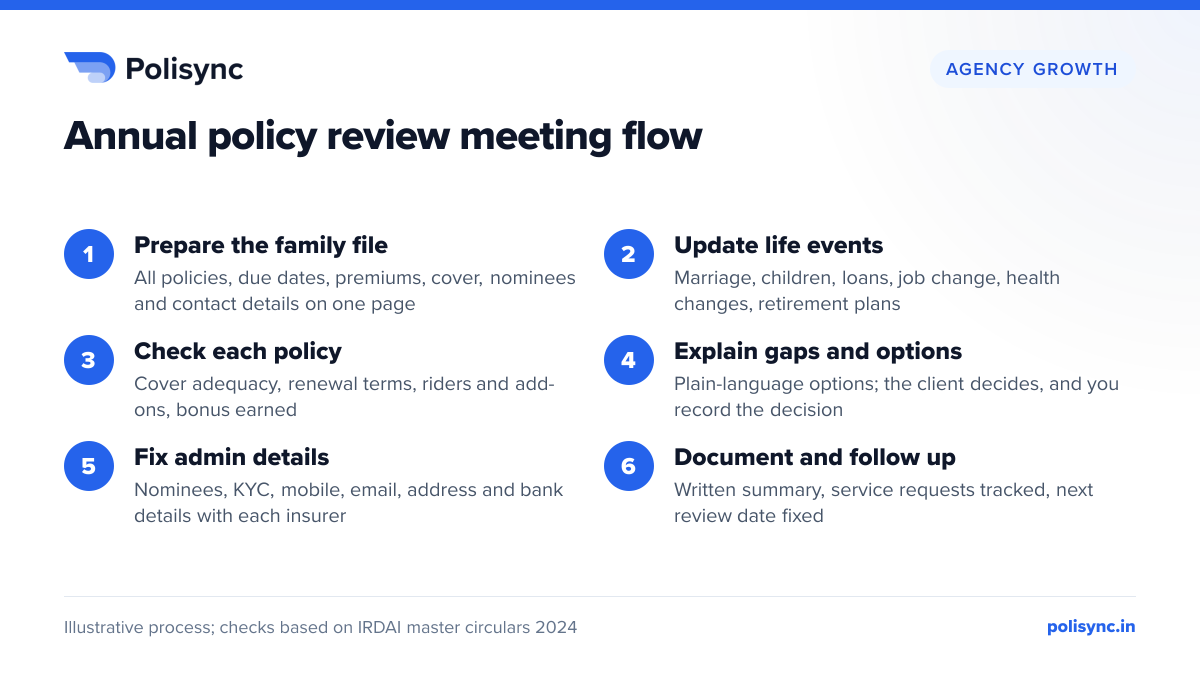
Keep the meeting to about an hour and follow the same order every time. A fixed agenda stops it drifting into a product pitch. The timings below are illustrative; adjust them to the size of the household.
Sample agenda for a 60-minute review (illustrative):
- 0 to 5 minutes, welcome and purpose: explain that this is a check-up of existing cover, and confirm the client is comfortable with you taking notes.
- 5 to 15 minutes, life update: ask open questions about family, work, health, loans, goals and big expenses planned for the next 12 months.
- 15 to 35 minutes, policy-by-policy walk-through: go through your family view, line by line, using the checks in the next section.
- 35 to 45 minutes, gaps and options: summarise any shortfall in cover and explain options in plain language, without pressure.
- 45 to 55 minutes, admin fixes: nominee changes, contact and bank updates, KYC refresh and auto-debit mandates. Fill the forms on the spot if you can.
- 55 to 60 minutes, recap and next steps: read back what was agreed, who does what and by when, and fix the date of the next review.
Which life events should trigger a review outside the annual cycle?
The annual meeting is the floor, not the ceiling. Ask clients to call you whenever one of these events happens, because each one changes what their cover should look like. The family insurance planning guide for agents goes deeper on structuring cover across a household.
- Marriage: add the spouse to health cover, revisit term cover for a new dependant, and update nominees.
- Birth or adoption of a child: review life cover for the longer dependency period, add the child to the family floater, and plan education goals.
- Home loan or other large loan: check whether life cover is enough to clear the outstanding loan and still support the family.
- Job change or move to self-employment: employer group cover may stop or change, so personal health and life cover become more important.
- Parents becoming dependent: consider separate health cover for them rather than stretching the family floater.
- New vehicle or home: new motor and home policies, and a check that existing ones are cancelled or transferred correctly.
- Approaching retirement: shift focus from income replacement to health cover continuity and retirement income.
What should you check in each type of policy?
Term and life insurance
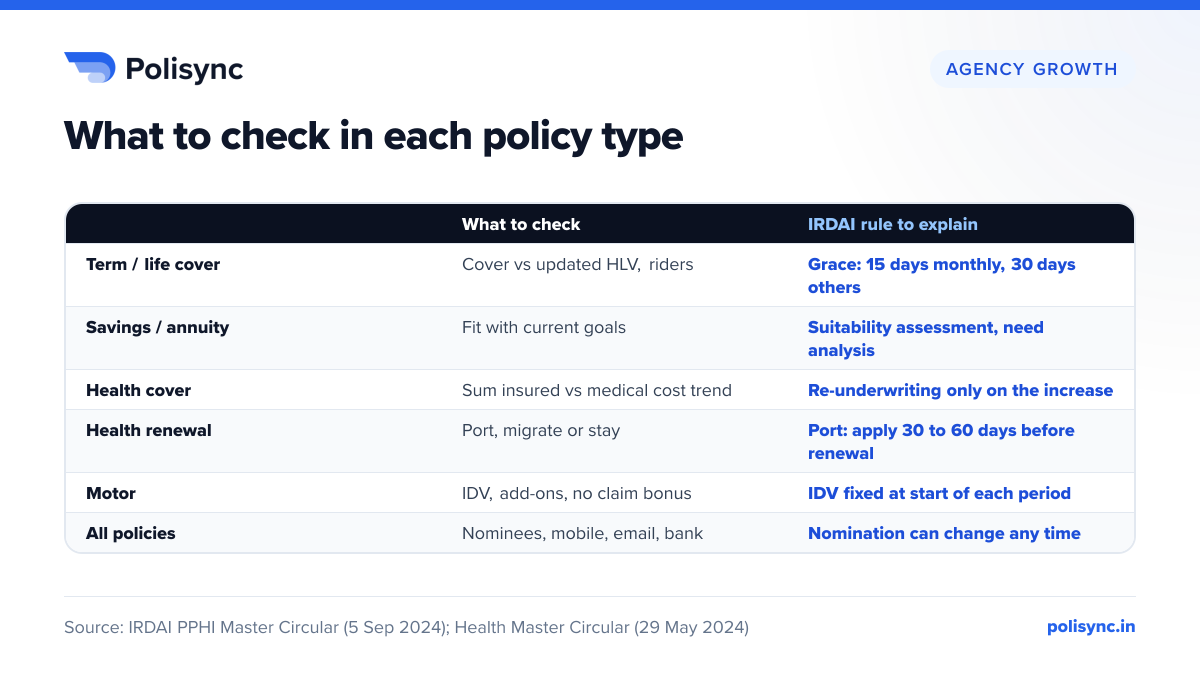
Start with adequacy. Human life value (HLV) is the present value of the income a person is expected to contribute to their family over their working life. Compare current cover with an updated HLV, especially after a salary jump or a new loan; our guide on how much life insurance cover a client needs using human life value walks through the method.
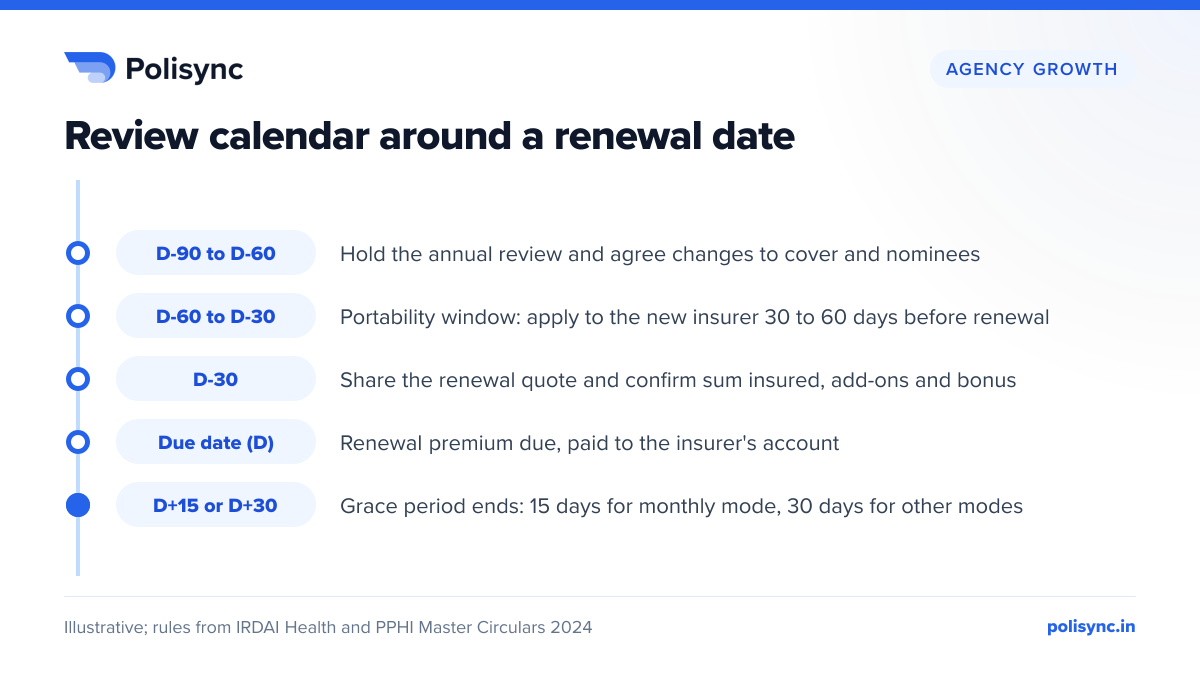
Then check that premiums are being paid on time. Under the IRDAI Master Circular on Protection of Policyholders' Interests, 2024, the grace period is 15 days for monthly premiums and 30 days for quarterly, half-yearly or annual premiums, and the policy stays in force during it. If a client is struggling to pay, discuss it now rather than after the policy lapses.
For savings and annuity products, revisit whether the plan still matches the client's goals. The same circular requires a suitability assessment for savings-related life products and annuities (except annuities bought from NPS proceeds and employer superannuation funds), with the need analysis documented and a copy given to the client.
Health insurance
The key question is whether the sum insured has kept pace with hospital costs. Aon's 2026 Global Medical Trend Rates report (India findings, 11 December 2025) projected an 11.5% rise in employee medical plan costs in India for 2026, after a projected 13% for 2025, against a global average of 9.8%. These are employer plan cost trends rather than a hospital price index, but they show why a sum insured chosen five years ago may now be thin.
Hypothetical illustration: if a treatment costs ₹3 lakh today and costs rise 11.5% every year, the same treatment would cost about ₹5.2 lakh in five years (₹5.17 lakh). A ₹5 lakh family floater that looked comfortable at purchase may no longer be.
The IRDAI Master Circular on Health Insurance Business (29 May 2024) sets rules worth explaining at renewal:
- Renewal cannot be denied because the policyholder made claims in earlier years.
- Insurers cannot re-underwrite at renewal unless the sum insured is increased, and then only to the extent of the increase.
- Renewing within the grace period protects accrued credits such as sum insured, no claim bonus and waiting periods.
- Portability is allowed at renewal. Under clause 24.2 of the PPHI master circular, the client applies to the new insurer at least 30 days, but not earlier than 60 days, before the renewal due date; insurers may still consider a request made within 15 days of renewal, provided there is no break in cover. See our health insurance portability guide for the full process.
The PPHI circular also explains no claim bonus: the insurer may give it, at the policyholder's choice, as a cumulative bonus (higher sum insured at no extra premium) or a discount on the renewal premium. Its sample Customer Information Sheet notes that when the sum insured is increased, any waiting period starts afresh only for the enhanced portion.
Motor insurance
For motor policies, check three things: the Insured's Declared Value (IDV), the add-ons and the no claim bonus. The PPHI circular says the IDV is treated as the sum insured and is fixed at the start of each policy period, and that the premium for every add-on must be shown separately in the premium computation table. It also lists options such as pay-as-you-drive cover and comprehensive cover that includes depreciation. Confirm the no claim bonus on the renewal notice matches the client's actual claim history.
Nominations, KYC and contact details (every policy)
According to the PPHI circular, nomination is mandatory to make claim payment easier on the death of the life assured, a policyholder can name more than one nominee with percentage shares, an appointee can be named for a minor nominee, and the nomination can be changed at any time during the term. The circular also asks policyholders to update mobile numbers, email IDs, address, bank details and nominee details when they change. Our explainer on nominee vs legal heir vs beneficial nominee helps you explain why this matters.
How should you document the review under IRDAI rules and the DPDP Act?
Write down what was discussed, what you recommended and what the client decided, including advice they chose not to take. For savings and annuity products, the PPHI circular requires the suitability information and the salesperson's recommendation to be preserved as part of the policy records, with consent of the prospect and the salesperson obtained on that information.
Review notes also contain personal data, which the Digital Personal Data Protection Act, 2023 will regulate. Its core duties are not yet in force: MeitY's commencement notification (G.S.R. 843(E), 13 November 2025) brings the notice and consent rules (Sections 5 and 6, except 6(9)) and the data fiduciary duties in Section 8 into force eighteen months after publication, in May 2027. Only the definitions, Data Protection Board provisions and a few procedural sections took effect immediately.
Once those sections apply, Section 6 requires consent to be free, specific, informed, unconditional and unambiguous, and limited to the data needed for the stated purpose. Section 5 requires a notice explaining what data is collected and why, consent can be withdrawn as easily as it was given, and Section 8 asks for complete, accurate and consistent data where it is used to make decisions about the person. The DPDP Rules, 2025 carry the same eighteen-month period for phased compliance, according to a PIB backgrounder dated 17 November 2025. Treat consent and clear records as good practice today. Our DPDP Act guide for insurance agents covers the details.
What your review note should record:
- Date, attendees and the policies reviewed.
- Life changes the client reported.
- Recommendations made, with reasons, and the client's decision on each.
- The purpose for which you hold their data, and their consent (good practice now, and a legal duty once the DPDP consent provisions apply).
- Service requests raised (nominee change, address update) and their reference numbers.
- The agreed date for the next review.
What should you do after the meeting?
Send a short written summary within a day or two: what you checked, what changed and what happens next. Then track every service request until it is closed. The PPHI circular sets a 7-day turnaround for insurers to act on requests such as change of address and registration or change of nomination, so follow up if you do not see confirmation in that window.
When should you schedule reviews through the year?
Anchor each household's review to its biggest renewal, usually the family health policy, and hold it 60 to 90 days before the due date. That timing leaves room to raise the sum insured, compare options or apply to port within the IRDAI window, without risking a break in cover.
For households with renewals spread across the year, use the main review for the full picture and a short check-in call before each other renewal.
How do annual reviews help retention, persistency and referrals?
Reviews catch problems while they are still fixable: a premium that has become hard to pay, a nominee who has passed away, a sum insured that no longer covers a hospital stay. Each fix keeps a policy on the books and gives the client a reason to stay with you. Our guide to customer retention strategies for insurance agents covers the wider system.
A review that ends with a clear summary is also the natural moment to ask for introductions. A client who has just seen you protect their family's interests is far more likely to recommend you; see how to get insurance referrals for scripts. To know whether your review programme is working, track reviews completed, renewal rate and referrals received each month alongside the measures in insurance agent KPIs to track.
What this means for insurance agents: your action checklist
- List every household you serve and pick a review month for each, 60 to 90 days before its largest renewal.
- Build a one-page family view: policies, due dates, premiums, cover, nominees and contact details.
- Use a fixed 60-minute agenda so every review covers the same ground.
- Recheck life cover against an updated human life value after any income or loan change.
- Compare health sum insured with rising medical costs, and explain that only the increased portion is underwritten.
- Confirm nominees, KYC, mobile, email and bank details with each insurer, and raise change requests on the spot.
- Record recommendations, client decisions and consent in a written note, and send the client a summary.
- Track every service request against the insurer's 7-day turnaround, and book the next review before you leave.
This guide helps agents explain policies to clients and is not personalised financial advice. Always check the policy document and Customer Information Sheet.