

How much life cover does a client need? The Human Life Value (HLV) method answers it as the present value of the income the client would have contributed to the family until retirement, plus outstanding loans and major goals, minus existing cover and savings. For an illustrative 32-year-old earning ₹12 lakh a year, that works out to about ₹1.87 crore of total need, or roughly ₹1.25 crore of new cover.
This guide, written as of 7 August 2026, explains HLV, the needs-based method and the income-multiple rule of thumb, works through the full maths for one hypothetical Indian client, and shows how insurer underwriting limits and IRDAI's suitability rules shape what you can recommend. You can reproduce every number with our free Human Life Value calculator.
What is the Human Life Value (HLV) method?
Human Life Value is the present value of the future income a person would have spent on their family, after deducting what they spend on themselves. Put simply: if the earner died today, how large a lump sum would the family need, invested sensibly, to replace the money that would have come home every year until retirement?
The idea is credited to Solomon Huebner, the Wharton professor whom the Insurance Hall of Fame describes as the originator of human life value, which became a standard method of calculating insurance need. Indian insurers use the same logic today: Axis Max Life's HLV calculator, for example, asks for age, retirement age, income, loans, savings and existing cover, and its method deducts the earner's own expenses and taxes and adjusts for inflation and investment returns.
Two terms do most of the work:
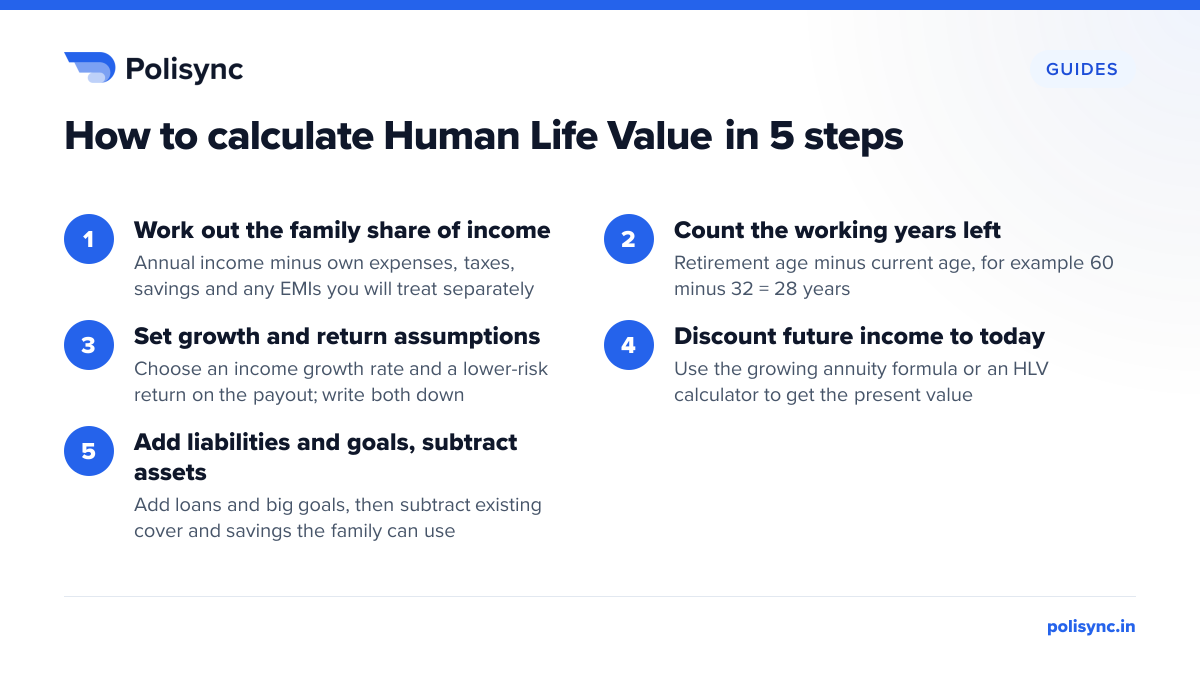
- Family share of income: the part of annual income that is spent on the household, after the earner's own expenses, taxes, savings and any loan EMIs you choose to treat separately.
- Discounting: converting future rupees into today's rupees, because a lump sum paid now keeps earning a return while the family draws it down.
How is HLV different from the needs-based and income-multiple methods?
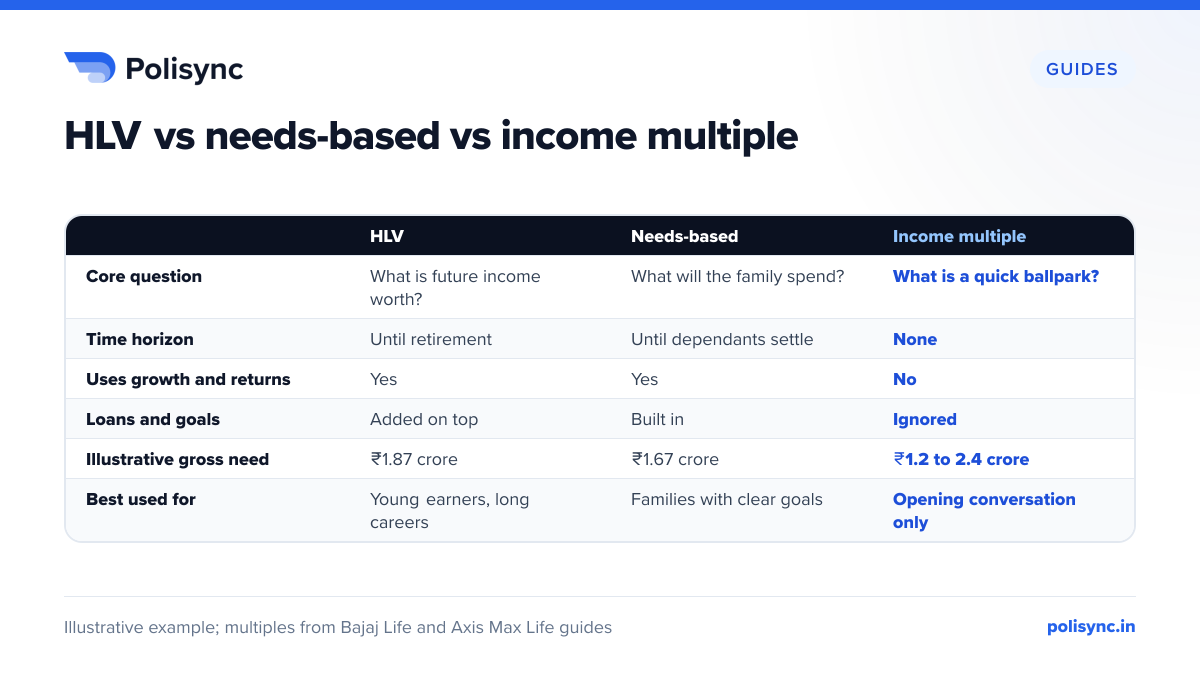
There are three common ways to size life cover, and each answers a slightly different question.
- HLV (income replacement): What is the earner's future income worth to the family today? It runs to retirement age and depends on income, personal expenses and your growth and return assumptions.
- Needs-based (expense) method: What will this particular family need to spend, and for how long? It adds up household expenses until dependants are independent, plus loans and goals, then subtracts existing assets. Both Axis Max Life and Bajaj Life describe this expense-replacement route alongside HLV.
- Income multiple: a quick rule of thumb. Bajaj Life's guide puts the optimal sum assured at 10 to 12 times annual income, while Axis Max Life suggests at least ten times and notes that some experts recommend 10 to 20 times. It is a heuristic, not a regulation, and it ignores the client's loans, assets and life stage.
Good advisers use HLV or a needs analysis to find the number, and the income multiple only as a sense check.
How do you calculate HLV step by step?
The calculation has five steps. The only real maths is step 4, which uses the growing annuity formula: PV = C x [1 - ((1 + g) / (1 + r))^n] / (r - g), where C is the first year's family share, g is the yearly growth in that share, r is the return assumed on the lump sum, and n is the number of working years left. The formula assumes each year's family share is received at the end of the year, so the first ₹6 lakh is discounted by one full year; this is also how our HLV calculator works.
Worked example: how much cover does a 32-year-old earning ₹12 lakh need?
The client below is hypothetical and every number is illustrative. The growth and return rates are teaching assumptions, not forecasts or advice.
Client profile:
- Arjun, 32, salaried, plans to retire at 60, so 28 working years remain.
- Annual income of ₹12 lakh. About ₹6 lakh a year goes on household running costs for his spouse and two children, aged 4 and 7. The rest covers his own spending, taxes, savings and the home-loan EMI.
- Outstanding home loan: ₹35 lakh.
- Children's higher-education goals: ₹30 lakh at today's cost for both children.
- Existing assets: an individual term plan of ₹50 lakh and ₹12 lakh in EPF, mutual funds and fixed deposits the family could draw on. His employer's group cover is left out because it may stop if he changes jobs.
- Assumptions: the family share grows 6% a year and the lump sum earns 8% a year.
Steps 1 to 4: the income replacement value
Family share C = ₹6,00,000. Working years n = 60 - 32 = 28. Growth g = 6% and return r = 8%.
First, (1 + g) / (1 + r) = 1.06 / 1.08 = 0.981481. Raised to the 28th power, that becomes 0.592515. Then 1 - 0.592515 = 0.407485, and dividing by (r - g) = 0.02 gives a factor of 20.3743.
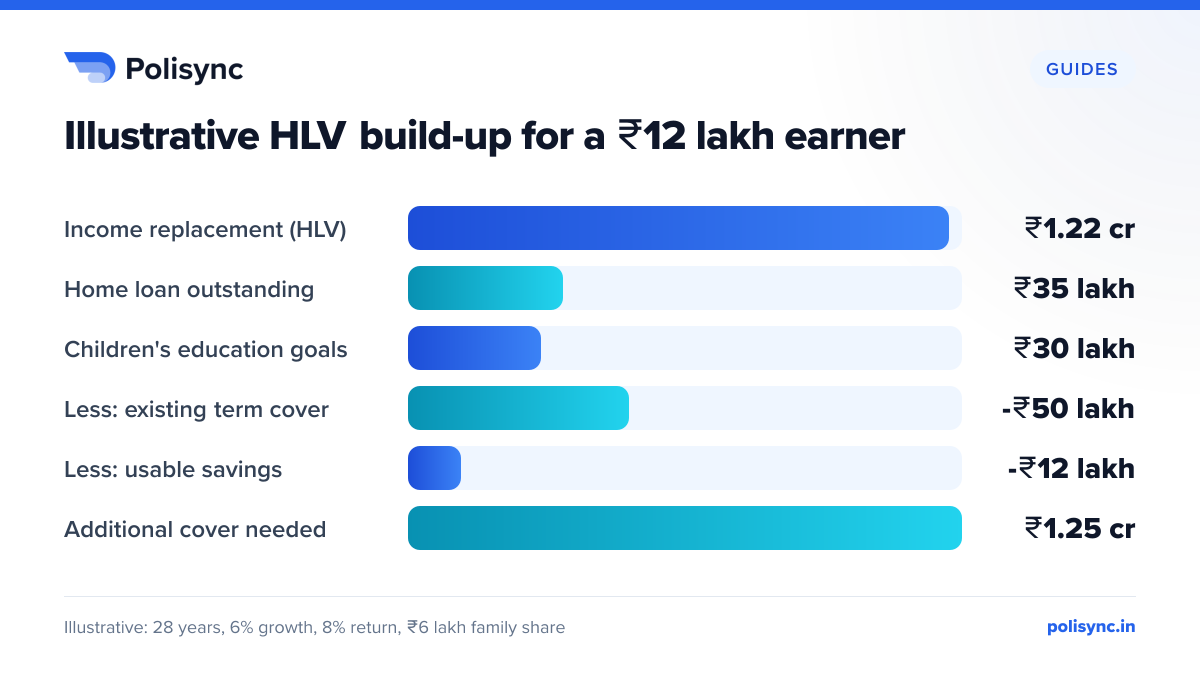
Multiply: ₹6,00,000 x 20.3743 = about ₹1.22 crore (₹1,22,24,561 without rounding). This is Arjun's pure HLV, the value today of 28 years of growing family support. Enter the same inputs in the HLV calculator, with personal expenses of ₹6 lakh, and you get the same answer. If you instead assume the family receives each year's support at the start of the year, multiply by (1 + r): 1.08 x ₹1,22,24,561 = about ₹1.32 crore.
Step 5: add liabilities and goals, subtract assets
- Income replacement (HLV): ₹1,22,24,561
- Plus outstanding home loan: ₹35,00,000
- Plus children's education goals: ₹30,00,000 (we assume education costs rise at the same 8% the payout earns, so today's cost stands in for the present value)
- Gross need: ₹1,87,24,561
- Less existing individual term cover: ₹50,00,000
- Less savings the family can use: ₹12,00,000
- Additional cover needed: ₹1,25,24,561, or about ₹1.25 crore
Arjun's total life cover would then be about ₹1.75 crore (₹50 lakh existing plus ₹1.25 crore new), roughly 14.6 times his income. In practice you would round to a sum assured the insurer offers and that fits his premium budget, subject to underwriting.
How sensitive is the answer to the assumptions?
Keeping everything else the same:
- If the family share grows 5% instead of 6%, the HLV falls to about ₹1.09 crore.
- If the payout earns 7% instead of 8%, the HLV rises to about ₹1.39 crore.
- If growth equals the return, each year's payment has the same present value, ₹6 lakh / 1.08, so the HLV is 28 x ₹5.56 lakh = about ₹1.56 crore (₹1.68 crore with start-of-year payments).
A one-point change in either assumption moves the answer by ₹13 lakh to ₹17 lakh. That is why you should write the assumptions down and show the client a range, not one magic number.
The same client under the needs-based method
Now size Arjun's cover by what his family would spend. Assume the ₹6 lakh household budget is needed until the younger child turns 25, which is 21 years, with the same 6% growth and 8% return. Its present value is about ₹97.4 lakh. Add the ₹35 lakh loan, the ₹30 lakh education goal and a ₹5 lakh emergency and final-expenses buffer, and the gross need is about ₹1.67 crore. After subtracting the same ₹62 lakh of cover and savings, the gap is about ₹1.05 crore.
The needs figure is lower because it stops at 21 years and leaves out his spouse's later-life needs, which a full needs analysis would add. The income multiple, at 10 to 20 times, gives ₹1.2 crore to ₹2.4 crore before any adjustment for his loan or existing cover. Our term insurance calculator gives a quick income-multiple estimate that also factors in loans and goals.
Which factors change the answer most?
- Inflation and income growth. HLV depends on the gap between how fast the family's spending rises and what the payout can earn. For context, on 25 March 2026 the Central Government retained the 4% CPI inflation target, with a tolerance band of 2% to 6%, for 1 April 2026 to 31 March 2031, according to the Reserve Bank of India. Costs such as school fees may not track the headline index, so test more than one growth rate.
- Age and working years. A 32-year-old has 28 earning years to replace; a 50-year-old on the same income has 10. HLV falls naturally with age.
- Number and ages of dependants. Young children, a non-earning spouse or dependent parents lengthen the period of support. Our family insurance planning guide shows how to map every member's needs.
- Loans. Home, car and personal loans should be cleared from the payout so the family keeps the asset. Avoid double counting: if an EMI already sits inside the family share, do not also add the outstanding loan.
- Goals. Children's education and marriage are lump sums on top of regular household spending.
- Existing cover and usable assets. Individual term plans, liquid investments and EPF reduce the gap. The family home usually should not, because the family still needs somewhere to live.
How much cover will an insurer actually allow?
The HLV you calculate is what the family needs; the sum assured an insurer accepts depends on its own underwriting. Under IRDAI's Master Circular on Life Insurance Products dated 12 June 2024, every life insurer must have a Board Approved Underwriting Policy covering areas such as risk assessment, tolerance limits and its underwriting philosophy. The detailed limits are therefore set insurer by insurer.
IRDAI's Master Circular on Protection of Policyholders' Interests notes that insurers may ask for income details with proof of income to ascertain premium-paying capacity, and asks them to spell out their financial underwriting requirements. In practice, insurers cap cover as a multiple of income that varies with age. Aditya Birla Sun Life Insurance explains that insurers multiply income by age-based factors such as 25X or 20X, then deduct existing life cover from that maximum. It lists typical income proofs such as ITRs, Form 16, recent salary slips and bank statements.
What this means in the meeting:
- If the HLV-based need is higher than an insurer's income grid allows, explain the gap honestly and never inflate declared income.
- Declare every existing policy on the proposal form, because insurers deduct it from the maximum eligible cover.
- Because an HLV-sized sum assured is large, most conversations start with pure term plans; our guide to term vs whole life insurance explains the trade-offs.
- Riders can add protection for specific risks but do not replace base cover; see insurance riders explained for clients.
When should clients review their life cover?
An HLV is a snapshot. It goes stale whenever income, dependants or debts change, and adding cover later usually means fresh underwriting at an older age. Prompt a review at these life events:
- Marriage, or a spouse leaving paid work.
- The birth or adoption of a child.
- A new home loan, a top-up loan or a large personal loan.
- A big salary jump, a promotion or a job change, especially if group cover from the old employer ends.
- Taking on responsibility for dependent parents.
- A loan being repaid or a child becoming financially independent, when cover needs may fall.
Outside these events, a yearly check that re-runs the calculation with current numbers keeps the cover honest.
How should agents present the number without mis-selling?
The IRDAI (Protection of Policyholders' Interests, Operations and Allied Matters of Insurers) Regulations, 2024, in force since 1 April 2024, define mis-selling to include "not taking reasonable care to ensure suitability of the policy" for the prospect. They also require insurers and distribution channels to follow the Authority's guidelines on product suitability and suitability assessment.
IRDAI's Master Circular on Protection of Policyholders' Interests, dated 5 September 2024, says that within 15 days of accepting a proposal the insurer must send the policy document with, among other papers, a copy of the benefit illustration and a copy of the need analysis document under suitability assessment, if any. The regulations also give a 30-day free-look period on life policies and new individual health policies with a term of one year or more; see our guide to the free-look period.
The Master Circular on Life Insurance Products requires every life insurer to give a customised benefit illustration at the point of sale, signed by both the prospect and the agent, which forms part of the policy document. For non-annuity products whose benefits are not all fixed at the outset, it must show guaranteed and non-guaranteed benefits at gross investment returns currently stipulated at 4% and 8% a year. Schedule B of the policyholder protection master circular exempts a few products from the illustration, including regular-premium pure term plans, so for those your written need analysis carries the weight.
Good practice when presenting an HLV:
- Show the working, the assumptions and a range, and give the client a copy.
- Separate the need from the product. HLV tells you how much cover; it does not justify a particular plan.
- Never use a large HLV figure to push a savings plan that delivers only a fraction of that cover.
- Size the premium to what the client can keep paying, because a lapsed policy protects no one.
- Record the client's inputs and your reasoning. Our guide on how to avoid insurance mis-selling covers documentation in more depth.
What this means for insurance agents: an action checklist
Use this sequence for every protection conversation:
- 1. Collect the facts first. Income, personal expenses, dependants and their ages, loans, goals, existing policies and usable savings.
- 2. Agree the assumptions with the client. Retirement age, income growth and the return on the payout, written into your notes.
- 3. Run HLV and a needs analysis side by side. Use the income multiple only as a sense check, never as the answer.
- 4. Show a range, not a point. Present the result at two or three sets of assumptions so the client sees how sensitive it is.
- 5. Check underwriting before promising cover. Confirm the insurer's income-based limits and the income proof it will need.
- 6. Document and schedule a review. Keep the need analysis on file and diary a review for the next life event or in 12 months. Agency software such as Polisync can help keep these records and review dates organised.