

Home insurance in India is most commonly sold as Bharat Griha Raksha (BGR), the standard home policy IRDAI made available from 1 April 2021. It covers the home building and household contents against fire, flood, earthquake, cyclone, riot, terrorism and other listed perils, on rebuilding cost, with no underinsurance penalty. Yet a Business Today report from August 2025 put the share of adequately insured homeowners at only about 1%.
For agents, that gap is an opportunity. A home is usually a family's largest asset, often bought with a loan, and the cover is simple once you know a few rules. This guide explains what BGR covers, how the sum insured works, what is excluded, how loan-linked policies fit in and how claims are settled.
What is Bharat Griha Raksha?
Bharat Griha Raksha is a standard fire and allied perils policy for dwellings. IRDAI introduced it through guidelines dated 4 January 2021 (Ref. IRDA/NL/GDL/MISC/004/01/2021), effective 1 April 2021. It replaced the Standard Fire and Special Perils (SFSP) policy that dwellings were earlier insured under, which came from the erstwhile All India Fire Tariff, 2001.
Key points from the 2021 guidelines:
- Every general insurer selling fire insurance had to offer BGR for all new risks and renewals from 1 April 2021, with its own name prefixed to the product.
- It covers the Home Building, the Home Contents, or both, for terms of up to 10 years, with terrorism cover built in.
- The policy wording, proposal form and key features document were standardised, and insurers could not alter them.
Is BGR still the standard home policy in 2026?
IRDAI's Master Circular on General Insurance Business, issued on 11 June 2024, moved general insurance product rules to a principle-based framework. Its Annexure C, the list of repealed circulars, includes the 2021 BGR guidelines at item 5. The same circular states that "Insurers shall not withdraw or discourage the use of or decline to offer to any customer any of the Tariff Products which have been in existence prior to issuance of this Master Circular", and asks insurers to let customers customise cover with add-ons.
In practice, insurers kept selling BGR-branded policies after the repeal. In a Business Today report from August 2025, executives at Liberty General and Shriram General described BGR as covering floods, storms and cyclones, for annual terms or up to 10 years. Insurers now have more freedom on tenure, limits and add-ons, so read the specific insurer's current wording before quoting features.
What does home insurance cover in India?
The standard BGR policy wording (the copy filed by Edelweiss General on the IRDAI website) covers physical loss, damage or destruction caused by these insured events:
- Fire, explosion or implosion, and lightning.
- Earthquake, volcanic eruption or other convulsions of nature.
- Storm, cyclone, typhoon, tempest, hurricane, tornado, tsunami, flood and inundation.
- Subsidence, landslide and rockslide, plus bush, forest and jungle fires.
- Impact damage of any kind (vehicle, falling tree, aircraft, wall) and missile testing operations.
- Riot, strike, malicious damage and acts of terrorism.
- Bursting or overflowing of water tanks, apparatus and pipes, and leakage from automatic sprinklers.
- Theft within 7 days of, and proximately caused by, any of the above events.
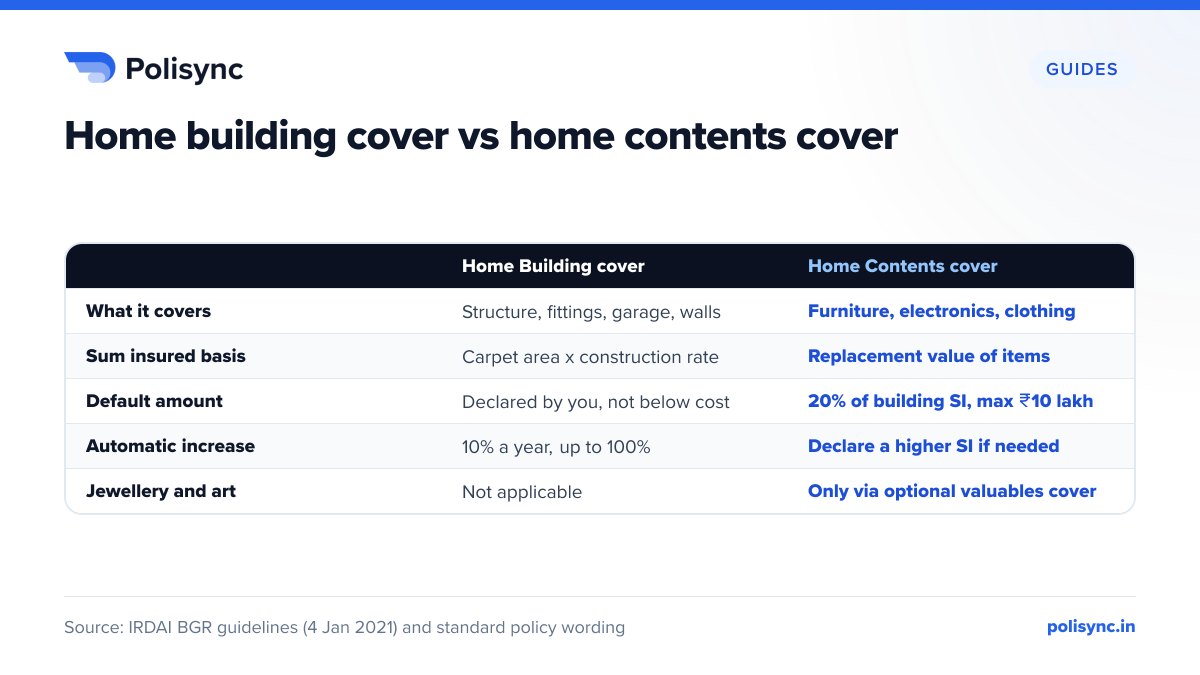
The Home Building includes permanent fixtures and fittings (sanitary fittings, wiring) and additional structures on the same site, such as a garage, compound wall, gates, septic tank and water tanks. General Contents means household items like furniture, electronics, kitchen equipment and clothing. Valuable Contents means jewellery, silverware, paintings, works of art, antiques and curios.
Built-in and optional covers in the standard wording:
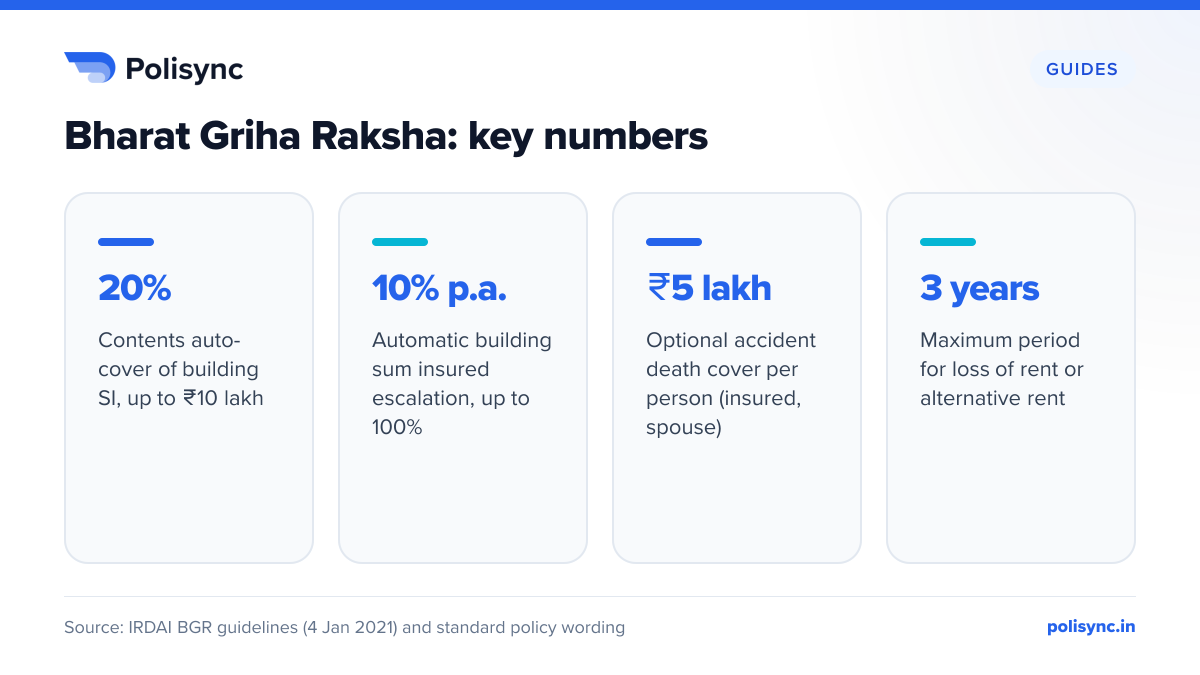
- Loss of rent and rent for alternative accommodation while the home is unfit to live in, for up to three years, backed by an architect's or local authority certificate.
- Architect, surveyor and consulting engineer fees up to 5% of the claim amount, and debris removal up to 2%, on top of the building claim.
- Optional valuable contents cover on an agreed value basis. The valuation certificate is waived if the sum insured is up to ₹5 lakh and no single item exceeds ₹1 lakh.
- Optional personal accident cover of ₹5 lakh per person if an insured peril that damages the home also causes the death of the insured or spouse.
How is the home insurance sum insured calculated?
The sum insured is the maximum the insurer will pay. Under the 2021 guidelines, the building and contents are insured on a reinstatement or replacement value basis, and insurance on market value is not permitted. In plain terms, the policy pays what it costs to rebuild or replace, not what the flat would sell for. Our insurance glossary explains these terms in more detail.
The rules agents should explain:
- Building: carpet area multiplied by the rate of cost of construction on the start date, as declared by the client and accepted by the insurer. The sum insured can be higher than this figure but not lower.
- No underinsurance penalty: underinsurance means the client bears part of a loss because the sum insured is below the true value. The standard BGR wording says it does not apply, so a lower sum insured does not cut the claim proportionately.
- Automatic escalation: on long-term policies the building sum insured rises by 10% of the starting amount on each anniversary, up to a total increase of 100%, without extra premium. On annual policies it grows daily by 1/365th of 10%.
- Contents: when the building is insured, general contents are automatically insured at 20% of the building sum insured, up to ₹10 lakh, unless the client opts out. A higher amount must be declared. Contents-only buyers, such as tenants, declare their own figure.
- Restoration: after a claim, the sum insured is restored on payment of proportionate premium for the remaining period.
Illustrative sum insured calculation
The numbers below are hypothetical and only show the method. Actual construction rates vary by city and building type and must be agreed with the insurer.
- Flat carpet area: 75 square metres. Assumed construction rate: ₹28,000 per square metre.
- Building sum insured: 75 x ₹28,000 = ₹21 lakh, even if the flat's market price is much higher because of land value.
- Automatic general contents cover: 20% of ₹21 lakh = ₹4.2 lakh (well under the ₹10 lakh cap).
- On a 5-year policy the building sum insured would rise by ₹2.1 lakh at each anniversary, reaching ₹29.4 lakh by the fourth anniversary, with no extra premium.
- If the family owns jewellery worth ₹4 lakh with no item above ₹1 lakh, the optional valuables cover could be taken without a valuation certificate.
What is not covered under home insurance?
The standard wording excludes, among other things:
- Deliberate acts, war, nuclear risks, and pollution unless linked to an insured event.
- Electrical or electronic breakdown from short circuit, over-running or self-heating (only the affected machine is excluded).
- Bullion, unset precious stones, manuscripts, documents, cash, cheques and vehicles.
- Items that go missing without a single identifiable event, and property removed from the home.
- Consequential losses, and any fall in market value after repair.
- Additions that increase carpet area by more than 10% unless declared and endorsed.
- Under the subsidence and landslide peril: normal cracking or settlement of new structures, coastal or river erosion, and defective design or workmanship.
Use matters too. The building must be used as a residence by the owner, family, tenant, licensee or employee. Holiday homes and lodging or boarding use are not covered, though working from home as a self-employed person is allowed.
Is theft or burglary covered?
Only partly. The base BGR cover pays for theft within 7 days of, and caused by, an insured event such as a fire or flood, not a routine break-in. IRDAI's Master Circular on Protection of Policyholders' Interests, 2024 says a homeowner can ask the insurer to include burglary and theft of contents, and electrical damage to appliances, in a homeowner policy, and that no warranties shall apply to homeowners insurance products.
Why is home insurance so underused in India?
The exposure is large. The Swiss Re Institute's January 2024 report on India estimated that 93% of India's natural catastrophe exposures were uninsured, because its Natural Catastrophe Resilience Index reading for India was just 7% in 2022. Average annual economic losses from natural disasters over 2013 to 2022 were USD 8 billion (inflation adjusted), 125% higher than the previous decade.
Monsoon floods are the recurring risk. Swiss Re notes that:
- India receives about 80% of its annual rainfall in the June to September monsoon, leading to inundation every year.
- There were 11 single flood events with economic losses above USD 1 billion in 2013 to 2022, against six in 2003 to 2012, including Kerala (2018) and northern India (2023).
Swiss Re names limited awareness and perception of the risks as one challenge in closing this protection gap, and notes that the cover which exists is mostly limited to major cities. Agents can answer the other common objections directly: the standard product is simple, contents are included automatically when the building is insured, and claims are paid on rebuild cost without an underinsurance cut.
How do home-loan-linked property policies work?
When a home is mortgaged, the policy schedule shows an Agreed Bank Clause naming the lender, so the bank's interest in the property is recorded. Many borrowers first meet property insurance this way, often as a policy arranged at the loan desk.
Borrowers have a choice. Under the RBI's Non-Banking Financial Companies - Undertaking of Financial Services Directions, 2025 (28 November 2025), which apply to housing finance companies (HFCs) through the RBI's Housing Finance Companies Directions, 2025, an HFC "should not adopt any restrictive practice of forcing its customers to go in only for a particular insurance company in respect of assets financed by it". Buying insurance through the lender is purely voluntary, with no linkage to the loan. In communications dated December 2024 and March 2025, the National Housing Bank also asked HFCs to take clear written consent and offer options from at least two insurers, as reported by Insurance Times.
When reviewing a client's loan-linked property policy, check:
- Is the sum insured based on rebuild cost, or simply on the loan amount?
- Does it cover only the building, leaving furniture and appliances uninsured?
- Does the policy term match the loan tenure, or will it lapse silently after a year?
- Are add-ons the family needs, such as burglary or valuables, included?
- If two policies cover the same risk with a lender involved, IRDAI's 2024 policyholder master circular says the insurer will not apply the contribution clause.
What this means for insurance agents
IRDAI's 2021 guidelines asked insurers to train agents and intermediaries to explain and market BGR, which signals that distribution was always expected to drive uptake. Home cover also fits naturally into the conversations you already have.
- Home-loan clients: a recent home buyer is a warm lead. Pair the property policy with term cover for the loan as part of a broader family insurance plan.
- Existing health and life clients: add a home question to your fact-find, as you would for health insurance cross-selling.
- Tenants: a contents-only policy protects their belongings. The standard wording places loss of rent and alternative accommodation cover under the Home Building cover, so do not promise it on contents-only cover.
- Flood and cyclone zones: reach out before the June to September monsoon, not after the first flood.
- Annual reviews: check that the sum insured still reflects construction costs and new appliances or jewellery. Our annual policy review checklist has a section you can adapt.
Home insurance also gives you a reason to contact clients outside renewal season, a retention lever covered in our guide on how to grow an insurance agency. Keeping property details, sums insured and renewal dates in one place, whether a spreadsheet or agency software like Polisync, makes those reviews faster.
How does a home insurance claim work?
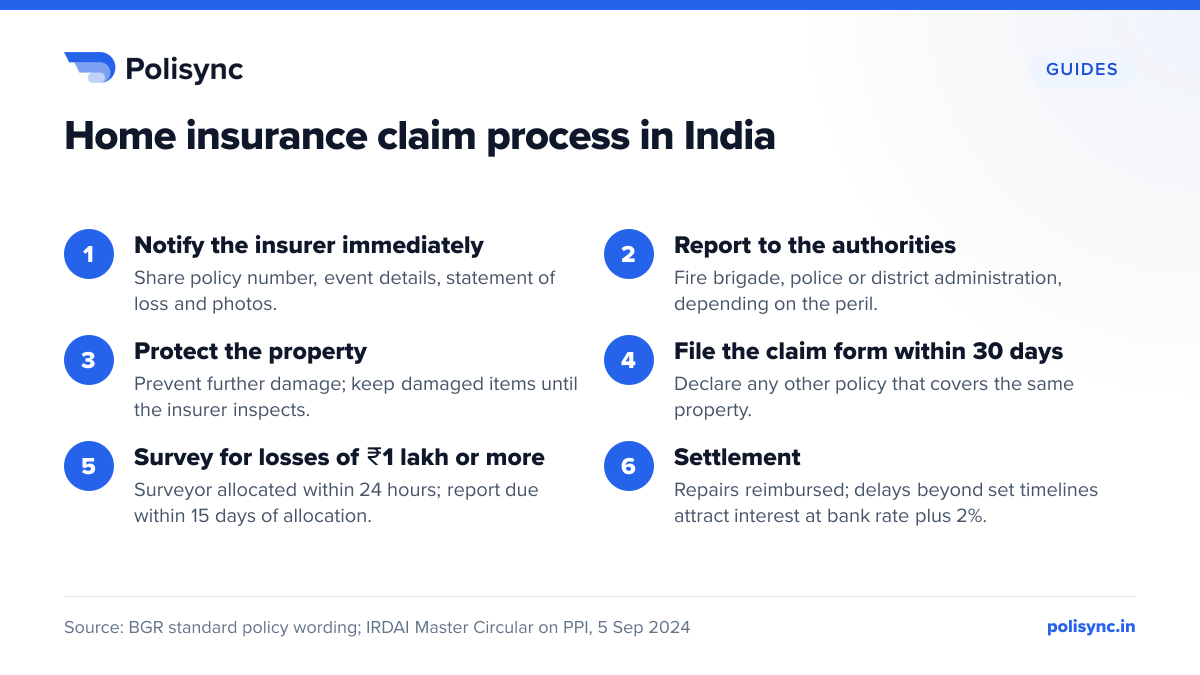
The standard wording sets out the client's duties, and IRDAI's 2024 policyholder master circular sets timelines for insurers and surveyors. Losses of ₹1 lakh or more under non-motor general insurance must be assessed by a registered surveyor.
- Notify the insurer immediately, with the policy number, details of the event, a brief statement of loss, police or authority reports, and photographs where possible.
- Report to authorities: fire brigade and police for fire, explosion or lightning; police for riot, malicious damage, terrorism or impact damage; the district administration for subsidence or landslide.
- Prevent further damage, but do not dispose of damaged items, clear debris or carry out non-urgent repairs until the insurer has inspected and agreed.
- Submit the claim form within 30 days of first noticing the loss, declaring any other insurance on the same property.
- Survey: a surveyor should be allocated within 24 hours of the claim being reported and report within 15 days of allocation, or ₹500 a day is payable to the claimant for the delay.
- Decision and settlement: the insurer normally decides within 7 days of the survey report (or 15 days from surveyor allocation, if earlier), but this timeline does not apply to property or building policies on a reinstatement value basis, which is how BGR insures the building. For building repairs, the client spends on repairs and claims that amount. Delayed settlement attracts interest at bank rate plus 2%, payable by the insurer on its own.
Two more rules help clients. IRDAI's master circulars say no claim shall be rejected for want of documents, and that an insurer cannot repudiate a claim for a policyholder's delay if the delay did not increase the assessed loss. Under the standard wording, though, the insurer is not liable after 12 months from the loss unless the claim is under pending action or arbitration.
Action checklist for agents
Use this sequence with every homeowner or tenant client:
- 1. Ask whether the home, its contents, or both are insured today, and who arranged the policy.
- 2. Collect carpet area, construction type and address to estimate rebuild cost at the insurer's rate.
- 3. Confirm the client understands that sum insured is rebuild cost, not market value.
- 4. List valuables and decide whether the optional valuables cover is needed.
- 5. Discuss add-ons such as burglary and electrical damage, with the premium for each shown separately.
- 6. For loan-linked policies, check the sum insured, tenure and contents cover, and explain the client's right to choose an insurer.
- 7. Give the client a one-page claim checklist: notify, report, protect, file within 30 days.
- 8. Diary a review before each monsoon and at every renewal.
