

Health insurance portability lets a client move an indemnity health policy to a new insurer and keep the waiting-period credit already earned. Under IRDAI's Master Circular on Health Insurance Business dated 29 May 2024, the old insurer must share data within 72 hours via the IIB portal, the new insurer must decide within 5 days, and credit carries over up to the old sum insured and no claim bonus.
This guide, current as of 10 August 2026, explains how porting works, what happens to waiting periods and cumulative bonus, where clients lose cover, and how agents can run a port without a gap. It is written for Indian insurance agents who need to explain the rules clearly to clients.
What is health insurance portability?
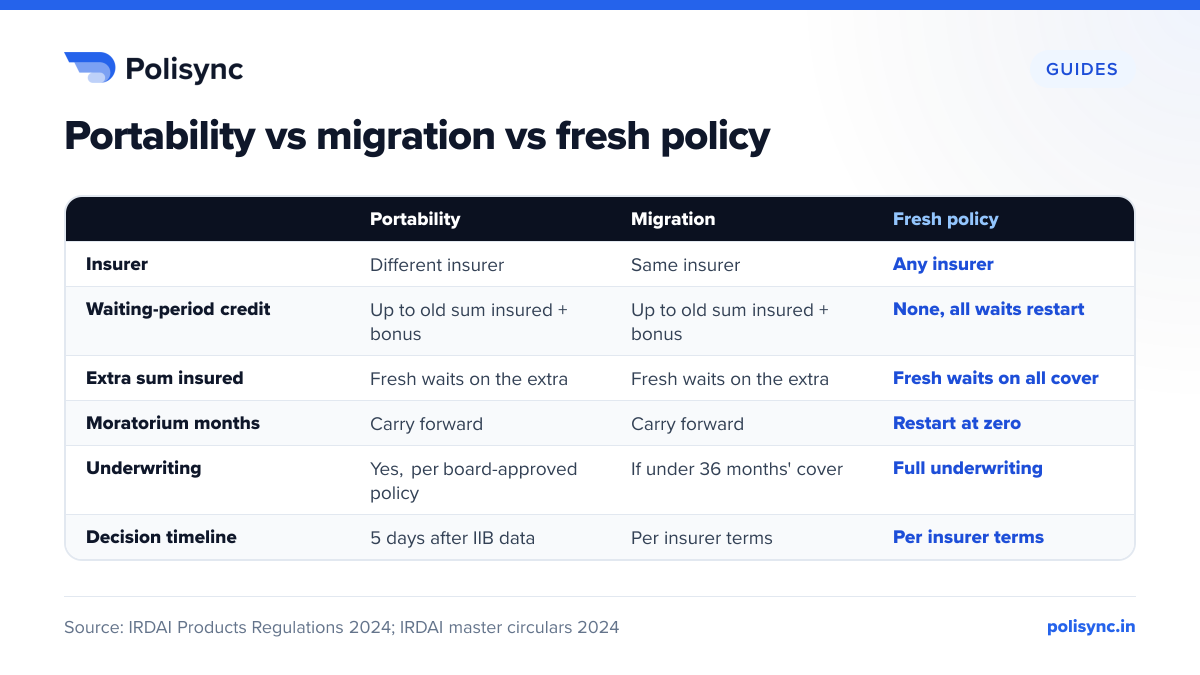
Portability is the right of a policyholder to shift an indemnity health policy from one insurer (the existing insurer) to another (the acquiring insurer) while carrying forward credits earned under the old policy. Migration is the same idea within one insurer: moving from one of its products to another without losing credits.
The 2024 Master Circular lists the credits that travel with the policyholder in both cases:
- Sum insured (to the extent of the previous policy)
- No Claim Bonus, including cumulative bonus
- Specific waiting periods (for named illnesses or procedures)
- Waiting period for pre-existing diseases
- Moratorium period
These rules apply to indemnity policies, meaning plans that reimburse actual hospital bills. The IRDAI (Insurance Products) Regulations, 2024 require general and health insurers to allow portability of all indemnity health policies, individual or group, except personal accident and travel policies, subject to the insurer's board-approved underwriting policy. Fixed-benefit covers should not be assumed to be portable.
What do IRDAI's 2024 rules say about porting?
Three IRDAI documents now govern porting: the Insurance Products Regulations, 2024 (notified 20 March 2024), the Master Circular on Health Insurance Business (29 May 2024, Ref: IRDAI/HLT/CIR/PRO/84/5/2024) and the Master Circular on Protection of Policyholders' Interests (5 September 2024), whose Chapter VI deals with portability. Together they set these obligations:
- The acquiring and existing insurers must jointly ensure the policyholder's entire underwriting details and claim history are transferred seamlessly.
- The existing insurer must supply the requested information immediately, and in not more than 72 hours, through the Insurance Information Bureau of India (IIB) portal.
- The acquiring insurer must decide and communicate on the proposal immediately, and in not more than 5 days of receiving that information.
- The policyholder can transfer credits to the extent of the sum insured, No Claim Bonus, specific waiting periods, pre-existing disease waiting period and moratorium period of the previous policy.
- No charges can be levied on the policyholder for porting in or porting out.
The health master circular also says accrued credits under ported and migrated policies count towards the moratorium period, defined as 60 months of continuous coverage, after which no policy or claim can be contested for non-disclosure or misrepresentation except for established fraud. The Products Regulations cap the pre-existing disease waiting period at 36 months of continuous coverage and define specific waiting periods as up to 36 months. For how each wait works, see our guide on health insurance waiting periods explained.
What happened to the 2020 migration and portability guidelines?
IRDAI's Guidelines on Migration and Portability of 1 January 2020 were folded into Chapter VIII of the Consolidated Guidelines on Product Filing in Health Insurance Business of 22 July 2020, which superseded them. The May 2024 health master circular lists those consolidated guidelines among the circulars it supersedes in Annexure-6, and the Products Regulations repealed the IRDAI (Health Insurance) Regulations, 2016 under which the 2020 norms were issued. Quote the 2024 rules to clients, not the 2020 text that still circulates online.
When should a client apply to port a health policy?
IRDAI does fix a window, in the policyholder-protection master circular rather than the health one. The client must apply to the new insurer to port the entire policy, with all family members, at least 30 days before, but not earlier than 60 days from, the renewal due date. Insurers may still consider a request made within 15 days of renewal, provided the acquiring insurer ensures there is no break in the policy. Porting is allowed only at renewal.
Many insurers ask for more notice than the regulatory minimum. Raheja QBE's portability guidelines require the proposal form, portability annexure and previous policy documents at least 45 days, but not earlier than 60 days, before expiry. Tata AIG's portability page also asks policyholders to give at least 45 days' notice and says plans cannot be ported between policy periods.
The safe rule for agents: start the conversation 60 days before renewal and submit by day 45. That satisfies both the IRDAI window and stricter insurer practice, and leaves time for medical tests, queries and a fallback renewal if the port is declined.
How long does the new insurer take to decide?
Once the client submits the portability and proposal forms, the acquiring insurer requests the policy and claim history through the IIB portal. The regulatory clock then runs in two short legs: 72 hours for the existing insurer and 5 days for the acquiring insurer. Add the insurer's own time for medical checks or document queries before the request is raised.
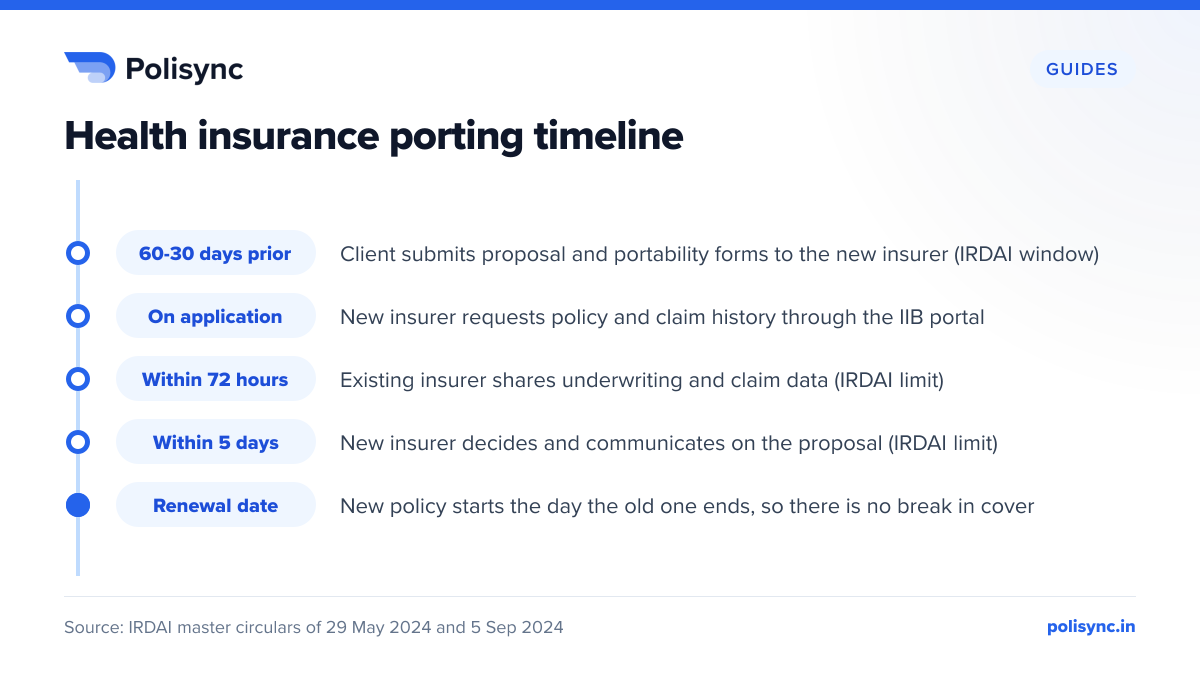
If the acquiring insurer stays silent well beyond 5 days after the IIB data has been shared, escalate in writing and keep the old renewal ready.
What happens to waiting periods, sum insured and cumulative bonus?
Credit follows the old cover, not the new one. The client keeps waiting-period credit on the previous sum insured plus the bonus earned. Anything above that is new cover and starts its own waiting periods.
- Previous sum insured: fully credited for time already served under pre-existing disease and specific waiting periods.
- Cumulative bonus: Raheja QBE's guidelines say portability applies to the previous sum insured and the cumulative bonus acquired. Treatment can differ by product, so confirm it in writing.
- Extra sum insured: Raheja QBE applies all waiting periods afresh to the increased or enhanced sum insured, and Tata AIG says credit applies only up to the existing sum insured.
- Moratorium: months of continuous cover already completed count towards the 60-month moratorium on the original sum insured. Under the Products Regulations, an enhanced sum insured runs its own 60 months from the date of enhancement.
Illustrative example: ₹5 lakh policy ported to ₹10 lakh
This is a hypothetical case to show the arithmetic. Suppose Meena has held a ₹5 lakh individual policy for 3 continuous years and has earned a ₹1 lakh cumulative bonus. Assume her old and new policies both carry a 36-month pre-existing disease wait and a 24-month specific illness wait. She ports to a new insurer and chooses a ₹10 lakh sum insured.
- ₹6 lakh protected (₹5 lakh + ₹1 lakh bonus): all 36 months already served, so no pre-existing disease or specific illness wait remains on this layer.
- ₹4 lakh extra: treated as fresh cover, so the full 36-month and 24-month waits start again for this layer only.
- Moratorium: 36 of the 60 months are complete on the original ₹5 lakh, leaving 24 months; the extra ₹4 lakh starts its own 60-month count.
- Result: a claim for a disclosed pre-existing condition in year one is payable up to ₹6 lakh, not ₹10 lakh, assuming the new insurer accepts the port without added exclusions.
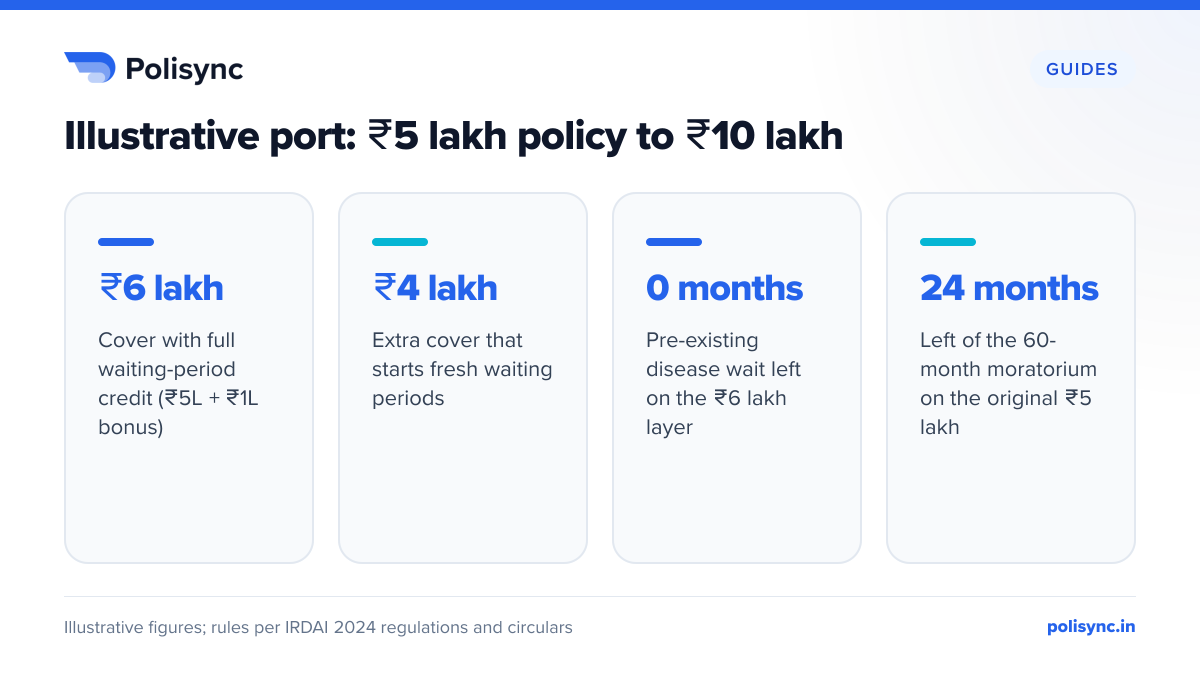
Clients often assume the whole new sum insured is "covered from day one". Walking them through a layer-by-layer example like this before they sign is the single best way to avoid a disputed claim later.
Can the new insurer refuse a port?
Yes. Porting is a right to apply with credit protection, not a guarantee of acceptance. The Products Regulations make portability subject to the insurer's board-approved underwriting policy, and the master circular requires the acquiring insurer to "decide" on the proposal.
Tata AIG lists common reasons ports fail, including incomplete information, late requests, frequent claims history, missing documents, age limits and breaks in renewal. Compare this with staying put: under the health master circular, an existing insurer cannot deny renewal because the client made claims, and cannot re-underwrite at renewal unless the sum insured is increased.
That asymmetry is why agents should never let a client cancel or skip the old renewal until the new policy is issued.
How is migration different, and can group cover be converted?
Migration within the same insurer
Migration moves a client to another product of the same insurer, with the same credits carried forward. Under the Products Regulations, the insurer may underwrite a migration only if the insured has not been continuously covered for 36 months. The health master circular also requires insurers to offer migration when a product is withdrawn, including a one-time renewal option if renewal falls within 90 days of withdrawal.
Group policies
The 2024 framework is broader than the old norms. The policyholder-protection master circular requires insurers to allow portability of individual, family floater and group health policies at renewal, and the Products Regulations apply portability irrespective of individual or group policy. Migration credits under the health master circular also extend to members of group policies.
For an employee leaving a company, the usual route is conversion to an individual or family floater policy with the group insurer. Raheja QBE's guidelines, for example, offer this on exit from the group, carrying over the sum insured and cumulative bonus, subject to product-specific underwriting and a decision within 15 days where underwriting is done. Check the insurer's conversion terms before the employee's last working day.
What documents are needed to port a health policy?
Requirements vary slightly by insurer, but the core set listed by Bajaj General, Tata AIG and Raheja QBE is consistent:
- Proposal form of the new insurer, filled in completely
- Portability form authorising the new insurer to fetch data
- Copies of previous policy documents for all continuous years
- Latest renewal notice of the expiring policy
- Medical records, discharge summaries and claim documents, if any
- Identity and address proof such as Aadhaar, PAN or passport
What are the common porting mistakes?
Most failed or painful ports trace back to a handful of avoidable errors:
- Letting the old policy lapse. Credits are protected if the policy is renewed within the grace period of 30 days for annual premiums. But the circular guarantees cover during grace only for instalment premiums, so an annual-premium client may have no cover for claims in that gap.
- Non-disclosure on the new proposal form. The new proposal is a fresh declaration. Undisclosed conditions invite disputes until the moratorium is complete, even though ported months count towards it.
- Assuming the extra sum insured is covered immediately. Only the old sum insured plus bonus carries credit.
- Ignoring hospital networks and sub-limits. A cheaper plan may have room-rent caps or fewer network hospitals. Review cashless vs reimbursement claims with the client before switching.
- Cancelling the new policy in free look. Every policy of one year or more has a 30-day free-look period, but cancelling after the old policy has ended leaves the client uninsured.
- Porting a fixed-benefit plan. IRDAI's portability rules cover indemnity policies and exclude personal accident and travel policies, so critical illness or personal accident covers should be reviewed separately.
What this means for insurance agents
A port is a retention risk for the agent who sold the old policy and an acquisition opportunity for the agent receiving it. One rule matters directly: under Chapter VI of the policyholder-protection master circular, the acquiring insurer shall not pay any commission or incentive to its employees or distribution channel on port-in policies during the port-in year. Explain this upfront, and never ask the client for a fee to make up for it.
Porting conversations also open doors: a client moving to a ₹10 lakh base may be better served by a smaller base plus a top-up, and a review is a natural time for a health insurance cross-selling discussion. For agents defending their book, a proactive pre-renewal review is one of the most effective customer retention strategies. Keep portability files, dates and correspondence in one place, whether in a spreadsheet or agency management software.
Agent action checklist for a health insurance port
- Flag every health renewal 75 days out and start the review at 60 days, as part of your normal policy renewal process.
- Collect all previous policy schedules to prove continuous cover with no break.
- Write down the protected amount (old sum insured plus bonus) and the fresh layer before quoting.
- Compare waiting periods, sub-limits, co-pay and network hospitals, not just premium.
- Help the client disclose every condition honestly on the new proposal form.
- Submit by day 45 before renewal and track the 72-hour and 5-day IRDAI clocks.
- Keep the old renewal ready; renew within grace if the new insurer has not accepted in time.
- Get written confirmation of credited waiting periods and cumulative bonus in the new policy schedule.