

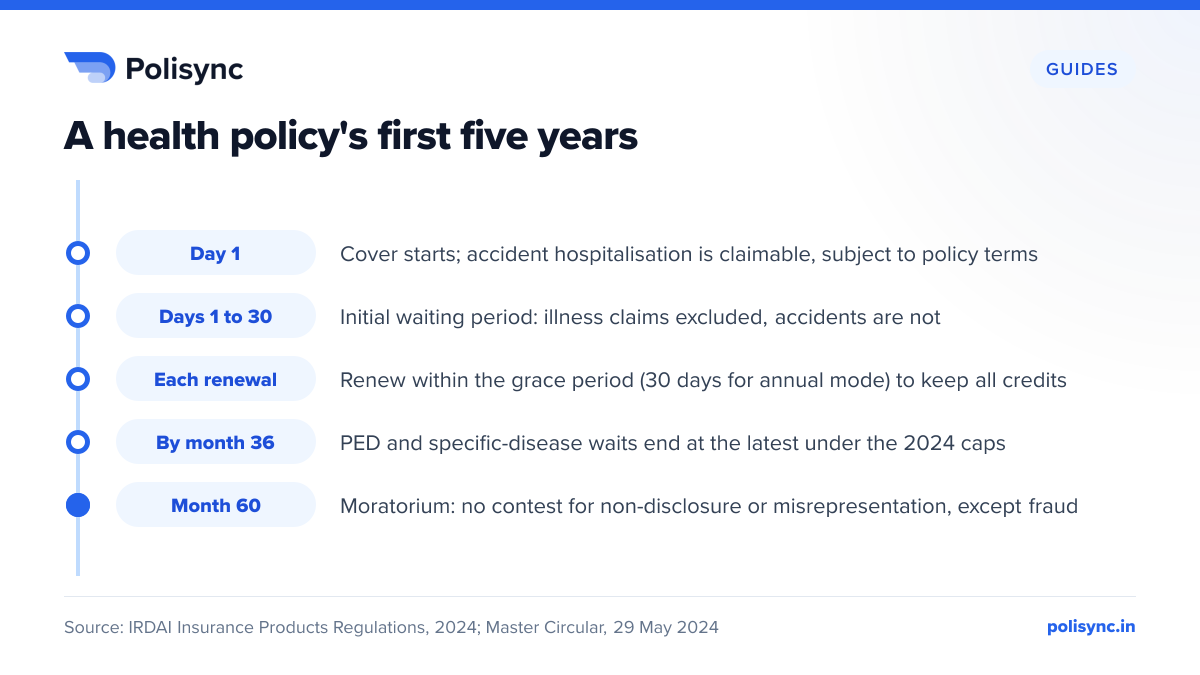
Retail health policies carry four main waits: an initial wait for illness (commonly 30 days, accidents excluded), a pre-existing disease (PED) wait capped at 36 months, specific-disease waits of up to 36 months, and maternity waits. After 60 months of continuous cover, the moratorium stops insurers contesting claims for non-disclosure, except established fraud. The 36- and 60-month limits apply from 1 April 2024 under the IRDAI (Insurance Products) Regulations, 2024.
A client admitted for planned surgery a few weeks after buying a policy may find the claim is not payable. This guide, current as of 27 July 2026, explains every wait so you can set expectations at the proposal stage, not at the claim desk.
What is a waiting period in health insurance?
A waiting period is a stretch of time after the policy starts during which certain illnesses or treatments are not covered, even though the premium has been paid. It protects insurers from people buying cover only once they know they need treatment.
A typical retail health policy can include:
- Initial waiting period: usually the first 30 days, for any illness other than an accident.
- Pre-existing disease (PED) waiting period: up to 36 months for conditions that existed before the policy began.
- Specific-disease or procedure waiting period: up to 36 months for a named list of illnesses and treatments set out in the policy.
- Maternity waiting period: where maternity is covered at all, the product sets its own wait.
- Moratorium period: not a waiting period, but a 60-month clock after which the insurer cannot contest the policy for non-disclosure or misrepresentation, except established fraud.
The Master Circular on Health Insurance Business dated 29 May 2024 requires insurers to list the waiting periods, portability, migration and moratorium terms in the Customer Information Sheet (CIS) that comes with every policy, and to take the policyholder's acknowledgement of it. It is available in a local language on request.
What changed in 2024 for PED waiting periods and the moratorium?
Before 2024, IRDAI's Guidelines on Standardization of Exclusions in Health Insurance Contracts, dated 27 September 2019, allowed a PED waiting period of up to 48 months, a specific-disease waiting period of up to 48 months and a moratorium of eight continuous years. In July 2020 those guidelines were folded into the Master Circular on Standardization of Health Insurance Products, whose standard PED definition also looked back 48 months before the policy start date.
The Insurance Products Regulations, notified on 20 March 2024 and in force from 1 April 2024, cut all three. Schedule III of the regulations defines a PED as a condition diagnosed, or for which medical advice or treatment was recommended or received, not more than 36 months before the policy began. It caps the PED waiting period at 36 months of continuous coverage, defines the specific waiting period as up to 36 months, and sets the moratorium at sixty continuous months. Business Today reported that existing policyholders would also benefit, with waiting periods aligned to the new three-year limit at renewal.
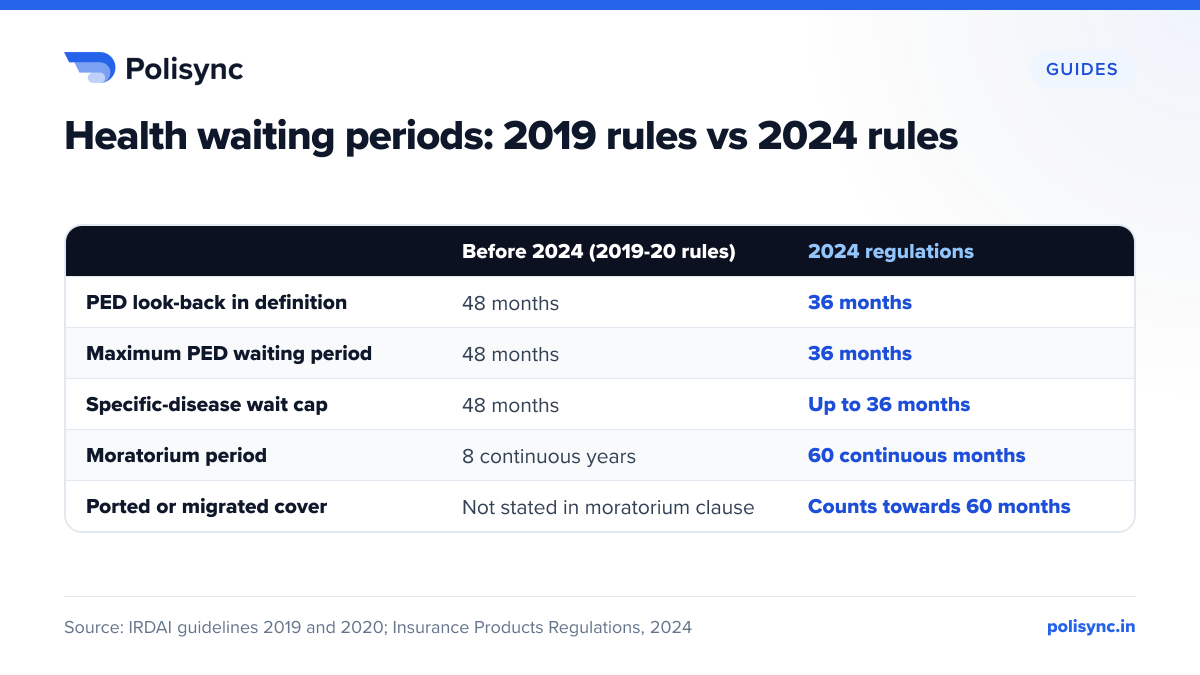
The master circular gave insurers until 30 September 2024 to modify existing products that did not comply, told them to protect waiting-period and moratorium credits already earned when a revised policy is issued, and allowed them to extend the new benefits to existing policyholders. The regulations also say insurers "may endeavor" to offer shorter PED and specific waiting periods, so 36 months is a ceiling, not a standard. The shorter waits were expected to lift premiums: ACKO's Rupinderjit Singh told Business Today in April 2024 that he expected most insurers to raise costs for all customers by 10 to 15%.
The 29 May 2024 circular also superseded 55 older health circulars, listed in Annexure 6 of its annexure document; the first is the July 2020 standardization master circular. So neither the 2019 exclusion guidelines nor their 2020 consolidation is in force any more: the limits now come from Schedule III, and the old standard wordings (codes such as Excl01 to Excl03) survive mainly in insurers' own policy documents.
How does the initial waiting period work, and is 30 days still standard?
Neither the 2024 regulations nor the master circular fixes the length of the initial wait. The Customer Information Sheet format in the annexure to the master circular only asks insurers to state the number of days, and says the wait does not apply on continuous renewal or to accidents. In practice, many retail products still use 30 days, the figure in IRDAI's earlier standard wording (code Excl03); TATA AIG, for example, describes a 30-day initial waiting period from the policy start date. So a road-accident admission on day five is claimable; a fever admission on day five usually is not.
- It is a one-time wait. The CIS format says it does not apply on continuous renewal, and the earlier standard wording lifted it once the insured had more than twelve months of continuous cover.
- It can apply to a higher sum insured. Under the earlier standard wording, which many policies still follow, the 30-day wait applies to any increase in sum insured, so check the policy wording.
What is the pre-existing disease (PED) waiting period?
The PED waiting period is the time a client must wait before claims for a disclosed pre-existing condition and its direct complications become payable. Common examples are diabetes, high blood pressure or thyroid disorders diagnosed or treated in the 36 months before the policy began.
The 36-month limit is the maximum, and some products use less: TATA AIG, for instance, states that PED waiting periods on its health plans range from 24 to 36 months. Always check the actual number in the schedule or CIS.
Three rules matter most to clients. Each appears in the current regulations or CIS format, and in IRDAI's earlier standard PED wording (Excl01) that many policies still reproduce:
- Cover after the wait depends on disclosure. Schedule III caps the wait for PEDs disclosed by the person to be insured, so a condition must be declared in the proposal and accepted by the insurer to be covered after the wait.
- A higher sum insured means a fresh wait. The CIS format says waiting periods start afresh only for the enhanced portion of the sum insured.
- Prior continuous cover counts. If the client has been covered without a break and ports or migrates, PED waiting-period credit earned under the earlier policy carries over.
Worked example: a client with diabetes
Illustrative example: Meena, 48, from Pune, was diagnosed with type 2 diabetes in 2025 and buys a policy starting 1 August 2026 with a 36-month PED waiting period. If she declares her diabetes and renews on time, a diabetes-related hospitalisation is claimable once 36 months of continuous cover are complete, that is, from August 2029. A fracture from a fall in 2027 is not a PED claim and is assessed under normal terms.
What are specific-disease and procedure waiting periods?
A specific waiting period is a period of up to 36 months from the start of cover during which the diseases and treatments named in the policy are not covered, unless they arise from an accident. Once the period is over, they are covered as long as the policy has been renewed without a break.
IRDAI's earlier standard wording for specific waits (Excl02), still used in many policy documents, adds four points worth explaining:
- The list is product-specific. Each policy names its own conditions and procedures, so compare lists, not just the number of months.
- The longer wait wins. If a listed disease is also a client's pre-existing disease, the longer of the two waiting periods applies.
- It applies even to new conditions. The wait applies even if the condition is contracted after the policy starts, or was declared and accepted without a specific exclusion.
- Portability reduces it. Continuous prior cover reduces the wait to the extent of that earlier cover, and a higher sum insured restarts the wait for the extra amount only.
How do maternity waiting periods work?
Maternity is not a regulated waiting period with a single number. IRDAI's earlier standard exclusion list included a maternity exclusion (Excl18), and many policies still carry it: it covers childbirth expenses, including caesarean sections, except ectopic pregnancy, as well as miscarriage (unless due to an accident) and lawful termination of pregnancy. Where a policy uses this exclusion, maternity costs are not covered at all, so check the policy wording first.
The 2024 regulations let insurers design maternity-specific products, and where a product or add-on covers maternity, the insurer sets the wait. For a couple planning a family, check whether maternity is covered, how long the wait is and whether newborn cover is included, then buy well before the planned pregnancy. Our family insurance planning guide for agents covers how to fit this into a family floater conversation.
What is the 60-month moratorium period and what does it protect?
Under the regulations and the master circular, once a client completes 60 months of continuous coverage, no policy or claim can be contested on grounds of non-disclosure or misrepresentation, except for established fraud. The Schedule III clause applies to health policies issued by general and standalone health insurers.
Key details for client conversations:
- Portability and migration count. Credits earned under ported and migrated policies are counted towards the 60 months.
- Enhanced cover runs its own clock. The moratorium applies to the sum insured of the first policy; for any increase, the 60 months run from the date of enhancement, on the enhanced limit only.
- Fraud is still fraud. The protection does not cover established fraud, so it is never a reason to hide a condition.
- Before 60 months, disclosure gaps are risky. A health policy is renewable except on grounds of established fraud, non-disclosure or misrepresentation, so a hidden condition found early can cost the client both the claim and the policy.
Business Today reported in September 2024 on a June 2024 National Consumer Disputes Redressal Commission ruling that insurers cannot deny claims over undisclosed pre-existing conditions where the policy was issued after assessing the insured's health. Treat such rulings as fact-specific; honest disclosure remains the only safe route.
How do portability, migration and renewals carry waiting-period credit?
Switching insurers or plans need not reset the clock. The master circular says a policyholder who ports to another insurer, or migrates to another policy with the same insurer, can transfer credits for sum insured, no claim bonus, specific waiting periods, PED waiting periods and the moratorium period.
- Portability timelines: the existing insurer must share the client's information within 72 hours through the Insurance Information Bureau of India portal, and the new insurer must decide on the proposal within 5 days of receiving it.
- Migration underwriting: the insurer may underwrite a migration proposal if the insured has not been continuously covered for 36 months.
- Grace period: premiums can be paid within 15 days for monthly mode and 30 days for quarterly, half-yearly and annual modes. Renewing within the grace period protects every accrued credit, though the circular guarantees cover during the grace period only for instalment premiums.
- Credit is limited to the old cover. Credit carries over to the extent of the earlier sum insured (plus any no claim bonus) and benefits; anything extra starts its own waits.
Hypothetical: a client with a ₹5 lakh policy and no accumulated bonus has held it for two years and ports to a ₹10 lakh policy with a 36-month PED wait. The first ₹5 lakh carries 24 months of credit, so only 12 months of PED wait remain on it. The additional ₹5 lakh faces the full 36-month PED wait, and its moratorium clock starts from the date of the increase.
Can a client reduce or buy back a waiting period?
Yes, on many products, but it is product-specific and costs extra. TATA AIG, for example, describes a "reduction in pre-existing disease waiting period" add-on that reduces the wait to 12 or 24 months, as stated in the policy, for a higher premium. Names, terms and costs vary by insurer and product.
When a client asks how to get covered sooner, quote only from the insurer's brochure, CIS and wording, never promise a price, and lay out the honest options:
- Pick a product with shorter built-in waits and compare the full specific-disease list, not only the headline months.
- Consider a waiting-period reduction add-on where one is available, and compare its extra premium with the risk the client is trying to cover.
- Keep existing cover and port it instead of letting it lapse and starting fresh.
- Buy early. Starting cover while the client is healthy means fewer conditions to declare and waits that end sooner; use the health insurance calculator to size the cover.
How should agents explain waiting periods to clients?
Unexplained waiting periods turn into disputes and mis-selling complaints (see our guide on how to avoid insurance mis-selling). A short, structured conversation at the proposal stage prevents most of them.
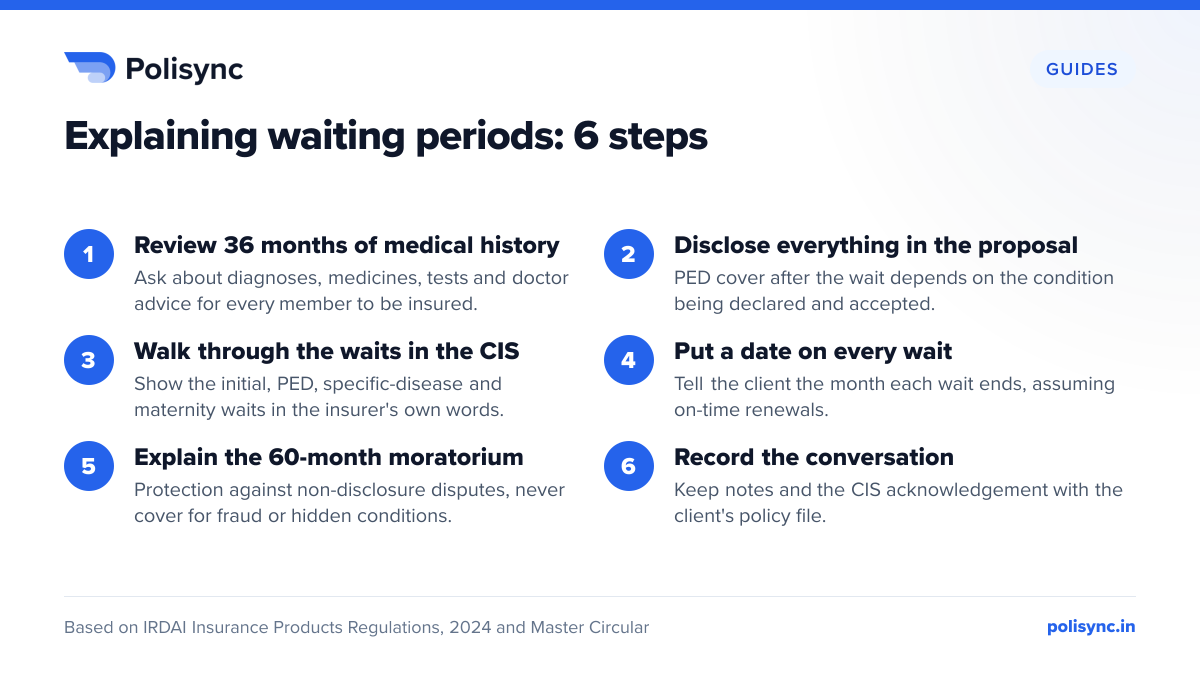
Two framing tips help. Separate "covered from day one" (accidents) from "covered later" (illness, PEDs, listed procedures). And explain that a claim rejected during a waiting period does not mean a bad insurer, which is also why the claim settlement ratio alone never tells the full story.
What this means for insurance agents
The 2024 caps make health insurance an easier conversation for people with chronic conditions, since the longest PED wait is now three years rather than four. That widens the market for health insurance cross-selling to your existing life and motor clients, especially those already managing a condition.
A practical checklist for every health proposal:
- 1. Collect the history. Note every condition diagnosed, treated or advised in the last 36 months for each member.
- 2. Compare waits, not just premiums. Line up initial, PED, specific-disease and maternity waits across two or three products.
- 3. Check portability first. If the client already has cover, port or migrate it instead of starting a new policy.
- 4. Explain the moratorium honestly. Five years of continuous cover protects against non-disclosure disputes, not fraud.
- 5. Flag sum insured increases. Any enhancement starts fresh waits and a fresh moratorium clock on the extra amount.
- 6. Diary the dates. Record when each wait and the moratorium end, and never let a renewal lapse. Agency software such as Polisync can help keep these records organised.
- 7. Get the CIS acknowledged. Keep the signed or digital acknowledgement with your client file.