

A trail commission is agent pay that arrives in later policy years, and only while the policy stays in force. IRDAI's consultation paper of 23 September 2026 does not use the word "trail". Instead it proposes lower first-year caps (up to 25% for agents on life policies) and renewal commission that steps up from 5% to a maximum of 7%. Comments close on 25 October 2026.
This guide explains the three kinds of commission, what the paper actually says about later-year pay, how commission rules got here, and what a renewal-heavy structure does to an agent's income, using clearly hypothetical models. Everything below is written as of 28 September 2026. Nothing in the paper is final law yet.
What are upfront, renewal and trail commissions?
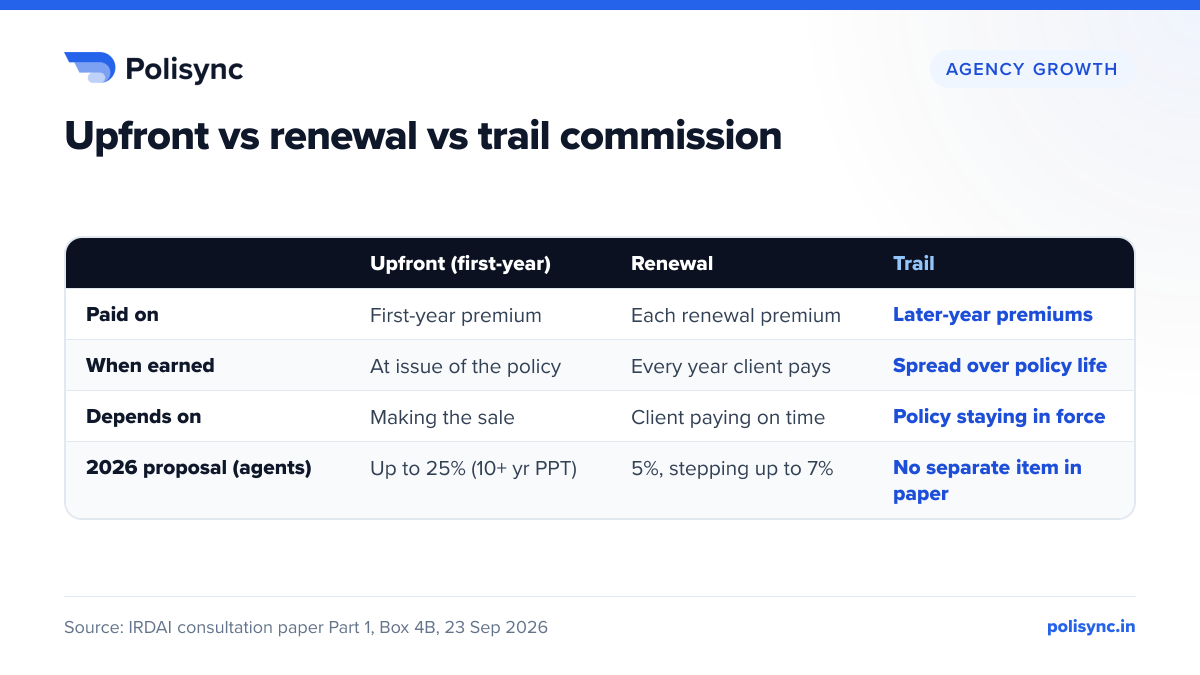
Life insurance commission in India is a percentage of the premium the client pays. What changes is when the agent earns it. Three terms matter.
- Upfront or first-year commission: a percentage of the first year's premium, earned when the policy is issued and the first premium is paid. It has historically been the largest single payout.
- Renewal commission: a smaller percentage of each renewal premium, earned every year the client pays again during the premium-paying term (PPT).
- Trail commission: an informal term for pay spread over the later years of a policy instead of being paid upfront. It is best known from mutual funds, where distributors earn a small ongoing amount while the investor stays invested.
In Indian life insurance, "trail" is mostly used as a loose synonym for renewal commission. For example, when IRDAI revised commission rules in 2016, Cafemutual described the 7.5% renewal commission on traditional plans as trail commission. The common thread is simple: this income exists only while the client keeps the policy alive.
What has IRDAI proposed on life insurance commission?
The paper is titled Recalibrating Economics of Insurance Distribution. IRDAI's press release of 23 September 2026 says commission limits would reflect segment, line of business, channel, product complexity and selling effort, and sets 25 October 2026 as the last date for comments. Part 1 and Part 2 of the paper are on IRDAI's website, and the consultation portal hosted by the Insurance Information Bureau takes feedback.
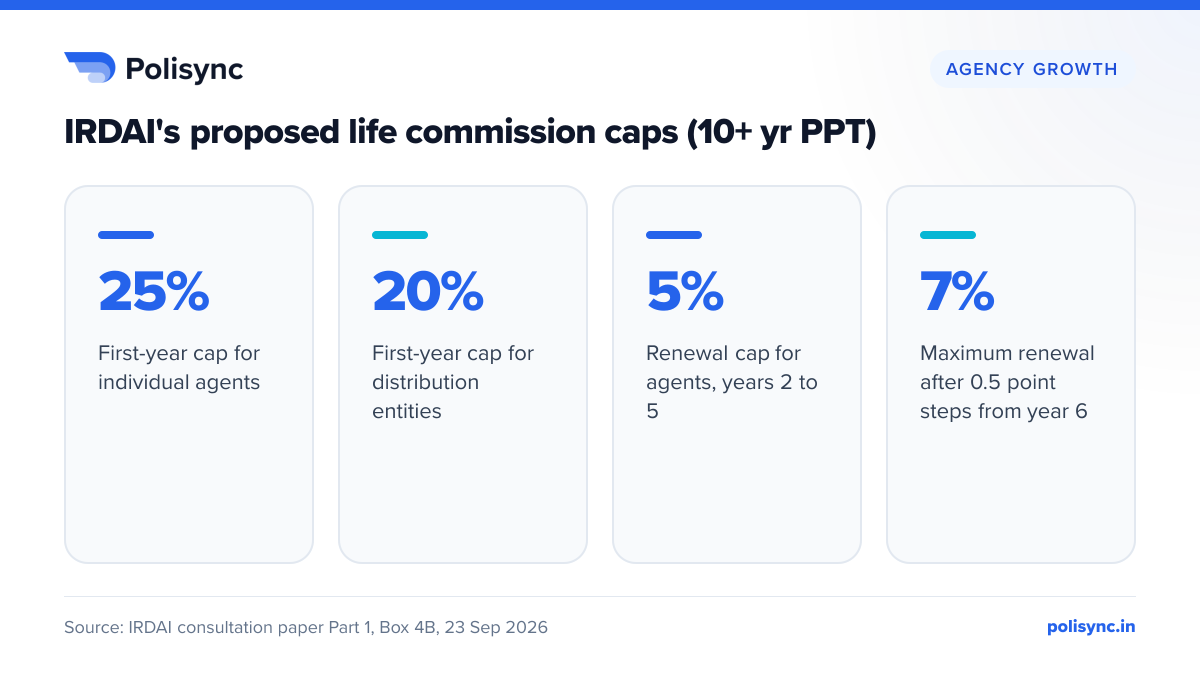
Life insurance caps sit in Box 4B of Part 1, Section 8. For each product, the box sets two numbers for distribution entities (brokers, corporate agents, banks and similar) and two for individual agents: a first-year cap and a renewal cap. Agents get higher first-year caps than entities at every PPT band, because they represent only one life insurer.
First-year caps by premium-paying term
For individual non-linked (par or non-par) and linked policies, the first-year cap rises with the PPT. Upstox's breakdown reports the same figures as the paper:
- PPT below 5 years: 6.25% for agents, 5% for entities (only non-par non-linked products allowed)
- PPT of 5 years: 12.5% for agents, 10% for entities
- PPT of 6 to 8 years: 17.5% for agents, 14% for entities
- PPT of 9 years: 22.5% for agents, 18% for entities
- PPT of 10 years and above: 25% for agents, 20% for entities
- Individual pure term, multi-year premium: 30% for agents, 25% for entities
- Individual pure term, single premium: 10% for agents, 7.5% for entities
The paper also proposes that the policy term cannot be less than 10 years or the PPT, whichever is higher.
Does IRDAI's paper propose a separate trail commission?
No. The word "trail" does not appear in the commission sections of Part 1 or in the press release. Some summaries describe the later-year pay as trail commission, but the paper's only mechanism is renewal commission, with a built-in step-up for long-running policies. There is no third payout stream on top of first-year and renewal commission.
The intent is still trail-like. Principle 9 of Section 8 says life commission should nudge distributors to keep policyholders on multi-year payment plans instead of incentivising the first-year payment. The reform objectives table lists "larger renewal commission" for products with longer payment terms and persistency.
How does the renewal step-up work?
For individual savings and ULIP policies, Box 4B proposes:
- Base renewal cap: 5% of the renewal premium for agents at every PPT band. For entities, 2% where the PPT is 5 years or less and 3% where it is 6 years or more.
- Step-up: from the beginning of the sixth policy year, the renewal cap rises by 0.5% of premium once every three years, subject to a maximum of 7%. The footnote carries this for both agents and entities.
- Paper's own example: 5.5% for the 6th, 7th and 8th policy renewals and 6% for the 9th, 10th and 11th. Continuing the pattern, an agent would reach 6.5% around years 12 to 14 and 7% from about year 15.
- Pure term plans: multi-year term carries a flat renewal cap of 10% for agents and 7.5% for entities, and the step-up footnote is not attached to it.
Two practical points follow. First, renewal commission is paid only within the PPT, so the 7% ceiling matters only for policies with a PPT of roughly 15 years or more. Second, the footnote mixes "policy year" and "policy renewal", so whether the first step lands in year 6 or year 7 may need clarifying in the final rules. For context, Part 2 of the paper found that insurers' average renewal commission currently ranges from 0% to 5%, with maximums of 2% to 8%.
When would commission be paid, and when can it be clawed back?
Three more proposals in Part 1 affect cash flow:
- Payment timing (paragraph 130): distributors must receive commission no later than the day after the free-look period ends, counted from the insurer's receipt of premium. Insurers should strive to pay within 7 days of receiving premium, and any delay should attract interest.
- Claw-back: insurers can recover excess commission where policies are cancelled, and mis-selling incidents should lead to commission claw-back (paragraph 140). The seller of each policy would also be tagged by identity, as explained in our post on IRDAI salesperson tagging on every policy.
- Rural and small-town add-on: for individual policies, business from towns and cities below 10 lakh population could earn an extra 10% of the applicable first-year limit, and towns below 50,000 and all rural areas an extra 20%. A 25% cap would become 27.5% or 30%. The add-on applies to the first-year premium only.
What does the paper leave unspecified?
The paper does not set a persistency threshold an agent must hit to earn renewal commission, a commencement date for the caps, or transition rules for renewals on policies already sold. Treat these as not yet specified until IRDAI notifies final regulations. For the wider paper, including health, motor and EoM limits, see our explainer on the IRDAI commission consultation paper.
How did agent commissions work before this proposal?
India has swung between fixed caps and insurer freedom:
- Fixed caps (up to March 2023): In December 2016, Cafemutual reported that IRDAI raised first-year commission on term plans to 40% of annual premium with 10% on renewals, while traditional plans carried first-year caps of 15% to 33% for PPTs under 12 years, 35% for longer terms, and 7.5% renewal commission throughout the PPT.
- Caps removed (from 1 April 2023): IRDAI did away with the cap on commission for agents and brokers. Insurers instead set commission through a board-approved policy, paid out of their overall expenses of management (EoM) limit.
- Unified rules (from 1 April 2024): The IRDAI (Expenses of Management, including Commission, of Insurers) Regulations, 2024, notified on 24 January 2024, merged the 2023 commission and EoM regulations into one framework.
Expenses of management (EoM) is the total an insurer may spend on running and distributing its business, expressed as a share of premium. Under the EoM regime, commission was limited only indirectly, which is why the 2026 paper proposes bringing back product-level caps.
Why does IRDAI want to move pay from year one to later years?
Distribution costs grew much faster than business. Part 2 of the paper, as Business Today reported, found that between FY23 and FY25, total remuneration to sampled life corporate agents rose about 125% while their new business premium grew about 28%. First-year commission on pure term insurance averaged 51%, with a maximum of 81%.
Front-loaded pay has not bought loyalty. Part 1 notes that 61st month persistency in life insurance is only 48%, meaning more than half of policyholders stop paying before five years despite heavily front-loaded remuneration. Lower first-year caps, a renewal cap that steps up from year six and claw-backs for mis-selling all push towards selling the right policy and keeping it in force.
How would a renewal-heavy structure change an agent's income?
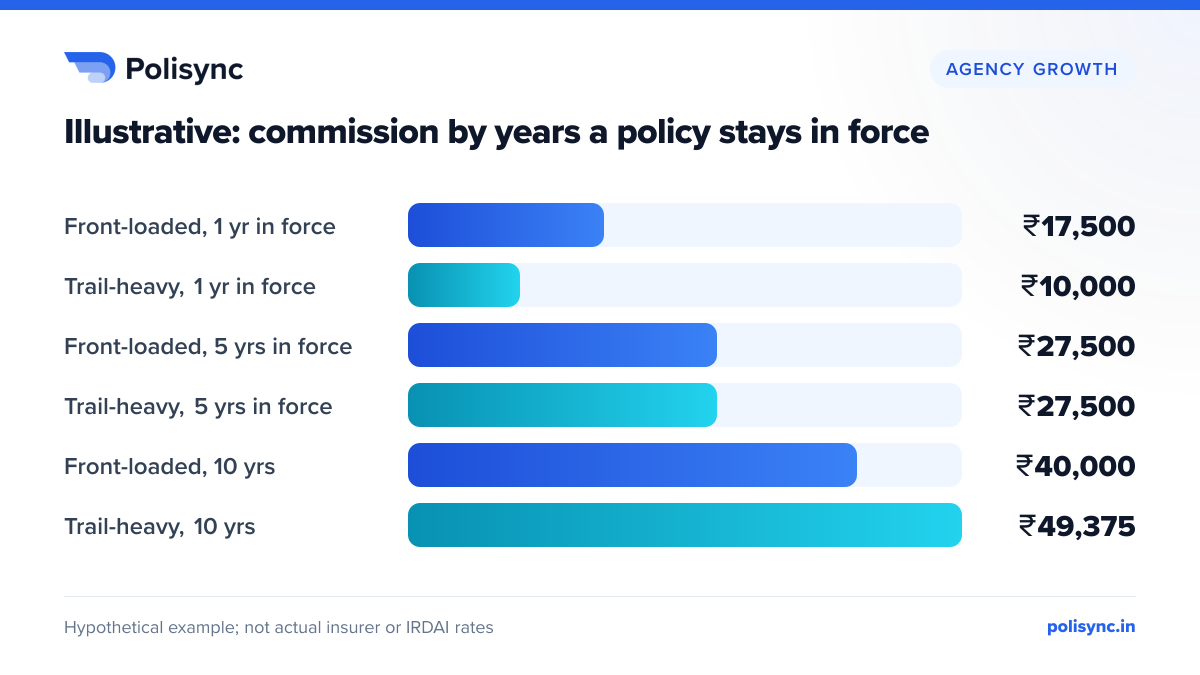
The model below is illustrative and hypothetical. The percentages show the mechanics only; the trail-heavy renewal rate is deliberately above the proposed caps, and neither structure is an insurer's actual rate. Assume one client pays an annual premium of ₹50,000 on a life policy with a 10-year PPT.
Two hypothetical structures with the same five-year total if the policy stays in force:
- Front-loaded: 35% in year 1 (₹17,500), then 5% a year in years 2 to 5 (₹2,500 each). Five-year total: ₹27,500.
- Trail-heavy: 20% in year 1 (₹10,000), then 8.75% a year in years 2 to 5 (₹4,375 each). Five-year total: ₹27,500.
The year-one dip is the first shock: ₹7,500 less, about 43% lower, on the same sale. The second lesson is that persistency decides everything. If the client stops after one year, the agent keeps ₹10,000 instead of ₹17,500. If the client pays for all 10 years at the same renewal rates, trail-heavy pays ₹49,375 against ₹40,000 for front-loaded.
Applying the proposed caps to the same example
Now use the proposed maximums for an agent on a 10-year-PPT policy, again with a hypothetical ₹50,000 premium. Year 1 at 25% pays ₹12,500. Years 2 to 5 at 5% pay ₹2,500 each, a five-year total of ₹22,500. Following the paper's example, years 6 to 8 at 5.5% add ₹2,750 each and years 9 and 10 at 6% add ₹3,000 each, a 10-year total of ₹36,750.
If final rules start the step-up one year later, the 10-year total would be ₹36,250. For a rural sale, the 20% add-on would lift year one to 30%, or ₹15,000. Insurers can always pay below a cap. Test your own assumptions with the free insurance commission calculator.
Your renewal book becomes the asset
Renewals stack across years. Hypothetically, an agent who writes 20 policies a year at ₹50,000 each, paid at the proposed 5% renewal cap, would in year 5 earn renewal commission on 80 earlier policies: ₹2,00,000 if all 80 stay in force, but ₹1,50,000 if only 60 do. Each lapse removes income for every remaining year of the PPT.
What this means for insurance agents
- Year-one income gets thinner. If final rules resemble the proposal, first-year commission would be capped at 25% on long-PPT savings plans and 30% on multi-year term plans, well below the 51% term average in IRDAI's data.
- Retention becomes income, not just service. A renewal cap that steps up from year six rewards agents whose clients keep paying.
- Individual agents keep an edge. First-year caps for agents are higher than for entities at every PPT band, and agent renewal caps are 5% against 2% to 3% for entities.
- Mis-selling becomes more expensive. Claw-backs and seller tagging make a poorly matched sale a financial liability, not just a complaint risk.
What should agents do now?
A practical checklist while the proposal is under consultation:
- 1. Read Box 4B in Part 1 of the paper and, if you have a view, submit comments on the IIB portal before 25 October 2026, directly or through your insurer or association.
- 2. Split your last 12 months of income into first-year and renewal commission so you know how exposed you are to a lower upfront cap. Our commission tracking guide shows how.
- 3. List every policy with a renewal due in the next 90 days and contact clients early, using the steps in our guide to reducing policy lapse rates.
- 4. Book an annual review with every long-term client. The annual policy review meeting checklist covers what to discuss.
- 5. Work on recently lapsed policies still within their revival window, following our guide on how to revive a lapsed life insurance policy.
- 6. Build a cash buffer of a few months' expenses, since a renewal-heavy model delays income even when lifetime earnings hold up.
- 7. Keep policy-level records of premium dates, commission received and commission expected, so you can spot late payouts once final timing rules apply.
Organised records matter more when income depends on hundreds of small renewal payments. Agency management software such as Polisync can help keep policies, renewal dates and commission records in one place instead of scattered spreadsheets.
How should agents explain this to clients?
Clients may read headlines about commission cuts and ask whether their policy is affected. Keep it factual: the proposal is about how distributors are paid, it is still a consultation, and it does not change the benefits of a policy they already hold. The paper does not set transition rules for existing policies, so avoid promising either way.
The stronger message is about service. When more of an agent's income depends on renewals, the agent has every reason to stay in touch, help with claims and review cover for years. That fits the habits in our guide to customer retention strategies for insurance agents.
