

In India, an individual insurance agent cannot appoint or pay sub-agents. Under Section 42 of the Insurance Act, 1938 only an insurer appoints agents, and Section 40 allows commission only to insurance agents and intermediaries, in the manner IRDAI regulations specify. Section 42A has barred principal agents since 2015. As of 9 September 2026, you build a team through insurer appointments or an IMF, corporate agency or broker.
This guide explains the legal reality first, then gives a practical playbook: who to recruit, how to get them licensed, what the first 90 days should look like, which KPIs to watch and how to pay and keep good people without breaking the rules.
Can an insurance agent appoint sub-agents in India?
No. Under Section 42 of the Insurance Act and the IRDAI (Appointment of Insurance Agents) Regulations, 2016, an insurance agent is an individual appointed by an insurer to solicit or procure insurance business. The appointment letter, the agency code and the identity card all come from the insurer's designated official, not from another agent.
Section 40 of the Insurance Act then closes the money route: no person may pay commission or any other reward for soliciting or procuring insurance business to anyone except an insurance agent or an insurance intermediary, and then only in the manner IRDAI regulations specify. An agent or intermediary who breaches Section 40 faces a penalty of up to ₹1 lakh. Section 41 separately bans rebating commission or premium to a client, with a penalty of up to ₹10 lakh.
Section 42A, inserted by the Insurance Laws (Amendment) Act, 2015, bars insurers from appointing any Principal Agent, Chief Agent or Special Agent and prohibits selling insurance through a multilevel marketing scheme. The 2016 agents' code of conduct repeats this: no soliciting without an appointment and no multilevel marketing. Under Section 42(4), a person acting as an agent in breach of the Act faces a penalty of up to ₹10,000, while an insurer that transacts business through such a person can be fined up to ₹1 crore.
Common "sub-agent" arrangements that cross the line:
- Paying a relative, friend or office assistant a per-policy cut for bringing in clients.
- Letting an unlicensed helper pitch products and fill proposals under your agency code.
- Running a recruit-the-recruiter chain where you earn on your downline's sales, which is multilevel marketing.
- Passing part of your commission back to the client as a discount, which is rebating under Section 41.
What changed for team builders in 2025 and 2026?
The Sabka Bima Sabki Raksha (Amendment of Insurance Laws) Act, 2025 (Act No. 40 of 2025, assent 20 December 2025, in force from 5 February 2026) changed the rules for anyone thinking of moving from agent to intermediary. It inserted Section 42D(4A), so that an intermediary's registration stays in force, subject to an annual fee, until IRDAI suspends or cancels it. It also inserted Section 40(2A), which lets IRDAI set limits, payment methods and disclosure rules for commission paid to agents and intermediaries. It did not change the Section 40 and 42 rules above.
The same Act added Section 105BA. Acting as an insurance intermediary without registration now attracts a penalty of ₹1 lakh to ₹10 lakh, and anyone who appoints or transacts business through an unregistered intermediary faces ₹10 lakh to ₹1 crore. Informal "agencies" that collect business from unlicensed people are squarely in this zone.
IRDAI then notified the IRDAI (Insurance Intermediaries) (Amendment) Regulations, 2026 on 30 July 2026. For corporate agents, brokers and Insurance Marketing Firms, the key changes are:
- Continuous registration: no more three-year renewals; an annual fee of the higher of ₹10,000 or one twenty-fifth of one per cent (0.04%) of the previous year's commission and other receipts, plus taxes.
- Fresh certificates: existing three-year registrants must apply before 31 January 2027, or by 31 March 2027 with reasons and an extra ₹750.
- Training: Principal Officers, corporate agents' Specified Persons and IMF Insurance Sales Persons must complete at least 25 hours of training every three years.
- Salesperson tagging: from 1 January 2027, the proposal, policy and certificate must carry the name and functional identity of the person who sold the policy.
Law firm Trilegal's 3 September 2026 note reads these changes as a move from periodic renewals to continuous supervision. Cafemutual's report on the press release said every policy would carry details of agents, intermediaries or insurers' sales executives, but the notified text is narrower. It amends only the corporate agent, broker, IMF, web aggregator and CSC regulations, not the 2016 agents' regulations, so tagging applies to intermediary salespeople, not tied agents.
What are the legal ways to build an insurance sales team?
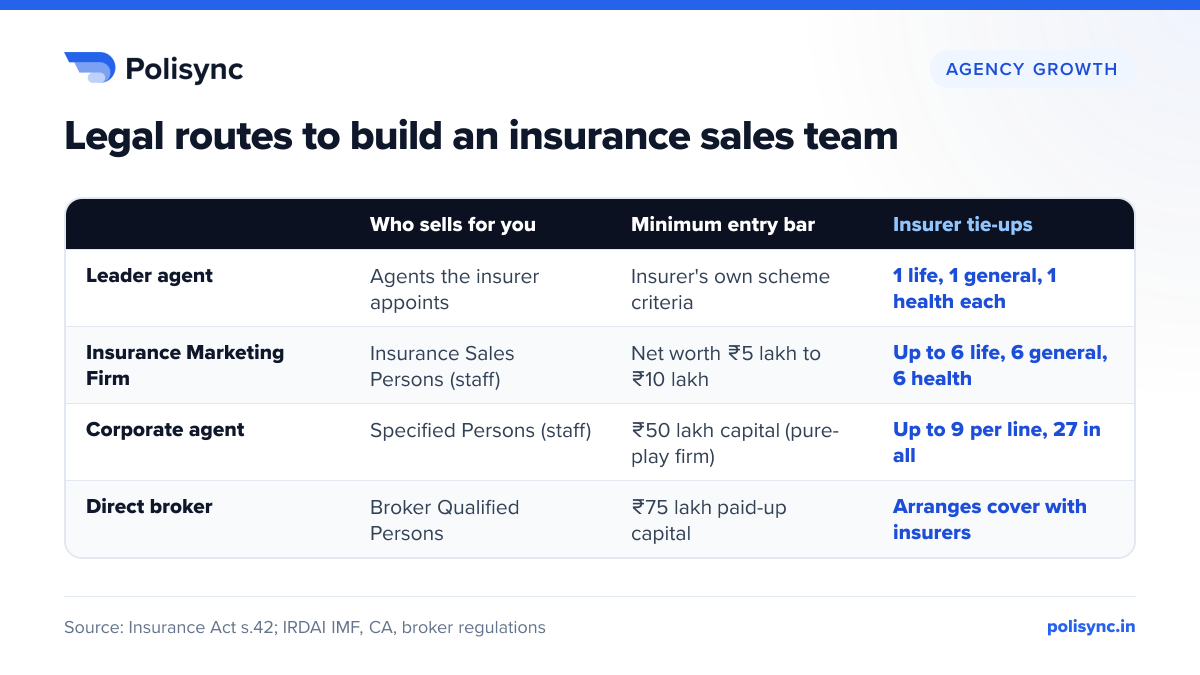
There are four practical routes. They differ in who appoints your team members, how much capital you need and how many insurers you can work with.
1. Grow as a leader agent through your insurer
You stay an individual agent, scout and mentor candidates, and the insurer appoints each one with their own agency code. Any reward you earn for building the team must come from your insurer under its own approved scheme; the 2016 regulations require each insurer to file a board-approved agency policy covering remuneration, incentive commission and benefits. Insurers also run their own recruitment programmes, such as LIC's Bima Sakhi stipend scheme for women aged 18 to 70. Ask your branch for the current terms of any leader or mentor scheme.
2. Register an Insurance Marketing Firm (IMF)
An IMF is an IRDAI-registered entity that employs Insurance Sales Persons (ISPs) to sell insurance. Under the IMF Regulations, 2015, it needs a net worth of ₹10 lakh, or ₹5 lakh if it opts for a single aspirational district. Under the Insurance Intermediaries (Amendment) Regulations, 2022, notified on 5 December 2022, an IMF can operate in all districts of the state it is registered for and work with up to six life, six general and six health insurers at a time.
3. Set up a corporate agency
A corporate agent sells through Specified Persons, who are its employees. Under the Corporate Agents Regulations, 2015, a company doing only insurance distribution needs ₹50 lakh of equity capital and net worth, and Specified Persons must have passed at least Class 12. The 2022 amendment lets a corporate agent tie up with up to nine insurers per line, and a composite corporate agent with up to 27 in all. The 2026 amendment requires every Specified Person to hold a valid Letter of Enrolment issued by IRDAI.
4. Become an insurance broker
A direct broker arranges insurance for its clients with insurers. The Insurance Brokers Regulations, 2018 set a minimum paid-up capital of ₹75 lakh for a direct broker, and sales are made by Broker Qualified Persons, who are trained and examined employees or directors. Brokers, corporate agents, IMFs and web aggregators can also sell through Point of Sales Persons (POSPs), who must be tagged on policies like any other salesperson under the 2026 rules. See our POSP vs agent vs broker comparison for how those roles differ.
Which route should you choose?
A simple way to decide:
- Leader agent if you want to stay with one life, one general and one health insurer and build gradually without registering an entity.
- IMF if you want a multi-insurer retail business across one state with a modest capital base.
- Corporate agency if you already run a company with a large customer base, such as a dealership or finance firm.
- Broking if you want to advise commercial and retail clients across insurers and can fund the capital and compliance team.
Whichever route you pick, our guide to growing an insurance agency covers the business-side questions of positioning, lead flow and hiring order.
How do you recruit the right people?
Recruit for trust and persistence first, product knowledge second, because knowledge can be trained. Good profiles include people with existing community networks, such as retired bank or government staff, homemakers returning to work, young graduates from your locality and tax or accounting professionals.
Before you put anyone forward, check the basics:
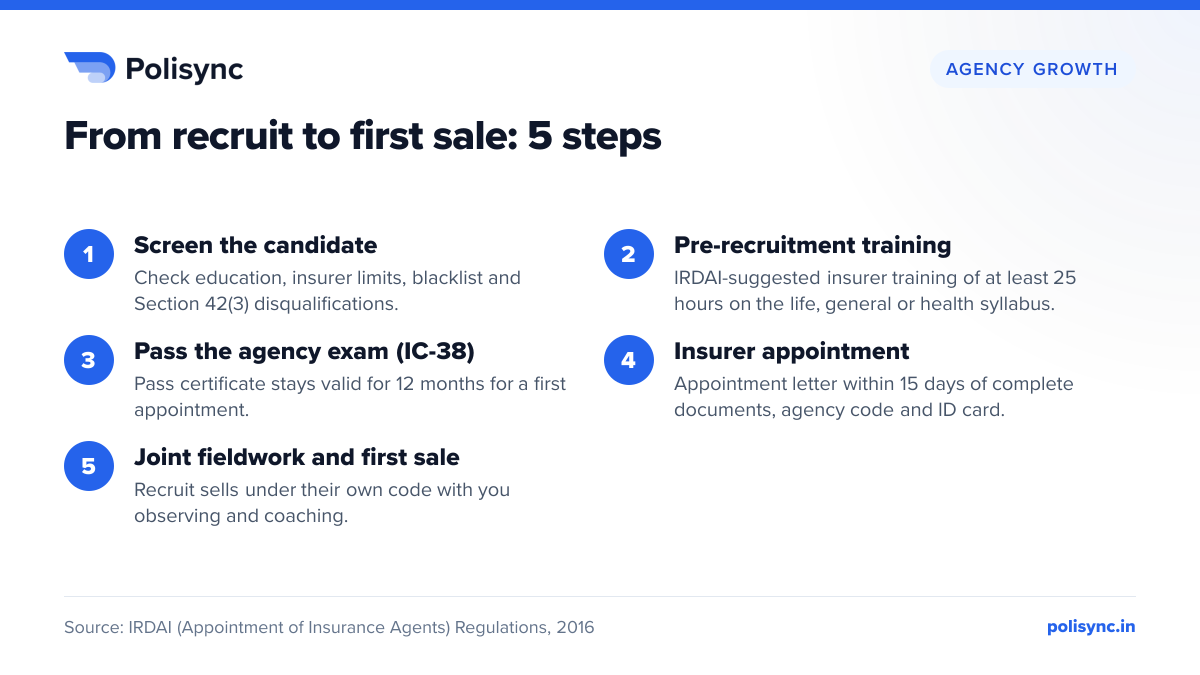
- Education: IRDAI suggests insurers set at least Class 10 in their board-approved agency policy; corporate agents need Class 12 for Specified Persons.
- No disqualification: the insurer's designated official checks Section 42(3) disqualifications, the centralised list of agents and the blacklist.
- Insurer limits: a candidate cannot already hold an appointment with another life, general or health insurer of the same type.
- Cooling-off rule: anyone whose agency was cancelled by an insurer cannot reapply for five years.
Point candidates to our guide on how to become an insurance agent in India so they understand the process before the first interview.
How does a recruit go from licensing to the first sale?
Under the 2016 regulations, IRDAI suggests that insurers provide pre-recruitment training of not less than 25 hours, after which the candidate sits the Insurance Agency Examination run by an IRDAI-recognised examination body. The Insurance Institute of India refers to this as the IC-38 examination. The pass certificate is valid for 12 months for a first appointment.
Once all documents are in, the designated official should issue the appointment letter within 15 days, allot an agency code and give the agent an identity card. Your job is to make sure no recruit pitches a client before that card is in hand.
What should a new recruit's first 90 days look like?
Most recruits who quit do so before they feel competent. A structured first quarter, with you in the room for early meetings, shortens that gap. The plan below is illustrative; adapt it to your insurer's own induction.
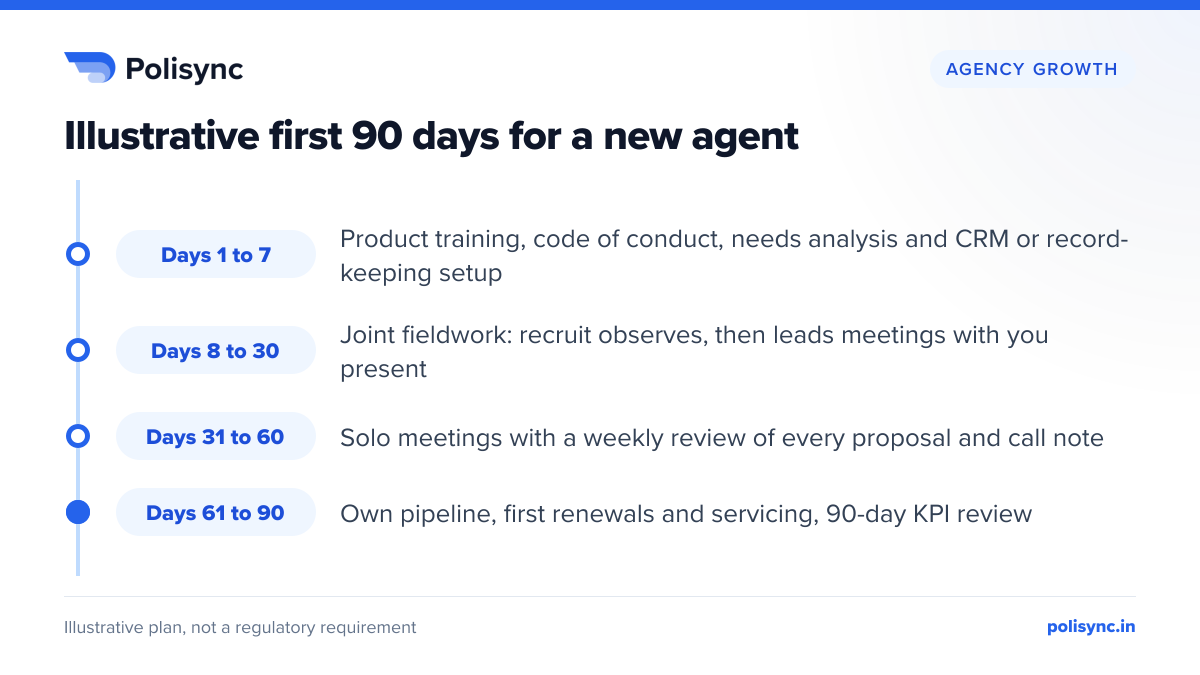
Make joint fieldwork count:
- Plan each joint call in advance and agree who leads which part.
- Debrief within 24 hours: what the client needed, what was missed, what to say next time.
- Role-play objections weekly, using real conversations from the field.
- Block fixed prospecting hours in the recruit's diary; our time management guide has a template.
Which team KPIs should you track?
Track a small set of numbers per person, every month, and review them one-to-one. Our post on insurance agent KPIs to track explains how to calculate each one.
- Activity: meetings booked and held per week.
- Conversion: proposals per meeting and policies issued per proposal.
- Persistency: share of policies still in force at renewal, the best early signal of good selling.
- Quality: complaints, free-look cancellations and proposals returned for missing information.
- Servicing: renewals collected on time and claims assisted.
For your strongest performers, a clear stretch goal helps. Our MDRT qualification guide shows how to set one.
How do you pay and retain team members legally?
Money must flow through legitimate channels. In the leader-agent model, each recruit's commission is paid by the insurer to the recruit, and any team-building reward reaches you only through the insurer's approved scheme. In an IMF, corporate agency or broking firm, the firm receives commission and pays its employees salary and incentives.
Never pay unlicensed staff a per-policy reward for bringing in business; Section 40 prohibits it. You can pay an office assistant a salary for admin work such as data entry or document collection, provided they do not solicit.
Retention levers that work within the rules:
- A visible career path, from agent to mentor to team leader or ISP to Principal Officer.
- Recognition tied to quality metrics such as persistency, not just first-year premium.
- Fast, fair support on policy servicing so recruits are not left alone with angry clients.
- Earning loyalty rather than blocking exits: under the 2026 rules a corporate agent's silence on a Specified Person's request to switch counts as no objection after 30 days.
How do you keep the team compliant?
Under Section 42(5) of the Act, the insurer is responsible for its agents' acts and omissions, and from 2027 every intermediary sale made through a salesperson will be tagged to a named person. Mis-selling by one recruit therefore damages the whole team's standing with insurers.
Build these checks into your routine:
- Code of conduct: recruits must identify themselves and their insurer, explain the proposal form, disclose commission scales if asked and recommend products that fit the client's needs.
- No shortcuts on disclosure: never let a recruit coach a client to omit health or income facts. See how to avoid mis-selling.
- Client data: the DPDP Act's main duties on notice, consent and security come into force in May 2027, 18 months after the commencement notification of 13 November 2025. Treat them as good practice now: limit who in the team sees each client's documents and keep consent records.
- Records: keep each recruit's policies, renewals and complaints in one shared system, not personal phones. Agency software such as Polisync can help keep these records organised.
What this means for insurance agents: an action checklist
Work through these in order:
- Stop any informal commission-sharing or per-policy payments to unlicensed helpers today.
- Decide your route: leader agent, IMF, corporate agency or broker, based on capital and ambition.
- If you choose an intermediary route, budget for the net worth or capital, the ₹10,000 application fee and the annual fee plus taxes, and plan for the 25-hour training cycle.
- Write a one-page recruitment profile and screening checklist.
- Agree the pre-recruitment training and IC-38 exam schedule with your insurer or examination body.
- Run the 90-day onboarding plan with weekly joint fieldwork and a fixed KPI review.
- Prepare for salesperson tagging from 1 January 2027 by recording who sold every policy.