

Health insurance pays your hospital bills; critical illness insurance pays you. A health policy settles actual treatment costs. A critical illness (CI) policy pays a fixed lump sum once a listed illness, such as cancer or a first heart attack, is diagnosed and the insured survives a set period, often 30 days. As of 28 August 2026, CI cover complements a health policy; it does not replace one.
This guide explains both products as an agent should explain them across the table: what each pays for, how a CI claim works, where IRDAI's rules sit after the 2024 overhaul, how tax works under the Income-tax Act, 2025, and how to size CI cover without overselling.
What is the difference between health insurance and critical illness insurance?
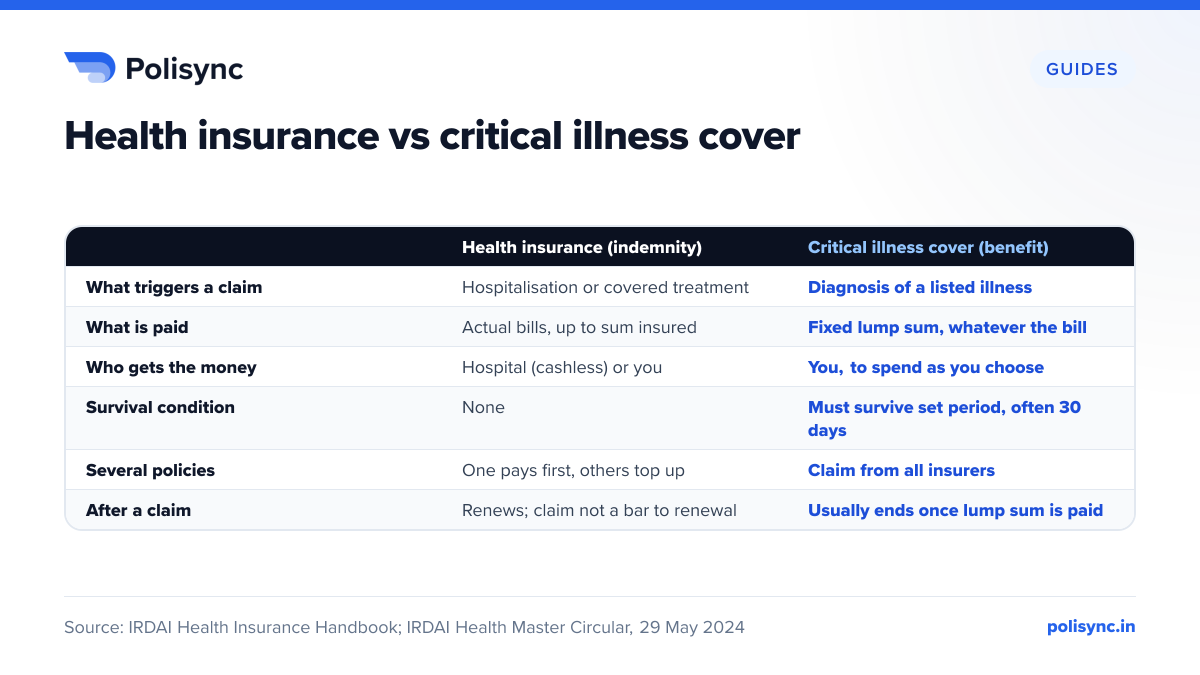
IRDAI's own Handbook on Health Insurance describes the split neatly. A hospitalisation policy covers, fully or partly, the actual cost of treatment for hospital admissions. A critical illness benefit policy instead provides a fixed lump sum on diagnosis of a specified illness or on undergoing a specified procedure, and once that lump sum is paid the plan usually ceases.
Indemnity means the insurer restores the financial loss you actually suffered, no more. Fixed benefit (or benefit-based) means the insurer pays an agreed amount when a defined event happens, whatever the bill. That one difference drives everything else: how claims are filed, whether you can claim from two insurers, and what the money can be used for.
How does an indemnity health insurance policy pay?
A health policy pays for treatment. Under the IRDAI Master Circular on Health Insurance Business dated 29 May 2024, insurers must decide cashless authorisation requests within one hour and grant final discharge authorisation within three hours of the hospital's request. The circular asks insurers to strive for 100% cashless settlement; where cashless is not available, such as at a non-network hospital, the client pays first and claims reimbursement.
Because it is indemnity cover, the payout can never exceed the loss. If a client holds two indemnity policies, the same circular lets the client choose which policy to claim under first; that insurer becomes the primary insurer and coordinates with the others for any balance. Insurers also cannot deny renewal because a claim was made in earlier years.
The limitation is just as clear: a health policy only pays medical bills that fall within its terms. It does not replace the salary a patient loses during months of chemotherapy, the EMI that falls due, or the cost of a family member taking unpaid leave. That is the gap CI cover is built for. For layering higher medical limits instead, see our guide on super top-up vs top-up health insurance.
How does critical illness insurance work?
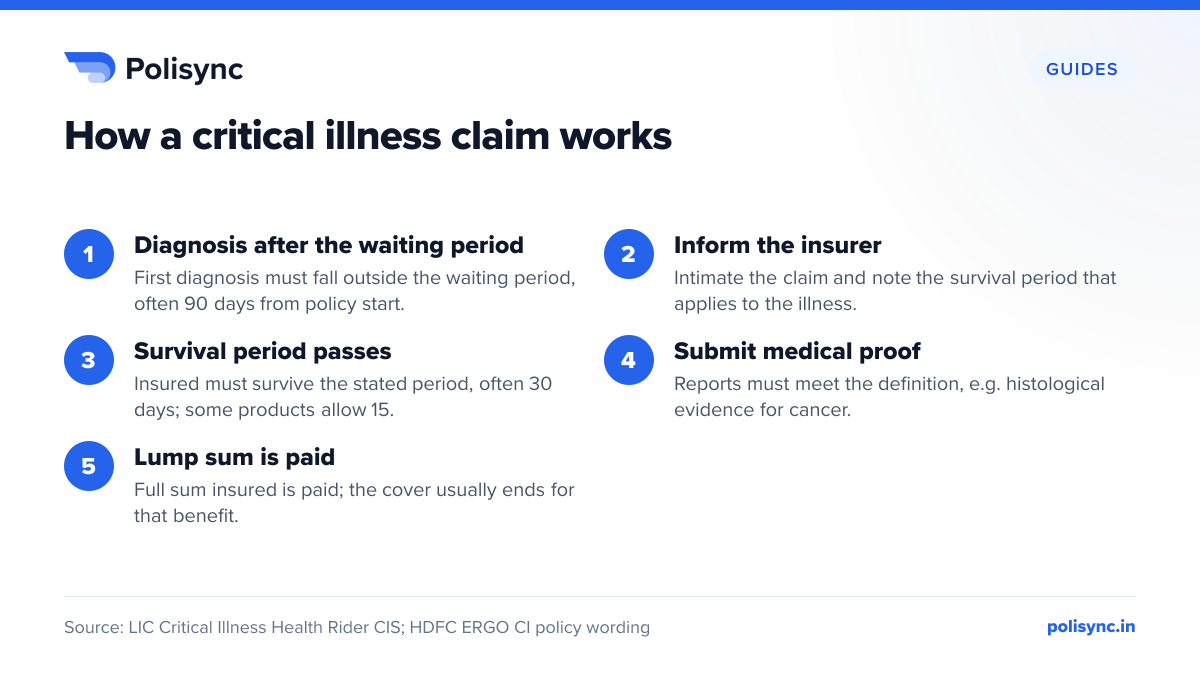
A CI policy pays its full sum insured as a lump sum when the insured person is diagnosed with one of the covered illnesses and meets the policy definition. HDFC ERGO's Critical Illness Insurance policy wording, for example, pays the sum insured as a lump sum if the illness occurs for the first time during the policy period and the insured survives for at least 30 or 15 days, as opted, after diagnosis.
The money is not linked to the hospital bill. The family can use it for treatment not covered elsewhere, travel to a specialist centre, home nursing, loan EMIs or simply to replace lost income. Under the 2024 health master circular, policyholders with benefit-based policies can claim from all insurers under all policies when the insured event occurs.
What is the survival period and waiting period in critical illness cover?
- Waiting period: a period at the start of the policy during which a diagnosis does not qualify. LIC's Critical Illness Health Rider (UIN 512B227V01) applies a 90-day waiting period from the start or revival of risk, whichever is later; a diagnosis, or signs or symptoms, within that window means no benefit and the rider ends, although the wait does not apply to conditions arising directly from an accident, according to its Customer Information Sheet.
- Survival period: the number of days the insured must live after diagnosis before the benefit is payable. The same LIC rider uses 30 days unless a specific illness definition sets a different period; if death occurs within it, no CI benefit is payable.
- Product-specific: HDFC ERGO's CI policy lets the buyer opt for a 30-day or 15-day survival period. Always read the survival and waiting clauses of the exact product before quoting them to a client.
Health policies have their own waiting periods for pre-existing and specified diseases, which work differently. Our explainer on health insurance waiting periods covers those in detail.
How does a critical illness claim work?
A CI claim needs less paperwork about bills but stricter medical proof. The insurer checks two things: does the diagnosis meet the policy definition, and has the survival period passed?
What illnesses are covered, and are the definitions standard?
IRDAI's Master Circular on Standardization of Health Insurance Products of 22 July 2020 (IRDAI/HLT/REG/CIR/193/07/2020) prescribed standard nomenclature for 22 critical illnesses and required insurers to use those definitions without exception wherever a product covered them. IRDAI modified three of those definitions on 27 May 2022 (IRDAI/HLT/REG/CIR/104/5/2022): cancer of specified severity, multiple sclerosis with persisting symptoms, and loss of speech.
The 22 standard critical illnesses in the 2020 list:
- Cancer of specified severity, myocardial infarction (first heart attack of specific severity), open chest CABG, open heart replacement or repair of heart valves
- Coma of specified severity, kidney failure requiring regular dialysis, stroke resulting in permanent symptoms, major organ or bone marrow transplant
- Permanent paralysis of limbs, motor neuron disease with permanent symptoms, multiple sclerosis with persisting symptoms, angioplasty, benign brain tumour
- Blindness, deafness, end stage lung failure, end stage liver failure, loss of speech, loss of limbs, major head trauma, primary (idiopathic) pulmonary hypertension, third degree burns
Where the rules stand now: Annexure 6 of the 2024 health master circular annexures lists 55 older health circulars, and the circular itself states that it supersedes all of them. They include the 2020 standardisation master circular (item 1), its 28 August 2020 corrigendum (item 3) and the 27 May 2022 modification of CI definitions (item 33). In practice, current product documents still use the standard wording. LIC's Critical Illness Health Rider, for instance, follows the 2022 cancer definition word for word: it excludes prostate tumours with a Gleason score of 6 or less (unless at least T2N0M0) and thyroid cancers classified T1N0M0 or below, and it drops the 2020 exclusion of all tumours in the presence of HIV infection.
The number of illnesses varies widely by product. The LIC rider offers a choice of 15 or 40 major critical illnesses, the latter with an assisted living benefit of 1% of the CI sum assured each month for 36 months for seven specified conditions. A longer list is not automatically better; what matters is whether the common claims (cancer, heart attack, stroke, kidney failure) are defined fairly.
What do the definitions exclude?
Definitions decide claims. Under the standard cancer definition, the diagnosis must be supported by histological evidence of malignancy, and tumours described as carcinoma in situ, benign, pre-malignant or non-invasive are excluded, as are non-melanoma skin cancers unless they have spread to lymph nodes or beyond. The heart attack definition excludes other acute coronary syndromes and any type of angina. Clients should hear this before they buy, not at claim time.
Standalone critical illness policy or rider: which is better?
CI cover is sold in two forms: as a standalone policy from a general or health insurer, or as a rider added to a life or health policy. Life insurers' riders are governed by the IRDAI Master Circular on Life Insurance Products of 12 June 2024, which names the critical illness rider among the rider types insurers may file under its Use and File procedure.
Key rider limits under that circular:
- Clause 7.17.2: the premium for health-related or critical illness riders must not exceed 100% of the base product premium (other life riders together are capped at 30%).
- Clause 7.17.3: the benefit under each rider must not exceed the base policy's sum assured, so a CI rider on a ₹50 lakh term plan cannot pay more than ₹50 lakh.
- Clause 7.17.4: a rider must bear the nature and character of the base policy, participating or non-participating, and the insurer must make provisions in its books accordingly.
A rider is convenient and often cheaper to administer, but it ties the CI cover to the base policy. A standalone policy can be sized independently and kept even if the client changes the life cover. Our guide to insurance riders explained for clients walks through how to present each option.
Who needs critical illness insurance?
CI cover is most relevant for:
- Single-income households, where a long illness stops the only salary.
- Self-employed professionals and business owners, who have no paid sick leave and whose income depends on being present.
- Clients with large EMIs, such as a home loan, where missed instalments compound the stress of illness.
- Clients with a family history of cancer, heart disease or stroke, subject to honest disclosure and underwriting.
- Clients already holding employer group cover, who want a personal benefit that is not tied to their job.
CI cover is a complement, not a substitute. A client with only CI cover still has no protection for a hospital stay that is not a listed critical illness, such as dengue or a fracture. Make sure the base health cover is in place first; our health insurance cross-selling guide shows how to raise both in one review.
How much critical illness cover should a client buy?
There is no IRDAI formula for CI sum insured. A sensible way to frame it is to estimate the money the family would need during a long recovery that a health policy would not pay. Treat any multiple of income as a starting point for conversation, not a rule, and use needs-based selling to tailor it.
Illustrative sizing (hypothetical client, numbers for explanation only):
- Annual take-home income ₹12 lakh; assume 12 months of reduced or no income during treatment and recovery: about ₹12 lakh.
- Home loan EMI of ₹25,000 a month for those 12 months: about ₹3 lakh, if not already covered by the income figure.
- Treatment costs above the health sum insured, travel and home care: assume ₹4 lakh.
- Total gap of roughly ₹16 to ₹19 lakh, so a CI cover of around ₹15 to ₹20 lakh would be the range to discuss.
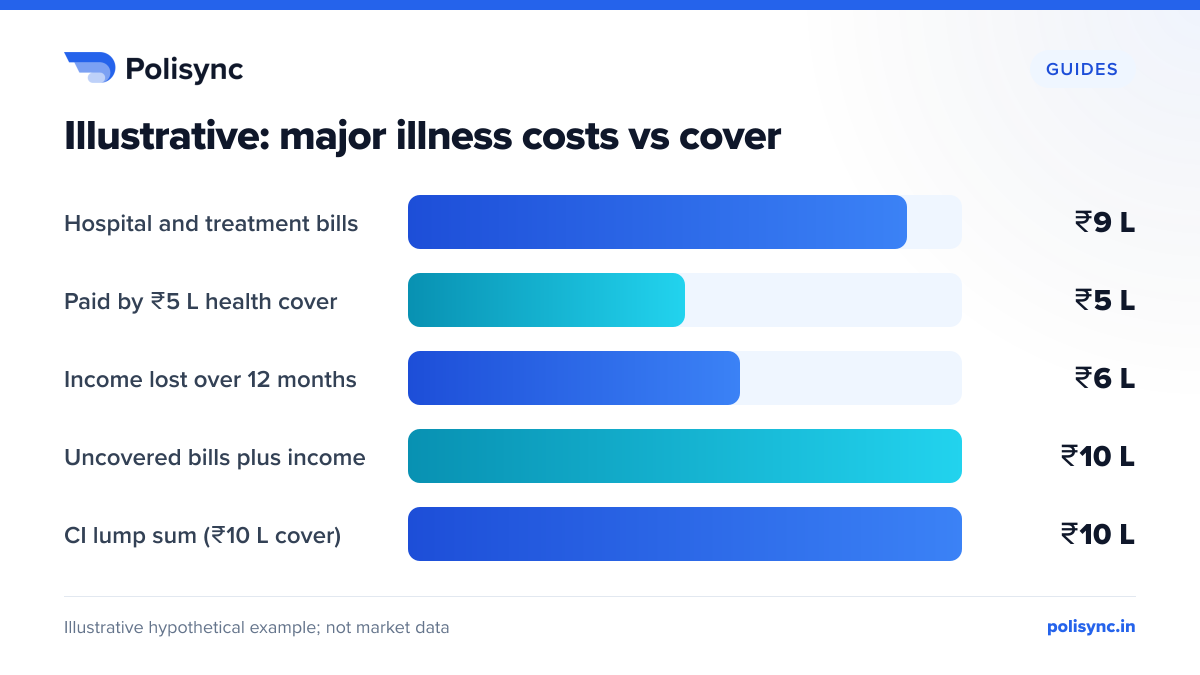
The bar chart below shows the same idea for a hypothetical family with a ₹5 lakh health policy facing a major illness: bills of ₹9 lakh leave ₹4 lakh unpaid, and ₹6 lakh of lost income takes the gap to ₹10 lakh, which a ₹10 lakh CI lump sum would match. The numbers are illustrative, not average costs.
For clients who also need life cover, the human life value method uses a similar income-based logic, and the two conversations fit naturally together.
Is critical illness insurance eligible for tax deduction under Section 80D?
The Income-tax Act, 2025 came into force on 1 April 2026 and replaced the Income-tax Act, 1961. The health insurance deduction familiar as Section 80D is now Section 126 of the new Act for tax year 2026-27 onwards. It allows a deduction for premiums paid to effect or keep in force an insurance on the health of the assessee or family, where the cover is under a scheme made by the General Insurance Corporation (approved by the Central Government) or by any other insurer and approved by IRDAI.
Limits under Section 126 (formerly 80D):
- Up to ₹25,000 for self, spouse and dependent children, raised to ₹50,000 if the insured person is a senior citizen.
- A further ₹25,000 for parents, raised to ₹50,000 if they are senior citizens.
- Preventive health check-ups count within these limits, up to ₹5,000; premiums must be paid other than in cash.
- Under the default new tax regime (Section 202), Chapter VIII deductions including Section 126 are not available, so the benefit applies only to clients who opt out of it.
A standalone CI policy from a general or health insurer is a health insurance product, so its premium generally shares the same Section 126 limit as the client's mediclaim premium; it is not an extra allowance. For CI riders on life policies, ask the insurer for a premium certificate showing the rider premium separately, and suggest the client confirm the treatment with their tax adviser.
Why is honest disclosure so important for CI cover?
Because CI pays a large sum on a single diagnosis, insurers look closely at medical history at claim time. The 2024 health master circular says no health insurance policy or claim can be contested for non-disclosure or misrepresentation, except established fraud, after a moratorium period of 60 months of continuous coverage. Before that, an undisclosed condition can put the claim at risk.
Fill the proposal form with the client, not for the client. Record existing conditions, medications, tobacco use and family history accurately. Our guide on avoiding insurance mis-selling covers documentation habits that protect both the client and the agent.
What this means for insurance agents
CI cover is one of the clearest value conversations an agent can have, because it answers a question health insurance cannot: how will the household manage while the earner is unwell? It also carries risk. Clients who expect CI to pay for any hospitalisation, or who do not understand survival periods and definitions, become disputed claims.
Action checklist for your next client review:
- 1. Confirm the client has adequate indemnity health cover before discussing CI.
- 2. Explain the difference in one line: health pays the hospital, CI pays the family.
- 3. Show the exact list of covered illnesses and read the cancer and heart attack definitions together.
- 4. Point out the waiting period and survival period of the specific product, in days.
- 5. Compare a standalone policy with a rider, noting the rider cap at the base sum assured.
- 6. Size the cover from the client's income gap and EMIs, labelling any numbers as estimates.
- 7. Complete disclosures carefully and keep a signed copy of the proposal form.
- 8. Note renewal dates and policy details in your records; agency software such as Polisync can keep these organised.